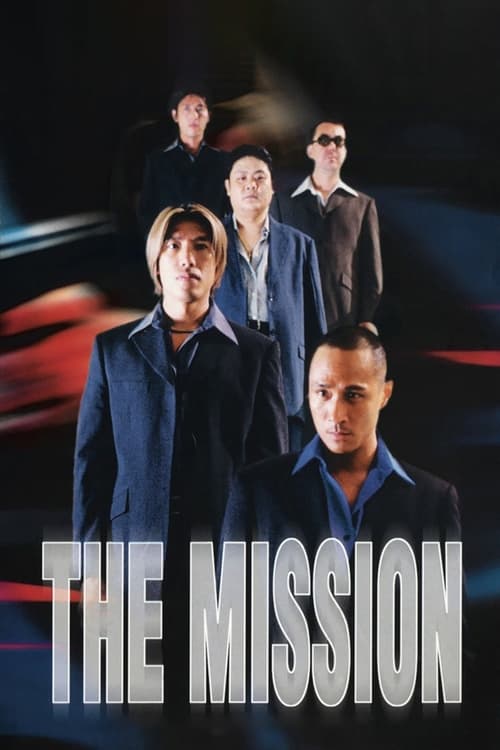
The Mission
1999 · Johnnie To
For when you want crime cinema with style to burn — minimal plot, maximum atmosphere, and action that rewards close attention. A perfect late-night pick when you're tired of noise and want precision instead.
What it's about
After triad boss Lung survives an assassination attempt, five hired professionals — each with his own temperament and history — are brought together to guard his life until the plotters are found. Out of that spare setup comes a study of men who kill for a living: how they wait, how they read a room, and what the code they live by costs when it's finally tested.
The experience
Cool, terse, and hypnotic — long stretches of stillness and deadpan camaraderie punctuated by gunfights staged like chess problems. At barely over an hour, it's all muscle: you lean forward and stay there.
Performances
Anthony Wong anchors the crew with granite stillness, and Francis Ng and Lam Suet round out an ensemble whose bond is built almost entirely through glances, cigarettes, and shared silence.
The craft
Johnnie To reinvents the gunfight as geometry — bodyguards frozen in formation, holding positions across a space, so the tension lives in stillness rather than movement; the shopping-mall standoff is one of the most imitated action set pieces of its era. Made fast and lean, it's a master class in doing more with less.
Why it matters
A touchstone of modern Hong Kong cinema and the film that crystallized Johnnie To's mature style, its influence echoes through two decades of crime films that treat action as composition rather than chaos.
Snapshot
The Mission (Cantonese title 槍火, literally "Gunfire") is a lean, seventy-odd-minute crime picture that has become one of the touchstones of modern Hong Kong cinema and the film most often used to define Johnnie To's mature signature. Its premise is deliberately spare: after a triad boss, Lung (Simon Yam), survives an assassination attempt, five men of varying temperament — Curtis (Anthony Wong), Roy (Francis Ng), Mike (Roy Cheung), Shin (Jackie Lui), and James (Lam Suet) — are assembled to guard his life. Out of that thin scaffolding To builds a study of professional stillness, male camaraderie, and the codes that bind men who kill for a living. The film is celebrated above all for reinventing the Hong Kong gunfight as something static and geometric rather than kinetic, and for a final act that turns loyalty into a moral trap. Made quickly and cheaply at the Milkyway Image house that To and Wai Ka-fai had founded a few years earlier, it is frequently read as the purest distillation of the "Milkyway style."
Industry & production
The Mission was produced through Milkyway Image, the company Johnnie To co-founded with Wai Ka-fai in 1996 as a vehicle for tougher, more idiosyncratic genre filmmaking than the mainstream Hong Kong industry of the late 1990s typically supported. The film arrived during a period of acute crisis for that industry — the post-1997 handover years saw production volumes and box-office receipts fall sharply, piracy surge, and many of the territory's biggest talents drawn toward Hollywood. Against that backdrop, The Mission is often cited as an emblem of Milkyway's survival strategy: keep budgets small, shoot fast, and let a repertory company of trusted actors and crew do more with less.
The film is widely reported to have been shot very quickly — accounts commonly cite something on the order of two to three weeks — and on a modest budget, largely between other, more commercial To assignments (1999 was an unusually productive year for him, also yielding Running Out of Time). I would flag that the exact shooting schedule and budget figures repeated online should be treated cautiously; they are frequently stated but not always well sourced, so I present them as reported rather than verified. What is not in doubt is the ethos: the constraints were real and became part of the aesthetic, forcing the economy of coverage and the reliance on held, largely static setups that define the picture.
The screenplay is credited to Yau Nai-Hoi and Nam Yin, both central to Milkyway's writing culture; Yau in particular was a long-running To collaborator whose spare, structurally-minded scripting shaped much of the studio's crime output. The ensemble cast is drawn from what became To's recurring troupe — Anthony Wong, Francis Ng, Roy Cheung, Lam Suet, Simon Yam — several of whom To would reassemble for the film's spiritual companion piece nearly a decade later.
Technology
The Mission was shot on 35mm film, the standard for Hong Kong theatrical features of the period; this predates the digital-cinematography turn, and nothing about the production suggests any technological novelty in capture or effects. On the contrary, its interest lies in the near-total absence of the technological augmentation that dominated the era's action cinema. There is little in the way of visual effects, wirework, or elaborate squibs-and-stunts spectacle. The film's power is built from analog, on-set fundamentals: lens choice, blocking, the placement of practical lights within real (or spare, minimally dressed) interiors, and above all the discipline of what the camera holds and for how long. In an era when Hong Kong action increasingly leaned on optical velocity and coverage, The Mission's "technology" is essentially the opposite — a subtraction.
Technique
Cinematography
The photography is credited to Cheng Siu-Keung, To's most important and enduring cinematographer, and the film is a showcase for the restrained, architectural look the two developed together. Frames are often locked or nearly so, wide enough to register the geometry of a space and the exact spatial relationships between armed men. Light tends toward the low, hard, and directional, carving figures out of shadow with a cool palette. The camera prefers to observe from a fixed vantage, letting tension accumulate through composition and duration rather than movement; when the men take up defensive positions, Cheng's framing turns them into points on a grid, so the audience reads a firefight almost as a diagram of sightlines and cover.
Editing
The most discussed formal choice in The Mission is its rhythm — and that rhythm is fundamentally an editorial and staging decision. Where the dominant Hong Kong gunfight of the 1990s was cut fast and fluid, To and his collaborators hold shots long past the point of comfort, letting stillness itself become suspense. Cuts are withheld until motion demands them, so that when violence does erupt it lands as a sudden puncturing of a held frame rather than a continuous flow. (I would note the specific editor-of-record credit is one I am not fully certain of, so I will not attribute a name; the effect, however — patient duration broken by abrupt bursts — is unmistakable and central.)
Mise-en-scène / staging
Staging is where The Mission is genuinely innovative. The film's celebrated set piece — an ambush in a shopping mall — abandons the running-and-gunning grammar of heroic bloodshed for a near-motionless standoff: the bodyguards freeze in place, guns raised, each covering an angle, and the scene proceeds through micro-adjustments and held breath. The choreography is spatial and positional rather than balletic; men move only when they must, and the drama is in who can hold their nerve and their line of fire. To reportedly favored real-time blocking worked out on set with the actors, and the results feel less like conventional action choreography than like the staging of a tense negotiation. This is balanced by quieter passages of camaraderie — most famously an idle bit of business in which the men, waiting through dead time, kick a crumpled ball of paper around an office like a soccer game. That scene, built entirely from staging and performance, is doing as much characterization as any dialogue in the film.
Sound
The score, by Chung Chi-Wing, is one of the film's most identifiable features: a cool, laid-back, jazz-inflected guitar theme that recurs across the picture and lends the men's vigil an almost loungey, deadpan swagger. The music's relaxed groove plays deliberately against the lethal stakes, coding the bodyguards' professionalism as a kind of unhurried style. Sound design elsewhere is spare and functional, favoring silence and ambient quiet during the standoffs so that the crack of gunfire arrives with maximal shock. The interplay of near-silence, the recurring theme, and sudden report is integral to the film's rhythm.
Performance
The acting is ensemble work of a high order, and much of it is achieved through restraint. Anthony Wong, as the senior and most self-possessed of the five, anchors the group with watchful gravity; Francis Ng brings a spikier, more volatile energy as Roy; Roy Cheung projects hard competence; Lam Suet, the odd man out physically, supplies both humor and pathos; and Jackie Lui's Shin is the youngest and most exposed, which the finale will exploit. Simon Yam plays the boss with cool authority. The performances lean on economy — glances, posture, small shifts of weight — because the direction gives the actors held frames and time in which the smallest gesture registers. The chemistry of the group, more than any single turn, is the film's engine.
Narrative & dramatic mode
Structurally, The Mission is a two-movement piece. The first and longer movement is a "job" narrative — the assembly of the team, the escalating attempts on Lung's life, and the growth of trust among five strangers into something like a fraternity. Its dramatic mode here is observational and procedural, closer to a hangout film punctuated by violence than to a plot-driven thriller. The second movement is a moral test: once the external threat is resolved, a private transgression within the group (a betrayal of the boss's trust involving Shin) forces Curtis to choose between the code that should govern him and the loyalty he now feels to a brother-in-arms. The film's real subject turns out to be not survival but conscience — how men who live by rules behave when the rules and their affections point in opposite directions. The resolution is famously understated, favoring implication over spectacle.
Genre & cycle
The Mission belongs to the Hong Kong triad/crime action tradition, but it is best understood as a reaction against the "heroic bloodshed" cycle that John Woo and Ringo Lam had defined in the late 1980s. Where that cycle prized operatic excess, slow-motion carnage, and melodramatic pathos, The Mission is dry, minimal, and cool. It participates in a late-1990s Milkyway cycle of crime films — alongside works like A Hero Never Dies (1998) and Running Out of Time (1999) — that reworked genre convention with a more austere, existential sensibility. Within that cycle, The Mission is the purest exercise in stripped-down form, and it helped establish a template — the professional ensemble under pressure, the static gunfight — that To would return to.
Authorship & method
The film is central to the case for Johnnie To as an auteur. It crystallizes preoccupations that run through his best work: masculine loyalty and its codes, fate and contingency, the aestheticization of stillness, and the ensemble as a moral unit. To's method on the film exemplifies his reputation for improvisatory, on-set problem-solving — blocking sequences in the moment with actors rather than adhering rigidly to storyboards — and for extracting maximum expressive value from minimal means.
Authorship here is genuinely collaborative in the Milkyway manner. Cinematographer Cheng Siu-Keung supplied the controlled, architectural image; composer Chung Chi-Wing provided the signature cool-jazz theme that so shapes the film's tone; writers Yau Nai-Hoi and Nam Yin built the spare, two-movement structure. Producer-collaborator Wai Ka-fai's role as To's Milkyway partner is part of the authorial context even where his specific contribution to this title is less foregrounded. The film is a strong argument that To's signature is inseparable from this repertory of collaborators.
Movement / national cinema
The Mission is a landmark of post-handover Hong Kong cinema and of the Milkyway Image project specifically. It stands slightly apart from the celebrated 1980s Hong Kong New Wave and its second wave, representing instead a distinct late-1990s current: filmmakers sustaining a genre tradition through a period of industrial contraction by working small, personal, and stylistically bold. As Hong Kong's national cinema faced existential pressure — from Hollywood, from piracy, from a shrinking regional market — Milkyway's model became one of the more artistically fruitful responses, and The Mission is frequently cited as its exemplar.
Era / period
The film is inseparable from its moment: Hong Kong in 1999, two years after the return to Chinese sovereignty, with the local film industry in visible decline. That context shadows the movie's themes of loyalty, precarity, and men doing a dangerous job under uncertain conditions, and it also explains the production's economy. The period's constraints — small budgets, fast schedules, a reliance on trusted repertory talent — are legible in every frame, and part of the film's later mythology is that such straitened circumstances produced something so assured.
Themes
The governing theme is loyalty and the codes that structure male professional life — how a group of solitary, dangerous men become a brotherhood, and what that bond costs when it collides with the hierarchy they serve. Related concerns run throughout: professionalism as an ethic and an aesthetic; restraint and self-possession as forms of virtue; fate and contingency (survival as much a matter of positioning and luck as skill); and, in the final movement, conscience — the moral weight of a decision made off the books, between men, out of the boss's sight. The film treats violence not as catharsis but as a test of character, and its emotional core is the tension between duty and friendship.
Reception, canon & influence
The Mission was strongly received critically, and it marked a decisive elevation of To's standing among serious critics and on the festival circuit; it is routinely named among his finest films and among the key Hong Kong films of its decade. Johnnie To won Best Director for the film at the Hong Kong Film Awards, recognition that helped consolidate his critical reputation. (I would treat any more granular awards tally cautiously and not enumerate specifics I can't verify.) Over time it has entered the canon of modern Hong Kong crime cinema and become a frequent reference point for the "static gunfight" as a distinct stylistic mode.
Looking backward, the film's influences are largely defined by contrast: it responds to, and deliberately inverts, the heroic-bloodshed template of John Woo and Ringo Lam, while its cool minimalism and ensemble-of-professionals framework resonate with international crime traditions (the disciplined-criminal-crew lineage associated with figures like Jean-Pierre Melville is a comparison critics have often reached for, offered here as affinity rather than documented borrowing).
Looking forward, its legacy is substantial. Within To's own filmography it is the clear forerunner of PTU (2003) and, most directly, Exiled (2006), which reassembles much of the same ensemble and revisits the bodyguard-brotherhood structure so explicitly that it is widely regarded as a companion piece or spiritual sequel. More broadly, The Mission helped establish the international art-house appreciation of To that would later bring him to Cannes, and it has been credited by many admirers — Western critics and filmmakers among them — with expanding the vocabulary of the action film toward stillness, geometry, and restraint. Its central set piece remains one of the most cited and imitated gunfights in contemporary genre cinema.
Reception
Made fast and cheap during Hong Kong cinema's post-handover slump, it quietly won Johnnie To Best Director at the Hong Kong Film Awards — and has since grown from insider favorite into the consensus pick for his masterpiece and a gateway drug to all of Milkyway Image.
How The Mission was received, from release to now →
Influences: the films it descends from and the films it influenced
- Le Samouraï (1967) — Melville's near-wordless behavioral minimalism — a professional rendered through economy of gesture and affective flatness rather than dialogue — is the model for The Mission's restrained-ensemble performance register.
- Le Cercle Rouge (1970) — The patient, dialogue-free set piece built from real-time blocking and withheld cutting — craft shown through disciplined process — is the direct antecedent of To's silence-and-stillness suspense construction.
- The Killer (1989) — The heroic-bloodshed template of multiplied motion, slow-motion squibs and balletic camera is precisely what To inverts by subtracting movement into the frozen, geometric static gunfight.
- City on Fire (1987) — Lam's grimy, sweat-and-handheld triad-and-undercover realism supplies the loyalty-under-cover milieu that Milkyway coolly re-photographs with locked framing instead of nervous motion.
- Once Upon a Time in the West (1968) — The architectural standoff — bodies fixed at measured distances in space, tension wound by held wide framing and ambient silence rather than cutting — is the compositional grammar behind the static gunfight.
- Seven Samurai (1954) — The assembled crew of hired protectors treated as a moral unit defending a principal establishes the bodyguard-brotherhood ensemble structure To adopts wholesale.
- The Killing (1956) — The heist told as the interlocking labor of a professional crew, each defined by function, models the professionalism-as-aesthetic framework and the spare, mechanistically plotted structure.
- Army of Shadows (1969) — The fatalistic cell bound by unspoken codes, where loyalty is transacted in glances and doom is procedural, prefigures The Mission's loyalty-and-codes ethic and cool desaturated light.
- Violent Cop (1989) — To deploys static wide-angle compositions and spare masculine interaction — the lobby stakeout sequence in particular — with the same elliptical restraint and sudden precise violence Kitano established, transposing the formal vocabulary into Hong Kong crime cinema with acknowledged debt to Kitano's influence on his staging approach.
- Le Deuxième Souffle (1966) — Adopts Melville's stillness-as-performance and ritualized gangster iconography — men holding frozen postures in charged silence — translating honor-and-betrayal into a minimalist choreography of loyalty.
- PTU (2003) — Extends the nocturnal ensemble-in-formation and the withheld-cut, real-time patrol across empty streets, escalating the static-tension geometry into a whole feature of waiting.
- Election (2005) — Carries forward the triad-codes-and-ritual subject and the restrained, ceremony-over-action register, replacing gunplay spectacle with the same anthropological stillness.
- Exiled (2006) — Reassembles nearly the same repertory ensemble and bodyguard-brotherhood structure, explicitly revisiting the static-standoff choreography and cool-jazz-scored fatalism as a companion piece.
- No Country for Old Men (2007) — Builds suspense from near-scoreless silence punctured by isolated gunfire and locked, geometric compositions of predator and prey — the same subtraction-based tension The Mission pioneered in genre cinema.
- Drive (2011) — Adopts the cool-minimalist professional whose competence is his character, long held silences, and stillness broken by sudden violence — professionalism-as-aesthetic rendered in synth rather than jazz.
- The American (2010) — Sustains a whole film on the locked-frame observation of a craftsman-killer's methodical process, extending the withheld-cut, dialogue-sparse patience The Mission made a viable action mode.
- Infernal Affairs (2002) — To's method of staging professional criminal men through geometric spatial precision and extended silence — bodies placed in relation to architecture rather than to dialogue, tension produced by withheld rather than spoken meaning — directly informs Infernal Affairs' obstructed-eyeline staging and its principle that confrontation scenes should be stripped of all theatrical scaffolding.
- The Raid (2012) — To's extreme geometric precision in staging bodies within architectural space — characters defined entirely by their spatial relationship to walls, columns, and angles — established a grammar of space-as-constraint that Evans literalizes: The Raid's choreography is incomprehensible without the architecture, exactly as To designed the Milkyway mall sequence.
- A Hero Never Dies (1998) — To's immediately preceding Milkyway film formalizes the same operatic-yet-ironic code of brotherhood and fate, testing the stylized loyalty ritual that The Mission strips down to stillness.
- The Longest Nite (1998) — A Milkyway noir sibling sharing Cheng Siu-Keung's low-key directional lighting and hard architectural framing of nocturnal Hong Kong space, part of the house style The Mission crystallizes.
Similar films
- The Killer (1989) — influence & lineage · same viewing thread
- Exiled (2006) — influence & lineage
- PTU (2003) — influence & lineage
- Hard Boiled (1992) — same viewing thread
- A Better Tomorrow (1986) — same viewing thread
- The Raid (2012) — same viewing thread
- The Furious (2026) — same viewing thread
- New World (2013) — same viewing thread
All the films related to The Mission →
Watch it with: curated runs of related films
- Elegant Savagery — A run of sleek, merciless thrillers where vengeance arrives in tailored suits and is paid in broken bone — watch these when you want beauty and brutality in the same frame.