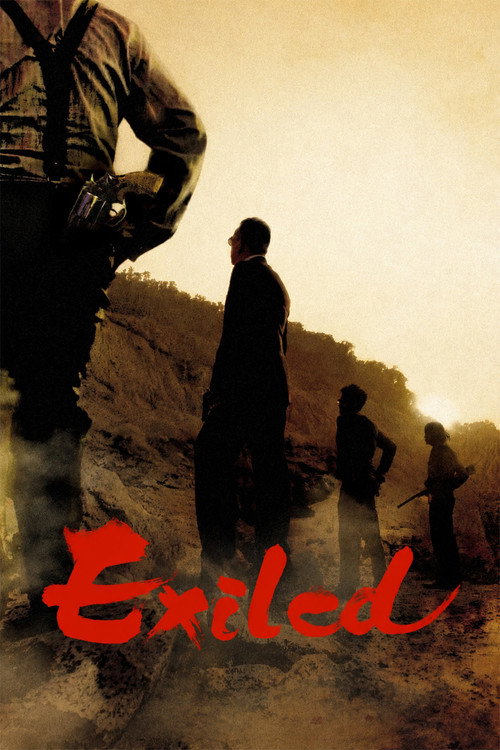
Exiled
2006 · Johnnie To
For when you want style — a slow-burn crime picture to sink into late at night, where the pleasure is in the poses, the silences, and the standoffs. More hypnotic than adrenaline-pumping; bring patience and it pays off.
What it's about
Macau, 1998, the last months before the handover: two hitmen arrive to kill an old friend who betrayed the boss, and two more arrive to protect him. All five grew up together in the same gang, so instead of shooting, they share a meal, help the target fix up his home for his wife and baby, and let a coin toss steer what happens next. Then the job they take to buy time goes sideways, and the brotherhood has to decide what its loyalty is actually worth.
The experience
Cool, fatalistic, and strangely tender between the gunfights — a movie that ambles like a western at high noon, then erupts into shootouts staged like choreography. It plays as an elegy as much as an action film; you feel the ending coming the whole time, and that's the point.
Performances
Anthony Wong's weathered stillness anchors the crew, with Francis Ng and Simon Yam rounding out an ensemble of Hong Kong veterans who convey decades of shared history through glances and body language more than dialogue.
The craft
Johnnie To stages gunplay like dance — long-held compositions, billowing curtains, muzzle flashes in the dark — and openly borrows the sun-bleached grammar of the spaghetti western, twanging score included. The shootouts are built for a big screen and good speakers: geometry, smoke, and silence between the shots.
Why it matters
A festival-feted high point of post-handover Hong Kong crime cinema that cemented Johnnie To's international reputation as the genre's great stylist, mourning a whole tradition of heroic-bloodshed filmmaking even as it perfected it.
Snapshot
Exiled (放·逐, Fong Juk) is Johnnie To's operatic gangster elegy, a film in which the machinery of a heroic-bloodshed shootout is slowed, stylized, and turned toward mourning. Set in Macau in the final months before the enclave's 1999 handover to China, it follows five old gang brothers — two dispatched to kill a former comrade, two arriving to protect him, and the marked man himself — who resolve their contradictory orders not through violence but through a shared meal, a rebuilt home, and a coin toss. The film is widely understood as a companion piece to To's The Mission (1999), reassembling much of that cast and its ethic of laconic male loyalty. Where The Mission was minimalist and contained, Exiled is expansive, sun-bleached, and self-consciously mythic, borrowing the grammar of the Sergio Leone western and the fatalism of the Sam Peckinpah gunfight. It premiered in competition at the Venice Film Festival and has since become one of the most admired late works in To's Milkyway Image filmography, prized for a sequence of gunfights choreographed with the precision of dance and the melancholy of a farewell.
Industry & production
Exiled was produced through Milkyway Image, the Hong Kong company To co-founded with Wai Ka-Fai in 1996, which by the mid-2000s had established a distinctive dual identity: commercial comedies and star vehicles that funded a parallel line of austere, personal crime films of which this is a signature example. The picture belongs to the second strand — an auteur project greenlit on the strength of To's festival standing and Milkyway's ability to work efficiently with a repertory company of actors and crew who had collaborated many times before. That continuity of personnel is central to how the film was made: To is known for shooting quickly and often without a locked script, developing scenes on set with collaborators who understand his shorthand, and Exiled's ensemble — Anthony Wong, Francis Ng, Roy Cheung, Lam Suet, Simon Yam, Nick Cheung, and Josie Ho — was largely drawn from that established stock company. The Macau setting was both an aesthetic and industrial choice, giving the production distinctive colonial-Portuguese architecture and a sense of a place at a historical threshold, distinct from the Hong Kong locations that dominate the genre. Precise budget and box-office figures are not something I can state reliably here; the film is generally characterized as a mid-budget production whose reputation rests on critical and festival reception rather than blockbuster returns.
Technology
Exiled was made in the mid-2000s, at the tail end of the film-origination era for prestige Hong Kong cinema and before digital capture became standard; it bears the look of photochemical cinematography, with the grain, latitude, and warm highlight roll-off characteristic of film stock exposed in strong natural and practical light. The film's technological signature is less about novel apparatus than about the disciplined use of conventional tools — anamorphic-style widescreen framing, extensive use of squibs and practical gunfire effects, and physical stunt and wire work rather than digital augmentation. The gunfights are built from in-camera choreography and editing rather than computer-generated imagery, which is precisely why they read as tactile and weighted. I have not been able to confirm the specific camera and lens packages used, and would rather flag that gap than invent a spec sheet.
Technique
Cinematography
The cinematography is by Cheng Siu-Keung (also credited as Cheng Siu-keung / "Charlie" Cheng), To's long-standing director of photography and one of the essential authors of the Milkyway house style. His work here is defined by a golden, dust-and-tungsten palette, deep pools of shadow, and a fondness for silhouette — figures reduced to dark shapes against warm windows or lamplight. Cheng composes in wide, stable frames that hold the full ensemble in a single geometry, so that the spatial relationships between characters carry dramatic meaning. The camera favors slow, deliberate reframings over frenetic movement; even in the shootouts, the coverage privileges legibility and choreography, letting the viewer track who stands where. Recurring motifs — a swaying overhead lamp, drifting gunsmoke, a fluttering curtain, light shafts thick with particulate — give the image a painterly, almost still-life quality that offsets the violence.
Editing
The editing is credited to David Richardson, another frequent To collaborator. The cutting rhythm is one of the film's most distinctive features: it withholds and delays, building shootouts around suspended stillness — the long freeze before a draw, the held tableau of standoff — then releasing into bursts of coordinated fire. Rather than accelerating cuts to manufacture chaos, the editing often slows time, employing pauses and slow motion to lend the gunplay a ceremonial, balletic cadence. This tempo of held breath and sudden release is what critics most often single out as the film's formal achievement.
Mise-en-scène / staging
Staging is arguably the film's true subject. To arranges his gunmen in sculptural configurations — men fanned across a room, a coin spinning in the air, bodies falling in patterned unison — that treat the shootout as choreography. The famous set pieces (the opening exchange in the empty apartment, the clinic ambush, the final multi-party standoff) are organized around clear spatial rules and repeated visual gambits: the coin toss that outsources decision to chance, the shared cigarette, the group photograph. Props recur with talismanic weight — the harmonica, the tin of food, the paper, the photograph — becoming emblems of a fraternity that the plot is steadily dismantling. Furniture, meals, and domestic ritual are staged with the same care as violence, so that the act of rebuilding a home carries as much dramatic charge as any gunfight.
Sound
The score — a spaghetti-western-inflected suite of guitar, harmonica, and percussion that openly echoes Ennio Morricone — is central to the film's mythic register; I understand the music to be credited to Guy Zerafa (with additional composition sometimes attributed to Dave Klotz), and I flag that credit as one to verify rather than assert with total certainty. Sound design contrasts long stretches of near-silence and ambient hush against the sharp report of gunfire, so that violence erupts out of quiet. The diegetic harmonica played by one of the gunmen bridges score and story, folding the western idiom into the fiction itself.
Performance
Performance is built on restraint and ensemble rhythm. Anthony Wong anchors the film as Blaze, the reluctant leader, in a mode of weary gravitas; Francis Ng, Roy Cheung, and Lam Suet fill out the brotherhood with economical, lived-in physicality, trading on years of shared screen history that lends their camaraderie authenticity. Nick Cheung plays Wo, the hunted ex-gangster, with subdued desperation, and Josie Ho grounds the film's emotional stakes as his wife and the mother whose future the men resolve to secure. Simon Yam appears as the crime boss whose vendetta drives the plot. The performances are deliberately taciturn — meaning is carried in glances, postures, and the choreography of the group rather than dialogue.
Narrative & dramatic mode
The narrative is spare to the point of parable. Its dramatic engine is a moral impossibility — four men bound by brotherhood are split by orders to kill and to protect the same friend — resolved by deferring agency to fate. The coin toss becomes the film's structuring device, a way of dramatizing men who would rather surrender to chance than betray one another. The plot proceeds in movements: the standoff and reconciliation, the decision to undertake one last job to provide for Wo's widow and child, the botched robbery, and the culminating reckoning. Characterization is achieved through action and iconography rather than backstory; the film assumes and exploits the audience's sense of these men as archetypes. It operates less as a plotted thriller than as a ritual working-out of loyalty, obligation, and doom.
Genre & cycle
Exiled descends from the Hong Kong "heroic bloodshed" tradition codified by John Woo in the late 1980s — the cult of male brotherhood, the balletic gun opera, the sacralization of loyalty — but it deliberately hybridizes that lineage with the American and Italian western. Its wandering gunmen, its frontier-town Macau, its Morricone-flavored score, and its Peckinpah-esque slow-motion carnage place it in explicit dialogue with Leone and The Wild Bunch. Within To's own cycle it forms a loose diptych with The Mission, sharing cast, ethos, and the theme of professional gunmen bound by an honor code, and it sits alongside works like Election (2005) and PTU (2003) in Milkyway's run of crime cinema that reworks genre convention toward fatalism and formalism.
Authorship & method
The film is unmistakably a Johnnie To work, exhibiting his signature marriage of formal control and existential fatalism. To's method is collaborative and improvisatory within a stable repertory system: he is known for building scenes on location with trusted actors and crew, often refining the script during production. That method depends on his key collaborators. The screenplay is credited to Szeto Kam-Yuen and Yip Tin-Shing, longtime Milkyway writers. Cheng Siu-Keung's photography and David Richardson's editing supply the visual and temporal signature described above, and the western-tinged score provides the mythic frame. The recurring ensemble — Wong, Ng, Cheung, Lam, Yam — functions almost as an authorial instrument, a company whose shared history lets To stage brotherhood with minimal exposition. The result is a cinema of authorship-through-collaboration, in which the "To style" is inseparable from this specific team.
Movement / national cinema
Exiled belongs to post-1997 Hong Kong cinema and, more specifically, to the Milkyway Image movement that revitalized the local crime film after the industry's mid-1990s downturn. It exemplifies a strand of Hong Kong art-inflected genre filmmaking that circulated internationally through festivals while remaining rooted in local genre traditions and star personae. Its Macau setting on the eve of that territory's own handover extends a preoccupation, widespread in Hong Kong cinema of the era, with transition, sovereignty, and the passing of an old order — the film's exiled gunmen legible as figures of a way of life being overtaken by history.
Era / period
Made in 2006, the film sits at a hinge in Hong Kong cinema: past the anxieties of the immediate 1997 handover, into an era of shrinking local production and growing engagement with mainland co-production and the international festival circuit. Its diegetic setting — Macau in 1998, immediately before the 1999 Portuguese-to-Chinese handover — deliberately doubles the era's real historical mood, using a colonial twilight as the backdrop for a story about loyalty and obsolescence. The film thus reads as both a product of and a meditation on a period of endings.
Themes
The governing themes are brotherhood and loyalty tested to destruction; fate and chance, dramatized through the coin toss and the men's willingness to let fortune decide; and exile — geographic, social, and existential — as the condition of men who no longer belong to the world they inhabit. The film mourns a vanishing code of honor, mapping the twilight of these gunmen onto the historical twilight of colonial Macau. Domesticity and provision form a countertheme: the men's last job is undertaken not for glory but to secure a home and future for a widow and child, so that the impulse to build shadows the compulsion to destroy. Money and gold circulate as objects of both greed and sacrifice, while recurring motifs — the photograph, the shared meal, the harmonica — insist on fellowship as the only value that survives.
Reception, canon & influence
Exiled was received warmly by international critics and festival audiences, cementing To's standing as one of world cinema's foremost stylists of screen violence; its Venice competition premiere was central to that international profile. Reviewers consistently singled out the choreography of its gunfights, the golden-hued cinematography, and the elegiac tone, situating it among the strongest works of To's mature period. Its influences run backward to John Woo's heroic-bloodshed cinema, to Sergio Leone and the spaghetti western (in score, setting, and iconography), and to Sam Peckinpah's slow-motion elegies for outlaw brotherhood; the shadow of The Mission falls over it most directly of all. Forward, its legacy lies in consolidating a recognizable "Johnnie To" mode of balletic, fatalistic gun opera that has been widely admired and imitated, and in strengthening the international critical case for Milkyway Image as a major body of contemporary genre authorship. Its precise long-term influence on subsequent filmmakers is best described qualitatively rather than with specific attributions, and it endures primarily as a touchstone for stylized action staging and for the melancholy reinvention of the Hong Kong crime film.
Reception
It landed in competition at Venice in 2006 to warm reviews, and its stock has only climbed since — what once looked like a stylish genre exercise is now routinely ranked among Johnnie To's two or three best films and a peak of the whole Milkyway Image project.
How Exiled was received, from release to now →
How to watch Exiled: what to notice on a first viewing
- Watch figures turn to silhouette against warm windows. Cheng Siu-Keung lights the film in a golden, dust-and-tungsten palette, often reducing men to dark shapes against lamplight rather than lighting their faces directly. The men start to look like figures in a legend before the story even explains who they are.
- Watch the coin spin before any decision gets made. To repeatedly hands outcomes to a tossed coin, a gambit that recurs across the film whenever these men would otherwise have to choose. Letting chance decide becomes its own kind of loyalty: nobody has to be the one who chose against a friend.
- Notice the long freeze before anyone draws a gun. The editing holds standoffs in suspended stillness, then releases into a sudden, coordinated burst of gunfire rather than building through rapid cuts. The pause is doing the tension's real work, so the gunfire itself becomes almost a relief.
- Track the harmonica, the tin, and the photograph. A handful of small objects keep recurring across the film in different hands and different scenes, carried between the men like tokens. These objects hold the group's history together more plainly than any line of dialogue does.
- Watch how wide, stable frames hold the whole group. Cheng composes in frames that keep the full ensemble visible together, so where each man stands relative to the others is always legible. You can always read the group's geometry, which is exactly what a story about shifting loyalties needs you to see.
The whole guide to watching Exiled, with the keys for a rewatch →
Influences: the films it descends from and the films it influenced
- The Wild Bunch (1969) — Multi-camera slow-motion montage of falling bodies intercut at varying speeds, staged as an elegy for a band of gunmen made obsolete, whose only surviving code is loyalty to each other — the exact tonal and editorial template of Exiled's shootouts.
- Once Upon a Time in the West (1968) — Morricone's operatic, harmonica-driven scoring and the ritualized near-motionless standoff held in extreme anamorphic width before a sudden burst of violence — a device To lifts wholesale into his suspended pre-gunfight stillness.
- The Good, the Bad and the Ugly (1966) — The geometry of the three-way standoff — circling glances cut in ever-tightening close-ups — and the coin-toss/fate motif, which To restages as his trinity-of-gunmen structure governed by chance.
- A Better Tomorrow (1986) — The heroic-bloodshed template of gangster brotherhood bound by an honor code that values loyalty over money, giving Exiled its sentimental core of men who kill and die for a shared past.
- The Killer (1989) — Two-handed slow-motion balletic gunfight choreography and the aestheticized professional killer whose violence is staged as lyrical, almost liturgical performance.
- Hard Boiled (1992) — Spatially legible gun-choreography sustained across long takes, treating an extended shootout as one continuous, readable set-piece rather than a cut-driven blur.
- The Mission (1999) — The direct predecessor: same repertory ensemble staging brotherhood with almost no dialogue, and To's signature 'suspended stillness' gunfight where bodyguards hold rigid geometric formation and fire without moving instead of running for cover.
- Le Samouraï (1967) — The taciturn professional's ascetic minimalism and fatalism, with performance built from stillness and ritual gesture rather than exposition — the model for Exiled's wordless ensemble.
- Yojimbo (1961) — The structural spine of a lone gunman playing two rival factions against each other in a lawless town, which To adapts to Macau's power vacuum on the eve of the handover.
- PTU (2003) — Nocturnal choreographed ensemble stillness — armed men blocked in slow, formalized movement through empty sodium-lit streets — the same anti-kinetic staging grammar Exiled deploys.
- Fallen Angels (1995) — Advances Fallen Angels' heroic-bloodshed deconstruction by substituting melancholy camaraderie and procedural fate for operatic catharsis, maintaining stylized balletic staging while draining the genre of triumphalism — the elegiac continuation of WKW's dismantling of the hitman form.
- Sparrow (2008) — Extends the ensemble-as-instrument into near-musical choreography, staging the umbrella-pickpocket standoff as balletic slow-motion group movement descended directly from Exiled's set-pieces.
- Vengeance (2009) — Reprises Exiled's aging killer with fading memory and its moonlit, freeze-frame group shootouts almost as a sequel-in-spirit, continuing the exact suspended-stillness gun-opera mode.
- Drug War (2012) — Carries To's geometric, spatially-mapped shootout choreography forward into harsh mainland daylight realism, proving the staging grammar independent of Exiled's golden nocturnal palette.
- John Wick (2014) — Inherits the balletic, spatially-clear 'gun-fu' set-piece with rhythmic, choreographed reloads and blocking descended straight from the Woo/To Hong Kong tradition Exiled crystallized.
- The Pig, the Snake and the Pigeon (2023) — Procedural criminal organization logic treating violence as negotiated ritual between professionals operating within an implicit code — the cooler procedural intelligence the dossier attributes to To's influence, generating moral weight through restraint rather than operatic excess.
- Deliver Us from Evil (2020) — Milkyway's Asian-crime-abroad idiom — the expatriate criminal operating in a city that is legally and linguistically hostile — plus gunfights blocked as fixed spatial geometry, with every combatant's position and sightline established before the first shot.
- Fulltime Killer (2001) — Self-conscious cinephilic stylization of the hitman genre in anamorphic widescreen gun ballet, foregrounding the same genre-quotation impulse toward Leone and Woo.
- Election (2005) — Milkyway fatalism structured as parable, where triad ritual and blind chance — not agency — decide who lives, mirroring Exiled's coin-and-bullet determinism.
- A Bittersweet Life (2005) — A contemporaneous Korean elegiac-gangster film sharing the golden-hued, melancholic stylization of a loyal enforcer's balletic downfall, staged with the same lyrical-violence aesthetic.
Similar films
- The Mission (1999) — influence & lineage
- A Better Tomorrow (1986) — influence & lineage
- The Killer (1989) — influence & lineage
- Hard Boiled (1992) — influence & lineage
- PTU (2003) — influence & lineage
- A Bittersweet Life (2005) — influence & lineage
- Yojimbo (1961) — influence & lineage
- Infernal Affairs (2002) — shared sensibility