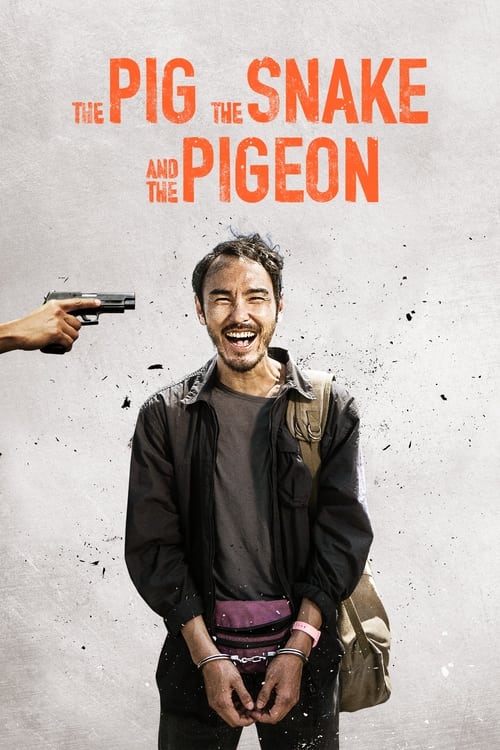
The Pig, the Snake and the Pigeon
2023 · Wong Ching-Po
For when you want a hard-hitting crime thriller that doesn't play by the usual rules — something pulpy and propulsive with a real sting. Not a comfort watch; it earns its violence and its strangeness.
What it's about
Chen Kui-Lin is Taiwan's third most-wanted criminal, and he's dying of cancer. Rather than fade out, he decides to hunt down and eliminate the two men ranked above him, so he can die as the most wanted outlaw in the country — a last act of pure vanity that takes him from Taiwan's neon cities into its strange rural interior. Underneath the gangster mechanics runs an old idea: a man trying to purge his own poisons before the end.
The experience
Fast, violent, and weirder than it first appears — it starts as a kinetic manhunt and keeps swerving into darker, stranger territory, including one extended stretch that plays like a horror film. It's bleakly funny in places and genuinely shocking in others.
Performances
Ethan Juan is magnetic as Chen Kui-Lin — swaggering, wounded, and increasingly haunted, holding the film together through every tonal swerve.
The craft
Wong Ching-Po shoots the action with real kinetic authority, moving from cramped urban corridors to eerie countryside with confidence, and the structure — one target at a time, each a different flavor of evil — gives the film the shape of a fable. Loud, punchy, and great with good speakers.
Why it matters
A word-of-mouth phenomenon that became one of the most-watched Chinese-language films on streaming in early 2024 and kicked off a wider conversation about the revival of Taiwanese genre cinema.
Snapshot
A Taiwanese-Hong Kong crime thriller that brings two ancient symbolic frameworks — the classical Chinese legend of Zhou Chu and the Buddhist doctrine of the three poisons — to bear on a contemporary gangster narrative. The film follows Chen Kui-Lin, a terminally ill career criminal ranked third on Taiwan's most-wanted list, who resolves to eliminate the two criminals above him before his cancer does its work, crowning himself the nation's supreme outlaw as a final vanity. Shot with kinetic authority across Taiwan's urban corridors and rural interior, it became one of the most-watched Chinese-language films on streaming platforms in early 2024, reaching audiences far beyond its initial theatrical footprint and generating sustained conversation about the renewal of Sinophone genre cinema.
The English title draws on Buddhist iconography: the three animals at the hub of the Wheel of Life — pig, snake, and rooster or bird — represent the three poisons (三毒, sān dú) that bind beings to cycles of suffering. In the standard Tibetan iconographic tradition, the pig figures ignorance or delusion (moha), the snake aversion and hatred (dvesha), and the rooster or bird desire and greed (raga). The Mandarin title, 周處除三害 (Zhōu Chǔ Chú Sān Hài), reaches further back: Zhou Chu was a third-century Jin dynasty figure, notoriously a local bully, who set out to eliminate three harms afflicting his village — a man-eating tiger, a river dragon, and, he was devastated to learn, himself, the third and worst harm. That story is one of Confucian moral reform; this film is darker about whether reform is possible, or desired.
Industry & production
The film was produced within the contemporary Taiwanese commercial sector, with co-production elements linking it to Hong Kong through its director. Taiwan's industry in the 2020s occupies an unusual position: the island's art-cinema lineage — rooted in the New Wave auteurs of the 1980s and 1990s — coexists uneasily with a popular sector that has long struggled against Hollywood and Korean competition for domestic theatrical audiences. The Pig, the Snake and the Pigeon represents the sector's better-resourced genre output: a film with sufficient financing for extended action sequences, multi-region location shooting, and a nationally recognized cast.
The involvement of Wong Ching-Po, a Hong Kong director whose career traverses that industry's post-handover decades, signals the continued cross-strait migration of talent that has characterized Sinophone cinema since the early 2000s. Specific production company credits and financing structures are not consistently available in English-language trade coverage; the record on this point is genuinely thin for Western scholarship, and detailed production documentation in Chinese-language sources would be required to fill it.
The film's theatrical release was followed by Netflix acquisition and prominent placement on the platform, which proved transformative for its reach. Netflix's sustained investment in Chinese-language crime content throughout this period — following Korean genre cinema's global expansion — created a distribution pathway that amplified the film's audience beyond what a conventional theatrical run could have achieved in the current Taiwanese market.
Technology
The film appears to have been captured on digital cinema equipment, consistent with industry-standard practice for Taiwanese productions of this budget tier in the early 2020s. The cinematography achieves a high-contrast, often sun-bleached palette — matching the exteriors of Taiwan's highways, rural townships, and temple compounds — that reads as a deliberate colorimetric choice made in digital intermediate rather than purely naturalistic capture. The widescreen frame accommodates the spatial demands of action choreography while supporting the film's periodic treatment of landscape as moral context.
Specific technical credits — camera system, lens package, DI pipeline — have not been confirmed in available English-language production documentation. The visual result is consistent with the saturated, graphically keyed grading prevalent in contemporary East Asian genre production of this period.
Technique
Cinematography
The visual strategy moves between registers with purpose. Interior spaces — interrogation rooms, cult dormitories, criminal safehouses — receive a hard, pragmatic light that emphasizes texture and confinement. Exterior passages, particularly those set across Taiwan's central landscapes and coastal approaches, open the frame to wider, more elemental conditions: bleached concrete, flat subtropical sky, the specific emptiness of provincial roads between sites of violence. This tonal distinction is not merely atmospheric; it maps Chen Kui-Lin's passages between the enclosed moral worlds of criminal hierarchy and the cult compound against the open road that both connects them and offers the illusion of escape.
Camera movement during action sequences tends toward purposeful mobility — grounding spectacle in spatial legibility, an inheritance of Hong Kong action cinema's preference for comprehensible choreography over purely kinetic blur. The film's major set pieces demonstrate confident staging that allows the viewer to track bodies through space, a craft value that distinguishes better-made entries in the regional crime genre from their more frantic counterparts.
Editing
The editing is tightly rhythmed through action sequences and more measured in expository and transitional passages. The three-act structure — one target per act, each in a distinct register — imposes a deliberateness on the overall rhythm; the editing accommodates these tonal shifts without sacrificing momentum. The middle section, set in and around the cult compound, adopts a more unsettled tempo, deploying ellipsis and delayed revelation to register the protagonist's disorientation in an environment that operates by different rules from the criminal world he knows.
Mise-en-scène / staging
Production design achieves convincing specificity across the film's varied locations. The film neither aestheticizes criminality in the manner of glossier international crime productions nor adopts a purely grime-realist texture. The cult compound represents a concentrated design achievement — a space at once banal and disturbing, whose institutional orderliness and performed serenity mask what occurs within. The staging of violence tends toward the visceral and immediate rather than the balletic; this marks a partial departure from the more choreographically elaborate tradition of Hong Kong heroic bloodshed even as that tradition plainly informs the director's formation.
Sound
Score and sound design support the film's tonal range without overwhelming it. Music is deployed with restraint during action sequences and more expressively in the film's thematically loaded intervals. The sound design of key violent sequences is conspicuously physical — the material reality of violence is acoustically present rather than stylized away. Specific composer credits require verification against primary production documentation; the English-language record is incomplete on this point.
Performance
The central performance — by Ethan Ruan (阮經天), one of Taiwan's most prominent actors of his generation — anchors the film's tonal range. Ruan navigates a protagonist who is simultaneously comic (the vanity of wanting to be number one on a most-wanted list is intrinsically absurd), genuinely menacing, and intermittently humanized by the film's gestures toward redemption and its systematic refusal of easy resolution. The performance works largely through physical containment and strategic release: extended passages of watchful, almost animal stillness punctuated by moments of explosive action or unguarded emotion. Whether this constitutes fully rendered interiority or a rigorously maintained surface is a question the film deliberately holds open — and Ruan does not close it from his side.
Supporting performances provide a gallery of criminal types and institutional figures — including the cult leader — against whom Chen Kui-Lin is measured and found, in various senses, both wanting and, paradoxically, more honest than his adversaries.
Narrative & dramatic mode
The film operates within the picaresque — a criminal protagonist moving through episodic encounters structured as a quest — but systematically undermines that form's usual ironic distance. Chen Kui-Lin's journey is structurally comic (reach the top of a list; die having done so) but thematically elegiac. The dramatic mode is best understood as tragicomic crime parable: genre conventions function as vehicles for questions about dying well, about whether violence can constitute self-expression, and about the difference between notoriety and significance.
The three-act structure follows the three-target itinerary with a corresponding shift in thematic register across acts — from the explicitly criminal milieu of the first target through the quasi-institutional violence of the second to the totalized false transcendence of the cult's third act. The correspondence to the three poisons (delusion, hatred, desire in some traditional orderings) is legible in the finished film, though whether this mapping was rigorously designed or partly emergent is not documented in available production accounts.
The ending — which generated substantial discussion in Asian film communities upon release — refuses to resolve the tension between the protagonist's self-narrative and the world's judgment of him. This refusal is the film's most distinctive moral gesture and the source of its continued interpretive life.
Genre & cycle
The film belongs to a recognizable cycle of East Asian crime cinema that achieved expanded international visibility through streaming in the 2010s and early 2020s. Within this cycle, it draws on several distinct genre lines.
From John Woo's heroic bloodshed films — The Killer (1989), Hard Boiled (1992) — it inherits the genre's foundational vocabulary: extended action choreography, a criminal code that functions as ethics, and the operatic treatment of male sentiment. Johnnie To's Milkyway Image productions of the late 1990s and 2000s subsequently refined this tradition into a cooler, more procedurally rigorous register (The Mission, 1999; Election, 2005); Wong Ching-Po's Hong Kong formation is in visible dialogue with both branches.
Korean crime cinema of the 2000s–2010s expanded the regional genre into quasi-supernatural and culturally specific territory — Na Hong-jin's The Wailing (2016) being a signal example of integrating religious dread and cult dynamics into crime structure. The Pig, the Snake and the Pigeon's middle act, centered on the cult compound and its charismatic leader, resonates with this strand, particularly the manipulation-and-revelation dynamics that Korean crime films developed around fraudulent religious authority.
Taiwanese crime cinema provides the more immediate local context: the island's genre production in the 2000s and 2010s developed a harder-edged register distinct from both the art-cinema tradition and Hong Kong genre imports, rooted in the specific social texture of Taiwan's criminal-legitimate border zones. The film draws on this local material — landscape, institutional character, the particular form of organized crime in Taiwan — without being reducible to it.
Authorship & method
Wong Ching-Po emerged from Hong Kong's film industry during its difficult post-handover transition, developing a filmography oriented toward crime, violence, and moral darkness at the harder edges of the commercial spectrum. His work has demonstrated consistent formal ambition within genre constraints — a willingness to use genre frameworks as containers for more probing thematic content and to pursue visceral impact without sacrificing structural coherence. His move into Taiwanese production reflects both the increasing integration of Sinophone film industries and the commercial opportunities created by streaming platform investment in Chinese-language content during this period.
The film's writer and additional key creative collaborators — cinematographer, editor, composer — have not been consistently identified in English-language critical coverage. This constitutes a genuine lacuna; close authorship study of the film would require systematic engagement with Chinese-language production and trade sources.
Movement / national cinema
The film occupies a complex position relative to Taiwanese national cinema. Since the 1980s, Taiwan's international film reputation has been built almost entirely on its art-cinema output — Hou Hsiao-hsien's long-take meditations on history and memory, Edward Yang's urban social panoramas, Tsai Ming-liang's durational minimalism. This tradition, while commercially marginal, established a prestige framework against which Taiwanese popular cinema has been implicitly measured and typically found wanting.
The Pig, the Snake and the Pigeon belongs to neither the auteur tradition nor the undistinguished commercial sector; its Hong Kong director and genre formation place it in a hybrid space characteristic of contemporary Sinophone co-production. It benefits from Taiwan's locations, its cast of locally recognized performers, and its specific cultural material (the three poisons, the Zhou Chu allusion, the particular social geography of Taiwanese criminality), while bringing Hong Kong genre competences to bear on that material. The result is nationally specific in content but industrially transnational in formation — a distinction worth maintaining in any serious account of the film's cultural meaning.
Era / period
The film arrives at a moment of realignment for Chinese-language genre cinema broadly. The creative and industrial exhaustion of Hong Kong cinema — a decades-long decline accelerated by the political transformations following 2019 — has coincided with renewed energy in Taiwanese production, partially enabled by streaming investment and partially reflecting a particular cultural confidence in the island's own story-telling resources. Korean genre cinema's global breakthrough provided both a model and competitive pressure: it demonstrated that non-English crime films could achieve substantial international audiences while raising the standard against which other regional cinemas are now implicitly measured.
The Pig, the Snake and the Pigeon is an exemplary instance of the streaming-era crime film: formally accomplished enough to satisfy genre audiences, culturally specific enough to offer something beyond generic formula, and sufficiently high-concept (the death-wish most-wanted quest; the cult confrontation) to translate across linguistic barriers. Its Netflix success represents not merely a distribution event but an indicator of the shifting ecosystem for Chinese-language popular cinema — one in which quality genre production can, for the first time in decades, find an audience commensurate with its ambitions.
Themes
Mortality as permission: The terminal diagnosis does not humble Chen Kui-Lin; it liberates him from the future-oriented calculations that constrain ordinary criminal behavior. The film is unusually clear-eyed about the relationship between knowing you will die and the recklessness that knowledge can license — and about the vanity, as well as the freedom, of operating without consequence.
The three poisons as structure: The Buddhist framework is not ornamental. The film's three antagonists — and the protagonist's encounters with them — stage successive lessons in the poisons that, per Buddhist doctrine, generate suffering: desire, hatred, and delusion in various orderings depending on tradition and context. Whether Chen Kui-Lin is inoculated against these poisons by contact with them, or whether he embodies them in his own right, the film holds as its central ambiguity.
Criminal identity and state recognition: The most-wanted list is simultaneously a bureaucratic instrument of state authority and a perverse ledger of criminal prestige. Chen Kui-Lin's desire to top it represents an endorsement of the very classificatory system he nominally opposes: he needs the state's recognition to validate his self-narrative. This tension — between the criminal's performative rejection of social order and his deep investment in its forms of acknowledgment — is one of crime cinema's enduring preoccupations, and the film handles it with more precision than the genre usually manages.
False transcendence: The cult sequence extends the Buddhist framework toward organized spiritual fraud. The cult leader — offering followers a simulacrum of liberation — represents the most dangerous form of delusion, one that systematically destroys its adherents under the sign of their salvation. That Chen Kui-Lin, himself a figure of considerable violence, is positioned as the agent who disrupts this false transcendence is the film's most pointed structural irony — and the source of the moral complexity its ending refuses to dissolve.
Reception, canon & influence
Critical reception: The film generated significant attention in Chinese-language film media and among Asian cinema specialists internationally. Several critical accounts positioned it as a significant achievement within contemporary Sinophone crime cinema — formally accomplished, culturally resonant, morally unresolved in generative rather than evasive ways. English-language criticism, where it engaged with the film, reached characteristically for comparisons with Park Chan-wook's revenge trilogy and the Milkyway Image school; whether these comparisons adequately address the film's specific cultural coordinates is an open question. The Buddhist and classical Chinese literary frameworks constitute symbolic material that Hong Kong and Korean genre cinema does not typically engage, and critical language for assessing that specificity has been slow to develop in Western film writing.
Influences on the film (backward): The lineage is eclectic but traceable. From John Woo: operatic commitment to genre as a vehicle for intense male affect and moral weight. From Johnnie To: cooler procedural intelligence, criminal organization as social structure. From Na Hong-jin and Kim Jee-woon: the integration of quasi-supernatural dread and religious manipulation into crime narrative, the tonal instability that prevents genre comfort. From Taiwan's own crime tradition: the specific landscape and institutional texture. The Buddhist and classical Chinese literary materials are the film's distinctive contribution to this inheritance — elements unavailable from any of its sources.
Legacy and forward influence: The film's Netflix placement transformed its cultural footprint. It became, in early 2024, one of the most-discussed Chinese-language films in international online film culture, reaching viewers who would not have sought it out theatrically and generating reception across demographic categories unusual for genre cinema of this origin. Its longer-term place in the canon is not yet determinable given the recency of its release, and any claim about specific films it will be understood to have shaped would be premature. What can be said is that it demonstrated, at a commercially and critically visible scale, that Taiwanese genre production could achieve the kind of tonal and cultural specificity that sustains serious critical attention — and that Hong Kong directorial talent, displaced from its traditional industrial home, could find productive conditions elsewhere in the Sinophone world. On both counts, it is likely to be cited in any subsequent account of Chinese-language genre cinema's development in the streaming era.
A Deleuzian reading
A man learns that he is third.
The full Deleuzian reading of The Pig, the Snake and the Pigeon →
Reception
It did respectably in Taiwan after its Golden Horse premiere, but the real story came months later: in March 2024 it became a shock blockbuster in mainland China — a graphically violent Taiwanese crime film out-grossing its home run many times over and dominating the mainland box office for weeks.
How The Pig, the Snake and the Pigeon was received, from release to now →
Influences: the films it descends from and the films it influenced
- The 36th Chamber of Shaolin (1978) — Buddhist monastic institution as site of graduated physical ordeal and moral transformation: the chamber-by-chamber discipline structure provides the direct template for the Zhou Chu outlaw-reform arc Wong maps onto Taiwanese crime genre, grounding the Buddhist three-poisons framework in a martial-arts lineage.
- A Better Tomorrow (1986) — Heroic bloodshed codification: slow-motion action choreography as a formal device for moral elevation, and the honor code as the framework within which violence acquires significance — the operatic grammar Wong inherits as his starting point before subjecting it to Buddhist irony about violent self-redemption.
- The Killer (1989) — Mobile camera treating action space as emotional orchestration rather than documentary coverage: Woo's balletic kinetic grammar for tracking violence, which Wong inherits as the baseline for his own purposeful mobile camera in the film's action sequences.
- Hard Boiled (1992) — Hyperreal physical violence sound design — layered foley impact, gunfire acoustics, spatial reverb — that makes bodily harm register as moral event rather than mere spectacle, a sonic standard that directly informs how Wong's film calibrates the weight of its own violence.
- Fallen Angels (1995) — Bleached high-contrast cinematography and expressively mobile handheld camera applied to Hong Kong crime atmosphere: palette as emotional alienation rather than atmospheric decoration, a visual grammar Wong directly inherits for the moral bleaching of his own crime world.
- Sympathy for Mr. Vengeance (2002) — Tragicomic parable structure in which each act of violence compounds the original harm through ironic moral coincidence — the formal model for Wong's three-poisons architecture, where each criminal pursuit produces outcomes antithetical to the protagonist's redemptive intention.
- Oldboy (2003) — Ellipsis and delayed revelation as structural architecture: significant causal information systematically withheld until the edit releases it, so the picaresque quest retroactively reframes its own moral stakes — the mechanism Wong adapts for his three-act tonal segmentation and open ambiguous ending.
- Election (2005) — Triad institutional hierarchy staged as ceremonial uncanny: basement ritual spaces and formalized power transfers give criminal social order architectural weight, the direct precedent for Wong's cult compound staging and interior/exterior moral mapping.
- A Bittersweet Life (2005) — High-contrast chiaroscuro visual grammar in Korean crime, and prolonged physical containment followed by volcanic release as the signature performance-action unit — the bodywork pattern Wong's staging of the protagonist's escalating violence directly echoes.
- Exiled (2006) — Procedural criminal organization logic treating violence as negotiated ritual between professionals operating within an implicit code — the cooler procedural intelligence the dossier attributes to To's influence, generating moral weight through restraint rather than operatic excess.
- I Saw the Devil (2010) — Three-act tonal segmentation across incompatible registers — procedural thriller, body horror, tragicomedy — where each section refuses the genre coherence the prior section established, the structural model for Wong's Buddhist three-poisons segmentation.
- Drug War (2012) — Cross-strait criminal procedural in which Mainland and Hong Kong institutional structures mirror each other across jurisdictional lines, establishing the Sinophone co-production crime template that frames both the production context and the institutional mirroring in Wong's film.
- A Sun (2019) — Taiwanese crime-drama deploying institutional staging to map moral condition through architectural space — prison, home, hospital as morally coded interiors — within a three-part structure tracking a family's criminal disintegration, the closest Sinophone peer to Wong's structural and staging approach.
- The Medium (2021) — Religious compound as institutional uncanny with spiritual manipulation of a sequestered community, staged with tonal instability between procedural documentary observation and supernatural horror — working the same cult-compound-as-uncanny-institution territory as Wong's pigeon-chapter sequences.
- Limbo (2021) — Hong Kong director in Sinophone co-production deploying high-contrast monochrome palette as moral register and extreme physical violence design — a direct peer production sharing Wong's displaced-auteur context and his commitment to visual grammar that uses tonal extremity to carry moral weight.
Similar films
- A Better Tomorrow (1986) — influence & lineage · same viewing thread
- Hard Boiled (1992) — influence & lineage · same viewing thread
- The Killer (1989) — influence & lineage · same viewing thread
- Oldboy (2003) — influence & lineage
- Sympathy for Mr. Vengeance (2002) — influence & lineage · same viewing thread
- A Bittersweet Life (2005) — influence & lineage · same viewing thread
- I Saw the Devil (2010) — influence & lineage · same viewing thread
- The Gangster, the Cop, the Devil (2019) — same viewing thread
All the films related to The Pig, the Snake and the Pigeon →
Watch it with: curated runs of related films
- Elegant Savagery — A run of sleek, merciless thrillers where vengeance arrives in tailored suits and is paid in broken bone — watch these when you want beauty and brutality in the same frame.