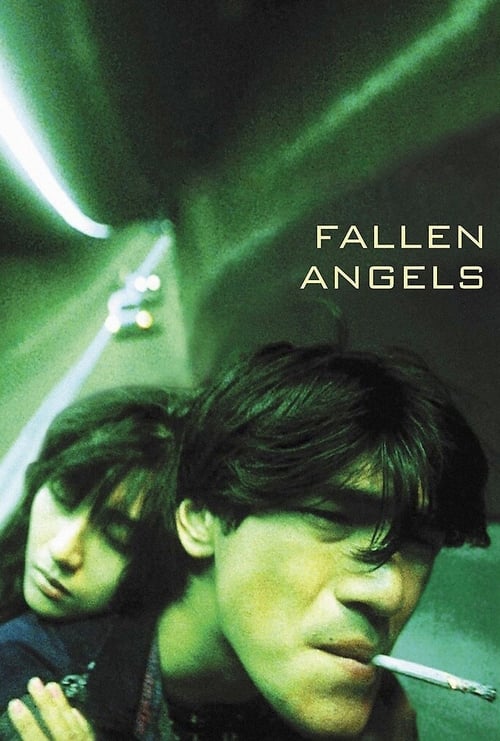
Fallen Angels
1995 · Wong Kar-Wai
Generates discourse without new films: the Blossoms Shanghai TV pivot, In the Mood for Love's ascension up the Sight & Sound poll, and his permanent status as Letterboxd's most romanticized stylist.
For a late night when you're feeling restless and romantic in equal parts — city-lonely, a little wired, wanting a film that feels like wandering streets after midnight. More vibe than plot; surrender to it.
What it's about
In Hong Kong after dark, a weary hitman does his jobs while the partner who books them — a woman he's never really met — falls obsessively in love with the traces he leaves behind. Orbiting them is a mute ex-convict who breaks into closed shops at night and runs them as his own, hustling strangers and aching for connection. Their lonely paths keep almost crossing in the neon.
The experience
A rush of neon, smoke, and longing — frantic on the surface, heartbroken underneath. It swings between deadpan comedy, sudden violence, and moments of tenderness that catch you off guard, all at 2 a.m. energy.
Performances
Takeshi Kaneshiro is a live wire as the mute drifter — hilarious, sweet, and devastating without a word of dialogue — and Michelle Reis makes obsession look like the loneliest job in the world.
The craft
Christopher Doyle's cinematography shoves ultra-wide lenses right into faces, so the city smears and warps around every character — the whole film looks like a fever remembered fondly. Wong Kar-Wai cuts it to jukebox rhythms with slow-motion smears of motion; on a big screen with the sound up, it's intoxicating.
Why it matters
It cemented the mid-90s Hong Kong look that music videos, fashion, and indie cinema have been borrowing ever since, and it remains the wildest, most nocturnal entry in Wong Kar-Wai's run of lovesick city films.
Snapshot
A neon-soaked, kinetically fragmented noir set across Hong Kong's night-time streets, Fallen Angels follows two loosely braided storylines: a disengaged hitman (Leon Lai) and the obsessively devoted female partner (Michelle Reis) who coordinates his assignments and haunts the spaces he vacates; and He Zhiwu (Takeshi Kaneshiro), a mute ex-convict who squats in closed storefronts after hours, commandeering them as one-man businesses, pining for connection. The two strands share a late-night fast-food counter as their only common ground, and they converge in the film's closing minutes with a gesture of wordless tenderness on a motorcycle. Operating at the intersection of genre deconstruction, urban poetry, and romantic melancholy, the film compresses the manic energy of Hong Kong into roughly ninety minutes of near-hallucinatory image-making.
Industry & Production
Fallen Angels originated as a third narrative strand conceived for Chungking Express (1994). When that film ran long, Wong Kar-Wai removed what would become the He Zhiwu material and developed it separately, pairing it with a new hitman story. The two films therefore share a genetic link — a common tone, some overlapping locations, and the same principal collaborators — though Fallen Angels tips far darker in mood and further into stylistic extremity.
Production was handled through Wong's own company, Jet Tone Productions, which gave him the creative autonomy he required. Wong's method — developing scripts during production rather than before it, improvising scenes on location, sometimes withholding plot information from actors to provoke authentic uncertainty — meant the shoot extended across several months in 1994 and into 1995. Exact production figures are not part of the public record, and no verified budget figure has been widely cited; what is established is that the film, like most of Wong's mid-1990s work, operated with a relatively small crew that could maneuver rapidly through the unpermitted night-time shoots that characterize the cinematography. The film was released theatrically in Hong Kong in September 1995.
Technology
Cinematographer Christopher Doyle chose extreme wide-angle optics — lenses in the range of 9 to 18mm — as the film's primary visual instrument, a choice that radically distorts spatial relationships, flares available and practical light sources across the frame, and pushes depth of field to a vertiginous extreme even in very close quarters. The approach had antecedents in Doyle's work with Wong on Chungking Express, but Fallen Angels presses the technique further: faces loom into the foreground while environments recede at impossible angles, creating a geometry of estrangement even in intimate scenes. The camera stock is pushed and grain is treated as an expressive element rather than a flaw. Certain sequences use step-printing — a technique in which frames are printed multiple times in the optical or digital intermediate — to produce a stuttering, strobing slow motion that fragments the flow of action. Available fluorescent and neon light sources are used in preference to conventional film lighting, locking the film to the specific chromatic spectrum of Kowloon at night: lime greens, deep reds, cold blues, the amber spillage of convenience-store interiors.
Technique
Cinematography
Doyle's handheld camera is in near-constant motion, and it rarely operates at conventional eye level. It tilts, cants, and pushes toward subjects from low angles or sweeps across ceilings and walls. The extreme wide-angle distortion means that a figure crossing a room ten feet deep may appear to travel for what feels like a great distance. This optical exaggeration is not merely stylistic mannerism; it externalizes the characters' psychological states — their alienation from shared space, their inability to close the distance between themselves and others despite physical proximity. The film was shot in the saturated, high-contrast visual register that Doyle and Wong developed across their collaboration, with available Hong Kong nightscapes — the signage of Mong Kok and Tsim Sha Tsui, the corridors of the MTR, the fluorescent interiors of closed noodle shops — providing both setting and light source simultaneously.
Editing
William Chang Suk-Ping, who serves as both production designer and editor across Wong Kar-Wai's filmography, cut Fallen Angels. The editing rhythm is associative rather than causal. Rather than constructing sequences around action-reaction logic, Chang works with rhythm, repetition, and discontinuity: a gesture, a reaction, a cut to an unrelated space, a return. The result mirrors the fragmented interiority of the voiceover narrations — characters who articulate their interior lives in words while their bodies enact something entirely other. Long stretches of the hitman's storyline are constructed around mood montage rather than event: scenes that document habitual, recurrent action rather than singular incident.
Mise-en-scène / Staging
Wong's staging reflects his improvisational production method. Actors are frequently placed in real Hong Kong commercial spaces — the late-night McDonald's in Lan Kwai Fong, actual Kowloon storefronts — and asked to inhabit them rather than perform within a conventionally constructed set. William Chang's production design work consequently involves selection and enhancement of existing locations rather than construction from scratch. The result is an environment that bears the textures of actual urban life: the clutter of a noodle stall, the fluorescent sameness of a late-night convenience store, the grime of a pedestrian underpass. Objects and spaces carry emotional weight in lieu of dialogue; the hitman's apartment, tended by the partner who cleans it obsessively though she is never invited in, becomes a compressed emblem of unfulfillable longing.
Sound
The sound design places the film inside Hong Kong's acoustic density — traffic, Cantonese conversation, the hiss and rattle of the MTR, the compressed ambience of small interiors. Music plays a prominent role and mixes licensed pop material with incidental scoring. Laurie Anderson's "Speak My Language" appears in the film and is among the most noted musical choices. The film's sound, like its image, resists a clean separation between score and ambient noise, allowing the city itself to function as an ongoing sonic presence. The voiceover narrations — both the female partner's internal monologue in the hitman strand and He Zhiwu's commentary in the second strand — are layered against image in a mode characteristic of Wong: the spoken interior state frequently contradicts or obliques away from what is visible.
Performance
Wong Kar-Wai's practice of withholding narrative context from actors, and of developing characters through the shoot itself, gives the performances an unrehearsed affective quality that distinguishes them from conventional genre work. Leon Lai's hitman is composed almost entirely of surface — a studied blankness that the film refuses to explain or motivate — while Michelle Reis as the partner works almost entirely in non-verbal registers: how she cleans, how she sits, how she handles objects in the hitman's space. Takeshi Kaneshiro's He Zhiwu, mute but physically voluble, carries the film's comedy and its most overt sentimentality simultaneously. Karen Mok's Blondie, a character from He Zhiwu's past who resurfaces, operates at the opposite extreme from Lai's minimalism: broad, performatively excessive, comic in a mode that edges toward pathos.
Narrative & Dramatic Mode
Fallen Angels is structured as a diptych of parallel storylines with minimal causal connection. Wong had worked with multi-strand narratives in Chungking Express and Days of Being Wild before it, but here the strands share even less plot causality — their relationship is thematic and tonal rather than narrative. Each strand is organized not around a problem to be solved but around a condition to be inhabited: the hitman's voluntary emotional anesthesia; the partner's unrequitable devotion; He Zhiwu's voracious, comic need for contact with strangers. Voiceover narration, used across both strands, externalizes interiority without resolving it. The film is less interested in what happens than in how a particular psychic state feels from inside it. The climax — if it can be called that — consists not of action but of a motorcycle ride that lasts a few minutes and gives He Zhiwu a brief, unspoken moment of contact with another person before the lights of the tunnel arrive and the film ends.
Genre & Cycle
The hitman plot is the film's most explicit generic anchor: it draws on Hong Kong heroic bloodshed cinema as developed by John Woo, Tsui Hark, and their colleagues in the late 1980s, but strips the genre of its operatic moral scaffolding. The hitman has no code, no articulated loyalty, and no tragic backstory that the film allows to matter. Genre conventions are cited and then subtracted from, leaving their silhouettes. The result is less a genre film than a critical meditation on the emotional architecture the genre usually deploys. The film sits alongside other mid-1990s works that approached Hong Kong action cinema from an art-cinema vantage — a small cycle that includes Johnnie To's early quieter films and the more introspective strands of the New Wave directors — though Wong's approach is the most formally extreme of them.
Authorship & Method
Wong Kar-Wai's authorial practice is inseparable from his collaborative core: Christopher Doyle (cinematographer), William Chang (production designer, costume designer, editor), and the evolving ensemble of actors who returned across multiple films constitute a de facto creative unit. Fallen Angels is among the purest expressions of the method: no completed screenplay existed at the outset; scenes were improvised, discarded, and rebuilt; the two storylines were edited together as a final formal decision rather than a predetermined structure. Wong has described his films in terms of mood and sensation rather than narrative intention, and Fallen Angels represents perhaps the most radical enactment of that principle in his 1990s work. Doyle's visual contribution is not incidental but constitutive — his optical choices define the film's emotional register at least as much as the written material. William Chang's editorial rhythm gives the film its distinctive sense of time: not continuous, not quite discontinuous, but hovering in a kind of extended present tense.
Movement / National Cinema
Fallen Angels is a product of the Hong Kong New Wave's second generation — directors who emerged in the late 1980s and early 1990s after the initial wave of Ann Hui, Tsui Hark, Allen Fong, and Patrick Tam. Wong Kar-Wai belongs to this second wave alongside Stanley Kwan and others who pushed Hong Kong cinema toward international art-cinema networks without abandoning the popular genre forms that structure the local industry. The film is also marked, more implicitly than explicitly, by the anxieties of the 1997 handover — a shadow across much of the serious Hong Kong cinema of the period. Where Chungking Express treats the transition with wry lightness and Happy Together displaces the city entirely, Fallen Angels offers a Hong Kong of the present tense: hyperactive, insomniac, burning with energy that has nowhere to go. Whether this constitutes political allegory in any strict sense is a question critics have debated without consensus, and the film itself resists reduction to a single interpretive frame.
Era / Period
The film is a mid-1990s artifact in multiple senses: it reflects the specific chromatic and formal vocabulary that defined international art cinema's prestige aesthetic in the years between the Sundance explosion and the digital turn; it embodies the handover-era anxiety of Hong Kong commercial and cultural life; and it participates in the specific moment when Hong Kong cinema enjoyed its most sustained international critical visibility, partly through festival circuits and partly through the concurrent popularity of action cinema exports. Its visual style — pushed grain, wide-angle distortion, available neon light — would become legible retrospectively as quintessentially "1990s" in a way that both authenticates and dates it.
Themes
The film's themes organize around contact and its failure. Nearly every character is defined by an asymmetric desire: the partner wants the hitman, who does not want her; He Zhiwu wants human connection and finds only transient, improvised versions of it; Blondie re-enters He Zhiwu's life as an unresolved residue of a past he cannot articulate. Distance and proximity are treated spatially — the wide-angle lens is itself a figure for closeness that cannot close — and temporally, through the voiceover's meditations on missing and being missed. Habit and repetition recur: the hitman's mechanical professional routine, He Zhiwu's nightly annexation of strangers' businesses, the partner's cleaning of a space she cannot legitimately occupy. The city is both site and condition: Hong Kong's density makes solitude possible in the midst of crowds, and its energy makes stasis feel like a form of violence.
Reception, Canon & Influence
Backward influences: The genealogy behind Fallen Angels runs through Jean-Luc Godard — Breathless, Alphaville, Band of Outsiders — whose dismantling of genre conventions and integration of literary voiceover into image-driven narrative provided a structural model. Alain Resnais's strategies of temporal discontinuity and interior narration are also pertinent. Within Hong Kong cinema, the film is in explicit dialogue with the heroic bloodshed genre it deconstructs. Wong has cited Edward Hopper's paintings of American loneliness — images of figures in diner booths and hotel rooms — as an influence on the visual imagination behind several of his films, though specific attributions require caution. The influence of French New Wave existentialism on Hong Kong's urban noir mode had been established before Wong by directors including Patrick Tam.
Critical reception: Fallen Angels was received at the time primarily as an extension and intensification of Chungking Express, which had preceded it and enjoyed slightly warmer immediate reception. Some critics found the film's fragmentation more exhilarating than its predecessor's; others found it more inaccessible. Tony Rayns and other Western critics writing in festival contexts were consistently attentive to Wong's formal ambitions throughout the period. The film did not achieve the festival prize recognition that Wong's subsequent Happy Together would (Cannes Best Director, 1997), and assessments of Fallen Angels within Wong's filmography have varied — some critics place it as his most purely cinematic achievement; others find its looseness and tonal extremity less controlled than Chungking Express or In the Mood for Love. Over time, critical opinion has tended to consolidate around the film as a key document of 1990s international art cinema and one of the defining works of Hong Kong cinema's handover era.
Forward influence: The visual language codified in Fallen Angels — extreme wide-angle optics, available-light neon color, step-printed slow motion, handheld kinesis in urban night spaces — became one of the most widely diffused aesthetics in the decade following the film's release. Its influence is visible across music video production, advertising, and subsequent art cinema from East Asia and beyond. Directors including Park Chan-wook have acknowledged Wong's formal impact. Nicolas Winding Refn's interest in neon-soaked urban nocturnes and alienated protagonists in silent emotional extremis is legible as a distance response to this body of work, though direct influence claims require care. More broadly, the film helped establish that genre material — hitman plots, romantic triangles — could be radically defamiliarised through formal means without losing audience engagement: a proposition that has been revisited by numerous subsequent filmmakers. Within Wong Kar-Wai's own filmography, Fallen Angels represents the final full expression of his anarchic, neon-era Hong Kong mode; the melancholy would intensify and the kinesis would slow as he moved toward In the Mood for Love and the more measured formal procedures of his post-2000 work.
A Deleuzian reading
She has a key to his apartment, though he never gave her one.
The full Deleuzian reading of Fallen Angels →
Reception
In 1995 it was widely shrugged off as a hipper, hollower retread of Chungking Express — style over substance, said the critics. Three decades on it's the one the internet fell in love with: a restored, canonized cult object that plenty of fans now rank above its sunnier sibling.
How Fallen Angels was received, from release to now →
Influences: the films it descends from and the films it influenced
- A Better Tomorrow (1986) — Codified the hitman-as-romantic-outcast in Hong Kong cinema and established slow-motion ballistic choreography as the genre's rhetorical register — the heroic-bloodshed conventions Fallen Angels directly inherits before dissolving them into neon-lit alienation rather than operatic catharsis.
- Chungking Express (1994) — Christopher Doyle first consolidated his extreme wide-angle handheld technique and parallel-strand narrative architecture here; the He Zhiwu storyline was literally excised from this film during editing and reworked as Fallen Angels' second diptych strand, making the two films genetically continuous.
- Days of Being Wild (1990) — First deploys the voiceover-as-interiority method — characters narrating desires their bodies never act on — and the mood-montage editing that constructs emotional atmosphere through repetition of gesture rather than causal incident, both carried wholesale into Fallen Angels.
- Branded to Kill (1967) — Deconstructs the hitman genre through non-causal editing and extreme stylization that subordinates plot coherence to sensory texture — the Japanese New Wave precedent for Fallen Angels' replacement of genre narrative logic with associative atmosphere.
- Pierrot le Fou (1965) — The associative editing structure — sequences linked by emotional rhyme rather than continuity — and the female voiceover as melancholy counterpoint to male action directly model Fallen Angels' partner-narration device, wherein Michelle Reis's obsessive interior monologue runs against the hitman's wordless behavior.
- Alphaville (1965) — Raoul Coutard's available-light cinematography treating a modern city's artificial illumination as alienating noir landscape is the formal template for Doyle's use of Kowloon neon as simultaneous light source and psychological register, rather than supplementary set dressing.
- Shadows (1958) — Established improvisational production as a viable formal method — actors given character and situation rather than script, shot on location with available light at pushed grain — the direct procedural precursor to Wong Kar-Wai's practice of developing scenes and withholding plot from actors during the shoot.
- The Wild Bunch (1969) — Introduced step-printing as a sustained expressive device in action cinema — frames reprinted to produce strobing slow-motion — establishing the technical vocabulary Doyle and Wong employ to fragment and aestheticize violent action in Fallen Angels' hitman sequences.
- Tokyo Drifter (1966) — Wong uses a hitman protagonist to establish the same hollow genre archetype Suzuki deployed — the killer whose professional code replaces psychological interiority — while scoring action sequences with music that functions structurally rather than atmospherically, and treating Hong Kong neon color as emotional saturation rather than environmental description.
- Happy Together (1997) — Doyle's same pushed-grain, step-printed available-light language applied to Buenos Aires nightscapes, with asymmetric-desire voiceover-interiority transposed to a queer romantic register — an immediate parallel development using identical formal tools to Fallen Angels, shot by the same core collaborators.
- In the Mood for Love (2000) — Refines Fallen Angels' step-printing slow-motion passages and contrapuntal voiceover interiority into their most distilled form, with Mark Lee Ping-bin maintaining the available-light grain aesthetic as Wong's mood-montage approach reaches full formal maturity.
- Millennium Mambo (2001) — The opening sequence — a young woman walking a neon-lit pedestrian corridor in step-printed slow motion while her retrospective female voiceover plays against the image — directly cites Fallen Angels' visual and narrative grammar, transplanting Doyle's strobing neon-corridor method to Taipei's nightclub spaces.
- Suzhou River (2000) — Handheld wide-angle cinematography in Shanghai's nocturnal urban interiors deployed as alienated landscape, combined with a male first-person voiceover narrating asymmetric romantic obsession — a direct transposition of Fallen Angels' cinematographic and narrative method to a mainland Chinese urban context.
- Tropical Malady (2004) — Extends Fallen Angels' diptych formal innovation — two parallel strands sharing characters but operating in wholly separate registers that never converge — into a spiritual-realist framework, with the non-verbal performance register and the refusal to resolve narrative asymmetry carried forward as structural principles.
- Exiled (2006) — Advances Fallen Angels' heroic-bloodshed deconstruction by substituting melancholy camaraderie and procedural fate for operatic catharsis, maintaining stylized balletic staging while draining the genre of triumphalism — the elegiac continuation of WKW's dismantling of the hitman form.
- The Pig, the Snake and the Pigeon (2023) — Bleached high-contrast cinematography and expressively mobile handheld camera applied to Hong Kong crime atmosphere: palette as emotional alienation rather than atmospheric decoration, a visual grammar Wong directly inherits for the moral bleaching of his own crime world.
- Last Life in the Universe (2003) — Doyle's extreme wide-angle proximity and saturated nocturnal palette establish the close-yet-estranged register reused in Last Life's intimacy-as-distance framing.
- Rye Lane (2023) — Pioneers the extreme wide-angle/fisheye lens pressed close to faces in cramped interiors, warping intimate two-shots into expressionist distortion — the exact optical signature Allen-Miller borrows.
- Swallowtail Butterfly (1996) — Wide-angle handheld pressed inches from faces in cramped interiors, and the casting of Cantopop performers whose recording persona is part of the character — the axis Iwai makes explicit by casting Hong Kong singer Andy Hui and musician Chara as leads.
- Head-On (2004) — Fuses wide-angle handheld mobility, saturated hot neon color and a curated pop-song score treated as authorial statement rather than accompaniment — Klausmann's palette and Akin's soundtrack method share this DNA.
- Ashes of Time (1994) — Extends Ashes's wide-angle spatial distortion and step-printed nocturne into neon Hong Kong, keeping the elliptical, voice-over-narrated confessional lyric.
Similar films
- Happy Together (1997) — influence & lineage · same viewing thread · often watched together
- In the Mood for Love (2000) — influence & lineage · same viewing thread · often watched together
- Days of Being Wild (1990) — influence & lineage · same viewing thread
- Chungking Express (1994) — influence & lineage · often watched together
- Exiled (2006) — influence & lineage
- Queer (2024) — often watched together
- The Furious (2026) — often watched together
- 2046 (2004) — shared sensibility
All the films related to Fallen Angels →
Watch it with: curated runs of related films
- Love Against the Grain — A run of films where desire refuses the shape its world demands — opera stages, drought-struck Taipei, an honor-bound Lahore household, drenched Buenos Aires — and burns brighter, and more dangerously, for the refusal.