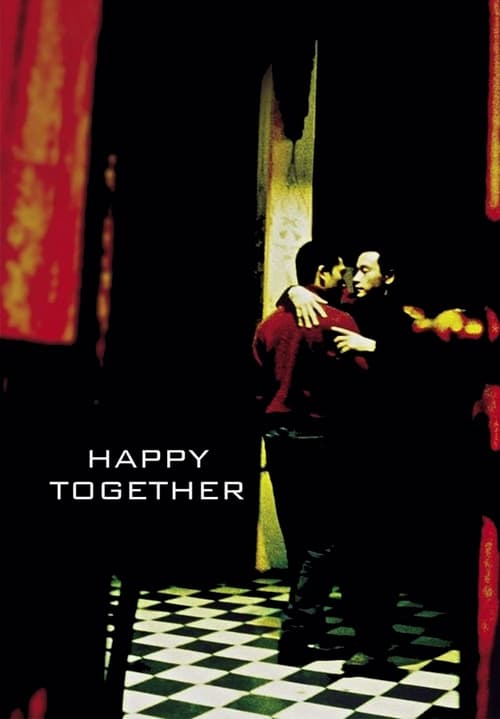
Happy Together
1997 · Wong Kar-Wai
Generates discourse without new films: the Blossoms Shanghai TV pivot, In the Mood for Love's ascension up the Sight & Sound poll, and his permanent status as Letterboxd's most romanticized stylist.
For when you're up for a beautiful heartbreak — post-breakup viewing, homesick viewing, or any night you want a film that feels things at full intensity. Emotionally demanding, deeply rewarding.
What it's about
Two men from Hong Kong — volatile, magnetic Ho Po-wing and steadier, wounded Lai Yiu-fai — travel to Argentina hoping to start their relationship over, and instead get stuck in Buenos Aires, broke and far from home, cycling through breakups and reconciliations neither can quit. It's a love story told from inside the exhaustion of loving someone who keeps leaving.
The experience
Raw and aching, by turns tender, prickly, and dryly funny — it captures the exact texture of a relationship you can't fix and can't leave. It lingers for days.
Performances
Tony Leung and Leslie Cheung are devastating together — Cheung all reckless charm, Leung carrying whole arguments in his silences. It's two of Hong Kong cinema's greatest stars at their most exposed.
The craft
Shot on location in Buenos Aires with Christopher Doyle's restless, gorgeous camerawork, sliding between stark black-and-white and saturated color, scored to tango and longing. Every frame looks like a memory you're not sure you can trust.
Why it matters
It won Wong Kar-Wai Best Director at Cannes, cemented him as one of world cinema's essential voices, and stands as a landmark of queer cinema from Asia.
Snapshot
Wong Kar-Wai's fifth feature is the most geographically displaced and emotionally austere work of his career: a two-hander about a gay Hong Kong couple stranded in Buenos Aires, caught in a cycle of rupture and reconciliation that neither man can break nor sustain. Shot in Argentina during the months preceding the 1997 handover of Hong Kong to China, the film turns exile, temporal dislocation, and the impossibility of a shared future into formal principles. It is simultaneously Wong's most overtly queer film, his most politically charged, and his most rigorously stripped-down — a pressure-cooker of bad faith and exhausted longing that won him the Best Director prize at Cannes and fixed his reputation as one of world cinema's essential voices.
Industry & production
Happy Together was produced through Wong's own company, Jet Tone Productions, with co-production support from Block 2 Pictures. The decision to shoot entirely outside Hong Kong — in Buenos Aires, with an Argentine crew supplementing the core Hong Kong team — was characteristic of Wong's increasing ambition for self-determined, internationalized production after the critical success of Chungking Express (1994) and Fallen Angels (1995). The film was made without a conventional screenplay; Wong developed the project through improvisation, extended rehearsal periods, and iterative shooting, keeping the precise shape of the narrative fluid well into production.
The casting of Leslie Cheung Kwok-wing (Ho Po-wing) and Tony Leung Chiu-wai (Lai Yiu-fai) brought together two of Hong Kong cinema's most bankable and critically respected stars. Cheung in particular carried strong associations with queer identity in Hong Kong public culture, having spoken openly about his bisexuality. A third key figure, Chang (played by Taiwanese actor Chang Chen), was added during production. No specific budget figures have been authoritatively published; the record here is thin.
The shoot was prolonged and grueling. Wong and his team spent months in Argentina, and the volume of footage accumulated vastly exceeded conventional feature ratios — a recurrent feature of Wong's method that made the editing phase as much a creative act of discovery as the shooting itself.
Technology
Christopher Doyle shot the film on 35 mm, exploiting the full expressive range of available stock choices to generate the film's signature chromatic instability. The cinematography alternates between richly saturated color and desaturated black and white, with the transitions functioning expressively rather than representationally: roughly, color codes a certain intensity or intimacy between the two men, while black and white marks periods of separation and emotional withdrawal — though Wong resists any schematic consistency.
Doyle and Wong made extensive use of step-printing and overcranking to produce slow-motion and time-stretch effects that became among the most imitated visual signatures of late-1990s art cinema. The opposite register — time-lapse and fast-motion — appears at key structural moments, notably in a compressed late-film passage suggesting forward movement out of stasis. The handheld camera is often pushed into extreme proximity, using wide-angle lenses that distort space and force the viewer inside the claustrophobic geometry of the men's shared rooms. The grain structure of the image is treated as a carrier of feeling rather than a deficiency to be corrected.
Technique
Cinematography
Christopher Doyle's work here is arguably the most aggressively intimate of his collaborations with Wong. Where Chungking Express allowed the camera a certain playful mobility through Hong Kong's urban density, Happy Together constricts space to the point of suffocation: the Buenos Aires apartment, the kitchen, the tango bar corridor. The wide-angle lens recurs obsessively, pressing faces and bodies into the frame's edges, exaggerating the physical closeness of men who cannot emotionally connect. The famous shot of Ho Po-wing's face lit by a bare lamp — trembling between tenderness and threat — is representative of Doyle's approach: unstable light, urgent proximity, the sensor registering sweat and texture.
The black-and-white sequences carry a different grain and tonal quality, cooler and more distanced, as if memory has bleached the color out. The interplay between registers keeps the viewer alert to the emotional temperature of each scene rather than allowing passive immersion.
Editing
William Chang Suk-ping edited the film, as he had done — and would continue to do — on nearly all of Wong's features. Chang also served as production designer and costume supervisor, making him arguably the most influential single collaborator in Wong's filmography after Wong himself. The editing of Happy Together is characterized by ellipsis and compression: entire chapters of the relationship are implied by a cut rather than dramatized, and the chronological order of events is sufficiently scrambled that the film feels closer to the experience of retrospective grief than to narrative unfolding. Lai's voiceover narration anchors the viewer not in a present-tense story but in a consciousness sifting through the wreckage of experience.
Mise-en-scène / staging
The Buenos Aires setting is used anti-touristically. Argentina's famous visual splendors — wide boulevards, the Río de la Plata — are mostly withheld; instead the film occupies cramped interiors, dim service corridors, and the working-class kitchens of a city that is always somewhere else from where the characters want to be. The sole exception is the Iguazú Falls, which functions as the film's great withheld horizon: Ho speaks of wanting to go there, the two men never manage the journey together, and it is only Lai alone — after Ho has finally, permanently gone — who stands before the falls and weeps. The image of the waterfall is introduced early through a table lamp bearing a photograph of it, a piece of domestic geography that makes the falls both present and forever deferred.
Sound
The sound design is inseparable from the film's emotional architecture. Astor Piazzolla's tango compositions — particularly his nuevo tango idiom, with its expressive dissonance and rhythmic urgency — score the film's more turbulent passages, lending Buenos Aires an emotional authenticity that the visual strategy deliberately withholds. The film's most celebrated sonic moment is Caetano Veloso's a cappella performance of the Mexican folk song "Cucurrucucú Paloma," which appears in a single devastating sequence: its mournful, unanswered call becomes a kind of thesis statement for everything the film is doing. Lai records Ho's voice on a cassette tape in secret, and the recurring motif of voices preserved and replayed connects to Wong's broader preoccupation with the materiality of memory and desire.
Performance
Both Leung and Cheung sustain extraordinary performances under conditions of improvisation and physical duress. Leung, typically cast in cool, contained roles, allows Lai's desperate attachment to accrue slowly through small acts of watching and waiting — he is almost entirely reactive, a man defined by what he cannot stop wanting. Cheung's Ho Po-wing is the more volatile figure: mercurial, cruel, genuinely vulnerable when injured, capable of casual devastation. The power asymmetry between the two men — Ho's freedom to leave, Lai's compulsion to receive him — is embodied rather than argued. Chang Chen, working in a different register entirely, brings a quality of clear-eyed presence to the Taiwanese traveler Chang; his friendship with Lai functions as an image of what uncomplicated intimacy might look like, set against the corrosive intimacy of the central relationship.
Narrative & dramatic mode
The film is organized around repetition rather than development. The phrase "starting over" (重新開始, chung san hoi chi) recurs like a structural tic: Ho proposes it; Lai consents; the cycle resumes and destroys itself. Wong's narrative mode here is recursive rather than progressive — the story doesn't advance toward a destination so much as spiral through the same coordinates with diminishing returns. This formal choice enacts the film's argument: the couple cannot transcend their pattern because the pattern is what they are.
The film's Chinese title, 春光乍洩 (Chun Gwong Cha Sit) — roughly, "Spring Light Leaks Out" or "Leaking Spring Brightness" — carries multiple valences: a photographic metaphor (light leaking through the camera body, ruining the film), a sexual suggestion, and an image of something beautiful and irretrievable. The English title, a deliberate irony against the Turtles' 1967 pop optimism, inverts the Chinese title's elegiac fatalism into something more sardonic.
Genre & cycle
Happy Together belongs to the international art cinema of the 1990s in its visual grammar and its comfort with narrative indeterminacy. Within Hong Kong cinema it sits in the tradition established by the Hong Kong New Wave (second wave), alongside the work of Stanley Kwan and the earlier Wong features. It is, more specifically, a queer romance — one of the few major works of the decade to center gay male desire without treating it as either pathological or politically programmatic. It does not belong to the New Queer Cinema of early-1990s American independent film; its concerns are aesthetic and metaphysical rather than activist. Within Wong's filmography it forms a loose trilogy with Days of Being Wild (1990) and In the Mood for Love (2000) — three films in which desire is constitutively self-defeating.
Authorship & method
Wong Kar-Wai's method has been extensively documented and is consistent across his career: he works without a finalized script, shooting speculatively over extended periods, and discovers the film's shape through the editing. This approach gives his films their characteristic quality of discovered rather than designed feeling — sequences seem to have been arrived at rather than constructed. On Happy Together the method was taken to an extreme by the logistical complexity of a foreign-location shoot with a cast whose availability was constrained by other commitments.
Christopher Doyle's contribution to the film's visual identity cannot be overstated; the Doyle-Wong partnership between Chungking Express and In the Mood for Love represents one of the most productive director-cinematographer collaborations of contemporary world cinema. Doyle was a co-author of the visual grammar that made Wong's films internationally recognizable. William Chang's triple function — editor, production designer, costume designer — produces a coherence between the film's visual environment and its internal rhythm that no single-function collaborator could have achieved. Wong has consistently acknowledged Chang as central to his creative process. The film's musical selections, particularly the Veloso and Piazzolla choices, were Wong's own; his curation of pre-existing music as emotional infrastructure rather than score is one of the defining characteristics of his authorship.
Movement / national cinema
Happy Together is a Hong Kong film made entirely outside Hong Kong, which is part of its meaning. The city appears fleetingly in archival footage — a 1960s cityscape, brief and disorienting — and in a final sequence set in Taipei's street-level transit, which Lai reaches after leaving Buenos Aires. The displacement of the Hong Kong subject to a Latin American context in the year before the handover is the film's underlying political condition, even if it is never stated. Hong Kong cinema in this period was preoccupied, overtly or obliquely, with the question of 1997: what it meant to be a Hong Kong subject under the horizon of Chinese sovereignty. Wong's solution — to remove the protagonists entirely from the territory, to set them adrift at the other end of the world — transforms the political anxiety into an existential condition rather than a topical one. Buenos Aires, itself a city of exile and tango, of nostalgia for a better past, functions as a mirror image of a city contemplating its own imminent transformation.
Era / period
The film was made in and represents the mid-1990s moment in world cinema when video exhibition, festival culture, and the critical infrastructure of art cinema created a viable international market for auteur filmmaking from outside Europe and North America. Wong's work was central to this moment — alongside Abbas Kiarostami, Hou Hsiao-hsien, and Edward Yang — and Happy Together's Cannes prize was both a recognition of this and a consolidation of it. The film belongs to the era's broader interest in queer visibility in mainstream and arthouse exhibition: the years immediately following the New Queer Cinema wave, when queer themes were increasingly legible to international festival audiences.
Themes
Exile and displacement structure every level of the film: geographical (Hong Kong men in Argentina), linguistic (Cantonese speakers in a Spanish-speaking city), emotional (two people estranged from their own desires). The impossibility of return — to Hong Kong, to a better version of the relationship, to an earlier self — is stated in the recursive "start over" motif and enacted by the narrative's refusal to resolve. The film meditates on what desire does when it has nowhere to go: Lai's love for Ho is not diminished by Ho's cruelty; it simply accretes, becomes a kind of wound he carries and tends. The Iguazú Falls functions as the film's symbol of deferred wholeness — the beautiful, overwhelming thing that cannot be shared and is finally encountered alone. The cassette tape preserving Ho's voice, replayed in secret, extends this meditation to the relationship between memory and presence: the recorded voice is both more reliable and more painful than the living man.
Reception, canon & influence
Happy Together won the Best Director prize at the 1997 Cannes Film Festival, the most significant recognition Wong had yet received internationally. Critical response in Europe and North America was strongly positive, with reviewers emphasizing both the film's formal originality and its emotional impact. It was less commercially successful in Hong Kong than Wong's earlier films, in part because of its queer subject matter and in part because of the demanding nature of the viewing experience.
Influences backward: Wong's own previous work is the clearest formal antecedent — the mobile handheld aesthetics of Fallen Angels, the temporal dislocations and recurring motifs of Chungking Express, the elliptical love story of Days of Being Wild. Beyond his own filmography, the film draws on Michelangelo Antonioni's treatment of romantic exhaustion and alienated landscapes; on Jean-Luc Godard's willingness to disrupt narrative continuity in service of emotional truth; and on the tradition of literary queerness in Latin American writing, particularly the work of Manuel Puig, whose Buenos Aires-set fiction explores the intersections of desire, exile, and popular culture. Whether Wong read Puig directly as a source is not established in the documentary record, but the thematic kinship is profound. The film also draws on the cultural grammar of tango — a form built around longing for an absent other — as both musical score and existential metaphor.
Legacy and forward influence: Happy Together was a watershed in the international visibility of queer Asian cinema, arriving at a moment when that visibility was contested and fragile. It demonstrated that queer subject matter could coexist with formal prestige at the highest level of international art cinema recognition. The film's visual grammar — step-printed slow motion, unstable handheld proximity, the interplay of color and black and white — was widely absorbed into the visual culture of the late 1990s and 2000s, influencing music video aesthetics and a generation of filmmakers drawn to sensory, non-linear modes of storytelling. The Caetano Veloso sequence became one of the most cited moments in the post-1990s canon of world cinema.
Within Wong's own trajectory, Happy Together marks the pivot to the more formally austere and emotionally restrained mode that would define In the Mood for Love (2000) and 2046 (2004): a cinema of withheld fulfillment, of desire preserved in the amber of form. The film's influence on subsequent Hong Kong and East Asian cinema engaging with queer themes — including, in different registers, the work of Stanley Kwan — is significant, though specific attributions remain underexplored in the critical literature. What is beyond dispute is that Happy Together expanded the thematic and formal possibilities available to Hong Kong cinema at the precise historical moment when that cinema was most urgently asking what it was and where it could go.
A Deleuzian reading
A cheap table lamp sits in a Buenos Aires apartment.
The full Deleuzian reading of Happy Together →
Reception
It premiered at Cannes 1997 to real acclaim — Wong won Best Director — but for years it sat in the shadow of Chungking Express and In the Mood for Love. Now it's fully canonized as one of the great queer films of the '90s, its stock rising with every rewatch cycle.
How Happy Together was received, from release to now →
Influences: the films it descends from and the films it influenced
- Days of Being Wild (1990) — The Buenos Aires epilogue seeded the Argentine setting; William Chang's simultaneous production design, costume design, and editing credit — the triple-role collaboration that structures Happy Together's look — originates here.
- Chungking Express (1994) — Step-printing as subjective time-dilation and pre-existing Western pop music as emotional counterpoint ('California Dreamin'') established the visual and sonic vocabulary Happy Together intensifies.
- Fallen Angels (1995) — Christopher Doyle's extreme wide-angle distortion — sub-12mm lenses producing radically convex, compressed close-ups — reached its most aggressive form here before Happy Together absorbed and modulated the technique.
- Hiroshima Mon Amour (1959) — The fragmented, recursive chronology in which the same romantic moments recur with altered emotional charge — edited to disrupt linear time as a register of traumatic desire — is the formal model for Happy Together's elliptical narrative structure.
- L'Avventura (1960) — Romantic exhaustion externalized through alienated geography: characters whose emotional states are encoded in landscapes they cannot properly inhabit, displacing psychological interiority onto spatial environment — the structural model for Happy Together's Buenos Aires as affective prison.
- Pierrot le Fou (1965) — Color and black-and-white within a single film deployed as expressive register shift rather than period marker; narrative fragmentation serving emotional rather than plot logic — both formal strategies Happy Together adopts for its color/B&W alternation sequences.
- Tangos: El exilio de Gardel (1985) — Established Astor Piazzolla's nuevo tango as the defining musical grammar of Argentine exile in international art cinema — the specific tonal and cultural register that Happy Together's Piazzolla-saturated soundtrack directly cites.
- My Own Private Idaho (1991) — Elliptical, non-linear queer love story using disrupted chronology and hallucinatory image-insets to externalize desire and displacement — the template for treating queer romance in a formally experimental festival art-cinema register that Happy Together inherits.
- Fox and His Friends (1975) — Descends from Fox's model of gay relationships as sites of economic and emotional exploitation staged through reflective surfaces and claustrophobic interiors rather than as a coming-out narrative.
- In the Mood for Love (2000) — Refines Happy Together's step-printed slow motion into its most precisely choreographed form; retains William Chang's triple-role production/costume/editing collaboration; extends the deferred-horizon structure — two people who never fully come together — to its most austere register.
- 2046 (2004) — Tony Leung's character returns from Buenos Aires carrying Happy Together's emotional logic; the recursive-repetition narrative and deferred-horizon motif become the film's explicit subject, replaying HT's grammar as conscious self-quotation.
- Lan Yu (2001) — Applied the elliptical, handheld queer-romance form that Happy Together's Cannes Best Director prize legitimized — non-linear flashback chronology, close-proximity physical staging — to a Beijing setting, the first major Chinese-language inheritor of HT's queer formal register.
- Last Life in the Universe (2003) — Shot by Christopher Doyle, directly transplanting Happy Together's wide-angle distortion, controlled color temperature, and step-printing vocabulary into a Thai-Japanese love story — the most direct Doyle-mediated transmission of HT's visual grammar to another national cinema.
- Spring Fever (2009) — Desaturated handheld cinematography, elliptical chronology, and queer male romance in a formally ambitious mode that cites Wong Kar-Wai's post-Happy Together visual vocabulary as the legitimizing model for mainland Chinese queer art cinema.
- My Blueberry Nights (2007) — Transplants Happy Together's step-printing, pre-existing music curation, and scriptless-improvisation method to an American road-movie setting — and, as the first post-Doyle WKW film, inadvertently reveals how much of the HT visual grammar was specific to the Doyle collaboration.
- Cloud (2007) — Queer two-hander of constrained, obstacle-bound love rendered through handheld, available-light intimacy in cramped rooms.
- Laurence Anyways (2012) — Charts a queer relationship's decay through abrupt saturated-color shifts and pop needle-drops rather than plot, the structuring device Dolan inherits for his decade-spanning love story.
- And Then We Danced (2019) — Wong's handheld, close-quarters shooting of two men and the kitchen tango establish dance and cramped physical proximity as the language of queer longing.
- Your Name Engraved Herein (2020) — Christopher Doyle's wet neon-saturated nocturnes and the elliptical, fragment-based editing of a doomed same-sex affair recalled in pieces underwrite the film's humid-nocturne palette and memory-structured cutting.
- Love in the Big City (2024) — Establishes the cramped shared apartment as the entire emotional arena of a gay relationship, staged in clinging intimate two-shots and cut into elliptical fragments that skip the on-again/off-again cycles rather than dramatizing them — the exact spatial and editorial grammar Love in the Big City uses for Heung-soo's flat.
- Weekend (2011) — A claustrophobic chamber two-hander confining a gay couple's cycles of intimacy and friction to a few rooms, the small-cast pressure-cooker staging Weekend miniaturizes to one flat.
- Tropical Malady (2004) — Color and black-and-white deployed at the film's structural midpoint as an ontological register shift; queer male desire organized around a deferred encounter the narrative refuses to resolve — formal parallels to HT's color-alternation device and recursive-repetition structure.
- Elephant (2003) — Step-printed slow motion as a device suspending institutional time; extended handheld tracking shots through alienated corridors treating a familiar location as affectively anti-touristic space — HT's visual grammar applied to American subject matter.
- Vive L'Amour (1995) — Contemporary 1990s Chinese-language cinema of queer longing and claustrophobic shared-apartment proximity, working the same theme of desire-in-cramped-space through a kinetic rather than static register.
- Crossing (2024) — Queer characters stranded in a foreign city far from home, rendered through intimate handheld texture that makes the alien metropolis a character shaping their longing and estrangement.
- Farewell My Concubine (1993) — Carries forward Leslie Cheung's dan-inflected performance register — the self-abnegating, doomed queer desire and mercurial cruelty — into a new formal context, extending the actor's specific tragic vocabulary.
- Madame Satã (2002) — Pairs a saturated warm-amber palette with restless handheld intimacy to render queer displacement, the same color-and-camera coupling Madame Satã uses for claustrophobic desire.
- The Wedding Banquet (1993) — Chinese-language gay cinema of the same decade that extends the Banquet's placement of a queer relationship inside diasporic displacement, though trading farce for durational mood.
Similar films
- Fallen Angels (1995) — influence & lineage · same viewing thread · often watched together
- In the Mood for Love (2000) — influence & lineage · same viewing thread · often watched together
- Days of Being Wild (1990) — influence & lineage · same viewing thread
- Chungking Express (1994) — influence & lineage · often watched together
- 2046 (2004) — influence & lineage
- Farewell My Concubine (1993) — same viewing thread
- The Wedding Banquet (1993) — same viewing thread
- Comrades, Almost a Love Story (1996) — same viewing thread
All the films related to Happy Together →
Watch it with: curated runs of related films
- Love Against the Grain — A run of films where desire refuses the shape its world demands — opera stages, drought-struck Taipei, an honor-bound Lahore household, drenched Buenos Aires — and burns brighter, and more dangerously, for the refusal.