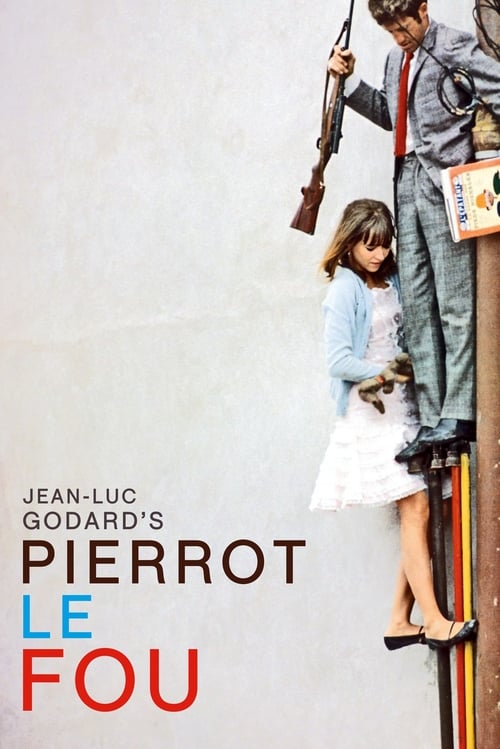
Pierrot le Fou
1965 · Jean-Luc Godard
For when you're tired of movies that behave and want one that breaks all the rules in front of you — an adventurous night, not a comfort watch. Reach for it when you want cinema that feels like a jailbreak.
What it's about
A man walks out on his comfortable Parisian life mid-dinner-party and hits the road south with Marianne, an old flame who happens to be running from hit-men connected to Algeria. What starts as an escape becomes a life on the run — stolen cars, seaside hideouts, spur-of-the-moment crimes — with the Mediterranean glittering ahead and trouble always one step behind. It's a love story and a getaway movie that keeps tearing up its own map.
The experience
Playful, restless, and unpredictable — it swerves from slapstick to violence to musical numbers to characters talking straight at you, sometimes within a single scene. You never settle in; you're carried along on pure color and momentum, laughing one minute and blindsided the next.
Performances
Jean-Paul Belmondo and Anna Karina are magnetic together — he all rumpled intelligence and wounded romanticism, she quicksilver and unreadable, singing and dancing and lying with the same bright face.
The craft
Shot in blazing primary colors — reds, blues, and yellows straight out of a comic strip — against Mediterranean light that begs for a big screen. Godard throws out the rulebook: jump cuts, interrupted songs, painted faces, scenes that comment on themselves, all held together by sheer visual confidence. It looks like a pop-art painting that learned to move.
Why it matters
One of the defining works of the French New Wave and the point where Godard broke decisively with conventional storytelling — its anything-goes freedom has echoed through independent film, music video, and every lovers-on-the-run movie since.
Snapshot
A man walks out of his life. Ferdinand Griffon — called Pierrot by the woman who will destroy him — abandons a Parisian bourgeois dinner party mid-sentence, takes up with his former lover Marianne Renoir, and flees south toward the Mediterranean through a landscape simultaneously beautiful, violent, and saturated with the primary colors of comic strips. What follows is simultaneously a road movie, a love story, a gangster film, a political essay, and a prolonged meditation on whether cinema can hold thought and sensation in the same frame. It cannot, finally — the film ends with a face painted blue and yellow, a belt of dynamite, and a word spoken too late. Pierrot le Fou is the film in which Godard definitively broke with classical narrative while still mourning what he was losing.
Industry & production
The film was co-produced by Rome Paris Films (Georges de Beauregard) and Dino De Laurentiis's Italian company, shot in the summer of 1965. The international co-production structure — typical of mid-decade European art cinema — gave Godard a wider budget and the use of Belmondo, then among the most bankable French stars following Breathless (1960), while retaining the improvisational latitude he required. The source novel, Lionel White's pulp thriller Obsession (1962), provided only the skeleton of a couple-on-the-run plot; Godard discarded most of its mechanics and used it as a launching pad rather than a blueprint.
The production coincided almost exactly with the dissolution of Godard's marriage to Anna Karina, who plays Marianne; the emotional undertow of that ending is inseparable from the film's texture. Whether Godard deliberately exploited this biographical fact or found it simply unavoidable is a matter of record that remains genuinely ambiguous. What is documented is that Karina was cast knowing the biographical resonance, and that the film marked effectively the end of their sustained creative partnership. Specific budget figures for the production have not been authoritatively published, and any circulating numbers should be treated with caution.
Technology
Raoul Coutard shot the film in Techniscope, a two-perforation 35mm format that produced a widescreen 2.35:1 image at roughly half the cost of anamorphic lenses, with a slightly grainier image that suits the film's oscillation between lyrical beauty and rawness. The stock was Eastmancolor, which Coutard and Godard pushed toward the hypersaturated end of its range — the reds and blues of the film are not naturalistic but expressionistic, closer in palette to a Matisse canvas or a Marvel comic than to the desaturated location realism of early Nouvelle Vague work. The combination of Techniscope's wide frame and Coutard's frequent use of handheld or loosely supported camera produced images that feel both painterly and unstable, composed but never settled.
Technique
Cinematography
Coutard's work here represents a deliberate departure from even his own earlier handheld aesthetic. The camera moves with considerable freedom — tracking laterally along sequences of gestures, drifting across faces mid-sentence — but is equally willing to lock off for a static tableau that holds long enough to feel like a painting being consulted rather than a narrative moment being staged. The use of natural light along the Côte d'Azur sequences bathes scenes in a Mediterranean intensity that Godard immediately undercuts with flat, artificial primaries in interior sequences. Rack focus and zoom lenses appear alongside lens choices that emphasize depth; no single photographic regime governs the film. The result is a texture that refuses to let the eye settle into any one mode of attention.
Editing
The film was edited by Nassim Dorey. The editing in Pierrot le Fou evolves from the jump-cut strategy of Breathless toward something more architecturally complex: temporal ellipses are so radical that entire days or episodes vanish between cuts, narrative continuity is periodically abandoned in favor of associative or tonal logic, and intertitles interrupt the image track to insert written language — chapter headings, quotations, the word "Cinémascope" — as a material competing with the images rather than explaining them. Musical sequences are cut to a different rhythm than dramatic ones, and the film's tonal switches — from comedy to lyricism to violence to essay — are achieved as much through editing as through script or performance.
Mise-en-scène / staging
Godard stages Pierrot le Fou as a series of ontological collisions. Theatrical, even declamatory gestures coexist with naturalistic behavior in the same frame. Direct address to the camera is deployed not as a Brechtian alienation technique per se but as a kind of confession, or despair — Ferdinand addresses the camera when the fiction cannot contain what he needs to say. The film's most celebrated staged sequence places Belmondo and Karina opposite Samuel Fuller — who appears as himself at the opening party — for a brief exchange on the nature of cinema ("A film is a battleground: love, hate, action, violence, death — in one word, emotion"), staging documentary reality and fictional performance as continuous surfaces.
Props and costume carry iconographic weight throughout: the comic-strip aesthetic of certain sequences, Marianne's costuming in red and white, Ferdinand's blue face at the film's end as a citation of both Picasso's Blue Period and commedia dell'arte. Locations are used non-realistically; the Côte d'Azur functions as an Edenic landscape already containing the evidence of its own exhaustion.
Sound
The sound design — partly the result of direct-sound recording in the French New Wave manner — is characterized by abrupt tonal discontinuities. Antoine Duhamel's score functions in fragments rather than as sustained underscore; melodic cells enter and are cut off mid-phrase, as though the emotional support that music conventionally provides in film is being withdrawn or questioned. Silence is used structurally rather than naturalistically. Dialogue is sometimes treated with equal weight to ambient sound and sometimes privileged over it in ways that shift without warning. Karina's brief musical performance — "Ma ligne de chance" — inserts a moment of self-contained song into the narrative fabric, a genre interruption that is characteristically Godardian.
Performance
Jean-Paul Belmondo plays Ferdinand as a man in whom thought has become a form of paralysis; his physicality — athletic, easy, generous — is placed in constant ironic tension with the intellectual commentary his character delivers. He is at once the most embodied and the most cerebral figure in the film. Anna Karina's Marianne is drawn as pure appetite and pure action, incapable of stillness; the performance is naturalistic in its surfaces but theatrically calibrated in its broader design. The political mini-drama that Marianne and her brother perform for American tourists mid-film is an explicit citation of Brechtian separation of mode, with Karina switching registers in a way that comments on acting as such. The chemistry between the two principals carries biographical charge that Godard does not attempt to defuse.
Narrative & dramatic mode
Pierrot le Fou is not a story that wants to be told but a condition that wants to be inhabited. The narrative — couple flees Paris, traverses France, reaches the sea, commits crimes, splits, rejoins, dies — is interrupted so systematically by digression, direct address, essayistic interlude, and political commentary that what arrives at the ending is not the conclusion of a plot but the exhaustion of a sensibility. The film's mode is lyric-essayistic: Ferdinand keeps a journal, reads Élie Faure's History of Art aloud, and addresses the camera in the second person. Marianne, constitutionally impatient with Ferdinand's impulse to narrate experience rather than live it, enacts the film's structural antagonism between word and image, literature and cinema, consciousness and desire.
Genre & cycle
The film operates across three genre registers simultaneously: the American B-movie (explicitly cited — Fuller's cameo is both homage and critique), the French literary road narrative, and the romantic tragedy. Its debt to Hollywood noir and the gangster picture is worn as costume rather than as structure; the film borrows the situations of genre without accepting its logic of causality and resolution. This strategic generic promiscuity is characteristic of the Nouvelle Vague as a whole but reaches a particular intensity here, because the genre elements are insufficient to the emotional stakes. The film refuses to resolve as a thriller, as a romance, or as a road movie, and the frustration this generates in spectators attuned to genre fulfillment is part of its intended effect.
Authorship & method
Godard is often described as writing the script of Pierrot le Fou on the morning of each day's shoot, slipping pages or whispered lines to actors at the last moment — a working practice that enforced a quality of provisional commitment, of speech as immediate utterance rather than rehearsed delivery. Whether this account is precisely accurate or itself partly mythological, it corresponds to the film's texture: dialogue feels thought at the moment of speaking, not recalled. Raoul Coutard, Godard's regular cinematographer across the decade, was a collaborator of unusual importance; his ability to achieve complex images rapidly, in available light and on location, enabled the Nouvelle Vague's economics and aesthetics simultaneously. Antoine Duhamel, who composed the score, was relatively early in his film career here; the fragmentary, withdrawn quality of the music reflects both Godard's direction and the film's refusal of conventional emotional guidance. The productive and personal collaboration with Karina as his creative interlocutor — extending across Une Femme est une Femme, Vivre sa Vie, Bande à part, and others — reached both its most painful and most aesthetically consequential point in this film.
Movement / national cinema
Pierrot le Fou is a central document of the French Nouvelle Vague, though it marks the moment when the movement's founding energies — the liberation of the camera, the reflexive citation of Hollywood, the romantic vitalism — begin to curdle into something more agitated and less celebratory. Godard's trajectory through the decade moves from the exuberant play of Breathless and Bande à part toward the explicit political cinema of La Chinoise (1967) and Week End (1967); Pierrot le Fou occupies the inflection point. It is still, barely, a love film — but the consumer capitalism satirized in the opening dinner party, and the Algerian War cited in Marianne's connections to hit men, signal that the political world is entering the frame, and that it is incompatible with the romantic project.
Era / period
The film is a document of 1965 in ways beyond the incidental: the commodified leisure of the opening Parisian world, the advertising slogans and television sets that furnish it, the American popular culture that saturates the environment all register a specific postwar European modernity. The Algerian War — officially concluded in 1962 but still traumatically present in French political consciousness — provides the film's unresolved violent backstory. The Mediterranean idyll that Ferdinand and Marianne seek is figured against a historical present that refuses to disappear. The mid-1960s moment — the last years before May '68 transformed European political culture — is precisely the era this film inhabits: aware of the failure of liberal individualism, not yet committed to any revolutionary alternative.
Themes
The film's central antinomy is between Ferdinand and Marianne as embodiments of two incompatible modes of existence: thought and sensation, word and image, the desire to mean and the desire to live. Ferdinand reads, narrates, and annotates his experience; Marianne inhabits and enacts hers. The film does not adjudicate between them — both positions are shown as insufficient — but proposes that their incompatibility is lethal. Love, in Pierrot le Fou, is not the overcoming of difference but the discovery that difference is irreducible.
Consumer society appears as a suffocating frame: the opening dinner party in which guests speak only in advertising language is one of the film's most precise social critiques, presenting late capitalism as a reduction of human speech to the vocabulary of commodity. The couple's flight is partly an escape from this world, but Godard insists on showing them as constituted by it — the America they recreate on their Mediterranean island is still stocked with comic books, movies, and guns.
Art — painting especially, but also literature and cinema — runs through the film as a mode of salvage that is also a mode of evasion. Ferdinand's citations of Renoir (whose name Marianne bears), Velázquez, and Céline index a tradition that cannot help him; he knows it, and cannot stop reaching for it. The film's self-reflexivity about cinema — its willingness to foreground itself as a constructed image — is part of this thematic; Godard is making a film about the limits of what films can do.
Reception, canon & influence
Pierrot le Fou premiered at the 26th Venice International Film Festival in September 1965. Critical response at the time was divided: admirers recognized it as Godard's most complete and ambitious statement to that point; detractors found its refusal of narrative coherence self-indulgent. It was not a substantial commercial success. Pauline Kael was among the critics who engaged seriously with the film in the Anglophone world, though her response was characteristically ambivalent about Godard's intellectual manner. Over the following decade, as the Nouvelle Vague was absorbed into international film culture, the film's reputation stabilized as a canonical work — eventually placing on multiple iterations of critical polls of the greatest films.
Looking backward, the film absorbs and cites American B-cinema — particularly Samuel Fuller, Howard Hawks, and the gangster genre — alongside French literary modernism (Rimbaud, Céline, Queneau), the history of painting, and a strain of cinematic self-awareness deriving from both Brecht and Mack Sennett. The coupling of violence, desire, and political commentary anticipates the film's own forward influence.
Its forward reach is wide. Terrence Malick's Badlands (1973) — another doomed couple moving through a landscape both beautiful and indifferent — shares structural and tonal DNA with Pierrot le Fou, though Malick's debts are rarely acknowledged directly. Jim Jarmusch's early work, particularly Stranger Than Paradise (1984), absorbs the aesthetic of purposeful deadpan, fragmented narrative, and genre refusal. More diffusely, the film's visual grammar — saturated primary color as emotional register, the jump-cut as an honest admission of the camera's inability to sustain time, the fourth-wall address as a last resort of sincerity — entered the repertoire of international art cinema so thoroughly that its specific origins became difficult to trace. Godard himself described Pierrot le Fou in various interviews as a search for cinema rather than the making of one; the film's openness, its productive failure to resolve, is arguably what has kept it alive.
A Deleuzian reading
A man sits in a bathtub, fully clothed in the version we remember, reading aloud from Élie Faure's history of art to a small daughter who isn't really listening.
The full Deleuzian reading of Pierrot le Fou →
Reception
It split critics at its 1965 Venice premiere — French censors even restricted it to over-18s for 'intellectual and moral anarchy' — but it's since climbed into the heart of the canon, now routinely ranked among Godard's two or three greatest films and a Sight & Sound poll regular.
How Pierrot le Fou was received, from release to now →
Influences: the films it descends from and the films it influenced
- Breathless (1960) — Establishes the Godard-Coutard method of available-light handheld shooting and jump-cut continuity rupture that Pierrot pushes from cut-within-a-scene into ellipses swallowing whole days.
- Une femme est une femme (1961) — First Godard-Coutard color film with Karina, rehearsing the primary-hued, genre-pastiche palette and direct-address play that Pierrot weaponizes into full comic-strip expressionism.
- Johnny Guitar (1954) — Anti-naturalistic melodrama where saturated reds and blues carry emotion rather than describe space — the Ray color logic Godard adopts for his Matisse-like artificial interiors.
- Shock Corridor (1963) — Fuller's tabloid 'cinema as raw emotion' aesthetic, literally cited when Fuller appears at the party to define film as 'love, hate, action, violence, death — emotion.'
- Hiroshima mon amour (1959) — Fuses literary essayistic voiceover with elliptical, associative editing, modeling the lyric-essay register in which Pierrot lets written and spoken language compete with the image.
- Voyage to Italy (1954) — Plays a couple's disintegration as a Mediterranean road film shot in real locations, the documentary-realist substrate Godard inherits then overpaints with artifice.
- Lola Montès (1955) — Reflexive, theatrically framed widescreen color spectacle that stages performance as performance, prefiguring Pierrot's Brechtian register-switching and presentational tableaux.
- La Règle du jeu (1939) — Deep-staged coexistence of declamatory theatrical gesture and naturalistic behavior in one frame — the Renoir staging grammar Godard nods to through Marianne's surname.
- Le Mépris (1963) — Same Coutard widescreen color method applied to bold primary blocks and a film-about-filmmaking reflexivity, the immediate companion experiment in cinema critiquing itself.
- Gun Crazy (1950) — Extends the folie-a-deux lovers-on-the-run into color and improvisation, keeping the sex-guns-death triad and the fatal female partner who pulls the man toward annihilation.
- Pickup on South Street (1953) — Literalizes the debt by casting Fuller in cameo to define cinema as raw 'emotion — love, hate, action, violence, death,' the aesthetic creed Pickup embodies.
- Summer with Monika (1953) — The couple's flight to an island where the idyll rots from boredom, combined with Karina and Belmondo turning to note that they are speaking to the audience, recombines Monika's arc with its Brechtian rupture in color and scope.
- Week-end (1967) — Hardens Pierrot's intertitle chapter-headings and tonal/genre dissolution into a fully ruptured structure where written cards openly fight the image track.
- Bonnie and Clyde (1967) — Imports Nouvelle Vague editing rhythm into a lovers-on-the-run film, lurching between slapstick comedy and sudden violence the way Pierrot cuts tone against tone.
- Badlands (1973) — Lays detached, lyrical voiceover over a young couple's killing-spree road movie, inheriting Pierrot's split between sensuous landscape image and essayistic narration.
- Mauvais Sang (1986) — Revives saturated primary-color compositions and on-the-run lovers' lyricism as explicit Godard-Coutard homage, including direct-address emotional rupture.
- Chungking Express (1994) — Christopher Doyle's smeared handheld and hypersaturated Eastman-like color, paired with abrupt genre and tonal pivots, carries Coutard's unstable-but-painterly frame forward.
- Pulp Fiction (1994) — Builds narrative from interrupting chapter title-cards and promiscuous genre-mixing, treating pulp-novel structure as a launching pad to be ruptured exactly as Godard did with Lionel White's source.
- La Chinoise (1967) — Coutard's first extended use of saturated primary color as compositional argument—the Mediterranean sequence's reds, blues, and yellows read as flat graphic fields, not naturalistic environment—establishes the chromatic politics-of-surface that La Chinoise inherits and intensifies in its Maoist red apartment as color-ideology made literal.
- Punch-Drunk Love (2002) — The flat fields of primary red, blue, and yellow deployed as emotional annotation in Barry's blue suit and his industrial environment descend directly from Godard's chromatic system here, where color functions as mood notation rather than naturalistic information.
- Fallen Angels (1995) — The associative editing structure — sequences linked by emotional rhyme rather than continuity — and the female voiceover as melancholy counterpoint to male action directly model Fallen Angels' partner-narration device, wherein Michelle Reis's obsessive interior monologue runs against the hitman's wordless behavior.
- Happy Together (1997) — Color and black-and-white within a single film deployed as expressive register shift rather than period marker; narrative fragmentation serving emotional rather than plot logic — both formal strategies Happy Together adopts for its color/B&W alternation sequences.
- Nowhere (1997) — Established pop-art primary-color production design and doomed-lovers antinaturalism with deadpan direct-to-camera address, the Godardian color-and-artifice grammar Araki lifts.
- Kamikaze Girls (2004) — Godard's primary-color pop-art frames and characters who break the fourth wall to address the audience directly are the art-cinema root of Momoko's to-camera narration and comic-book color blocking.
- Made in U.S.A (1966) — Extends the bande-dessinée palette and political-pulp collage, continuing Pierrot's comic-strip primaries and genre-as-citation logic with Karina.
- 2 or 3 Things I Know About Her (1967) — Develops the whispered essayistic commentary track and consumer-capitalism critique into a near-pure sociological essay-film.
- Tokyo Drifter (1966) — Godard's bold primary-color set and costume design used as emotional coding, his embedding of diegetic song sequences as formal interruption, and his actors' theatrical remove from their own genre roles represent contemporaneous development of the same formal strategies Suzuki was pursuing within the Nikkatsu genre system.
Similar films
- Weekend (1967) — influence & lineage · often watched together
- Contempt (1963) — influence & lineage · often watched together
- Breathless (1960) — influence & lineage
- A Woman Is a Woman (1961) — influence & lineage
- Vivre Sa Vie (1962) — same viewing thread · often watched together
- Masculin Féminin (1966) — same viewing thread · often watched together
- Band of Outsiders (1964) — same viewing thread
- La Dolce Vita (1960) — same viewing thread
All the films related to Pierrot le Fou →
Watch it with: curated runs of related films
- Adrift in the Modern World — Watch these when you want to drift through postwar Rome and Paris alongside people who have everything and feel nothing — they rhyme on beautiful boredom, aimless days, and a search for meaning that modern comfort keeps failing to supply.