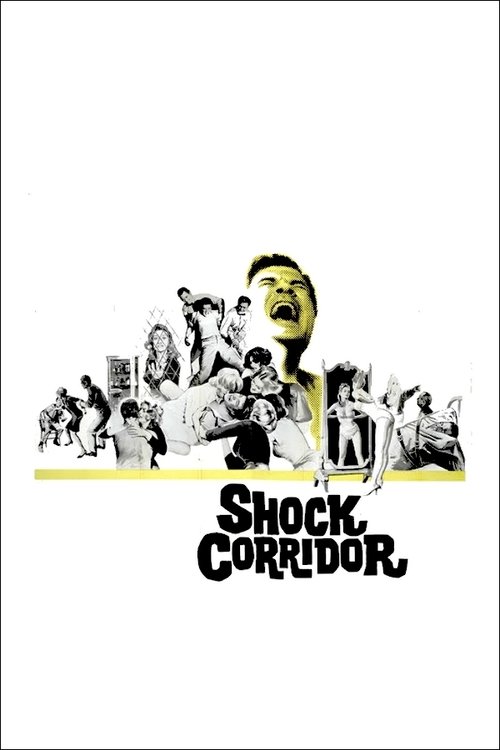
Shock Corridor
1963 · Samuel Fuller
For when you want something bold and unhinged — a midnight-movie jolt with a conscience. Reach for it when tasteful restraint sounds boring and you want a film that grabs you by the collar.
What it's about
Johnny Barrett, a reporter hungry for a Pulitzer, has himself committed to a mental hospital to solve a murder no one else can crack — with his reluctant girlfriend Cathy posing as his sister to sell the ruse. Inside, his three key witnesses are patients whose delusions each mirror a national wound: war, racism, the bomb. The deeper Johnny digs for his story, the harder it gets to stay the sane man in the room.
The experience
Feverish, blunt, and lurid — pure tabloid energy welded to a genuinely unnerving descent. It swings between pulpy thrills and moments that hit like a slap, and it doesn't do subtle; that's the point.
Performances
Peter Breck goes for broke as Johnny, his cocky reporter's front cracking by degrees, and Constance Towers gives Cathy a wounded steadiness that anchors the film's wildness.
The craft
Samuel Fuller wrote, produced, and directed with a newspaperman's punch, and Stanley Cortez's black-and-white photography turns the asylum's endless corridor into a stage of nightmares — punctured by sudden, disorienting bursts of color footage. The dialogue lands like headlines.
Why it matters
A cult landmark of American independent filmmaking, its willingness to drag race, war, and the bomb into a B-movie made Fuller a hero to generations of maverick directors.
Snapshot
Shock Corridor is Samuel Fuller's delirious 1963 melodrama about Johnny Barrett, an ambitious newspaperman who has himself committed to a mental hospital to solve a murder among the patients—and wins his story at the cost of his sanity. Working at the far edge of the American independent margin, Fuller wrote, produced, and directed a film that uses the asylum as a frontal diagnosis of the national psyche: its three key witnesses are a Korean War defector who now believes he is a Confederate general, a Black civil-rights pioneer who has retreated into the persona of a white supremacist, and an atomic scientist who has regressed to childhood. Shot in black-and-white by the great Stanley Cortez, punctured by bursts of Fuller's own color travel footage, and bracketed by an epigraph from Euripides—"Whom God wishes to destroy, he first makes mad"—the film is at once tabloid pulp and savage allegory. Long dismissed in its day as lurid, it has since been canonized as one of the essential American films of its decade and a touchstone for directors drawn to Fuller's blunt-force expressionism.
Industry & production
Shock Corridor belongs to the twilight of the studio era's B-picture economy, made wholly outside the majors. Fuller produced it through an independent arrangement (the Leon Fromkess–Sam Firks production setup) with distribution by Allied Artists Pictures, the company that had grown out of Monogram and specialized in low-budget genre fare. This placement is essential context: Fuller was not making a prestige social-problem film of the kind the majors occasionally underwrote, but a cheaply mounted exploitation property whose subject matter—madness, sex, murder—was calculated to sell on a lurid marquee while smuggling in Fuller's preoccupations.
The production was fast and frugal. The film is widely reported to have been shot in roughly ten days on a modest budget, almost entirely on a single stage standing in for the hospital's central corridor (nicknamed "the Street") and its adjoining wards. Precise budget and box-office figures for the picture are not reliably documented in a form worth quoting, and I won't invent them; what is clear from the result is an economy of means—few sets, a small principal cast, and a shooting schedule that demanded Fuller's notoriously decisive, pre-visualized approach. The constraint is inseparable from the style: the claustrophobia, the recycled corridor, the theatrical compression all read as both aesthetic choice and budgetary necessity. Fuller, a former tabloid crime reporter who had broken into Hollywood as a writer before directing war and crime pictures across the 1950s, brought a journalist's economy and a pulp showman's instinct for the provocative image. By 1963 he was an established but never quite respectable figure, valued for delivering exploitable product on time, which is precisely the latitude that let Shock Corridor be as strange as it is.
Technology
The film was made on standard 35mm black-and-white stock, the default texture of the low-budget American picture of its moment. Its most distinctive technological gesture is the intrusion of color: at intervals the monochrome image erupts into 16mm color footage representing the characters' hallucinations and memories—a Japanese street, an Amazonian river, African landscapes. This material was not staged for the film; it was footage Fuller had shot himself on his travels, repurposed and blown up to stand in for the patients' delusions. The seam between formats is deliberately visible, the color grainier and more saturated than the surrounding black-and-white, so that the technological mismatch itself signals the rupture of a deranged mind. It is a resourceful solution—color inserts were cheaper than staging exotic sequences—turned into a genuine formal idea.
Technique
Cinematography
The cinematography is the work of Stanley Cortez, who had shot Orson Welles's The Magnificent Ambersons and Charles Laughton's The Night of the Hunter, and who would photograph Fuller's next film, The Naked Kiss, as well. Cortez brings a deep-focus, high-contrast expressionism to the confined hospital interior. The long central corridor is rendered as a stylized, almost abstract space, its perspective exaggerated by lens and lighting so that figures seem stranded in a vanishing tunnel. Cortez and Fuller exploit the geometry relentlessly: characters are stacked along the corridor's length, swallowed by darkness or pinned in pools of hard light. The most celebrated image is a hallucinated indoor rainstorm, water pouring down inside the ward as Johnny's mind collapses—a coup of in-camera surrealism achieved on a soundstage. Throughout, the camera presses close on faces in delusional monologue, and the deep-focus staging keeps foreground and background in simultaneous tension, a technique Cortez had honed on far more lavish productions and here adapts to a tiny set.
Editing
Cut by Jerome Thoms, the film's editing is keyed to Fuller's instinct for the jolt. The structure alternates sustained, theatrical takes—patients delivering long monologues of madness—with abrupt insertions: the color hallucination reels, the snap to violence, the eruption of the nymphomaniac ward. The color sequences are dropped in as hard breaks rather than dissolved transitions, so that the cut itself enacts the patient's dissociation. Fuller's editorial sensibility, formed in the pulp economy of telling a story in the fewest, hardest strokes, governs the rhythm: scenes arrive at their point quickly and then detonate. The accumulation of these jolts builds the film's mounting hysteria toward Johnny's final breakdown.
Mise-en-scène / staging
The single corridor set is the film's organizing space and its central metaphor—a literalized "street" down which the inmates wander, each a captive of a private delusion. Fuller stages the ward as a cross-section of America: the murder, the witnesses, and Johnny's investigation all play out in this compressed arena. Particular set pieces are staged for maximum shock—Johnny's terrifying detour into "Nympho Alley," where he is mobbed by the women's ward, and the recurring image of patients arrayed along the corridor like a frieze of the nation's afflicted. The staging is frankly theatrical, owing as much to the proscenium as to naturalism, which suits a film whose subject is performance: Johnny is acting insane, and the line between his performance and the real thing is the drama.
Sound
The score is by Paul Dunlap, a reliable composer of low-budget genre pictures and a frequent Fuller collaborator, who supplies a brassy, anxious accompaniment that swells under the melodramatic peaks. Equally important is the film's use of the human voice: the delusional monologues are the film's principal sound texture, with the witnesses' raving and Johnny's increasingly unmoored narration carrying the thematic weight. Detailed technical documentation of the sound work is thin, but the design's logic is clear—voice as symptom, the soundtrack of a country talking itself into madness.
Performance
Peter Breck plays Johnny Barrett in a register of escalating mania, beginning as a cocky reporter coaching himself through his impersonation and ending in catatonic collapse; it is a deliberately unmodulated, full-throttle performance that matches the film's pitch. Constance Towers, who would return for The Naked Kiss, plays his girlfriend Cathy, a stripper press-ganged into posing as the "sister" whose feigned incestuous fixation provides Johnny's cover story; her musical number and her anguished warnings give the film its few notes of tenderness and dread. The supporting turns carry the allegory: Hari Rhodes as Trent, the Black integration pioneer ventriloquizing the racism that broke him; James Best as Stuart, the Korean War defector lost in Confederate fantasy; and Gene Evans, a Fuller stalwart, as Boden, the nuclear scientist regressed to a six-year-old. These performances are pitched as emblems rather than naturalistic portraits, each man a wound in the national body.
Narrative & dramatic mode
The film operates as a hybrid of detective story and descent narrative. Its engine is a classic whodunit—who killed Sloan in the kitchen?—pursued through an investigator who must extract testimony from witnesses too mad to be coherent. But the mystery is a frame for a moral fable about ambition and self-destruction. Johnny's plan, hatched with a complicit psychiatrist and his reluctant girlfriend, is to feign madness, win the confession, and claim a Pulitzer. The dramatic irony is total and announced from the first frame by the Euripides epigraph: the pursuit of the story consumes the pursuer. As Johnny absorbs the asylum's electroshock, violence, and contagion of delusion, his performance of insanity curdles into the real thing. He solves the crime and loses his mind, ending mute and catatonic—the prize won, the man destroyed. The mode is melodrama in the strict sense: heightened, moralized, built on stark oppositions and emblematic suffering.
Genre & cycle
Shock Corridor sits at the intersection of several genres—the journalist exposé picture, the asylum melodrama, the murder mystery, and the social-problem film—while belonging fully to none. It draws on the long Hollywood tradition of the crusading-reporter movie and on the cycle of postwar mental-illness dramas (the snake-pit asylum film), but Fuller pushes both toward exploitation, foregrounding the sex and violence the prestige versions suppressed. In the broader map of 1960s American cinema it is a key example of the disreputable B-film carrying ideas the respectable cinema would not touch, a lineage that runs through the work of directors operating below the radar of censorship and good taste. Its closest kin is Fuller's own follow-up, The Naked Kiss, with which it forms an unofficial diptych of American hypocrisy.
Authorship & method
Shock Corridor is among the purest expressions of Fuller as a total author: he wrote the original screenplay, produced, and directed, exercising the kind of control the studio system rarely permitted. His method—formed by his years as a New York tabloid crime reporter and a pulp novelist—favored the arresting headline image, the blunt confrontation, and the moral delivered like a punch. He famously worked from a fully imagined visual plan and shot fast, which the ten-day schedule demanded. The film is unthinkable without its key collaborators: cinematographer Stanley Cortez, whose expressionist deep-focus elevates the cramped set into something monumental; composer Paul Dunlap, supplying the melodramatic pulse; editor Jerome Thoms, executing the jolt-driven rhythm; and the ensemble of character actors, several of them Fuller regulars, who incarnate the national allegory. The use of Fuller's personal travel footage as hallucination material is the signature of an author folding his own life directly into the work.
Movement / national cinema
Though made entirely within the American independent fringe, Shock Corridor became a cause célèbre of European cinephilia, embraced by the critics and filmmakers of the French New Wave who saw in Fuller a primitive-modernist whose tabloid bluntness amounted to a personal style. Fuller's reputation as an auteur was substantially built by French criticism, which read his B-pictures as the authentic American cinema—violent, direct, unliterary. Domestically the film belongs to no movement; it is an outlier whose stature grew retrospectively. Its standing as a quintessential expression of American independent filmmaking, made against the grain of both the majors and the prestige social cinema, is central to how it is now understood.
Era / period
Released in 1963, the film is saturated with the anxieties of its moment. It arrives at the height of the Cold War and the civil-rights struggle, with the Korean War's trauma of "brainwashing" and defection fresh in memory and the nuclear threat a daily fact. Each of Fuller's witnesses encodes a specific contemporary terror: Stuart the Cold War turncoat and the era's panic over American POWs who renounced their country; Trent the violent backlash against desegregation, voiced through a man who integrated a Southern campus and was broken by it; Boden the dread of atomic science turned against its makers. The film thus functions as a state-of-the-union for 1963 America, registering the same fault lines—race, the Bomb, ideological warfare—that would rupture more visibly over the rest of the decade.
Themes
The film's governing theme is madness as national diagnosis: the asylum is America, and its inmates are the country's repressed sicknesses given voice. Racism is dramatized through Trent's appalling delusion, a Black man so deformed by the violence he endured that he parrots his persecutors. Nuclear terror is figured in Boden's regression to childhood, a mind that has fled its own knowledge. Cold War paranoia and the cost of ideological combat speak through Stuart. Overarching all of it is the theme of ambition as self-annihilation—the reporter who will sacrifice his sanity for a prize—and a corrosive critique of the press's appetite for sensation, written by a man who knew that world from the inside. The recurring motifs of performance and contagion bind these together: to impersonate madness in a mad country is to catch it.
Reception, canon & influence
On release the film met the condescension typically afforded exploitation product; its lurid surface and B-picture pedigree kept it from serious mainstream consideration in America, even as it found early champions among European critics predisposed to take Fuller seriously. Its reputation has risen steadily and dramatically. It is now widely regarded as one of Fuller's masterpieces and a landmark of 1960s American film, secured by its inclusion in the Criterion Collection and its standing in critical surveys of the period.
Looking backward, the film draws on Fuller's tabloid-journalism background, on the German expressionist tradition that Cortez carried forward from his work with Welles and Laughton, and on the Hollywood cycles of the reporter exposé and the asylum drama. Looking forward, its influence runs deep through the directors who took Fuller as a model of uncompromised, image-first filmmaking—Martin Scorsese, an outspoken Fuller advocate, and Jim Jarmusch, who folded Fuller and his sensibility into his own work, among others; Fuller's blunt expressionism and his use of genre as a vehicle for social fury echo through subsequent American independent cinema. Shock Corridor endures as the definitive demonstration of Fuller's thesis that the most disreputable film form could carry the most serious cultural reckoning—a pulp nightmare that turned out to be a documentary of its nation's mind.
A Deleuzian reading
Start with the corridor.
The full Deleuzian reading of Shock Corridor →
Reception
Dismissed by many American critics in 1963 as lurid tabloid sensationalism and stuck with B-movie distribution, it was championed by the French critics almost immediately — and has since climbed all the way to the Criterion Collection and the National Film Registry (1996).
How Shock Corridor was received, from release to now →
Influences: the films it descends from and the films it influenced
- The Cabinet of Dr. Caligari (1920) — Establishes the madhouse-frame narrative and madness-as-distorted-set that Cortez's expressionist deformation of the single corridor directly inherits.
- The Magnificent Ambersons (1942) — Stanley Cortez developed here the ceilinged, deep-focus interior that turns a cramped set monumental — the exact technique he scales onto the asylum corridor.
- The Night of the Hunter (1955) — Cortez's in-camera dream/nightmare surrealism and chiaroscuro deep-focus is the collaborator method he carries forward into Shock Corridor's hallucination passages.
- The Snake Pit (1948) — Defines the asylum-melodrama cycle's subjective spiraling-camera descent, treating the ward as an institutional microcosm Fuller weaponizes into national allegory.
- Detour (1945) — Poverty-row B-picture expressionism with first-person voice-over as the symptom of a doomed descent — the disreputable-form-as-serious-vision model Fuller perfects.
- Park Row (1952) — Fuller's self-financed newspaper film where his tabloid-reporter moral fury and headline-image staging first becomes the author's signature.
- Pickup on South Street (1953) — Fuller's jolt-cut rhythm and blunt confrontational close-up — the punch-delivered-moral method — established before Jerome Thoms applies it to the corridor.
- The Steel Helmet (1951) — Fuller's emblematic, full-throttle character-actor ensemble incarnating a national cross-section, the casting logic reprised among the ward's allegorical inmates.
- Titicut Follies (1967) — The literal documentary of the institution that realizes Fuller's thesis — the asylum ward filmed as a direct diagnosis of the nation's mind.
- One Flew Over the Cuckoo's Nest (1975) — Extends the ward-as-national-microcosm structure, populating the institution with an ensemble of emblematic inmates standing for the body politic.
- Taxi Driver (1976) — Scorsese, an avowed Fuller advocate, builds the film on voice-as-symptom narration and image-first expressionism rendering a mind disintegrating inside a sick society.
- The American Friend (1977) — Wenders cast Fuller and absorbed his blunt use of genre as a vehicle for social fury into the New German / American-independent crossover.
- Natural Born Killers (1994) — Pushes Fuller's jolt-cutting and intercut color/format inserts into a full assault, staging media-saturated madness as the same national diagnosis.
- Shutter Island (2010) — Scorsese channels Fuller's pulp-serious asylum mode — a descent narrative laced with subjective hallucination inserts that collapse the line between investigator and inmate.
- Pierrot le Fou (1965) — Fuller's tabloid 'cinema as raw emotion' aesthetic, literally cited when Fuller appears at the party to define film as 'love, hate, action, violence, death — emotion.'
- Branded to Kill (1967) — Fuller's staging privileges visual shock and graphic composition over psychological motivation within exploitation genre assignment — proposing that formal extremity inside commercial constraints is not aberration but method, the direct precedent for Suzuki's approach.
- Brainstorm (2001) — Fuller's premise of a lucid man swallowed by the asylum, his sanity eroding corridor by corridor, is the descent-through-the-ward structure Brainstorm inherits as its narrative spine.
- White Dog (1982) — Supplies the institution-as-laboratory procedural and the hard cut to a scalding close-up of a conditioned subject — Trent's internalized white supremacy is the identical thesis, transposed in White Dog onto a subject that cannot be argued with.
- Serpent's Path (1998) — Fuller, another of Kurosawa's declared debts, proves a single institutional chamber can carry an entire film and shoots tabloid material — madness, murder — in blunt frontal compositions that refuse to editorialize, the license behind Kurosawa's one-room construction of 1990s child-murder panic.
- The Naked Kiss (1964) — Fuller's immediate companion piece, also shot by Cortez, opening with the same in-camera surrealist shock and built on identical theatrical single-set compression.
- Repulsion (1965) — Confines a descent into madness to one theatrically compressed set, rendering the unraveling mind through in-camera surrealist distortion rather than optical effects.
Similar films
- One Flew Over the Cuckoo's Nest (1975) — influence & lineage · same viewing thread
- Pickup on South Street (1953) — influence & lineage
- Titicut Follies (1967) — influence & lineage
- Repulsion (1965) — influence & lineage
- Scarlet Street (1945) — shared sensibility
- Barton Fink (1991) — shared sensibility
- Point Blank (1967) — shared sensibility
- The Manchurian Candidate (1962) — shared sensibility
All the films related to Shock Corridor →
Watch it with: curated runs of related films
- Discipline and Defiance — A run of men pitted against total institutions — prisons, wards, camps, the state — where the only freedom left is refusing to break.