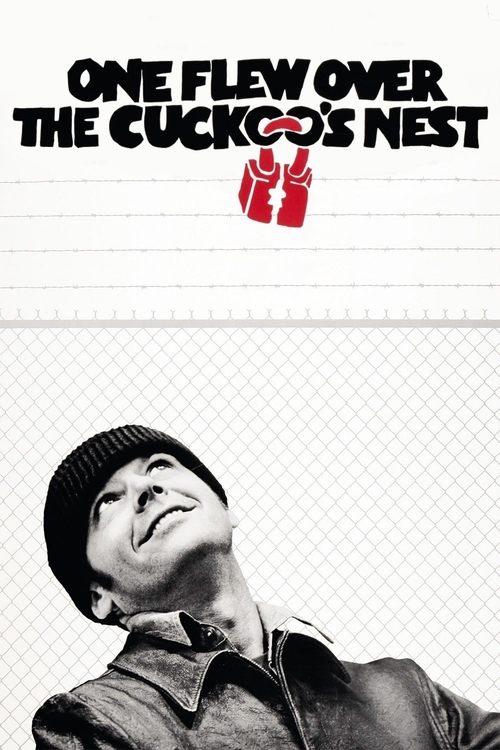
One Flew Over the Cuckoo's Nest
1975 · Miloš Forman
For when you want a stone-cold classic that earns the title — a film that entertains you the whole way and then hits you where it hurts. Emotionally heavy by the end; save it for a night you can sit with it.
What it's about
A fast-talking petty criminal fakes insanity to ride out his sentence in a mental hospital instead of a prison work farm. Inside, he finds a ward of men ground down into obedience and a soft-spoken head nurse whose control over them is absolute — and he can't help turning the place into a battleground. What starts as a con becomes a war of wills over what the patients are allowed to want.
The experience
Rowdy and genuinely funny for long stretches, then quietly devastating — the humor keeps disarming you so the institutional cruelty lands harder. Few films swing you from laughter to heartbreak with this much force.
Performances
Jack Nicholson's McMurphy is one of the great screen performances — all reckless charisma and animal vitality — and Louise Fletcher's chillingly calm Nurse Ratched is the perfect immovable object; both won Oscars, and the ensemble around them feels startlingly real.
The craft
Miloš Forman shot inside a working Oregon psychiatric hospital and directs the ensemble with a documentary looseness that makes the ward feel inhabited, not designed. The faces do the work: he holds on reactions, letting group-therapy scenes play like live combat. It's filmmaking that hides its own craft completely.
Why it matters
It swept all five major Academy Awards — only the second film ever to do so — and Nurse Ratched became cultural shorthand for institutional cruelty; it remains a cornerstone of 1970s American cinema.
Snapshot
Miloš Forman's adaptation of Ken Kesey's 1962 novel is one of the defining works of New Hollywood: a film that weaponizes institutional setting against heroic individualism, deploys an ensemble of largely unknown supporting actors to unsettling documentary effect, and arrives at a tragic catharsis that transcends its countercultural moment. Shot almost entirely inside a working psychiatric facility in Salem, Oregon, One Flew Over the Cuckoo's Nest swept all five principal Academy Awards — Picture, Director, Actor, Actress, and Screenplay — becoming only the second film in history to accomplish that, after Frank Capra's It Happened One Night (1934). Its cultural reach is proportionally enormous: Nurse Ratched has entered the language as a synonym for bureaucratic sadism, and R.P. McMurphy stands among the great rebel archetypes in American cinema.
Industry & production
The film's road to production is inseparable from the Douglas family. Kirk Douglas purchased the rights to Kesey's novel shortly after publication and starred in a Broadway stage adaptation in 1963–64; he spent over a decade attempting to mount a film version, accumulating rejections from studios reluctant to finance a story set in a mental ward. In the early 1970s Douglas passed the rights to his son Michael, who partnered with record producer and independent impresario Saul Zaentz to co-produce. The Zaentz/Douglas collaboration financed the film outside the studio system proper — United Artists acquired North American distribution rights — giving Forman and his collaborators an unusual degree of creative autonomy.
The decision to cast Jack Nicholson as McMurphy came after Burt Reynolds, James Caan, and Gene Hackman were all reportedly considered or passed on the role; Nicholson was by 1975 an established New Hollywood figure following Five Easy Pieces (1970) and Chinatown (1974), and his casting proved commercially and artistically essential. Louise Fletcher, cast as Nurse Ratched after Anne Bancroft and others were approached, was a relatively obscure television actress, which served Forman's preference for faces that did not carry star mythology. Brad Dourif, also largely unknown, was cast as the fragile, stammering Billy Bibbit and received an Academy Award nomination for Supporting Actor.
The production secured access to the Oregon State Hospital in Salem — a functioning institution — and superintendent Dr. Dean Brooks gave his cooperation, ultimately playing the film's lead psychiatrist, Dr. John Spivey. Several actual patients of the hospital appear in the ward scenes, a fact Forman was open about and which contributed materially to the film's unsettling authenticity. The supporting ensemble — Will Sampson, Danny DeVito, Christopher Lloyd, Vincent Schiavelli, Sydney Lassick — was chosen with an eye for physiognomic and behavioral specificity rather than conventional casting.
Technology
One Flew Over the Cuckoo's Nest is not a film defined by technological novelty but by the purposeful deployment of then-standard tools in the service of documentary realism. Filming inside a real institution with existing corridors, low ceilings, and institutional lighting constrained the cinematography in ways that became expressive choices. Lightweight handheld cameras, associated with the Direct Cinema and cinéma vérité traditions that had shaped both Forman's Czech work and American documentary of the 1960s, allowed the camera to move among actors without the apparatus of a studio production. The production used 35mm with lenses and stock suited to available-light interiors, avoiding the over-lit cleanliness typical of Hollywood institutional drama.
The sound design leans heavily on ambient diegetic noise — the ward's perpetual hum of institutional machinery, the game-show chatter of the television set — as environmental oppression rather than scored mood-setting. Jack Nitzsche's sparse score reinforces rather than supplements this approach, leaving long passages entirely free of non-diegetic music.
Technique
Cinematography
Haskell Wexler, a cinematographer closely associated with politically engaged American cinema (Medium Cool, 1969; Bound for Glory, 1976), served as director of photography. Wexler's approach emphasizes a muted, naturalistic palette that strips the ward of any glamour or romanticism: the green-and-gray institutional color scheme is reproduced faithfully, with no corrective warmth. Close-ups are used judiciously to register micro-expressions — particularly Fletcher's controlled neutrality — while medium and wide shots establish the spatial dynamics of power within the ward. The fishing-trip and basketball sequences, shot on location away from the hospital, introduce a different visual register: open space, natural light, and a looser, more expansive framing that codifies freedom against enclosure without resorting to heavy-handed visual metaphor.
Editing
The film was edited by a team of three — Richard Chew, Lynzee Klingman, and Sheldon Kahn — reflecting the collaborative, iterative nature of the cut. The editing rhythm is largely classical in its construction of scenes but shaped by an attention to behavioral duration: actors are allowed to finish gestures, to pause, to inhabit silence in ways that studio editing convention would truncate. Group scenes in the ward are assembled to distribute attention across the ensemble without hierarchizing around the star; the camera and cut are as willing to rest on a secondary patient's reaction as on Nicholson's performance. The pacing accelerates decisively in the film's final act, the editing tightening as institutional violence escalates.
Mise-en-scène / staging
Forman's staging throughout is governed by the architecture of enclosure. The ward is a world of sightlines — Nurse Ratched's glass-windowed station allows perpetual surveillance, the arrangement of chairs in group therapy enforces compulsory visibility — and Forman exploits the actual spatial geometry of the Oregon State Hospital rather than constructing something analogous. Actors are staged in clusters and rows that echo institutional furniture: the ward's geometry disciplines the body and the camera both. Against this, McMurphy's transgressions are choreographed as spatial violations — he vaults the nursing station, he breaks the routine's spatial logic — and these moments read as physically, not merely symbolically, liberatory.
Sound
The ward's sound environment is relentless and deliberately oppressive. The nurses' station speaker, through which Ratched addresses the ward, functions as a disembodied voice of institutional authority; the television is a narcotic drone. Forman and sound designer use silence strategically — group therapy sessions are punctuated by uncomfortable silence that the film does not rescue — and the final act culminates in a scream, Nicholson's elemental howl of grief, that ruptures the film's careful quietism. Nitzsche's score, where it enters, uses Indigenous American musical elements in conjunction with Chief Bromden's arc, though this choice reads uncomfortably within contemporary critical frameworks given questions of appropriation.
Performance
Forman's direction of actors draws on his Czech New Wave practice of working with non-professionals alongside trained actors to produce behavioral unpredictability. His approach with the ensemble in Cuckoo's Nest is essentially that of an extended repertory experiment: cast in residency at the hospital, actors spent time with actual patients, participated in group therapy sessions, and built behavioral vocabularies from observation. The result is an ensemble whose idiosyncrasies feel accumulated rather than performed. Nicholson's McMurphy is large, mercurial, and precisely calibrated — the performance is technically demanding in its shifts between charm and fury — while Fletcher's Ratched achieves something rarer: authority communicated almost entirely through stillness, posture, and the modulated voice. Will Sampson, a Creek Nation artist with no prior significant acting experience, grounds Chief Bromden in a physical and emotional authenticity that a trained actor might have overdetermined.
Narrative & dramatic mode
The screenplay by Lawrence Hauben and Bo Goldman departs significantly from Kesey's novel in one structurally decisive respect: the film reassigns the narrative center of gravity from Chief Bromden — the novel's first-person narrator, whose hallucinatory consciousness frames and filters everything — to McMurphy. The effect is both a commercial accommodation (the star vehicle demands protagonist legibility) and a thematic shift: where Kesey's novel is deeply interior, exploring the nature of perception and sanity from inside a compromised consciousness, the film is predominantly behaviorist, reading institutional power through action and confrontation rather than phenomenological distortion.
The dramatic mode is tragicomic: the first half operates with considerable energy and dark humor, McMurphy's gambits producing a rhythm of defiance and containment that reads almost as farce. The second half pivots toward tragedy with deliberate, escalating weight. The comic-tragic modulation is managed cleanly, without the jarring tonal discontinuity it risks, because the institutional logic that underlies the comedy is always present as menace.
Kesey publicly and consistently disowned the film, reportedly never watching it, objecting to the excision of Bromden's perspective and what he saw as a simplification of the novel's critique. His disavowal is part of the film's reception history but does not diminish it as an independent work.
Genre & cycle
The film belongs to a loose cycle of early-1970s American films structured around the individual's collision with institutional or bureaucratic systems: MASH (1970), Catch-22 (1970), The Last Detail (1973), and Dog Day Afternoon (1975) share its interest in the mechanisms of control and the costs of non-conformity. Within this cycle, Cuckoo's Nest is the most schematic — its allegory is unusually transparent — but also the most emotionally amplified. The psychiatric hospital is a legible analog for any total institution (prison, military, corporation), and the film was widely received as both a specific critique of psychiatric power and a broader allegory for American social conformity in the Nixon-and-after era.
It does not belong straightforwardly to horror, though it operates with horror's dread of confinement; nor to the prison film proper, though it shares structural features. It is most precisely a drama of domination and resistance organized around an ensemble.
Authorship & method
Miloš Forman (1932–2018) arrived in Hollywood with a fully formed aesthetic developed across a decade of Czech cinema. His early features — Loves of a Blonde (1965), The Fireman's Ball (1967) — are comedies of social embarrassment and institutional dysfunction built from non-professional casts and improvisation-adjacent methods, shot with a sociological eye for the absurdity of collective life under bureaucratic socialism. He emigrated to the West after the Soviet-led suppression of the Prague Spring in 1968; his Taking Off (1971) is an undervalued American debut, but Cuckoo's Nest was his full American arrival. His Czechoslovak experience of life under a system that pathologized dissent gave him a particular affinity for Kesey's material that no American director of the period could have brought to it with quite the same experiential charge — though Forman was characteristically modest about this biographical reading of the film.
Haskell Wexler's cinematography carries the political and documentary commitment of his broader career. Jack Nitzsche, composer and arranger previously associated with Neil Young and the Rolling Stones, brought an unconventional sensibility to the score. The three-editor team reflects both the density of the footage and the complexity of managing an ensemble film in the cutting room. Bo Goldman, who co-wrote the script with Lawrence Hauben, would go on to script Melvin and Howard (1980), consolidating a career in humanist character drama.
Movement / national cinema
One Flew Over the Cuckoo's Nest is a New Hollywood film in the strictest sense: independently financed outside the major studio system, directed by a foreign-born auteur, operating with freedoms — in subject matter, in the representation of sexuality, in the frank treatment of institutional violence — that the pre-1960s production code would not have permitted. It sits alongside Chinatown, Nashville, and Dog Day Afternoon as one of the period's most fully realized works.
At the same time, Forman's sensibility is not reducible to New Hollywood. His Czech New Wave inheritance — its interest in collective rather than individual behavior, its documentary-adjacent methods, its skepticism about heroism and institution alike — inflects Cuckoo's Nest in ways that distinguish it from the work of his American contemporaries. The film is less aesthetically self-conscious than Altman, less mythologically invested than Coppola; it is more ethnographic, more behaviorally patient, more interested in the ensemble than the star.
Era / period
The film was released in November 1975, deep in the decade that produced, after Vietnam and Watergate, a pervasive American cultural skepticism about authority and institutional life. Deinstitutionalization was an active policy debate in American mental health: the Community Mental Health Act of 1963 had set in motion a long movement away from large residential psychiatric facilities, a movement that was simultaneously a civil liberties advance and (as implemented) a social catastrophe. One Flew Over the Cuckoo's Nest arrives at the midpoint of this history — romanticizing a resistance to psychiatric confinement that had real-world correlates in the anti-psychiatry movement (R.D. Laing, Thomas Szasz) while depicting institutional violence with enough specificity to function as political critique.
Themes
The film's organizing tension is individual autonomy against the managed, therapeutic administration of conformity. Nurse Ratched does not employ overt violence as her first instrument; she employs shame, group pressure, the medicalization of deviance, and the strategic deployment of sympathy to enforce submission. This makes her power more insidious and the film's critique more precise than a simple tyranny narrative would permit: the ward operates through techniques that are recognizably therapeutic — group talk, medication, behavioral expectation — and the film's horror is that these techniques are wielded as control.
McMurphy's arc is the tragedy of a rebel who misreads the nature of the system he is fighting. He treats the ward as a negotiable social space — a prison where good behavior earns early release — and discovers too late that it is a total institution. His charisma and vitality become resources that the institution can absorb and ultimately destroy.
Chief Bromden's trajectory shadows and inverts McMurphy's: where McMurphy is destroyed, Bromden is liberated. The Chief's final act — lifting the hydrotherapy panel and escaping through the window — enacts the film's only unambiguous affirmation of freedom, and it is made possible by McMurphy's sacrifice. The film's politics are thus simultaneously optimistic (resistance produces possibility) and tragic (resistance is punished with annihilation).
Masculinity is a constant sub-theme: the ward's population is predominantly male, their dysfunction coded in terms of failed or suppressed masculine agency, and McMurphy's therapeutic method is an aggressive masculinism — sports, sexuality, risk — that is as much restoration of male confidence as political resistance. This dimension of the film sits uneasily within contemporary gender-critical frameworks, and the representation of Nurse Ratched as castrating feminine authority has been critiqued as misogynistic subtext.
Reception, canon & influence
Critical reception: The film was received as a major work on release, though critical responses were not uniformly celebratory. Some critics noted the simplification of Kesey's source and the film's tendency toward allegory; others found the ensemble work transformative and the direction precisely controlled. Its commercial success was enormous — one of the top-grossing films of 1975 — and the Academy's recognition at the following year's ceremony was unprecedented in the sound era for a non-blockbuster. Time has confirmed the film's canonical status; it appears consistently in major critical rankings and on AFI lists.
Influences on the film (backward): Kesey's novel is the primary source. Forman's Czech New Wave experience — particularly the methods of Miloš Forman and his collaborators at the FAMU film school tradition — provides the directorial approach. Italian neorealism's interest in social environment and non-professional performance is a more distant ancestor. The American Direct Cinema tradition (Frederick Wiseman's Titicut Follies, 1967 — itself a documentary set in a Massachusetts facility for the criminally insane — is a specific precursor in its observational approach to psychiatric institutions) informs the visual method.
Legacy / what it shaped (forward): One Flew Over the Cuckoo's Nest reshaped the cultural image of the psychiatric institution for at least a generation of filmmakers and audiences. Nurse Ratched became such a dominant archetype that Ryan Murphy's prequel series Ratched (2020) was produced as prestige television four and a half decades later, attesting to the character's persistent grip on the cultural imagination. The film's ensemble methods — patient, behaviorally attentive, ensemble-centered — can be traced in subsequent American films that take institutional environments as their setting, from Girl, Interrupted (1999) to The Perks of Being a Wallflower (2012). More broadly, McMurphy's archetype — the charismatic rebel who humanizes a stigmatized or marginalized group at the cost of his own destruction — has been refracted through dozens of subsequent films and television narratives. Forman himself drew on the film's methodological lessons for Amadeus (1984), his next major award-winning work, though in a wholly different register.
A Deleuzian reading
Start with a pane of glass.
The full Deleuzian reading of One Flew Over the Cuckoo's Nest →
Reception
No reappraisal needed — it swept the 'Big Five' Oscars and was a box-office phenomenon on release, and it's never really left the canon. The shift is in how we read it: modern viewers debate its portrayal of mental illness and of Nurse Ratched far more than 1975 audiences did.
How One Flew Over the Cuckoo's Nest was received, from release to now →
Influences: the films it descends from and the films it influenced
- Loves of a Blonde (1965) — Forman's first feature to cast non-professional provincial actors in an ensemble and build scenes through behavioral duration rather than dramatic incident — the exact method he scales to the Oregon State Hospital ensemble a decade later.
- Closely Watched Trains (1966) — Menzel calibrates the same tragicomic tonal register Forman inherits: behavioral observation of a passive protagonist navigating institutional authority, resolved by a sudden irreversible act of resistance that reframes the preceding comedy as tragedy.
- The Firemen's Ball (1967) — Forman casts actual firemen and local villagers, lets behavioral improvisation generate tragicomic rhythm, and uses a community institution as the stage for collective humiliation — the direct structural template for the ward as social microcosm.
- Titicut Follies (1967) — Wiseman's available-light handheld footage shot inside Bridgewater State Hospital with actual patients as subjects established that a functioning psychiatric institution and its real inmates could constitute the material of serious cinema — Forman follows this precedent directly at Oregon State.
- Medium Cool (1969) — Wexler's own feature as director demonstrates his handheld available-light political cinema in its fully developed form — ambient location noise instead of scored atmosphere, available-light interiors stripped of studio warmth — the same method he then applies as Cuckoo's Nest's DP.
- The Last Detail (1973) — Ashby places Nicholson's behavioral method against an institutional-escort framework — Navy regulations, chain of command, confinement — and discovers the tragicomic potential of a rebel performing against bureaucratic authority; it is the direct precursor to Nicholson's McMurphy mode.
- A Woman Under the Influence (1974) — Cassavetes establishes behavioral duration as a dramatic unit — extended takes following actors through psychological states rather than scripted beats — and uses psychiatric hospitalization as the institutional axis of domestic power; Forman inherits both the editing rhythm and the psychiatric frame one year later.
- Cool Hand Luke (1967) — Forman's democratic ensemble staging of institutionalized men around a Christ-figure rebel — the camera giving equal weight to the ward community's faces as to McMurphy's performance — directly extends Rosenberg's road-gang ensemble arrangement; the Christ-typology of a charismatic rebel who is broken by the institution specifically because he cannot stop inspiring others is structurally identical to Luke's.
- King of Hearts (1966) — Inherits the 'the inmates are the only sane ones' premise, casting the asylum as a truer society than the rationalized authority outside its walls.
- Shock Corridor (1963) — Extends the ward-as-national-microcosm structure, populating the institution with an ensemble of emblematic inmates standing for the body politic.
- Brute Force (1947) — Transposes Munsey to Nurse Ratched — confinement as totalitarian microcosm ruled by a soft-spoken, procedurally 'reasonable' sadist — carrying Brute Force's institution-as-fascism allegory into the asylum.
- Frances (1982) — Clifford deploys psychiatric institutionalization as the spatial and narrative mechanism through which a non-conforming woman is punished — transposing Cuckoo's Nest's architecture of enclosure to a female subject with the same anti-institutional argument that the state pathologizes dissent rather than treats illness.
- Full Metal Jacket (1987) — The boot-camp first half structurally replicates the Ratched/McMurphy dynamic: a sadistic authority figure enforces conformity through spatial surveillance and ritualized group humiliation, systematically breaking a charismatic individualist within a closed world of oppressive sightlines.
- Awakenings (1990) — Marshall casts actual neurological patients alongside professional actors, uses behavioral duration to observe patient states in real time, and deploys the diegetic ambience of a functioning hospital ward as environmental texture — directly extending Forman's documentary-inflected institutional method.
- The Shawshank Redemption (1994) — Darabont transposes the anti-institutional protagonist/ensemble-inmates/surveillance-architecture structure to a prison setting, inheriting Cuckoo's Nest's tragicomic modulation — darkly comic resistance giving way to tragedy — and its editorial distribution of attention across secondary ensemble figures.
- Girl, Interrupted (1999) — Mangold returns the template explicitly to its psychiatric setting — an ensemble of female patients navigating an authority figure whose sanity is contestable — replicating Forman's diegetic institutional ambience and ensemble-distributed editing to generate the ward's claustrophobic social ecology.
- Twelve Monkeys (1995) — The psychiatric institution as the irresolvable site where exceptional perception and clinical psychosis cannot be distinguished from within, combined with research-based method performance establishing behavioral authenticity in mental illness portrayal, sets the template Brad Pitt and the production directly built upon.
- Elling (2001) — Sources its institutional ensemble from a stage play and builds comedy from rehabilitation and contrasting physicality (verbal instigator vs. large silent companion), the McMurphy/Chief dyad prefiguring Elling/Kjell Bjarne.
- The Fisher King (1991) — Pioneers the sympathetic, non-clinical screen treatment of madness as resistance to an oppressive rational order rather than pathology to be cured.
- Brainstorm (2001) — Established the ward-as-carceral-machine dramaturgy — the individual crushed by institutional power, the chemically pacified chorus of inmates — that Brainstorm transposes to a Brazilian clinic, down to the sedation-into-docility arc.
- Man Facing Southeast (1987) — Supplies the asylum-as-microcosm template — the group-therapy circle, the ward routine as staging grid, and the charismatic patient whose serenity destabilizes institutional authority until the institution erases him.
- Miracle in Cell No. 7 (2013) — Codifies the single-institution ensemble of comic misfit inmates who rally around one outsider, mixing broad group comedy with an institutional-tragedy turn.
- Risky Business (1983) — Richard Chew's editorial method here — holding a take well past the point where a conventional comedy would cut, so rhythm comes from performance duration and not from the joke's assembly — is the same principle he applies to Risky Business's comic-timing-by-duration.
- Nashville (1975) — Altman's editing refuses to privilege any single performer over the ensemble, distributing screen attention across 24 characters through a logic of behavioral surveillance; Cuckoo's Nest applies the identical ensemble-distribution principle within the single closed world of the ward.
- Bound for Glory (1976) — Haskell Wexler as DP in consecutive years applies identical available-light handheld technique and muted naturalistic palette — the period's benchmark for politically engaged American cinematography — making the two films a direct cross-section of Wexler's working method.
- Short Eyes (1977) — Young shoots inside an actual New York City detention facility with former inmates as non-professional actors, reproducing Forman's institutional-location and real-subject casting strategy; the ensemble behavioral dynamics within a closed institutional space are structurally identical.
- Being There (1979) — Forman's patient wide shots hold the gap between what McMurphy IS and what different institutional observers NEED him to be — the same dramatic engine structuring Chance, with sustained framing used to keep that gap open rather than resolve it through psychological close-up.
- Equus (1977) — Same post-counterculture anti-psychiatry argument dramatized: institutional 'normality' as the disease and madness as suppressed vitality, the very inversion Dysart confesses to envying.
Similar films
- Full Metal Jacket (1987) — influence & lineage · same viewing thread
- Nashville (1975) — influence & lineage · often watched together
- A Woman Under the Influence (1974) — influence & lineage · often watched together
- Awakenings (1990) — influence & lineage
- Cool Hand Luke (1967) — same viewing thread · often watched together
- Catch-22 (1970) — same viewing thread
- The Bridge on the River Kwai (1957) — same viewing thread
- Shock Corridor (1963) — same viewing thread
All the films related to One Flew Over the Cuckoo's Nest →
Watch it with: curated runs of related films
- Discipline and Defiance — A run of men pitted against total institutions — prisons, wards, camps, the state — where the only freedom left is refusing to break.