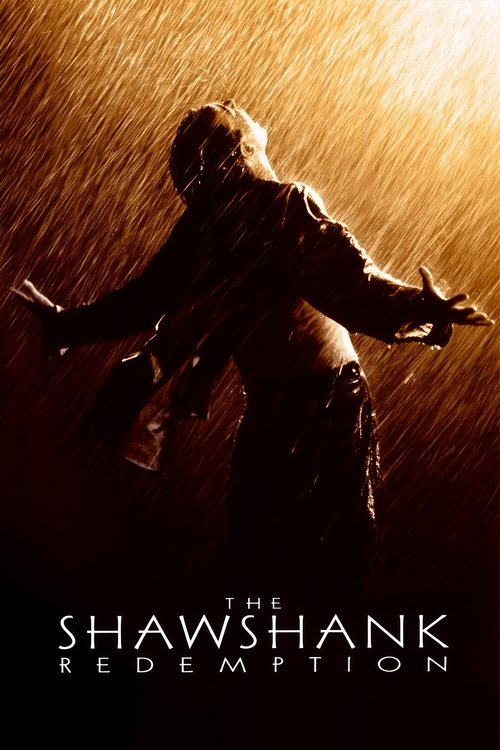
The Shawshank Redemption
1994 · Frank Darabont
For when you need to believe things can get better — a good cry and a lift in the same evening. One of the great comfort rewatches, and an easy film to hand to almost anyone.
What it's about
In the 1940s, a mild-mannered banker is convicted of murdering his wife and her lover and sentenced to life at Maine's brutal Shawshank prison. Over two decades inside he builds an unlikely place for himself — running the warden's books, building a library, and forming a deep friendship with Red, the inmate who can get you anything — while refusing to let the walls decide who he is.
The experience
Patient, warm, and quietly gripping — it takes its time the way a long friendship does, with real brutality along the way, and it builds to one of the most satisfying emotional payoffs in movies. Few films are this openly about hope without going soft.
Performances
Morgan Freeman's narration and easy gravity as Red are the soul of the film — it's the role people still hear his voice by — and Tim Robbins plays Andy with a stillness that keeps you guessing what's going on behind his eyes for two decades of story.
The craft
Frank Darabont adapts Stephen King's novella with classical patience, letting detail accumulate until the emotion is earned rather than demanded. Roger Deakins's cinematography gives the prison real weight and the rare open sky real meaning, and Thomas Newman's score has been imitated ever since.
Why it matters
A box-office disappointment that found its audience on video and television and grew into one of the most beloved films ever made — it has sat at or near the top of audience-voted greatest-film lists for decades.
Snapshot
An adaptation of Stephen King's 1982 novella Rita Hayworth and Shawshank Redemption, Frank Darabont's debut feature is a prison drama in the classical mold: slow in its accumulation of detail, unashamed in its moral architecture, anchored to a friendship between two men who can barely afford hope. Andy Dufresne, a banker convicted of a double murder he may not have committed, arrives at Maine's Shawshank State Penitentiary and over nearly two decades becomes a quiet legend — running the warden's illicit accounts, building a prison library, boring a tunnel behind a succession of pinup posters. The film is told almost entirely through the eyes of "Red" Redding, the contraband dealer who becomes Andy's closest friend and, eventually, his confessor. What seems like a naturalist prison study gradually reveals itself as a fable about the irrepressible persistence of the human spirit — a reading the film earns rather than simply announces. Shot in the disused Ohio State Reformatory, lit by Roger Deakins, scored by Thomas Newman, and edited by Richard Francis-Bruce, The Shawshank Redemption was a commercial disappointment in its initial release before becoming, through the alchemy of home video and cable television, one of the most widely seen and deeply beloved films in American cinema.
Industry & production
King's "Different Seasons" (1982) collected four novellas, none of them supernatural horror. Two had already been adapted by the time Darabont approached: Rob Reiner's Stand By Me (1986) had proven that King's quieter register could support prestige cinema. Frank Darabont, then primarily known as a genre screenwriter (A Nightmare on Elm Street 3, The Blob, The Fly II), acquired rights to the Shawshank story from King for a nominal fee — King, famously generous with emerging filmmakers, had established a pattern of low-cost licensing to writers and directors he believed in. Darabont completed a screenplay and was subsequently approached by Rob Reiner, who reportedly offered a substantial sum for the material on the condition of directing it himself; Darabont declined, choosing directorial control over financial security. Castle Rock Entertainment, Reiner's production company, backed the film anyway, with Niki Marvin producing. Columbia Pictures handled domestic distribution.
Principal photography was conducted primarily at the Ohio State Reformatory in Mansfield, Ohio — a Romanesque Revival structure that had ceased operations as a correctional facility in 1990 and whose architectural grandeur lent the film a visual weight no purpose-built set could have supplied. The production also shot at various Ohio locations. The reformatory's stone walls, vaulted corridors, and vast cell blocks give Shawshank its physical authenticity and its oppressive scale. The film's production budget was approximately $25 million, modest for a studio drama of its ambition.
Technology
The Shawshank Redemption was shot on 35mm with anamorphic lenses, a conventional choice that suited both the film's period setting and Roger Deakins' preference for optical rather than digital manipulation. Deakins used the widescreen frame to embed characters within architectural environments — the prisoners perpetually dwarfed by stone, steel, and institutional geometry. No significant special effects were employed; the technology is entirely in service of naturalistic rendering. The film predates digital color grading; Deakins' palette was achieved photochemically, through careful management of light sources and film stock, producing warm amber tones for flashbacks and muted, greenish-gray for Shawshank's interiors.
Technique
Cinematography
Roger Deakins received an Academy Award nomination for his work here, and Shawshank remains one of the central texts in any account of his career. The film opens with an alternating sequence — Andy drinking in a car at night, the couple inside the cottage, the courtroom — cut together in a way that compounds guilt and doubt before a single line of dialogue is heard. Darabont and Deakins then stage the arrival at Shawshank as a spectacle of institutional magnitude: Andy and his cohort descend from a bus into a yard framed in wide shot, the reformatory towers looming behind them, the guards a gauntlet of shadow. This establishing grammar — the human figure made small against stone — persists throughout.
Deakins is careful to modulate the film's visual temperature across its temporal span. Early prison scenes feel cold and flat; as years pass and Andy's influence within Shawshank grows, light enters more readily. The famous sequence in which Andy locks himself in the warden's office and broadcasts a Mozart aria over the public address system is shot with a quality of diffuse, almost celestial light, as if the institution itself were momentarily transfigured. The tunnel escape sequence, by contrast, is lit with almost clinical darkness — tactile and claustrophobic. The closing scene on the beach in Zihuatanejo is the film's brightest image, earned by contrast against everything that preceded it.
Editing
Richard Francis-Bruce's editing is one of the film's quieter achievements. The cut runs approximately 142 minutes and never appears to rush or loiter: Francis-Bruce maintains a tempo calibrated to the film's long temporal arc, allowing scenes to breathe without losing propulsive momentum. The film uses match cuts and dissolves to compress years of prison time, and its transitions between Andy's interiority — which we never directly access — and Red's narrated observations require delicate management of point-of-view. The intercut structure of the opening court sequence, and the slow-build cross-cutting of Andy's escape against the warden's oblivious morning routine, display an editorial intelligence that sustains tension across significant stretches of screen time.
Mise-en-scène / staging
Darabont stages Shawshank with a classicist's attention to threshold and enclosure. Doors, bars, fences, and windows recur as framing devices — the film's geometry is consistently one of containment punctuated by rare openings. The cell is filmed as both cage and, gradually, as a private space Andy has slowly made his own. The staging of authority figures — the warden, Captain Hadley — places them in elevated or frontal positions; prisoners are filmed in groups, individuated only as trust and narrative focus accumulate. The rooftop beer-drinking sequence, one of the film's iconic setpieces, is notable for staging prisoners in a relaxed horizontal spread against an open sky — a visual grammar of temporary freedom that contrasts directly with every other exterior in the film.
Sound
Thomas Newman's score, built on acoustic guitar, woodwinds, and understated orchestration, is one of the defining sounds of 1990s prestige American cinema. Newman avoids the melodramatic swells the material might have invited; his recurring themes are contemplative and slightly melancholic, supporting emotional weight without overwriting it. The use of diegetic music — the Mozart duet from The Marriage of Figaro, broadcast across the yard — is among the film's most carefully considered choices, the aria's freedom and beauty made more acute by its institutional context. Sound design in the prison sequences emphasizes concrete echoes and institutional ambiance: the particular acoustic of Shawshank, established early, becomes a character in itself.
Performance
Tim Robbins plays Andy Dufresne with studied restraint, calibrating his performance to a character the audience is never fully permitted to know. By filtering the narrative through Red's perspective, Darabont ensures that Andy remains at a slight remove — competent, calm, occasionally unknowable — which Robbins manages by underplaying rather than dramatizing. Morgan Freeman's performance as Red is the film's emotional center: the voiceover narration, gravelled and unhurried, carries the weight of a man who has spent decades learning to expect nothing. Freeman inflects Red's gradual recognition of what Andy represents with a care that never collapses into sentiment. The supporting ensemble — Bob Gunton as the scripture-quoting, corruption-practiced Warden Norton; Clancy Brown as the brutal but psychologically legible Captain Hadley; James Whitmore as the institutionalized librarian Brooks Hatlen — provides the film with a credible social world rather than mere atmosphere.
Narrative & dramatic mode
Shawshank operates in a mode that might be called the literary melodrama of endurance: its protagonist's arc is one of steadfast, nearly superhuman persistence rather than transformation. Andy does not fundamentally change across the film's nearly twenty-year span; he maintains his integrity, his plans, his hope. What develops is the audience's — and Red's — understanding of who he is. This narrative structure, in which the true protagonist is the narrator observing the central figure rather than the central figure himself, aligns Shawshank with first-person literary fiction (Nick Carraway watching Gatsby; Ishmael watching Ahab) more than with classical three-act screenplay architecture. Darabont preserves King's novella structure largely intact, including its epistolary closing movement — Andy's letters reaching Red across the postcard landscape.
The film maintains dramatic tension through a pattern of hope extended and deferred: each small liberation (the beer on the roof, the library expansion, the Mozart broadcast) is followed by institutional violence or setback. The murder of Tommy Williams — the film's most brutal plot turn — arrives precisely when genuine legal exoneration seems possible, which makes it devastating rather than merely tragic.
Genre & cycle
The Shawshank Redemption belongs to a tradition of American prison drama stretching from I Am a Fugitive from a Chain Gang (1932) through Brute Force (1947) and Cool Hand Luke (1967). Where earlier prison films frequently operated as social critique — the institution as indictment of society — Darabont's film is primarily concerned with interior life and moral character: Shawshank is less a critique of the carceral system than a stage on which human resilience is tested. The film emerged alongside a cycle of early-1990s literary adaptations and prestige dramas (The Player, Schindler's List, Remains of the Day, Quiz Show) and sits at an interesting angle to that cycle: less overtly "serious" in its formal ambition than its prestige peers, more committed to accessible emotional legibility.
Authorship & method
Frank Darabont came to Shawshank as a screenwriter who had spent years in commercial genre filmmaking; his commitment to a faithful, character-respecting adaptation of King's novella is evident in both the structural fidelity to King's text and the tonal calibration of the result. Darabont subsequently returned to King for The Green Mile (1999) and The Mist (2007), establishing himself as the primary cinematic interpreter of King's literary rather than horror register.
Roger Deakins, then already regarded as among the finest cinematographers working in English-language film, brought to Shawshank the disciplined naturalism he had developed across the Coen Brothers' Barton Fink (1991) and The Hudsucker Proxy (1994). His contribution here — the management of institutional light across a wide temporal span — is a master class in subordinating cinematographic virtuosity to narrative purpose.
Thomas Newman's score established a sound that Newman himself would revisit in subsequent career work; the acoustic minimalism of the Shawshank score was influential on the prestige drama idiom of the decade that followed.
Movement / national cinema
The Shawshank Redemption is an unreservedly American film — its concerns, its idiom, its setting, and its mythological investment in individual perseverance and reinvention belong to a distinctly American cultural tradition. It falls within no particular movement or school; it is instead a product of the classical Hollywood adaptation tradition, of studio prestige filmmaking, and of a particular strain of American literary sentimentalism that reaches back through King to John Steinbeck and beyond. The film's investment in the figure of the wrongly accused man, and in institutional power as both brutal and corruptible, engages American cultural anxieties that have deep historical roots.
Era / period
1994 is among the most celebrated single years in American commercial cinema. Pulp Fiction, Forrest Gump, Quiz Show, Four Weddings and a Funeral, and The Lion King were its cohort. Shawshank opened in late September and was largely overlooked in a crowded marketplace, earning modest returns before being nominated for seven Academy Awards — including Best Picture, Best Actor (Freeman), Best Adapted Screenplay (Darabont), and Best Cinematography (Deakins) — and winning none. The awards season was dominated by Forrest Gump, and Pulp Fiction's cultural detonation displaced attention from quieter work. The film's second life, achieved through VHS rental and cable television through the mid-1990s, is among the most documented second-chance trajectories in Hollywood history.
Themes
The film's central theme is hope as an act of will rather than circumstance — and specifically, the political economy of hope within structures designed to extinguish it. Andy's maintenance of interiority — his preservation of an inner life the institution cannot reach — is framed as both heroic and, in the film's own terms, practically effective: hope enables patience; patience enables escape. Against this, Brooks Hatlen's institutionalization — his inability to survive outside the prison he has spent decades accommodating himself to — stands as a counterweight, articulating the film's awareness that hope is unevenly distributed and that freedom can arrive too late.
A secondary thematic axis concerns the ethics of complicity. Andy launders the warden's money; the library and protections he secures for himself and his friends are purchased with moral compromise. The film does not dwell on this tension at length, but it does not fully erase it either.
Reception, canon & influence
The Shawshank Redemption received respectful but not ecstatic critical attention on its initial release; its seven Oscar nominations were its primary claim to prestige in the 1994–95 season. The transformation into canonical status was slow and driven by non-theatrical exhibition: VHS rental data from the mid-1990s indicated that the film was among the most frequently rented titles in the United States, and cable broadcasts on TNT extended its audience further. By the late 1990s it had reached the upper reaches of the IMDb user ratings, where it held the top or near-top position for many years — a peculiar form of popular canonization that has no precise equivalent in earlier film history.
Influences on the film (backward): The novella source, and King's non-horror literary voice, are the primary antecedent. Stand By Me (1986) demonstrated that this register of King could be adapted faithfully. The classical prison drama tradition — particularly Cool Hand Luke and Brute Force — informs the film's iconography and its interest in institutional power. The Morgan Freeman first-person literary voiceover owes a debt to Double Indemnity (1944) and the noir tradition of retrospective narration; it also anticipates the subsequent ubiquity of Freeman's voice as a marker of dignity and moral gravity in American cinema.
Legacy (forward): The Shawshank Redemption became a template for the redemption-narrative prestige drama of the late 1990s and 2000s. Its influence is discernible in The Green Mile (which Darabont made explicitly as a companion piece), in subsequent prison dramas that adopted its grammar of small resistances and incremental hope, and in the dominant mode of mass-audience prestige cinema that prizes emotional accessibility alongside literary seriousness. Freeman's voiceover performance established a set of conventions — the retrospective confessional narrator, the figure of accumulated wisdom — that recur throughout subsequent American cinema. The film's trajectory from box office disappointment to canonical beloved object has made it a frequently cited case study in the gap between initial reception and long-term cultural meaning.
A Deleuzian reading
Spring, 1949.
The full Deleuzian reading of The Shawshank Redemption →
Reception
A box-office disappointment in 1994 that went 0-for-7 at the Oscars (losing Best Picture to Forrest Gump), it was resurrected by VHS rentals and endless TNT cable airings into arguably the most beloved film of the decade.
How The Shawshank Redemption was received, from release to now →
Influences: the films it descends from and the films it influenced
- A Man Escaped (1956) — Builds its escape from tactile close-ups of improvised tools, spoons, and probed walls married to a first-person voiceover narrating the prisoner's patient interior calculation — the direct template for Andy's tunneling and Red's narration.
- Cool Hand Luke (1967) — Establishes the prison-yard-as-society staging in which an unbreakable individual's quiet defiance is read through the admiring eyes of fellow inmates, with authority shot as faceless mirrored-shade menace.
- Birdman of Alcatraz (1962) — Supplies the decades-long single-institution arc in which a convict ennobles himself through self-education and patient mastery, carried by Burt Lancaster's restrained, near-motionless underplaying.
- The Great Escape (1963) — Provides the tunnel-digging concealment procedural and the cross-cut breakout sequence that intercuts the escape against captors oblivious to it — the structural model for Andy's escape against the warden's morning routine.
- I Am a Fugitive from a Chain Gang (1932) — Foundational American prison-injustice melodrama that codifies the wrongfully-punished-man escape narrative and the formal indictment of the penal institution itself.
- Brute Force (1947) — Prison-as-fortress mise-en-scène with the sadistic warden/guard-captain as institutional villain and oppressive stone geometry that dwarfs and contains the men within the frame.
- Sunset Boulevard (1950) — Pioneers retrospective first-person voiceover as the film's emotional and structural center, the narration delivered with hindsight that frames every scene as already-completed memory.
- Amadeus (1984) — The observer-narrator who witnesses and frames another man's genius (Salieri/Mozart ≈ Red/Andy), plus the diegetic deployment of Mozart as transcendent rupture — echoed precisely in the broadcast aria.
- To Kill a Mockingbird (1962) — Prestige literary adaptation filtered through warm, nostalgic retrospective narration, earning its moral fable through accumulated naturalist period detail rather than announcement.
- Stand By Me (1986) — Castle Rock's proof that King's non-horror 'Different Seasons' novellas sustain prestige cinema, framed by an adult narrator's retrospective voiceover over a recalled past.
- One Flew Over the Cuckoo's Nest (1975) — Darabont transposes the anti-institutional protagonist/ensemble-inmates/surveillance-architecture structure to a prison setting, inheriting Cuckoo's Nest's tragicomic modulation — darkly comic resistance giving way to tragedy — and its editorial distribution of attention across secondary ensemble figures.
- The Hill (1965) — Prison-as-microcosm sustained on deferred, withheld catharsis and the slow accretion of institutional routine, with the warden as an authority whose performance of order conceals corruption.
- The Green Mile (1999) — Darabont's own reprise of the King prison world — framed retrospective narration, restrained ensemble underplaying, Thomas Newman scoring, and a death-row institution rendered with the same humane photochemical naturalism.
- The Hurricane (1999) — Wrongful-conviction endurance melodrama in which a man preserves dignity across long incarceration through self-discipline and is redeemed by patient outside intervention.
- A Prophet (2009) — The long-arc carceral bildungsroman in which an inmate accrues mastery and power within the institution's internal economy, extending the prison-as-society staging into a darker key.
- House of Sand and Fog (2003) — Deakins' patient, low-key naturalism and his habit of framing characters through doorways and barred thresholds set the visual grammar Perelman's film inherits.
- Meet Joe Black (1998) — Newman's swelling humanist orchestral template — patient, redemptive long lines — that became the late-1990s touchstone the seed's score consciously inhabits.
- Toy Story 3 (2010) — Its patient, methodical breakout mechanics and the benevolent-vs-corrupt authority axis echo directly in TS3's trash-chute-and-dumpster escape choreography.
- American Beauty (1999) — Extends Thomas Newman's minimalist marimba-and-piano scoring method and uses a posthumous retrospective voiceover that locates the emotional center outside the present action.
- Dead Man Walking (1995) — Mid-90s death-row drama built on the same restrained performance register and naturalist institutional light, with Robbins carrying Andy's underplaying into his own directorial framing of confinement.
- The Assassination of Jesse James by the Coward Robert Ford (2007) — Deakins extending his source-motivated photochemical naturalism and observer-narrator-framed legend, the human figure perpetually dwarfed by architecture and landscape.
- The War (1994) — Same-year showcase for Thomas Newman's signature nostalgic-Americana scoring — sustained piano-and-strings figures evoking memory and grace that he applies near-identically to The War.
- The Mist (2007) — Darabont's own King adaptation carrying his thematic signature — institutions, faith, and human decency under pressure — that The Mist deliberately inverts, proving his authorship is thematic rather than tonal by swapping consolation for annihilation.
- In the Name of the Father (1993) — The wrongful-conviction prison drama structured around endurance, faith, and a two-hander male bond inside the cell — the same prison-cell dramaturgy Sheridan invents by placing Gerry and Giuseppe together.
Similar films
- The Green Mile (1999) — influence & lineage · same viewing thread
- Dead Man Walking (1995) — influence & lineage · same viewing thread
- I Am a Fugitive from a Chain Gang (1932) — influence & lineage
- Cool Hand Luke (1967) — influence & lineage
- 12 Angry Men (1957) — same viewing thread · often watched together
- 12 Years a Slave (2013) — same viewing thread · often watched together
- The Hurricane (1999) — influence & lineage · same viewing thread
- Unforgiven (1992) — same viewing thread
All the films related to The Shawshank Redemption →
Watch it with: curated runs of related films
- Judgment and Mercy — Watch these together for the way each puts a life on the scales — a jury room, a death-row block, a slave plantation, a gunfighter's conscience — and asks what mercy costs the people handing down the verdict.