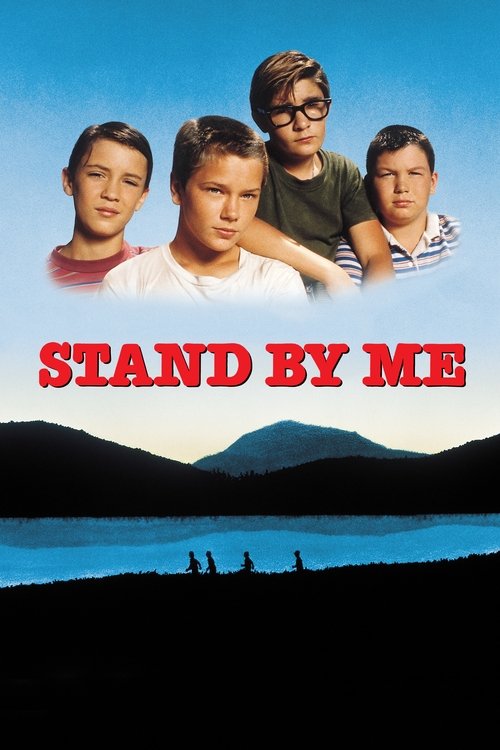
Stand by Me
1986 · Rob Reiner
For when you're homesick for a time in your life, or missing a friend you drifted from — the definitive 'nobody ever has friends like the ones they had at twelve' movie. A warm watch that earns its lump-in-the-throat ending.
What it's about
Oregon, the last weekend of summer, 1959. Four twelve-year-old boys — a bookish kid with writing dreams, his tough loyal best friend, a wild card with a painful home life, and a timid tagalong — hear that the body of a missing boy is lying in the woods miles away, and set out along the railroad tracks to find it. The hike is a lark at first, but between a junkyard dog, a leech-filled marsh, and the things they finally say to each other around a campfire, it becomes the weekend that defines them.
The experience
Funny, foul-mouthed, and talk-driven, then suddenly tender enough to wreck you — it holds nostalgia and grief in the same hand. It feels like remembering your own twelve-year-old summer, even if yours looked nothing like this.
Performances
River Phoenix, as the tough kid everyone's written off, gives one of the great child performances — a campfire confession scene of startling rawness for a young actor. The whole quartet feels like a real friendship, bickering and loyal in equal measure.
The craft
Reiner turns a Stephen King novella into a talk-first character piece: the film lives in the banter, the campfire stories, and a wistful adult narration looking back on it all. Late-summer light, railroad tracks stretching to the horizon, and a jukebox of 1959 radio hits — capped by Ben E. King's title song — give it its permanent golden-hour glow.
Why it matters
A sleeper hit that became the template for the kids-on-an-adventure story and proved Stephen King's non-horror work could make great cinema. Nearly every tale of small-town kids, bikes, and one fateful summer made since owes it something.
Snapshot
Stand by Me is Rob Reiner's adaptation of Stephen King's 1982 novella The Body, a coming-of-age drama framed as the memory of a middle-aged writer recalling a single late-summer weekend in 1959, when he and three friends hiked along railroad tracks to find the corpse of a missing boy. It is one of the defining American films about boyhood friendship, and it occupies an unusual place in King's screen legacy: a tender, talk-driven character piece drawn from a writer better known for horror. Released by Columbia in the summer of 1986 after a small platform opening, it became a sleeper success and lodged itself permanently in the popular memory, helped immeasurably by Ben E. King's titular 1961 single, which the film returned to the charts. Its reputation rests less on incident than on tone — the way it holds nostalgia and grief in the same frame — and on a quartet of child performances that have become a benchmark for the form.
Industry & production
The film was produced by Andrew Scheinman, Reiner, and Bruce A. Evans, with Evans and Raynold Gideon writing the screenplay; it was made for a modest budget (widely reported as roughly $8 million, a figure that should be treated as the commonly cited estimate rather than an audited number). It was Reiner's third feature, following This Is Spinal Tap (1984) and The Sure Thing (1985), and it marked a decisive turn from comedy toward dramatic register. The project carried the early imprint of Reiner's production company Castle Rock Entertainment, which he would co-found the following year and name — pointedly — after the fictional Maine town of King's fiction in which the story is set; the company's logo would later use imagery evoking the film's world. The picture was originally developed under the novella's title, The Body, and retitled to avoid morbid or pornographic misreadings, drawing instead on the song that anchors its emotional climax.
King's involvement was that of source author rather than active collaborator on the production, but his public endorsement mattered: he is widely reported to have called it the first truly successful adaptation of his work, a verdict that helped reframe him in Hollywood as a writer of human stories and not only of genre shocks. The film was shot largely in Oregon — Brownsville and the surrounding Willamette Valley standing in for the fictional Castle Rock, Oregon (Reiner relocated King's Maine setting to the Pacific Northwest) — with additional work near Eugene and at the McCloud River railroad area in Northern California. Marketing was cautious; Columbia platformed the release, letting word of mouth build before widening it, and the strategy paid off in a long, profitable run.
Technology
Stand by Me is a conventionally produced mid-1980s 35mm feature with no notable technical innovation — and that plainness is part of its design. It was shot photochemically in a flat, naturalistic mode that resists the gloss and high-key sheen common to studio product of its moment. There are no opticals-heavy set pieces, no synthesizer-driven sound design; the period setting is built through production design, costume, and a curated catalog of 1950s and early-'60s pop recordings rather than through any image- or sound-processing technology. The film's framing device — an adult writer typing at a then-contemporary 1980s word processor — is one of its few gestures toward the technology of its own production era, and it functions narratively (the act of writing as the act of remembering) rather than as spectacle.
Technique
Cinematography
Thomas Del Ruth's photography is the film's quiet engine. It favors golden, slightly hazy late-summer light, wide compositions that set the four small figures against the open geometry of railroad tracks and forest, and a generally unhurried, classical coverage that trusts the actors. The recurring image — children walking a single-point-perspective rail line that converges at a vanishing point — is both a literal journey and a visual metaphor for time and the future bearing down. Set pieces such as the trestle-bridge crossing, where an oncoming train forces a panicked sprint, are staged for clean spatial legibility and mounting tension rather than for stylistic flourish. The camera tends to sit at the boys' eye level, keeping the adult world (the bullying older teenagers, the indifferent town) at a slight, threatening remove.
Editing
Robert Leighton, Reiner's regular editor, cuts for performance and rhythm. The film's structure is episodic — a series of encounters and campfire conversations strung along the walk — and the editing's task is to modulate between comic digression (the "Lard-Ass" pie-eating story, rendered as an inset fantasy), sudden danger (the train, the leeches, the junkyard dog), and confessional stillness. The inset tall-tale sequence is the film's most overtly constructed passage, shifting register entirely to dramatize Gordie's gift as a storyteller, then snapping back to the campfire. The framing device bookends the narrative, and the cut from the adult writer's screen back into 1959 — and at the close, forward again — gives the whole an elegiac circularity.
Mise-en-scène / staging
The period world is built with restraint: clapboard houses, a diner, a treehouse clubhouse, the detritus of a small logging town. Costume and props do the period work without fetishizing it. Crucially, the staging keeps the four boys in close physical proximity throughout — walking abreast, huddled at the fire, crowded into the treehouse — so that the group itself becomes the film's central object, and the moments when one boy is isolated in the frame (Chris weeping, Gordie alone with the deer) register as ruptures in that closeness.
Sound
The soundtrack is a jukebox of 1950s–'60s American pop, diegetically and non-diegetically deployed, culminating in Ben E. King's "Stand by Me" over the climax and end. Jack Nitzsche's score is spare and largely deferential, ceding emotional space to the song catalog. The sound design privileges naturalism — crickets, the river, the percussive terror of the approaching train — and the film's most charged sound is often the human voice: the boys' overlapping insults and laughter, and the lowered, halting register of their confessions.
Performance
The film lives or dies on its four young leads, and they carry it. Wil Wheaton plays Gordie Lachance, the watchful, grieving writer-to-be, overshadowed at home by a dead older brother; River Phoenix gives Chris Chambers — the loyal, wounded boy marked by his family's bad reputation — a gravity and tenderness that many critics single out as the film's finest work, and which reads now with added poignancy given Phoenix's early death. Corey Feldman's Teddy Duchamp is volatile and damaged, the son of an abusive, institutionalized father; Jerry O'Connell's Vern is the soft, frightened comic ballast. Kiefer Sutherland, as the older bully Ace Merrill, supplies a genuinely menacing adult-world threat. Richard Dreyfuss frames the whole as the adult Gordie in voice-over and brief bookends. Reiner is widely credited with drawing these performances out through extensive rehearsal and trust-building among the boys; the naturalism of their rapport — the insults, the loyalty, the cruelty and care of pre-adolescent friendship — is the picture's signal achievement.
Narrative & dramatic mode
The film is a memory-play and a quest narrative at once. Its external plot — four boys walking to find a body — is a thin armature deliberately subordinated to its internal drama: the gradual exposure of each boy's home wound and the testing of their bonds. The adult-narrator frame establishes the entire story as recollection shadowed by loss, so that the present-tense adventure is always already elegiac; the closing revelation that Chris later died gives the nostalgia its undertow of grief. The mode is confessional and conversational, built on talk rather than action, and its dramatic climaxes are largely verbal and emotional — Chris's breakdown over a stolen-milk-money story, Gordie's grief for his brother — rather than physical, even though the genuinely frightening set pieces (train, leeches, the gun standoff with Ace) punctuate the journey.
Genre & cycle
Stand by Me is a coming-of-age drama and a nostalgic period piece, and it sits within a recognizable 1980s cycle of films looking back at American boyhood — kindred to The Outsiders (1983) in its tender masculinity and to the broader vein of Spielberg-era suburban-childhood cinema, though grittier and sadder than most. Its rail-line quest links it to a long tradition of the boys'-adventure narrative reaching back to Twain. Within the King adaptation cycle it is a deliberate counter-statement: where most King films of the era were horror, this drew on the non-supernatural strain of his writing and helped establish that such material could succeed onscreen, a lineage continued by The Shawshank Redemption (1994) and The Green Mile (1999), both also from non-horror King sources.
Authorship & method
The film is a clear authorial statement for Reiner, who has spoken of its personal resonance and who used it to prove he could direct serious dramatic material after two comedies. His method centered on the children: casting for chemistry and coaxing unguarded, naturalistic performances. The screenplay by Bruce A. Evans and Raynold Gideon is faithful to the spine of King's novella while tightening its structure and softening some of its bleakness; it preserves King's framing conceit of the writer remembering. Thomas Del Ruth (cinematographer) supplied the warm, classical look; Robert Leighton (editor) shaped its episodic rhythm; Jack Nitzsche (composer) provided the restrained score beneath the pop catalog. Source author Stephen King stands behind it all — the autobiographical texture of a small-town writer recalling his boyhood is recognizably his — even as the film's voice is finally Reiner's. The collaboration with Scheinman and the gestation of Castle Rock make this a foundational text for Reiner's most productive period, which would soon yield The Princess Bride (1987) and When Harry Met Sally... (1989).
Movement / national cinema
This is mainstream American studio cinema of the 1980s, unaffiliated with any formal movement. It belongs to a Hollywood tradition of accessible, performance-driven storytelling, and its sensibility — nostalgic, regional, intimate — connects it to an American vein of small-town remembrance running from Twain through mid-century coming-of-age fiction. Its relocation of King's Maine to Oregon is incidental to that Americana; the film's "nation" is less a geography than a mythic late-1950s small-town boyhood already vanishing at the moment it is recalled.
Era / period
The film operates on two temporal planes: the diegetic 1959 of the story and the mid-1980s of its making and framing. The 1959 setting places it on the cusp of the 1960s — the boys' world is pre-Vietnam, pre-counterculture, a last moment of a certain American innocence, which the film both honors and gently undercuts (the casual cruelty, the broken homes, the looming knowledge of mortality). Made in 1986, it is also a document of Reagan-era nostalgia, part of a decade's broad cultural reaching-back toward the 1950s. The friction between the two eras — the adult narrator's hindsight pressing on the children's present — is the source of its emotional power.
Themes
Its central themes are friendship and its impermanence; the loss of childhood innocence and the threshold of adolescence; class and inheritance (Chris and Teddy marked by their families' reputations, fighting to escape a destiny others assume for them); grief and the shadow of death (Gordie's brother, the corpse they seek, Chris's later fate); storytelling as a means of survival and self-definition (Gordie's gift, validated by Chris, framed by the adult writer's act of typing the memory). Above all it is about memory itself — the film's famous closing line, that no one ever has friends again like the ones at twelve, distills its insistence that the deepest bonds are also the most transient. The quest for the body becomes a confrontation with mortality that ushers the boys, unevenly, toward adulthood.
Reception, canon & influence
Reception. The film opened to strong reviews and built into a commercial sleeper over the summer of 1986, with critics praising its emotional honesty, its evocation of boyhood, and especially its young cast; River Phoenix's performance drew particular notice. The screenplay earned an Academy Award nomination for Evans and Gideon, and the film brought Reiner sustained recognition as a serious director. (Specific grosses and awards tallies beyond the screenplay nomination should be confirmed against a reliable database rather than asserted here.) Stephen King's reported enthusiasm for the adaptation became part of its story and reshaped industry perception of his non-horror writing.
Influences ON the film (backward). It draws directly on King's autobiographical novella The Body and, through it, on the long tradition of American boyhood-adventure narrative (the Twain lineage of boys and rivers and rites of passage). Its nostalgic register connects to earlier memory-films and to the period-recreation impulse of late-'70s/early-'80s Americana cinema; The Outsiders (1983) is a frequently cited contemporary kin in its earnest treatment of bonded, vulnerable young men.
Legacy / what it shaped (forward). Stand by Me became a touchstone for the coming-of-age genre, its railroad-track imagery and elegiac voice-over framing widely echoed and parodied; it is regularly cited as a model for ensembles of children navigating a dangerous adult world, a template visible in later nostalgia-driven properties — the period-set, kids-on-bikes mode that Stranger Things and similar works draw on owes a clear debt, as do numerous King-adjacent stories of small-town childhood (the structure resurfaces in the friendship dynamics of It). It helped launch the careers of its young cast and cemented Phoenix's reputation before his death made the film a memorial. It restored Ben E. King's song to cultural ubiquity. And it inaugurated, in spirit, the Castle Rock enterprise and the now-established notion that Stephen King's most durable screen adaptations may be his least supernatural. More than three decades on, it endures as one of American cinema's defining accounts of the friendships of childhood and the grief of outliving them.
A Deleuzian reading
Gordie takes the dawn watch alone.
The full Deleuzian reading of Stand by Me →
Reception
A sleeper hit in the summer of 1986 that critics liked but nobody expected much from — it's since hardened into THE American coming-of-age movie, and River Phoenix's death in 1993 gave every rewatch an elegiac weight the original audience never felt.
How Stand by Me was received, from release to now →
Influences: the films it descends from and the films it influenced
- American Graffiti (1973) — Established the template Stand by Me runs on: a wall-to-wall diegetic period-pop jukebox scoring an episodic, plotless ensemble night, capped by 'where are they now' epilogue text that converts the whole film into a memory-play.
- To Kill a Mockingbird (1962) — Model for the adult-narrator retrospective voice-over framing a child's-eye view of a small town, the frame-narrative bookend in which an aged remembering voice gives the boyhood action its elegiac weight.
- Summer of '42 (1971) — The elegiac adult voice-over recalling one formative summer, scored deferentially beneath the images — the precise nostalgic memory-play register Reiner adopts for the writer-remembering conceit.
- The 400 Blows (1959) — Originated the unguarded child-naturalism — coaxing a real boy rather than a trained actor — and the eye-level framing held at the child's height that Reiner replicated by casting for chemistry over polish.
- The Last Picture Show (1971) — Small-town period ensemble of adolescents shot in plain, classical, unfussy framing with a diegetic radio/pop soundscape standing in for an orchestral score.
- Days of Heaven (1978) — Néstor Almendros's magic-hour/golden-hour photography as the primary emotional register — the warm naturalist light over open landscape that Del Ruth's classical look echoes.
- Breaking Away (1979) — Continues the regional working-class boyhood-ensemble-at-a-threshold film, anchored in a precise sense of place and nostalgic naturalism about the summer everything changes.
- The Sandlot (1993) — Lifts the adult-narrator voice-over recalling a single nostalgic boyhood summer, told as episodic vignettes over a period oldies soundtrack.
- Now and Then (1995) — An explicit gender-flip: the frame narrative of grown friends reconvening to recall the formative childhood summer, set to an oldies jukebox — Stand by Me's structure transposed to girls.
- Mud (2012) — Carries forward the Twain river-quest of boys on the cusp of disillusionment, told through naturalistic Southern light and unforced child-ensemble performance.
- Super 8 (2011) — Revives the period-set kids-on-bikes ensemble facing an adult/military world in eye-level Amblin wonder — a direct synthesis of the Stand by Me child-quest template.
- Stranger Things (2016) — Builds its child-ensemble naturalism and dangerous-adult-world stakes on the kids-on-bikes nostalgia mode, explicitly quoting Stand by Me's walk-the-railroad-tracks staging.
- It (2017) — Reapplies the King small-town child ensemble (the Losers' Club) facing adult menace across a summer-quest structure modeled on the bonded-boys group dynamic.
- Hearts in Atlantis (2001) — Another King adaptation framed as an adult writer returning to remember a pivotal boyhood, deploying the same nostalgic memory-frame and deferential scoring beneath period texture.
- The Shawshank Redemption (1994) — Castle Rock's proof that King's non-horror 'Different Seasons' novellas sustain prestige cinema, framed by an adult narrator's retrospective voiceover over a recalled past.
- The Green Mile (1999) — Reiner's King adaptation established the precise structural device of an adult narrator retrospectively confessing the formative moral trauma of his youth—including the narrator directly addressing the camera at narrative open and close—which Darabont deploys verbatim for elderly Paul Edgecomb's nursing-home framing sequences.
- Almost Famous (2000) — Adult retrospective narrator explicitly reconstructing a defining adolescent journey in past tense, the voiceover framing giving the adult protagonist interpretive authority over what his on-screen younger self couldn't yet understand—the narrative device Almost Famous uses to let William contextualize his 1973 self.
- The War (1994) — Establishes the boyhood-gang adventure structured by retrospective nostalgic narration and a 1950s/60s period childhood treated as an irrecoverable lost eden.
- October Sky (1999) — Memoir-derived first-person nostalgia preserving the writer's documentary authority, staging period boyhood as an ensemble set against an industrial town.
- The Outsiders (1983) — Contemporary kin in its earnest, sun-burnished treatment of bonded, vulnerable young men, built on a golden-hour palette and an ensemble of unproven rising actors.
- E.T. the Extra-Terrestrial (1982) — The eye-level, kids-height framing of a child ensemble navigating a threatening adult world, rendered in suburban-Americana naturalism — the Amblin grammar Reiner shares.
- The Goonies (1985) — A quest-armature treasure adventure carried by a bickering pre-teen ensemble whose overlapping, naturalistic group banter is staged in tight physical proximity.
- Dazed and Confused (1993) — Extends the plotless, episodic period-nostalgia ensemble scored wall-to-wall by a diegetic rock jukebox, structured as drifting vignettes rather than plot.
- Cinema Paradiso (1988) — Reiner frames childhood retrospection through an adult professional storyteller (the writer at his keyboard, encoding loss into language) whose vocation makes the act of remembering itself reflexively visible; both films identify their adult protagonists as makers of narrative — filmmaker, writer — and use that identity to meta-frame the elegy as conscious reconstruction rather than involuntary flashback.
- My Life as a Dog (1985) — Frames an episodic boyhood marked by death through retrospective comparison-voice-over, comedy and anecdote masking grief — the same tragicomic-recollection mode.
Similar films
- It (2017) — influence & lineage · often watched together
- The Outsiders (1983) — influence & lineage
- To Kill a Mockingbird (1962) — influence & lineage
- Dazed and Confused (1993) — influence & lineage
- American Graffiti (1973) — influence & lineage
- The Princess Bride (1987) — often watched together
- The Long Walk (2025) — often watched together
- Au Revoir les Enfants (1987) — often watched together
All the films related to Stand by Me →