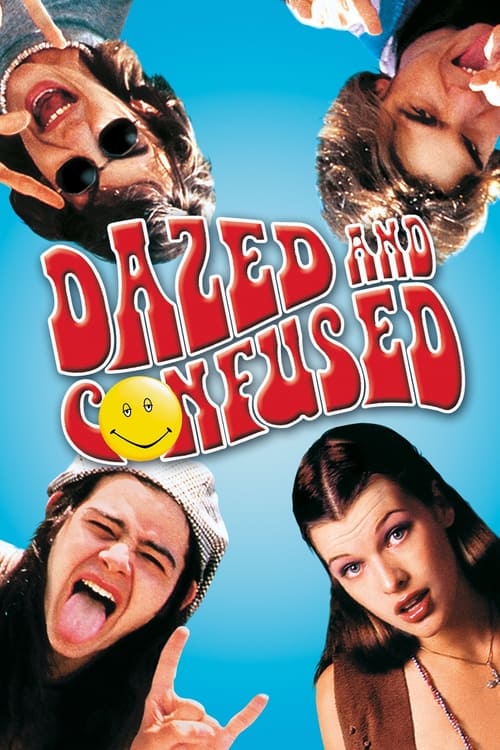
Dazed and Confused
1993 · Richard Linklater
For a low-stakes night when you want to relax into good company — comfort viewing with a killer soundtrack, equally great with friends or as a familiar rewatch you can half-live inside.
What it's about
The last day of school, May 1976, in a small Texas town: seniors haze the incoming freshmen, everyone hunts for the night's party, and a star quarterback who runs easily with stoners, jocks, and geeks alike weighs whether to sign his coach's no-drugs pledge. That's about all the plot there is — the movie just rides along as a dozen-plus teenagers cruise, talk, flirt, fight, and kill time until sunrise.
The experience
Pure hangout pleasure — loose, funny, and warm without being sappy, honest about the boredom and casual cruelty of being a teenager while still making you wish you were at that party. It drifts rather than drives, and that's the whole point.
Performances
A young Matthew McConaughey walks off with the movie as Wooderson, the too-old-to-be-here charmer whose drawled 'alright, alright, alright' became a piece of pop culture in itself — and the whole ensemble of then-unknowns is unusually alive and unaffected.
The craft
Linklater orchestrates a sprawling ensemble across one afternoon and night with such casual precision that it feels unscripted, and the wall-to-wall '70s rock soundtrack does as much scene-setting as any dialogue. The period detail is exact but never winking — it remembers 1976 rather than embalming it.
Why it matters
A box-office shrug that became one of the defining cult films of the '90s, it crystallized the 'hangout movie' as a form, launched a generation of actors, and cemented Linklater as American indie cinema's poet of killing time.
Snapshot
Dazed and Confused is Richard Linklater's affectionate, near-plotless chronicle of the last day of school in a small Texas town in May 1976, following a sprawling ensemble of high-schoolers across a single afternoon and night of cruising, hazing, beer-busting and aimless talk. Made on a modest budget for Universal's specialty arm and released in 1993, it underperformed theatrically but became one of the defining cult films of the 1990s, prized for its anti-nostalgic precision about adolescence and for launching or showcasing a remarkable cohort of young actors — most famously Matthew McConaughey, whose Wooderson and his drawled "alright, alright, alright" entered the culture wholesale. It crystallized the "hangout movie" as a self-conscious form and stands as a keystone of American independent cinema's early-'90s flowering.
Industry & production
The film arrived at the hinge between Linklater's micro-budget origins and the studio system's brief, post-sex, lies, and videotape appetite for independent voices. His 1991 feature Slacker — shot in Austin for a reported sum in the low tens of thousands — had become an art-house phenomenon, and Dazed and Confused was his step up to a union production with a real budget, financed through Universal and released by its specialty label Gramercy Pictures. Producers Sean Daniel and James Jacks shepherded it; the budget is generally reported at roughly $6.9 million, a fraction of which — figures around $1.6 million are commonly cited — went to clearing the wall-to-wall period rock soundtrack.
The production was marked by friction between Linklater's vision and studio expectations. By his own later account, Universal hoped for a broader, more conventional teen comedy and marketed the picture as a party movie in the "Just Say No" Reagan-Bush moment, a framing Linklater felt misrepresented a film that was observational rather than celebratory. He has spoken of an antagonistic relationship with the studio during post-production and release. The picture opened in late September 1993 to a soft theatrical run — domestic grosses are usually reported in the neighborhood of $8 million — before finding its real and lasting audience on home video and cable, where its rewatchable, dip-in-anywhere structure suited repeat viewing.
A meaningful production footnote concerns the title. The phrase comes from the Led Zeppelin song, and Linklater reportedly wrote personal appeals to band members seeking rights; the Zeppelin recording does not appear in the film, but the soundtrack is otherwise saturated with mid-'70s hard rock and AOR staples (Aerosmith, Alice Cooper, War, Foghat, Ted Nugent, Black Sabbath, ZZ Top, among others), making music clearance one of the production's central logistical and budgetary facts.
Technology
Dazed and Confused is not a film of technological innovation, and overclaiming on this front would be unwarranted. It was shot on 35mm with conventional period equipment, a notable step up in scale from the 16mm grain of Slacker. Its technical interest lies less in apparatus than in the deliberately analog texture of its world — the soundtrack delivered through car radios and 8-tracks, the diegetic centrality of the automobile and the FM dial. The most consequential "technology" of the film is arguably the soundtrack album itself as a commercial and cultural object: the music-licensing model it depended on, and the soundtrack's own life as a release, reflect the early-'90s economy in which catalog rock could anchor a film's identity and marketing. Where the documentary record on specific stocks, lenses, or lab processes is thin, it is more honest to say so than to invent specifics.
Technique
Cinematography
Lee Daniel, Linklater's cinematographer on Slacker, shot the film in a naturalistic register tuned to the golden, dust-lit quality of a Texas spring evening. The camera is mobile but unshowy, favoring fluid tracking and follow shots that move with characters through the social spaces of the film — the school corridors, the Emporium pool hall, the parking-lot cruise, and the climactic gathering at the moon tower. The much-cited opening, a slow track toward a GTO gliding into the school lot under Aerosmith's "Sweet Emotion," establishes the method: the camera as a relaxed participant drifting among bodies rather than a dramatizing instrument forcing attention. Color and light skew warm and slightly hazy, lending the period an immersive, lived-in glow that the film pointedly refuses to sentimentalize through its content.
Editing
Dazed and Confused marks the beginning of Linklater's enduring collaboration with editor Sandra Adair, who would go on to cut nearly all of his subsequent work. The editing's achievement is structural: with no central plot to track, Adair and Linklater weave a dozen-plus narrative threads into a continuous temporal flow across one afternoon and night, cross-cutting between groups so that the town feels simultaneously occupied. The rhythm is loose and associative — scenes are allowed to breathe and trail off — yet the overall shape tightens toward the dawn convergence at the moon tower and Randall "Pink" Floyd's small act of refusal. The cutting privileges social texture and overlapping talk over cause-and-effect momentum, which is precisely the form the material requires.
Mise-en-scène / staging
Period reconstruction is meticulous but worn-in rather than museum-like: feathered hair, bell-bottoms, muscle cars, wood-paneled rooms, the iconography of 1976 deployed as ordinary environment, not spectacle. Linklater stages the film as a series of porous group scenes in which characters cluster, disperse and recombine, the framing accommodating ensembles rather than isolating protagonists. The film's spaces are organized around adolescent social geography — who is allowed where, who is hunting whom (seniors paddling incoming freshman boys, humiliating the girls) — and the staging makes hierarchy and belonging legible through proximity and grouping. The result is a mise-en-scène of milieu, where meaning accrues from the arrangement of people in a place rather than from isolated dramatic beats.
Sound
Sound is foundational. The near-continuous needle-drop score functions as the film's connective tissue and its argument about memory: the period is summoned through its music as much as its images. Crucially, the songs are largely motivated and diegetic — pouring from car stereos and party speakers — so that the soundtrack feels embedded in the characters' world rather than imposed from above. Layered, overlapping dialogue, much of it loose and colloquial, completes the aural texture, privileging the ambient murmur of group life over crisp expository exchange.
Performance
The film is, above all, a triumph of ensemble performance and casting. Casting director Don Phillips — who had earlier cast Fast Times at Ridgemont High, a meaningful lineage — assembled a deep bench of young, largely unknown actors, including Jason London (Pink), Rory Cochrane (Slater), Wiley Wiggins (the hazed freshman Mitch), Adam Goldberg, Anthony Rapp, Parker Posey, Joey Lauren Adams, Milla Jovovich, Cole Hauser, Ben Affleck (as the sadistic O'Bannion) and Matthew McConaughey. Linklater encouraged improvisation and a naturalistic, lived-in delivery; McConaughey's Wooderson — the older guy who never left, articulating the film's wry thesis about clinging to high school — emerged substantially from this looseness and became the film's breakout. The performances share a refusal of the heightened, joke-forward register of mainstream teen comedy in favor of recognizable, slightly inarticulate adolescent behavior.
Narrative & dramatic mode
Dazed and Confused is a deliberately plotless, ensemble "slice of time" film. It observes the dramatic unities loosely — one place, roughly one day — and substitutes accumulation for plot: a mosaic of incidents (the hazing, the search for a party, the cruising, the moon-tower gathering) rather than a goal-driven arc. To the extent a spine exists, it runs through Pink, the football star pressured to sign a coach's "no drugs" pledge, whose quiet refusal to capitulate supplies the film's modest moral center and its statement of independence. The mode is observational, comic and elegiac at once — comedy of behavior rather than of gags, drama of mood rather than of crisis. This anti-dramatic structure, inherited from Slacker and refined here, is the film's signature formal gambit.
Genre & cycle
The film sits inside the teen/coming-of-age genre while pointedly revising it. Against the John Hughes-dominated 1980s cycle of plot-driven, emotionally resolving high-school movies, Dazed and Confused offers something more diffuse and unsentimental, closer to a sociological group portrait. Its most direct generic ancestor is George Lucas's American Graffiti (1973), the foundational one-night, ensemble, jukebox-scored teen-cruise film, against which Dazed is almost always read — Linklater's picture is the post-Watergate, harder-edged answer to Lucas's pre-Kennedy-assassination innocence. More broadly it belongs to the lineage of the "hangout movie," the loose-ensemble form whose antecedents reach back to Fellini's I Vitelloni (1953), and which Linklater did as much as anyone to name and popularize as a contemporary mode.
Authorship & method
Dazed and Confused is a central text of Linklater's authorship, drawn directly from his own adolescence in Huntsville, Texas, and continuous with the concerns of his career: the texture of real time, the drift of unstructured talk, the refusal of conventional dramatic engineering, and a deep curiosity about how young people inhabit a particular American place and moment. The film inaugurates two of his most important working relationships — with editor Sandra Adair and (continuing from Slacker) cinematographer Lee Daniel — and codifies a method built on extensive ensemble casting, rehearsal, improvisational latitude, and music as structuring principle. Linklater wrote the screenplay himself. His authorial stamp is the paradoxical combination of relaxed surface and rigorous design: the apparent shapelessness is the product of careful construction, a deliberate aesthetic of the everyday that he would extend across Before Sunrise (1995), Waking Life (2001), and ultimately the time-bound experiment of Boyhood (2014).
Movement / national cinema
The film belongs to the American independent cinema of the early 1990s — the post–sex, lies, and videotape, Sundance-era moment when distinctive regional voices secured studio specialty financing. Within that movement Linklater is the central figure of a specifically Austin, Texas scene, and Dazed and Confused is a landmark of regional American filmmaking, rooted in a non-coastal milieu and sensibility. It is part of the broader independent turn toward character, mood and milieu over genre mechanics, and toward filmmakers mining autobiographical and local material — a national-cinema story about the decentralization of American film away from Los Angeles and New York.
Era / period
Two periods are in play, and the film's intelligence lies in the gap between them. Its setting is May 1976 — the American Bicentennial year, post-Vietnam, post-Watergate, a moment of national hangover that the film registers obliquely through a teenager's musing about the country and through a pervasive sense of aftermath. Its making is 1992–93, and the film participates in that decade's wave of '70s revivalism while resisting its easy nostalgia: Linklater's 1976 is boring, cruel and aimless as often as it is fun, an explicit corrective to rose-tinted retrospection. The film is thus a period piece about one era made in the spirit of another, and its lasting power partly derives from refusing to flatter either.
Themes
Its governing themes are time, conformity and the texture of growing up. The film is preoccupied with rituals of belonging and exclusion — hazing, cliques, the policing of hierarchy — and with the quiet question of whether to submit to institutional and social pressure, dramatized in Pink's refusal to sign the pledge. Wooderson voices the film's meditation on those who cannot leave adolescence behind, making arrested time and the seduction of the past a central concern. Boredom, freedom and the open-ended drift of unstructured time are treated not as dead air but as the actual substance of being young. Underneath runs a gently anti-authoritarian, anti-nostalgic skepticism: a refusal to pretend that the past was better or that conformity is harmless.
Reception, canon & influence
Critical reception was warm if not universal at release, with many reviewers praising the film's authenticity, ensemble and soundtrack even as its commercial performance disappointed. Its canonical standing was secured over the following decade through home video, repeat viewing and word of mouth, culminating in a Criterion Collection edition that confirmed its art-house legitimacy; it is now routinely cited among the great American films about adolescence and a touchstone of '90s independent cinema. Quentin Tarantino is among the prominent filmmakers who have named it a favorite, a frequently cited marker of its standing among peers.
Looking backward, the film's clearest influence is American Graffiti, whose one-night ensemble-cruise template and jukebox scoring it inherits and revises, with the hangout lineage extending further back to Fellini's I Vitelloni; the teen-comedy tradition of Fast Times at Ridgemont High (linked concretely through casting director Don Phillips) is another evident forebear. Looking forward, Dazed and Confused is widely credited with consolidating the "hangout movie" as a recognized contemporary form and influencing a generation of plotless, ensemble, mood-driven films and television; its imprint is visible in subsequent coming-of-age and ensemble work across both media, and in Linklater's own loose companion piece Everybody Wants Some!! (2016), conceived as a "spiritual sequel" set in the early 1980s. Its most visible cultural legacy, however, may be human capital: the film served as a launchpad for a striking number of careers, McConaughey's above all, making it a documented incubator of 1990s and 2000s American screen talent.
A Deleuzian reading
A black GTO noses into the school parking lot, slow, the camera drifting alongside it the way you'd drift toward a car you recognized, and Aerosmith's "Sweet Emotion" comes up not as a score but as if someone in the next car over turned it on.
The full Deleuzian reading of Dazed and Confused →
Reception
It barely made a dent in 1993 — a modest box-office shrug that Linklater felt Universal dumped — then grew into a certified classic through video, cable, and dorm-room osmosis, eventually landing a Criterion release and a permanent spot on best-teen-movie lists.
How Dazed and Confused was received, from release to now →
Influences: the films it descends from and the films it influenced
- American Graffiti (1973) — Supplies the one-night cruising-ensemble template and the wall-to-wall diegetic jukebox (radio-DJ) score that structures cross-cut, plotless storylines — the form Dazed inherits and revises.
- I Vitelloni (1953) — Originates the episodic portrait of aimless young men loafing through a provincial town with no dramatic engine — the root of the hangout-drift structure.
- Fast Times at Ridgemont High (1982) — Concrete production link via shared casting director Don Phillips, and a naturalistic high-school ensemble cast from recognizable teen types rather than star vehicles.
- Slacker (1990) — Linklater's own Austin-regional method: a roving camera handing off between characters in real time with no protagonist and no plot, carried forward by DP Lee Daniel.
- Nashville (1975) — Model for overlapping, half-audible dialogue and decentralized multi-strand cross-cutting where the milieu, not a hero, is the subject.
- The Last Picture Show (1971) — Small-Texas-town adolescence rendered through regional naturalism and a built-environment milieu — the directly Texan forebear of Dazed's sense of place.
- Mean Streets (1973) — Establishes the saturated pop needle-drop as quasi-diegetic scoring laid over a loose, scene-to-scene hangout structure among a circle of guys.
- Cooley High (1975) — A last-day-of-school teen ensemble scored by a Motown jukebox — the same period-nostalgia-via-diegetic-music coming-of-age architecture.
- Diner (1982) — Improvised, overlapping male-ensemble hangout talk that generates character entirely through rambling conversation rather than incident.
- The Breakfast Club (1985) — Inherits the one-day classical-unity hangout structure and period needle-drop wall, dispersing the cross-clique ensemble across a town the way Hughes confined it to a room.
- Shampoo (1975) — Takes the one-day/one-night ensemble with no protagonist and a wall-to-wall licensed period soundtrack, cut by associative party assembly — characters looping into and out of a drifting social space rather than through a plot.
- Ferris Bueller's Day Off (1986) — A plotless single-day ensemble picaresque in which no principal completes an arc, held together entirely by crosscutting between drifting strands and a wall-to-wall licensed period soundtrack — Ferris's structure with the charismatic center removed.
- Everybody Wants Some!! (2016) — Linklater's declared 'spiritual sequel' — identical plotless-ensemble, unity-of-time, needle-drop hangout method transposed to the early 1980s.
- Boyhood (2014) — Pushes the same 'rigorous design under a relaxed everyday surface' to its limit, making the texture of passing time itself the structuring principle.
- Superbad (2007) — Consolidates the one-night teen-ensemble hangout as commercial form — mood and improvised banter over a near-absent plot.
- Freaks and Geeks (1999) — Carries the period high-school ensemble into television: naturalistic improvised performance, observational milieu, and era-specific needle-drops.
- Adventureland (2009) — A period summer hangout structured by nostalgic needle-drop curation and ambient, low-stakes ensemble drift rather than narrative drive.
- Mid90s (2018) — Period youth ensemble built from non-professional naturalism and a diegetic-music milieu, recreating Dazed's documentary feel for a specific moment.
- Once Upon a Time... in Hollywood (2019) — Linklater's anti-dramatic hangout-pace structure—in which ensemble peripatetic observation substitutes for conventional dramatic arc and the refusal of resolution is itself the formal argument—is the American independent precedent for Tarantino's deliberate narrative economy.
- Licorice Pizza (2021) — Linklater assembles a non-professional-adjacent ensemble through a single afternoon of episodic coming-of-age encounters, using the social world itself as dramatic engine without resolving into individual character arcs—LP's collective-milieu approach inherits this structure.
- Love Untangled (2025) — Refines the period-precise ensemble youth reconstruction where costuming, slang, and a curated era soundtrack do the world-building work with a plotless, buoyant tone.
- Kicking and Screaming (1995) — Demonstrates a feature sustained with no inciting incident, structured only by drift among a few locations inside a fixed time bracket, with ensemble rhythm and dialogue-first sound doing the work a plot would otherwise do.
- Tony (2026) — The plotless hang-out ensemble shot into magic hour, where scenes end when the conversation does rather than on story beats, and the older-to-younger mentorship is played as casual hazing-turned-tutelage.
- Before Sunrise (1995) — Extends the real-time unity of time and the privileging of unstructured, drifting talk over plot into a two-hander.
- Kids (1995) — Single-day, plotless youth ensemble cast from non-professionals for raw naturalism — the same unity-of-time observational method pushed toward vérité.
- Almost Famous (2000) — Period 1970s Texas rock culture rendered through a warm photochemical palette and a curated needle-drop catalog driving the emotional architecture of a single defining night—parallel formal construction of the same era and the same logic of songs as the adolescent's primary emotional vocabulary, though structured as collective rather than individual bildungsroman.
- Stand by Me (1986) — Extends the plotless, episodic period-nostalgia ensemble scored wall-to-wall by a diegetic rock jukebox, structured as drifting vignettes rather than plot.
- Linda Linda Linda (2005) — Shares the hang-out, plotless ensemble structure organized around a single compressed span of time and a needle-drop soundtrack, prizing texture and deadpan drift over incident — a Western analog to the same anti-melodramatic observation.
Similar films
- American Graffiti (1973) — influence & lineage · same viewing thread
- Fast Times at Ridgemont High (1982) — influence & lineage · same viewing thread
- mid90s (2018) — influence & lineage · same viewing thread
- Kids (1995) — influence & lineage · often watched together
- Slacker (1990) — influence & lineage
- Superbad (2007) — influence & lineage
- Boyhood (2014) — influence & lineage
- Before Sunrise (1995) — influence & lineage
All the films related to Dazed and Confused →
Watch it with: curated runs of related films
- Restless Youth, Rigid Walls — Watch these as one long walk through the school years — the teachers who crack you open, the friends who pull you off the sidelines, the first loves and the institutions you push against — where a beloved tearjerker and a surreal boarding-school revolt turn out to be cousins.