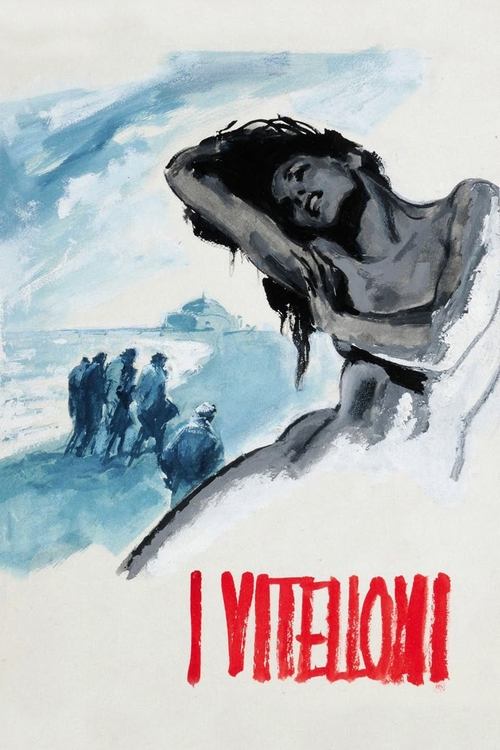
I Vitelloni
1953 · Federico Fellini
For when you feel stuck — between jobs, between versions of yourself — and want a film that gets it without lecturing you. Comfort viewing with a bittersweet aftertaste, not a heavy lift.
What it's about
Five grown men in a small Italian seaside town keep living like teenagers — sleeping late, chasing women, hatching schemes that never leave the café table. Fausto, the ringleader, is a womanizer whose antics torment his pregnant wife; Alberto dreams big and does nothing; Leopoldo scribbles at a play no one will stage; Riccardo wants to be famous; and quiet Moraldo watches it all, wondering if life might be happening somewhere else. Over the course of a year of off-season boredom, small humiliations start to pile up.
The experience
It plays as a warm, rambling comedy that slowly turns melancholy on you — you laugh at these guys, then catch yourself recognizing them. Gentle in pace, sharp in observation, with an ache that sneaks up in the final stretch.
Performances
Alberto Sordi is the heartbreaker of the group, playing the clowning dreamer whose bravado keeps cracking open to show the loneliness underneath — his drunken carnival night is one of the film's most quietly devastating passages.
The craft
Fellini shoots the dead off-season town in wintry black and white — empty beaches, wet piazzas, streets at 4 a.m. — so the setting itself becomes the trap the characters can't leave. The film drifts episodically rather than plotting, and that looseness is the point: it feels like time being wasted, beautifully. The last few minutes contain some of the most quietly expressive camerawork of its era.
Why it matters
This was the film where Fellini became Fellini — his first big success and the template for decades of movies about hometown friends who never grow up. Its DNA runs through generations of hangout films and coming-of-age stories about leaving (or failing to leave) home.
Snapshot
I Vitelloni is Federico Fellini's third feature and the first that is unmistakably, entirely his own — a melancholy comedy about five overgrown adolescents idling away their lives in a provincial Adriatic town during the dead off-season. The title is a piece of Romagnol slang, roughly "big calves" or "fatted yearlings," denoting young men who loaf about on their families' money long past the age when they should have found work, wives, or ambition. The film follows Fausto the philandering ringleader, dreamy Alberto, would-be playwright Leopoldo, fame-hungry Riccardo, and the watchful youngest, Moraldo, across roughly a year of small humiliations, aborted schemes, and seasonal boredom. It is at once tender and unsparing, and it occupies a pivotal place in Fellini's career: a transitional work that retains the textures of neorealism while turning decisively toward memory, caricature, and lyrical autobiography. It won a share of the Silver Lion at the 1953 Venice Film Festival, established Fellini as a major director in his own right, and became one of the most widely imitated templates for the "young men with nothing to do" film.
Industry & production
The film was made inside the precarious Italian production economy of the early 1950s, and its backstory is largely one of financial difficulty. Fellini's previous solo feature, Lo sceicco bianco (The White Sheik, 1952), had been a commercial disappointment, and producers were wary of him. Financing for I Vitelloni was assembled with effort; the producer Lorenzo Pegoraro (Peg Films) backed the project, and it was structured as an Italian–French co-production, with French participation (Cité Films) reflecting the common practice of the period for spreading risk and accessing additional markets. Beyond these broad facts, the granular production history — exact budget figures, shooting schedule, day-to-day events — is thinly documented in the English-language record, and I will not invent specifics.
The shoot used real provincial locations rather than the unnamed town of the story being a studio fabrication. The production filmed largely on the Adriatic and central-Italian coast and in towns standing in for Fellini's native Rimini — Ostia and Viterbo are the locations most consistently cited — using the deserted winter seafront, the piazza, the café, and the empty beach as its principal settings. This grounding in actual provincial geography is essential to the film's atmosphere of stranded, out-of-season emptiness. The film's commercial and critical success was decisive for Fellini's career: it recouped its standing in the industry, vindicated his authorial instincts, and cleared the path to La Strada the following year.
Technology
I Vitelloni was made with the standard tools of early-1950s Italian cinema: 35mm black-and-white film, the Academy aspect ratio (1.37:1), and conventional studio-and-location camera equipment of the period — well before the arrival of widescreen formats, which would only begin reshaping Italian production later in the decade. Like nearly all Italian films of the era, it was shot without synchronized location sound and post-synchronized entirely in the dubbing studio, the dominant Italian practice. This technological fact has aesthetic consequences throughout: dialogue, ambient sound, and Nino Rota's score are all built in post-production, giving the filmmaker freedom to compose the soundtrack as an independent layer over the image rather than capturing it on set. There is no evidence of unusual or experimental technology; the film's innovations are matters of sensibility and technique rather than apparatus.
Technique
Cinematography
The photography is credited principally to Otello Martelli — Fellini's frequent collaborator and one of the major Italian cinematographers of the period — with the production records also listing additional camera personnel (the film's lensing is sometimes attributed across more than one name, a reminder that Italian camera credits of the era could be shared). The visual style is restrained and observational compared with the baroque imagery of Fellini's later work, but it already shows his eye for the expressive emptiness of place: the long, deserted beachfront; the wind-scoured off-season piazza; the cavernous, half-empty dance hall during the Carnival sequence. The black-and-white tonality leans into wintry grayness, isolating figures against vacant backgrounds in a way that visually states the film's theme of arrested lives in a depopulated world.
Editing
The cutting (editing credited to Rolando Benedetti) serves an episodic, vignette-based structure rather than a tightly causal plot. The film is organized as a loose chronicle, advancing through a series of set pieces — the beauty pageant, the Carnival ball, the variety-show evening, the seductions, the final departure — held together by recurrent return to the group and by a third-person voice-over that frames events with gentle, retrospective irony. The rhythm is deliberately unhurried, mirroring the listlessness of its characters, and the editing allows individual scenes (notably Alberto's drunken Carnival night) to expand and breathe rather than driving toward narrative efficiency.
Mise-en-scène / staging
Staging is built around the geography of provincial idleness: the café table, the empty street, the seafront promenade, the family home from which the vitelloni never quite escape. Fellini choreographs the group as a loose pack, repeatedly framing the five together so that their collective inertia becomes the real subject. Two staged moments have become iconic. The first is Alberto's Carnival sequence, in which Alberto Sordi, drunk and costumed, drifts through the emptying ballroom and embraces a giant papier-mâché carnival mask — an image of grotesque, hollow festivity that anticipates the carnivalesque imagery of Fellini's later films. The second is the scene in which the men, riding in a car, jeer at a gang of road laborers ("Lavoratori!") only for the car to break down moments later, leaving them stranded and exposed — a perfectly staged comeuppance that crystallizes the film's judgment of their parasitic contempt for honest work.
Sound
Because the film is entirely post-synchronized, its soundtrack is a constructed environment. Nino Rota's score is central to its effect, threading wistful, slightly ironic melody through the comedy and lending the whole film its characteristic tone of affectionate melancholy. Sound is used to underline the contrast between the characters' fantasies and their flat reality, and the off-season town's quiet — wind, sparse footsteps, distant music from the dance hall — becomes an audible expression of emptiness.
Performance
The ensemble performances are the film's bedrock. Alberto Sordi, as Alberto, delivers the most celebrated turn — the Carnival drunk and the heckling-the-laborers scene are his — and the film was important in consolidating his stardom; Sordi would go on to become one of postwar Italy's defining comic actors. Franco Fabrizi plays Fausto with shallow, self-satisfied charm; Franco Interlenghi (already known from De Sica's Sciuscià) gives Moraldo a quiet, observing gravity that makes him the film's moral center and autobiographical surrogate. Leopoldo Trieste plays the pretentious playwright Leopoldo, and Riccardo Fellini — the director's own brother — plays Riccardo. Eleonora Ruffo plays Sandra, Fausto's wronged and pregnant young wife. The performances balance caricature with genuine pathos, never tipping fully into either farce or melodrama.
Narrative & dramatic mode
The film's mode is the episodic tragicomic chronicle. It has no single driving plot; instead it interweaves the men's parallel idlenesses, with Fausto's marriage and serial infidelities providing the strongest through-line and the most consequential stakes (a forced wedding, a pregnancy, a betrayal, a paternal reckoning). The dominant tone is comic, but the comedy is shadowed throughout by futility, shame, and the slow dawning that youth cannot be prolonged indefinitely. The third-person narration lends the whole an air of reminiscence, as if the events were already being recalled from a distance. The structure resolves not through a conventional climax but through departure: Moraldo, alone among the five, boards a morning train and leaves the town behind, while the others sleep on in their arrested lives. This open, valedictory ending is the film's dramatic signature.
Genre & cycle
I Vitelloni sits at the intersection of comedy and drama — the commedia tradition of Italian cinema inflected with realist social observation and personal lyricism. It belongs to, and arguably helped define, a recognizable type: the ensemble portrait of aimless provincial young men trapped between adolescence and adulthood. Within Italian cinema it can be read as a bridge between neorealism's social attention and the more character-driven, bittersweet commedia all'italiana that would flower later in the decade. Internationally, it became the prototype for a whole transnational cycle of "hangout" and arrested-adolescence films, a lineage discussed below.
Authorship & method
I Vitelloni is a foundational text of Fellini's authorship — the film in which his method first fully emerges. It is deeply autobiographical: the unnamed seaside town is a transfigured Rimini, the vitelloni are drawn from the young men of Fellini's own provincial youth, and Moraldo's departure for the city mirrors Fellini's own escape to Rome. The screenplay was written by Fellini with his two essential collaborators of this period, Ennio Flaiano and Tullio Pinelli — the writing partnership that shaped Fellini's films through the 1950s and into the 1960s, blending Flaiano's satirical wit with Pinelli's dramatic structure and Fellini's imagistic memory.
The other defining collaboration is with composer Nino Rota, whose score here begins the lifelong creative partnership that would become one of the most celebrated director–composer relationships in cinema. Cinematographer Otello Martelli and editor Rolando Benedetti execute the film's restrained visual chronicle. Fellini's method — caricature rooted in real memory, the elevation of the provincial and the grotesque into something tender and universal, the autobiographical surrogate observing from the edge of the frame — is already legible, even though the full Felliniesque extravagance of La Dolce Vita and 8½ lies ahead. Notably, the autobiographical thread of Moraldo's departure was something Fellini intended to continue in a planned project about Moraldo in the city, which was developed in script form but never realized as conceived.
Movement / national cinema
The film is best understood as a hinge within Italian postwar cinema. It emerges from the world of neorealism — location shooting, attention to ordinary provincial life, non-glamorous milieu — but it consciously turns away from neorealism's emphasis on the laboring poor and social-political urgency toward the interior lives, fantasies, and moral inertia of the lower-middle class. In this sense I Vitelloni is often cited as a key step in the movement beyond neorealism toward the more personal, psychological, and stylized cinema that would dominate the Italian art film of the later 1950s and the 1960s. It is a quintessential work of Italian national cinema in its specificity — the Romagnol town, the Carnival, the off-season Adriatic — even as its themes proved exportable across cultures.
Era / period
Made in 1953, the film belongs to the early postwar moment of Italian reconstruction, when the country was poised between austerity and the coming economic boom. Its portrait of provincial stagnation — young men with no work and no prospects in a small town offering nothing — reflects the real economic narrowness of the Italian provinces in this period, and the pull of the city (Rome, the industrial north) as the only avenue of escape. The film captures, with documentary fidelity beneath its comedy, the social texture of small-town Italy on the cusp of the modernization that would transform it within a decade.
Themes
The film's central theme is arrested development — the suspension of young men in a perpetual, increasingly pathetic adolescence, sustained by indulgent families and a town that asks nothing of them. Around this cluster several others: the gap between fantasy and reality (Leopoldo's literary delusions, Riccardo's dreams of fame, Fausto's self-image as a Don Juan); the suffocation of provincial life and the dream of the city; masculine vanity and its cruelty, especially in Fausto's treatment of Sandra; the tension between loyalty to the group and the need to break from it; and the passage of time, dramatized through the seasonal cycle and the off-season emptiness. Underlying all of it is a melancholy meditation on youth as something that must end, and on the courage — or simple desperation — required to leave. Moraldo's solitary departure renders this theme as a quiet act of growth amid collective stasis.
Reception, canon & influence
I Vitelloni was both a critical and commercial success on release and is generally regarded as the film that secured Fellini's reputation. It shared the Silver Lion at the 1953 Venice Film Festival, a major early endorsement. On its later international release it earned an Academy Award nomination for Best Original Screenplay (for Fellini, Flaiano, and Pinelli) at the 30th Academy Awards in 1958 — recognition that underscored the strength of its writing. It has since settled firmly into the canon as one of the essential Fellini films and one of the key Italian films of the 1950s.
Influences on the film (backward): I Vitelloni grows out of Italian neorealism — the De Sica/Zavattini and Rossellini current in which Fellini himself had worked as a screenwriter (notably on Rossellini's Roma città aperta and Paisà) — while reacting against its social-realist program. It also draws on the native traditions of Italian comedy and, most powerfully, on Fellini's own remembered youth in Rimini, which supplies its characters, settings, and emotional truth.
Legacy (forward): The film's influence has been enormous and is widely acknowledged. Its template — a loose ensemble of aimless young men drifting through a provincial town, structured as episodic vignettes shadowed by the question of whether anyone will ever leave — became the model for a major international lineage of "hangout" and coming-of-age films. Martin Scorsese has repeatedly cited I Vitelloni as a direct influence on Mean Streets; the film is regularly named as a touchstone for George Lucas's American Graffiti and Barry Levinson's Diner, both of which transpose its arrested-youth-in-a-small-place structure to American settings. Within Fellini's own career it launched the autobiographical, memory-driven vein that runs through La Dolce Vita, 8½, and Amarcord — the last of which returns to the same Riminese provincial world. Few films of the 1950s have proven so generative for later filmmakers, and I Vitelloni remains both a beloved work in its own right and a foundational ancestor of an entire genre of films about young men who cannot, or will not, grow up.
A Deleuzian reading
Start with the mask.
The full Deleuzian reading of I Vitelloni →
Reception
A hit from the start — it won the Silver Lion at Venice in 1953 and rescued Fellini's career after The White Sheik flopped. Today it's the go-to pick for people who insist early, earthbound Fellini beats the baroque later stuff.
How I Vitelloni was received, from release to now →
Influences: the films it descends from and the films it influenced
- Paisà (1946) — Fellini co-scripted this six-episode war fresco, and its chain-of-vignettes construction is the direct structural model for I Vitelloni's episodic, plotless drift through discrete set-pieces.
- Roma città aperta (1945) — As co-writer Fellini absorbed Rossellini's on-location postwar staging and post-synchronized sound, the neorealist working method Vitelloni retains even as it abandons the social-realist subject.
- Ladri di biciclette (1948) — Establishes the De Sica/Zavattini grammar of black-and-white, real-street chronicle of ordinary undramatic life that Vitelloni inherits and then sweetens into comedy.
- Ossessione (1943) — Visconti's proto-neorealist study of erotic torpor in a dead-end Po-valley town pioneers the provincial-stagnation atmosphere Vitelloni transposes to the off-season Adriatic resort.
- Luci del varietà (1950) — Fellini's co-directed debut already fields an ensemble of provincial dreamers and a troupe-of-misfits structure, the prototype for Vitelloni's gang of layabouts.
- Lo sceicco bianco (1952) — The immediately prior solo film inaugurates the Fellini–Flaiano–Pinelli script partnership and the Nino Rota scoring relationship that Vitelloni carries forward intact.
- La Dolce Vita (1960) — Literalizes Moraldo's train departure into Rome: its journalist-observer drifting through episodic nocturnal tableaux is the urban sequel Fellini had planned as 'Moraldo in città.'
- 8½ (1963) — Perfects Vitelloni's device of the autobiographical surrogate watching from the frame's edge, turning the memory-and-caricature method into full reflexive self-portrait.
- Amarcord (1973) — Returns to the same transfigured Rimini and revives the episodic-vignette, caricature-rooted-in-memory construction, making it the explicit companion-piece to Vitelloni.
- Mean Streets (1973) — Scorsese repeatedly cites Vitelloni as a model: an ensemble of aimless neighborhood men, a first-person voice-over conscience, and a hangout structure built from drifting episodes rather than plot.
- American Graffiti (1973) — Transplants the arrested-youth-in-a-small-place template—an ensemble of young men cruising one provincial night, shadowed by the question of who will finally leave—to small-town California.
- Diner (1982) — Lifts Vitelloni's portrait of overgrown boys who congregate, banter, and dodge adulthood, substituting a Baltimore diner for the café as the ensemble's idling-place built from loose anecdotal episodes.
- Dazed and Confused (1993) — Builds an entire film from Vitelloni's plotless ensemble-hangout grammar—many aimless young people, one drifting night, the unspoken pressure of leaving town—now as pure mosaic of vignettes.
- Playing for Keeps (2012) — Originates the post-neorealist study of arrested provincial men loitering at the edges of adult life, idly observing from the sidelines — the arrested-male-maturity and observational-loitering craft Muccino's Italian cinema descends from.
- Luca (2021) — The episodic, autobiographical portrait of aimless young men loafing in a small Adriatic seaside town is the provincial-youth structure Casarosa explicitly cites.
- The Hand of God (2021) — Establishes the provincial coming-of-age drift among aimless young men whose loafing, seaside idleness and one figure's departure for the city Sorrentino echoes in Fabietto's leaving Naples for Rome to become a filmmaker.
- My Friends (1975) — The provincial idlers who refuse adulthood, drifting in a male clique through pranks and evasions — the arrested-masculinity archetype and episodic loitering structure My Friends ages into midlife.
- The Last One for the Road (2025) — Establishes the template of aimless provincial young men drifting through a Northern-Italian town in episodic, plotless vignettes — the coming-of-age-that-refuses-to-arrive that Sossai's picaresque accretion inherits.
- Il sorpasso (1962) — Extends the same commedia all'italiana anatomy of male arrested development, including Vitelloni's signature tragicomic swerve from comic drift into a sudden bleak ending.
- I soliti ignoti (1958) — Shares the commedia all'italiana method of an ensemble of inept, self-deluding provincial dreamers played for affectionate caricature that tips into pathos.
- Les 400 coups (1959) — A parallel autobiographical-surrogate youth chronicle whose closing flight toward the sea rhymes with Moraldo's departure as the one escape from a stifling provincial milieu.
- Husbands (1970) — Carries the ensemble-of-men-refusing-to-grow-up into middle age, sustaining Vitelloni's plotless, behavior-driven hangout drift among male friends.
- The Executioner (1963) — Co-written by Ennio Flaiano, El verdugo's third screenwriter — shares his episodic satirical construction and wry provincial ensemble portraiture, the Italian scenarist's fingerprint on the co-production.
- Welcome Mr. Marshall! (1953) — Same-year choral portrait of a provincial town's drifting types, held together by ironic-warm affection rather than a single protagonist — the ensemble tonality (tender and mocking at once) that Berlanga shares.
Similar films
- La Dolce Vita (1960) — influence & lineage · same viewing thread
- Amarcord (1973) — influence & lineage
- 8½ (1963) — influence & lineage
- Big Deal on Madonna Street (1958) — influence & lineage
- Obsession (1943) — influence & lineage
- Bicycle Thieves (1948) — influence & lineage
- The Last One for the Road (2025) — often watched together
- The Flowers of St. Francis (1950) — often watched together
All the films related to I Vitelloni →
Watch it with: curated runs of related films
- Adrift in the Modern World — Watch these when you want to drift through postwar Rome and Paris alongside people who have everything and feel nothing — they rhyme on beautiful boredom, aimless days, and a search for meaning that modern comfort keeps failing to supply.