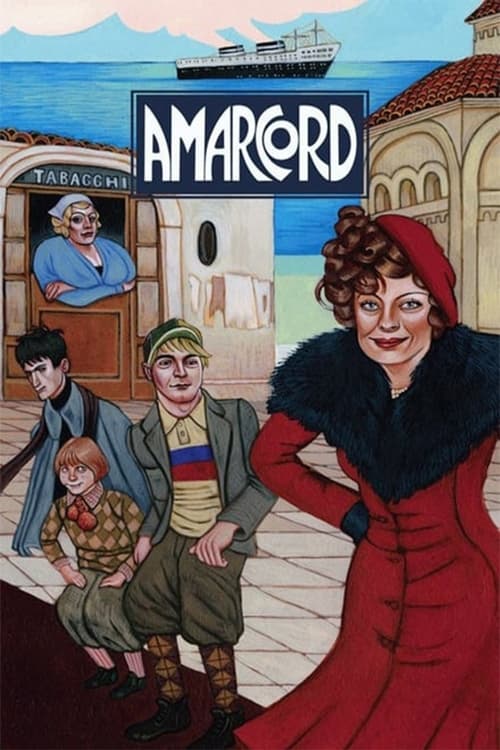
Amarcord
1973 · Federico Fellini
For when you want to be swept somewhere generous and strange — a film to sink into rather than follow. Comfort viewing of an unusual kind: nostalgic without being soft, perfect for a long unhurried evening.
What it's about
A year in the life of an Italian seaside town in the 1930s, remembered — and embellished — through the eyes of teenage Titta and a whole gallery of townspeople: his combustible family, the local priest, the town beauty, the eccentrics, and the strutting Fascist officials everyone half-mocks and half-fears. Less a plot than a parade of seasons, rituals, pranks, funerals, and daydreams.
The experience
Bawdy, tender, and dreamlike by turns — it moves like memory itself, drifting from schoolboy farce to moments of sudden wonder and melancholy. You laugh a lot, and then an image catches you off guard and stays with you.
The craft
Fellini reconstructs the town of his childhood entirely in the studio, which gives every snowfall, peacock, and ocean liner the heightened glow of something remembered rather than recorded. Nino Rota's carousel of a score binds the episodes together, and the parade of faces is a masterclass in casting for character.
Why it matters
It won the Academy Award for Best Foreign Language Film and stands as the most beloved late Fellini — the definitive screen portrait of how nostalgia and authoritarianism feed each other, remembered fondly and mistrusted at once.
Snapshot
A loose, episodic panorama of life in a fictional seaside town in Emilia-Romagna across the span of roughly one year in the mid-1930s, Amarcord draws on Federico Fellini's memories of growing up in Rimini under Mussolini's Fascist regime. The title is a contraction in the Romagnol dialect meaning "I remember," and the film treats memory not as a fixed archive but as a living, distorting force — half fantasy, half mortification. Where most autobiographical films center a single consciousness, Fellini distributes the film's attention across an entire community: the Biondi family, the local priest, the tobacconist, the town eccentric, the visiting prostitute, the Fascist party secretary. Young Titta (Bruno Zanin) functions as the nominal protagonist and Fellini's surrogate, but the real subject is the collective social body of the town itself — its desires, its cowardice, its complicity, its nostalgia for its own mediocrity. The film won the Academy Award for Best Foreign Language Film at the 47th Academy Awards ceremony in 1975.
Industry & production
Amarcord was produced by Franco Cristaldi through his company Vides Cinematografica, in co-production with the French firm P.E.C.F. Cristaldi had been one of the central figures in Italian art cinema production since the 1950s, and his partnership with Fellini gave the director considerable creative latitude. The film was shot entirely at Cinecittà studios in Rome — notably, not on location in Rimini. This decision was characteristic of Fellini's working method: the studio allowed complete control over light, atmosphere, and architectural fantasy. The entire town — its piazza, its Grand Hotel, its tobacconist's shop, the surrounding countryside — was constructed as an elaborate set under the direction of production designer Danilo Donati, who had designed Fellini's Satyricon (1969) and Roma (1972). The artificiality of this constructed world is not incidental; it is the film's epistemological argument, a claim that remembered places are always already fabrications.
Technology
The film was shot on 35mm anamorphic film. Cinematographer Giuseppe Rotunno worked with a palette of warm ambers and diffused golden light, rejecting sharp, high-contrast photography in favor of an enveloping haziness that literalizes the texture of imperfect recollection. Rotunno achieved this through controlled use of diffusion filters and carefully modulated studio lighting rigs, creating the impression that events are seen through gauze — close but somehow unreachable. The elaborate winter sequences use studio-generated artificial snow, which Fellini and Donati treated as a theatrical material rather than a documentary one: the snow falls too slowly, too picturesquely, accumulating into something between weather and stage effect.
The appearance of the ocean liner Rex — an enormous set piece in which the whole town rows out to sea in darkness to watch the great ship pass — required the construction of a practical set with working hydraulics to simulate ocean motion. The effect is both spectacular and deliberately improbable, the liner appearing like a hallucination out of the fog. A sequence involving a peacock appearing in winter snow similarly uses controlled studio conditions to achieve an image that would be unachievable, or at least uncontrollable, on location.
Technique
Cinematography
Rotunno's work on Amarcord ranks among the most sustained achievements in his long career. His primary task was to maintain tonal consistency across wildly disparate registers — broad farce, lyrical reverie, political satire, adolescent erotic fantasy — without letting the photography tip too far into either naturalism or theatrical abstraction. He accomplished this through a steady warm base temperature, from which individual sequences depart only modestly. The night sequences at the Grand Hotel or at sea are bathed in deep blue-black, with isolated pools of warm light; the summer sequences in the piazza are overexposed to a gentle blaze. Throughout, Rotunno avoids hard shadows, keeping the image open and accommodating to the film's tonal complexity.
Editing
Ruggero Mastroianni — younger brother of the actor Marcello Mastroianni and Fellini's regular editor across much of his late period — shaped the film's distinctive rhythm. Because Amarcord eschews conventional dramatic arcs, the editing cannot work through rising tension and resolution; instead, Mastroianni constructed a rhythm of accumulation and release, building pressure within individual episodes and then cutting away before the expected climax — to another scene, another character, another season. The transitions are often associative rather than causal, governed by mood or visual rhyme rather than narrative logic. This gives the film its quality of authentic reminiscence: one memory calls up another not because they are sequentially related but because something in the texture of one triggers the next.
Mise-en-scène / staging
Fellini stages scenes for the ensemble rather than the individual. In crowd sequences — the Fascist rally, the bonfire, the town's collective greeting of the Rex — the camera is pulled back to accommodate the social mass, individuals distinguishable by costume and body type but not privileged by conventional close-up. When individuals are isolated, Fellini tends to frame them in medium shot, often in relation to architectural space that dwarfs or contains them: the Grand Hotel's lobby, the church's confessional, the school classroom. The effect insists on the relationship between person and social institution even in seemingly intimate moments. Fellini also uses direct address — characters occasionally glance or speak toward the camera — not to break the fourth wall in a Brechtian register but to incorporate the audience into the film's collective memory act.
Sound
Nino Rota's score is indispensable to Amarcord's emotional register. Rota had collaborated with Fellini since Lo sceicco bianco (1952), and by 1973 their working relationship was one of the most productive in postwar European cinema. For Amarcord, Rota wrote themes that are simultaneously nostalgic and slightly grotesque — waltzes that circle a little too long, fanfares that shade into parody, tender melodies undercut by the wrong instrument. The music is performatively sentimental, modeling the film's argument that nostalgia is not innocent. The film also makes extensive use of diegetic sound and ambient crowd noise to thicken the social world of the town; dialect, regional accent, and overlapping voices create an acoustic texture that is irreducibly local.
Performance
Fellini cast both professional actors and non-professionals according to his established practice of sourcing faces rather than credentials. Bruno Zanin as Titta was a relative unknown; Pupella Maggio as Titta's mother Miranda brought experience in Italian theatrical and television comedy. Armando Brancia as the father Aurelio projects a working-class masculinity that is genuinely affecting in the film's more painful domestic scenes. The tobacconist Gradisca, the town beauty who becomes a symbolic object of collective fantasy, was played by Magali Noël with a kind of generous obliviousness. Fellini directed performances toward type rather than psychological interiority — characters are legible social functions as much as individuals — but within those types he encouraged physical specificity and improvisation, so that each figure carries a residue of irreducible personal quirk.
Narrative & dramatic mode
Amarcord is organized by season rather than by plot. The film opens in spring with the arrival of the manin volanti — the dandelion-like seeds that mark the turn of the year — and closes in spring again, after Gradisca's departure and a death. Within this seasonal frame, individual episodes are largely self-contained: the visit to the eccentric Uncle Teo in the asylum, the school scenes, the trip to the Grand Hotel, the political rally, the peacock in the snow. A lawyer figure (Luigi Rossi) serves as a periodic narrator, addressing the audience directly and providing context, but his interventions are intermittent and comic rather than structural. The film has no spine of causality; it coheres through tone, through the recurrence of characters and spaces, and through the steady application of Fellini's absurdist pressure to each new scenario. This is what the Italian critic Tullio Kezich — Fellini's authorized biographer — has described as a "mosaic" structure: the meaning emerges from the accumulation of tiles rather than from any single narrative line.
Genre & cycle
The film belongs to the Italian commedia all'italiana tradition in its satirical treatment of provincial bourgeois life and Fascist social ritual, but it substantially exceeds that genre's conventions. It is more accurately positioned within the European art cinema's strand of semi-autobiographical memory films, a mode that Fellini had helped define with I Vitelloni (1953) and 8½ (1963). Within Fellini's own career, Amarcord completes an informal trilogy of films engaging with his personal mythology: Roma (1972) had approached the city as a palimpsest; Amarcord returns to the childhood landscape with similar procedures. The film also participates in the broader early 1970s cycle of Italian films reconsidering Fascism from a critical-anthropological distance — a cycle that included Bernardo Bertolucci's The Conformist (1970) and Lina Wertmüller's work of the period — though Fellini's approach is less politically schematic and more anthropological than political in its critique.
Authorship & method
Federico Fellini had by 1973 entirely abandoned any residual attachment to neorealism in favor of a studio-bound, subjective cinema in which the image's reliability as document was always in question. His working method on Amarcord was characteristically improvisatory at the level of performance and atmosphere, though the overall structure was developed with his regular screenwriting collaborator Tonino Guerra. Guerra, who also wrote for Michelangelo Antonioni and Andrei Tarkovsky among others, brought to the collaboration a poet's feel for the image as emotional carrier and a historian's interest in regional particularity; the film's grounding in Romagnol dialect and custom owes much to his input. Giuseppe Rotunno translated Fellini's atmospheric intentions into a specific photographic grammar across this and several other films; his prior work with Luchino Visconti (Il Gattopardo, 1963) had given him experience managing large-scale period production with tonal rigor. Nino Rota's musical sensibility was so thoroughly integrated into Fellini's cinema that it is difficult to separate composer from director at the level of overall effect; each influenced the other's sense of timing and register. Ruggero Mastroianni's editing gave the film's episodic material its breathable, unhurried pace. Danilo Donati's production design provided the physical world within which all other decisions were made possible.
Movement / national cinema
By 1973, Italian cinema was in a period of significant strain. The economic model that had sustained the industry's golden age was faltering; the great genre cycles — the Spaghetti Western, the peplum — had peaked; and the political radicalism of the late 1960s had given rise to a partisan art cinema that sometimes demanded allegiances Fellini was unwilling to supply. Fellini occupied an anomalous position in this landscape: internationally recognized and commercially viable, he was temperamentally resistant to the ideological transparency demanded by both the political left and the popular market. Amarcord is Italian national cinema in the sense that it engages with a specific Italian historical experience — the integration of Fascism into everyday provincial life — but it does so through a mode of lyrical subjectivity that was regarded with suspicion by filmmakers committed to political directness. The film's success abroad (particularly in France and the United States) in some ways deepened this anomaly, making Fellini simultaneously the most internationally celebrated Italian filmmaker and one who occupied an uncomfortable relationship to the domestic critical establishment.
Era / period
The film is set in the mid-1930s, during the consolidation of Mussolini's regime. Fascism in Amarcord is treated not as ideology encountered in its explicit political form — there are no state trials, no violence — but as social atmosphere: the mandatory rallies, the portraits of the Duce, the youth organizations, the patriotic songs, the general expectation of enthusiastic conformity. Fellini's point is that Fascism was not simply imposed on a resistant population but was actively embraced and performed by ordinary people who found in it a structure for desire, pride, and community. This insight — that provincial Fascism was a collective cultural production rather than an external force — was both historically acute and, at the moment of the film's release, politically resonant: Italy in 1973 was living through the "Years of Lead," the period of left- and right-wing political violence that made questions of political complicity and collective responsibility urgently contemporary.
Themes
Memory and its distortions are the film's governing preoccupation. Amarcord argues, by structural demonstration rather than explicit statement, that what we remember is always already shaped by wish, by shame, and by the communities to which we belonged when the events occurred. The film refuses the consolations of nostalgia by holding together the beauty of the remembered world and its political horror without resolving them: the same community that produces the Gradisca fantasy and the magic of the Rex also performs enthusiastic Fascist ritual with no evident internal conflict.
Sexuality and its social regulation form a consistent counterpoint: Titta's erotic misadventures, the tobacconist's generosity, the schoolboys' collective fantasizing, the Grand Hotel sequences — all probe the gap between desire and the social scripts available to contain it. Provincial life is characterized as simultaneously stifling and generative, a condition of enforced togetherness from which no one fully escapes.
The relationship between individual and collective memory is addressed through the film's structural refusal to privilege Titta's perspective above the town's. Memory, Fellini suggests, is not a private archive but a social practice, and what is remembered is shaped by what the community needs to believe about itself.
Reception, canon & influence
On release, Amarcord was received as a major work of European art cinema. Critical opinion was broadly enthusiastic in Italy and France; in the United States, Vincent Canby of the New York Times was among those who greeted it as among Fellini's finest achievements. The Academy Award for Best Foreign Language Film elevated its international profile and secured its distribution. Over subsequent decades, its canonical status has remained high, though the nature of its critical estimation has shifted: early reception tended to celebrate its warmth and visual inventiveness; later critical readings, informed by scholarship on fascism and everyday life, have given more weight to its political dimensions.
Influences on the film are primarily internal to Fellini's own development: I Vitelloni (1953) established the small-town Adriatic setting and the ensemble of directionless young men; 8½ (1963) developed the autobiographical self-examination; the neorealist tradition in which Fellini apprenticed (he worked as a writer on Roberto Rossellini's Rome, Open City and Paisà in the mid-1940s) provided the foundational vocabulary of location authenticity against which Fellini's studio method was always implicitly arguing. The commedia dell'arte tradition and the visual vocabulary of the Italian popular press — caricature, satire, grotesque — run through the film's characterization.
Forward influence is harder to map with precision, as Amarcord operates through diffuse atmospheric influence rather than specific technique. Its model of collective memory as a narrative subject — the town as protagonist, episodic structure organized by seasonal rhythm rather than dramatic arc — has been absorbed into international art cinema without being directly cited. The film's treatment of Fascism as communal performance rather than external imposition influenced subsequent Italian cultural history scholarship as much as subsequent filmmaking. Among filmmakers, Fellini's procedure of studio-constructed memory environments — artificial, controlled, explicitly theatrical — has parallels in the work of directors as varied as Tim Burton, Paolo Sorrentino, and Wes Anderson, though in each case the line of influence runs through a broader tradition rather than through Amarcord alone. Sorrentino's The Great Beauty (2013) is the most frequently cited Italian instance of Amarcord's episodic, aestheticized approach to collective Roman life, and Sorrentino has acknowledged Fellini's importance to his formation, though the precise debts are diffuse. The film remains in active circulation as a teaching text for discussions of memory, Fascism, national identity, and the relationship between subjective experience and historical event.
A Deleuzian reading
The snow has been falling all day, too slowly and too prettily to be weather, and then a peacock walks out into the white piazza and opens its tail.
The full Deleuzian reading of Amarcord →
Reception
A hit from the start — it won Fellini his fourth Best Foreign Language Film Oscar and was embraced as a warm return to form after the chillier Roma. Today it's held up as the last unambiguous masterpiece of his career, the sweet spot before the late-Fellini debates begin.
How Amarcord was received, from release to now →
Influences: the films it descends from and the films it influenced
- I Vitelloni (1953) — Fellini's own earlier semi-autobiographical coastal-provincial portrait established the type-based ensemble template — the dreamer, the seducer, the mama's boy — that Amarcord reprises and expands into a full community canvas rather than a youth-focused quintet.
- Paisà (1946) — Rossellini's multi-episode non-continuous narrative structure across discrete Italian vignettes, each built with non-professional actors, established the mosaic-episodic form Amarcord inherits and transforms from documentary realism into theatrical memory.
- La Terra Trema (1948) — Visconti's radical ensemble non-professional casting of an entire Sicilian fishing village, combined with staging that frames individuals against architectural and coastal space, provided the Italian neorealist template for community-as-protagonist that Fellini then aestheticized and theatricalized.
- I Soliti Ignoti (1958) — Monicelli codified commedia all'italiana's ensemble of societal types — each character a comic-social specimen rather than a psychologically individuated person — establishing the genre convention of type-based performance that Amarcord deploys across its entire provincial cast.
- Divorzio all'italiana (1961) — Germi's commedia all'italiana staged a provincial community as a collective moral portrait — using type-based performance and ensemble crowd staging to expose bourgeois complicity through comedy — providing the genre framework for Amarcord's satirical treatment of Romagnol acquiescence to fascism.
- 8½ (1963) — Fellini developed at Cinecittà his method of studio-constructed autobiographical fantasy — artificial sets as an epistemological argument about memory's fabricating nature — while Rota's score blending diegetic ballroom music with orchestral underscoring established the sonic architecture Amarcord directly inherits.
- Roma (1972) — Immediately preceding Amarcord, Roma established the city-as-mosaic approach using the same production team — Rotunno's warm diffused photography, Rota's score, Cinecittà studio construction — and figure-to-architecture framing in crowd sequences; Amarcord shrinks the geography and gains a seasonal armature.
- La Strada (1954) — Fellini's seasonal episodic picaresque through collective memory extends the structural and sonic architecture of La Strada: Rota's score continues the leitmotif method with recurring melodic identities, the holy fool figures embedded in the ensemble (the incapacitated grandfather, the manic fascist, the dreaming Gradisca) multiply and democratize the Gelsomina archetype, and the Academy-ratio instinct for isolating figures against a vast landscape persists.
- Wild Strawberries (1957) — Fellini extended Wild Strawberries' structural logic of reconstructing a formative landscape through memory-tableaux whose idealized brightness signals nostalgic distortion; Fischer's overexposed summer-house sequences become Nino Rota's warm-but-ironic tonal palette in Amarcord.
- The Leopard (1963) — Rotunno as cinematographer applies his period-interior light method — warm, simulated available-light diffusion in large architectural spaces — to Fascist-era Rimini, while Fellini's episodic-tableau narrative structure and period-accurate diegetic music as the ambient sonic register directly extend The Leopard's formal and sound approach.
- Welcome Mr. Marshall! (1953) — Codifies the choral small-town portrait that pairs an ironic on-screen narrator with fantasy/memory interludes and folkloric spectacle — the same braid of ensemble, commentary, and dream that Berlanga assembled two decades earlier.
- Days of Heaven (1978) — Néstor Almendros's magic-hour warm amber diffusion cinematography — underlit, gauze-filtered, enveloping — extends the visual grammar Rotunno developed for Amarcord, combining it with seasonal agricultural rhythm as the primary narrative structure in place of dramatic arc.
- Fanny and Alexander (1982) — Bergman's seasonal episodic structure (Christmas, spring, summer, autumn) as a community-family portrait — with ensemble staging that frames individuals against theatrical domestic architecture and type-based bourgeois characterization — reprises Amarcord's formal template in a Swedish context, with Nykvist's warm studio-controlled cinematography.
- Nostalghia (1983) — Tonino Guerra's co-screenwriting with Tarkovsky extends his associative, non-causal episodic narrative method from Amarcord — scenes accumulating by mood and sensory texture rather than dramatic logic — into Tarkovsky's long-take contemplative mode, producing a memory-film structured around seasonal water imagery and cultural dislocation.
- Cinema Paradiso (1988) — Tornatore's warm amber diffusion cinematography (Blasco Giurato), seasonal episodic structure organized around communal rituals rather than individual drama, and type-based ensemble characters in a Sicilian piazza setting directly inherit Amarcord's genre template for the Italian semi-autobiographical provincial memory film.
- The Long Day Closes (1992) — Davies uses associative transitions triggered by remembered popular music rather than narrative cause — dissolving between domestic architectural spaces via a diegetic song-memory mechanism — creating the same rhythm of accumulation without dramatic arc that Rota's score structures in Amarcord, transposed to Liverpool working-class memory.
- Roma (2018) — Cuarón's semi-autobiographical memory film employs non-professional lead performance (Yalitza Aparicio), figure-to-architecture framing of a domestic worker against the family's modernist spaces, ensemble staging without a protagonist, and a seasonal year-spanning episodic structure — directly inheriting Amarcord's structural and casting methods.
- The Tin Drum (1979) — Models the episodic, carnivalesque chronicle of small-town fascism filtered through grotesque caricature and an adolescent's appetitive gaze that Schlöndorff's compression echoes.
- My Life as a Dog (1985) — Supplies the episodic-vignette structure of a provincial community rendered as ensemble grotesque, with comic surface laid over collective melancholy.
- Crooklyn (1994) — Establishes the plotless, seasonally-episodic memory-town structure — a childhood community rendered as a string of vignettes rather than a plot — that Crooklyn adopts for its Brooklyn block.
- Jacquot (1991) — Reconstructs a provincial childhood under fascist occupation as affectionately staged tableaux of memory, a mode Jacquot echoes in its warm, episodic restaging of the Occupation years.
- Hyenas (1992) — Fellini's carnivalesque processions and grotesque provincial chorus supply Hyenas's staging of the townspeople as a festive collective mass, the parade and public spectacle rendering greed as communal pageant.
- Lady Bird (2017) — Recalls a provincial hometown through warm comic memory-vignettes in which the town itself, not the plot, is the real subject — Sacramento as Gerwig's Rimini.
- The Conformist (1970) — Storaro and Bertolucci's figure-to-architecture framing — characters dwarfed or geometrically constrained by fascist institutional spaces — works the identical craft problem as Amarcord's staging of individuals against the Grand Hotel lobby or the party secretary's office, using architecture as a register of ideological pressure.
- Nashville (1975) — Altman's 24-character ensemble with no protagonist, governed by associative rather than causal transitions, and with diegetic crowd and musical sound as structural texture rather than background, independently converged on Amarcord's mosaic-episodic method using overlapping multi-track dialogue recording in place of Rota's score.
- 1900 (1976) — Storaro's warm amber cinematography with diffusion across decades of Italian rural history, ensemble community staging through seasonal agricultural rhythms, and figure-to-architecture framing of individuals against farmhouses and fascist gathering spaces, develop the same visual language for collective Italian historical memory.
- Hope and Glory (1987) — Ancestor of the transfiguring memory-chronicle: episodic, warmly exaggerated recollection of a provincial childhood under a regime, where memory inflates the comic and numinous over the historical — Boorman's golden-palette method of remembering.
- Life Is Beautiful (1997) — The Fellini-Piovani axis (Piovani scored late Fellini) and the mode of comic, fabulist memory of fascist-era provincial Italy that softens history into a child-scaled story.
- Eternity and a Day (1998) — Written by Tonino Guerra, its episodic, memory-woven fog-town lyricism links Angelopoulos's screenwriting collaborator to the associative-memory structure Eternity refines into a single dying day.
- We All Loved Each Other So Much (1974) — A near-contemporaneous choral chronicle built from communal memory and a tonal-shifting ensemble, weighing private nostalgia against national (Fascist) history in the same self-portrait mode.
- Love and Anarchy (1973) — Rota-scored and Rotunno-adjacent in its carnival grotesque, it treats provincial life under Fascism through comic caricature and pathos, the same Fellinian-carnivalesque-meets-1930s-Fascism gambit Wertmüller runs.
Similar films
- Cinema Paradiso (1988) — influence & lineage · same viewing thread
- 8½ (1963) — influence & lineage · same viewing thread
- Roma (1972) — influence & lineage
- I Vitelloni (1953) — influence & lineage
- We All Loved Each Other So Much (1974) — same viewing thread · often watched together
- El Sur (1983) — same viewing thread · often watched together
- The Great Beauty (2013) — same viewing thread
- The Best of Youth (2003) — same viewing thread
All the films related to Amarcord →
Watch it with: curated runs of related films
- The Past Is a Foreign Country — A run of films that reach back through memory — lost summers, vanished friends, the golden light of a place you can never return to — best watched in a row when you're in the mood to ache a little.