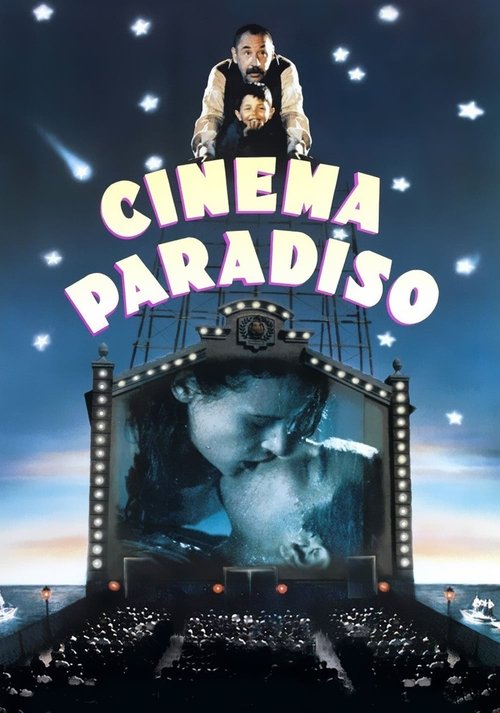
Cinema Paradiso
1988 · Giuseppe Tornatore
For when you need a good cry of the healing kind — a comfort film about why you love movies in the first place, ideal for watching with someone you miss.
What it's about
A successful filmmaker in Rome gets word that an old man from his Sicilian village has died, and the memories come flooding back: growing up as Totò, a fatherless boy obsessed with the movies at the village's one cinema, and his prickly, tender friendship with Alfredo, the projectionist who becomes his mentor and second father. It's a story about first love, a small town's shared life in the dark of a theater, and what you give up when you leave home.
The experience
Warm, funny, and openly sentimental — it earns your tears rather than stealing them, building through decades of village life to an ending famous for wrecking audiences. Ennio Morricone's score will follow you around for a week.
Performances
Philippe Noiret gives Alfredo a gruff, wounded tenderness that anchors the whole film, and young Salvatore Cascio is irresistible as the boy Totò — their double act is the movie's heart.
The craft
Tornatore stages the village cinema as a world unto itself — priests censoring kisses, whole social classes packed into one room laughing and weeping together — and Morricone's main theme is one of the most beloved pieces of film music ever written. The final sequence is a masterpiece of editing you shouldn't let anyone describe to you first.
Why it matters
Winner of the Academy Award for Best Foreign Language Film, it became a worldwide phenomenon and the modern standard for movies about loving movies — and a lasting elegy for the communal moviegoing it depicts.
Snapshot
A Sicilian filmmaker living in Rome receives word that the old projectionist of his village cinema has died. The news unlocks a cascade of memory: his childhood in the fictional village of Giancaldo, his obsession with the movies flickering through the booth of the Cinema Paradiso, and his formative friendship with the cantankerous, half-blind projectionist Alfredo. Nuovo Cinema Paradiso — released internationally as Cinema Paradiso — is simultaneously a bildungsroman, a love letter to the ritual of collective spectatorship, and an elegy for a vanishing institution. Its closing sequence, in which the adult Salvatore "Totò" Di Vita watches a reel of spliced-together censored kisses that Alfredo had secretly assembled for him, stands as one of the most celebrated endings in postwar world cinema. The film won the Academy Award for Best Foreign Language Film (1990) and the Jury Prize at Cannes (1989), transforming Tornatore from a promising Italian television director into an international figure.
Industry & Production
Cinema Paradiso was produced by Cristaldifilm, the company of veteran Italian producer Franco Cristaldi, in co-production with RAI, Italy's public broadcaster — a partnership that was typical of ambitious Italian prestige productions in the 1980s, when theatrical funding had grown increasingly precarious and television money had become structurally important to Italian filmmaking. Cristaldi had an illustrious track record stretching back to Visconti and Fellini's era, and his involvement lent the project credibility and resources unusual for a director whose prior feature, Il Camorrista (1986), had been a respectable but domestically focused crime film.
Tornatore shot the film primarily in Palazzo Adriano, a small town in the Palermo hinterland that stood in for the fictional Giancaldo. The film's theatrical centerpiece — the Cinema Paradiso itself — was constructed as a working set rather than simply dressed location, allowing the production to control the projection equipment, audience sightlines, and the visible decay of successive decades. Some exterior material was also shot in Bagheria, Tornatore's actual hometown, lending the project a degree of autobiographical topography. The village square, the projection booth, and the church where the village priest (a censor of screen kisses on moral grounds) views films before public screenings are all rendered with a specificity that suggests deep personal memory rather than generic Sicilian atmosphere.
The film's production history is inseparable from its complicated release. The version that premiered at Cannes in 1989 was substantially longer than the cut that reached most international audiences — the theatrical release ran approximately 123 minutes. A longer director's cut, restoring a major subplot concerning Totò's first love Elena and her role in his eventual permanent departure from Giancaldo, was released years later and runs considerably longer (some sources cite figures around 170 minutes, though the record on precise runtimes across regional versions is somewhat uneven). The restored subplot substantially changes the film's emotional logic and its characterization of Alfredo, making him a more morally complex figure. Most critical assessments and the film's canonical reputation were formed on the shorter cut.
Technology
The film's diegetic world encompasses nearly four decades of Italian exhibition history — from postwar 35mm nitrate projection through the eventual demolition of the Cinema Paradiso to make way for a car park. This span allowed the production design and props departments to assemble an unusually varied array of period projection technology, from the fire-prone carbon-arc systems that cause Alfredo's blinding accident to later xenon-lamp equipment. The nitrate fire sequence, in which the booth ignites and Alfredo is engulfed while young Totò raises the alarm, reconstructs a genuine hazard of mid-century exhibition that destroyed numerous small theaters across Italy and elsewhere — and it is one of the film's most viscerally researched passages.
Cinematographer Blasco Giurato shot on 35mm, deploying a palette of warm ambers and golds for the memory sequences that owes something to the Technicolor and Eastmancolor stock characteristics of the films being shown within the story. The choice to make the past warmer and the present cooler and more diffuse is not aggressively stylized — Giurato works with restraint — but it functions as a consistent visual grammar of nostalgia throughout.
Technique
Cinematography
Blasco Giurato, who had collaborated with Tornatore on Il Camorrista and would continue as his principal cinematographer through subsequent films, works here in a mode of controlled classicism. The camera is rarely ostentatious; compositions favour warm, shallow interiors — the booth, the church, the village square at night — and make expressive use of the projector beam itself as a practical source of light and a symbol of cinema's quasi-sacred mediation of reality. The Cinemascope-adjacent widescreen frame accommodates crowd scenes in the auditorium with a documentary instinct inherited (however distantly) from neorealism, while intimate two-shots between Totò and Alfredo are allowed to breathe without editorial intervention. There is no attempt to reproduce period-accurate cinematographic style for the flashback sections; the film reads as a contemporary remembering, not a recreation.
Editing
Mario Morra edited the film, and the structural challenge was considerable: the narrative spans roughly four decades across three distinct timeframes (childhood, adolescence, and adult return), with a present-tense frame set in Rome providing the nominal anchor. The transitions between time periods are handled cleanly rather than cleverly — dissolves and matched cuts rather than baroque formal conceits — which keeps the accumulating sentiment from tipping into manipulation. The editing of the film-within-the-film passages (excerpts from actual Italian and Hollywood productions playing at the Cinema Paradiso) requires careful calibration between the diegetic audience's reactions and the screen images, and Morra manages this with evident skill. The final sequence — the reel of kisses — is edited as a single sustained montage without musical interruption beyond the score, allowing each clip to land before the next arrives.
Mise-en-scène / Staging
Tornatore's staging consistently organizes the Cinema Paradiso around two focal points: the screen (which the audience faces) and the booth (from which Totò and Alfredo look back at both the screen and the crowd). This double perspective — projector and audience, boy and old man, past and present — governs the film's spatial grammar. The booth becomes a room of secrets, of pirated knowledge about cinema and about adulthood. The auditorium crowds, initially raucous and communal, thin over the years as television pulls viewers away, and Tornatore stages this depopulation with evident melancholy, using the same space at different densities to mark historical change. The church scenes, presided over by the priest-censor, add a third axis — institutional authority surveilling pleasure before releasing it — that the film does not press into allegory but allows to resonate.
Sound
Ennio Morricone's score is among the most recognized of his career, and its ubiquity has, for some critics, become inseparable from questions about the film's emotional transparency. The love theme (sometimes identified by the title "Se") and the main Paradiso theme are constructed in Morricone's late-romantic mode — melodic, harmonically uncomplicated, built for maximum emotional surface area. Andrea Morricone, Ennio's son, contributed arrangements and additional material. The score works in close alignment with picture rather than against it, amplifying emotional cues that the editing and performance already register. Whether this constitutes generosity or redundancy is a point of genuine critical debate. The ambient soundscape of the village — church bells, crowd noise, the mechanical clatter of the projector — is handled with care, and the inclusion of actual dialogue and music from the period films shown at the Cinema Paradiso (subject to licensing realities) grounds the diegetic world in actual cinema history.
Performance
Philippe Noiret's Alfredo is the film's moral and emotional center, and Noiret — a major figure in French and European art cinema — brings an authority and lived-in gruffness that prevents the character from becoming merely symbolic. His relationship with Salvatore Cascio (young Totò) is the film's core dynamic, and Cascio's performance as the obsessive, quick-witted child is notably unaffected — a quality that was widely remarked upon at the time of release. Marco Leonardi handles the adolescent Totò, and the transition between child and teenager is managed across a gap rather than through transformation scenes, which demands that both actors establish recognizable continuity of character. Jacques Perrin appears sparingly as the adult Salvatore, largely a receiving instrument for memory and feeling.
Narrative & Dramatic Mode
The film operates in the mode of retrospective memoir — the past is both recovered and inevitably constructed by the adult consciousness that frames it. Tornatore adopts what might be called a melodrama of duration: emotional payoff is structured across decades rather than acts, so that single images (the reel of kisses assembled by Alfredo) carry accumulated charge from everything that preceded them. The film's central relationship — between an orphaned boy and a surrogate father who teaches him to love and then to leave — follows the logic of the bildungsroman, but its final revelation (that Alfredo engineered Totò's departure, understanding that the village would otherwise swallow him) reframes the entire narrative as an act of deliberate renunciation by both mentor and pupil. In the shorter theatrical cut, this revelation is present but somewhat compressed; the director's cut develops it at length through the Elena subplot, which makes Alfredo's interference more active and morally ambiguous.
Genre & Cycle
Cinema Paradiso belongs to a cluster of late-1980s European films concerned with nostalgia, lost community, and the texture of collective memory — films that John Hill and others have grouped under the loosely applied term "heritage cinema," though that category was theorized primarily around British films of the same period. The Italian equivalent draws on an older tradition: Federico Fellini's Amarcord (1973) is the most obvious precursor, sharing the Emilian/Sicilian village setting, the episodic structure of memory, and the use of collective spectacle (the cinema, the Rex) as an index of community feeling. Tornatore's film is less formally experimental than Fellini's, more invested in individual psychological continuity, and more straightforwardly sentimental — differences that mark a shift from the art cinema of the 1960s–70s toward a more accessible emotional register.
The film also participates in a specifically Italian tradition of reflexive cinema — films about film, about projection, about the experience of spectatorship — though it does so without the intellectual self-consciousness of, say, Nanni Moretti's contemporaneous work. It is a love letter rather than a critique.
Authorship & Method
Giuseppe Tornatore (b. 1956, Bagheria, Sicily) wrote the screenplay himself, and the film's autobiographical dimensions are extensively documented in interviews, though specific correspondences between narrative events and biographical fact remain Tornatore's private account. He began his career as a photojournalist and documentary filmmaker before moving to narrative features, and a documentary instinct — an attention to social texture and ambient life — persists in his approach to the village scenes. Cinema Paradiso established the collaborators who would define his mature style: Giurato behind the camera, Morricone composing (across multiple subsequent films), and a preference for epic narrative spans that test the tolerance of international distributors.
The producer-director relationship with Franco Cristaldi appears to have been productive but not without tension, particularly around questions of length — the cutting of the original version was a source of documented frustration for Tornatore, though the specifics of who made which decisions have been characterized differently in different accounts.
Movement / National Cinema
By 1988, Italian cinema was in a period of institutional contraction and international marginalization — the neorealist tradition and its auteur descendants (Rossellini, Visconti, Fellini, Antonioni) had largely receded, and Italian genre cinema (the spaghetti western, the giallo, the poliziottesco) had peaked and was declining. The prestige production model, dependent on RAI co-financing and festival positioning, had become the dominant route for serious filmmaking, and Cinema Paradiso is a product of this structure. It looks back at Italian neorealism's Sicilian settings (De Sica's postwar poverty, Visconti's La terra trema) from a position of elegiac distance, aware that the world those films documented has passed. The film's enormous international success — particularly in France, where Noiret's presence was commercially significant, and in the United States — was unusual for Italian productions of the period and briefly renewed interest in Italian filmmaking abroad.
Era / Period
The film was made in the final years of the Cold War, during a period of Italian political turbulence and cultural anxiety about national identity and the homogenizing effects of television and later video. The Cinema Paradiso's eventual demolition — the theater blown up to make room for a car park — functions as a figure for these broader transformations, though Tornatore does not press the allegory heavy-handedly. The film was released into a European art-house market in transition, as multiplexes expanded and the single-screen village cinema became an endangered form. Its subject was, in this sense, directly topical as well as historical.
Themes
Memory and its unreliability; the mentor-student relationship and the necessity of departure; the cinema as communal ritual, as substitute family, as site of collective dreaming; the costs of ambition and geographical displacement; the erotics of the gaze (both the child's gaze at the screen and the more complicated gaze between Totò and Elena); institutional censorship and the persistence of what is suppressed; the irreversibility of time and the consolations art offers against it. The film does not develop these thematically so much as it accumulates them through accumulation of incident and image — the meaning is embedded in the texture of scenes rather than stated through dialogue or symbolism. Alfredo's accumulated aphorisms ("Get out. Don't come back. Don't write. Don't give in to nostalgia") are the film's nearest approach to explicit thematic statement, and they carry weight precisely because they are advice that the film's own form systematically violates.
Reception, Canon & Influence
Influences on the film: The shadow of Fellini's Amarcord is the most consistently cited precursor — the Adriatic/Mediterranean village as a space of collective memory, the episodic accumulation of character and incident, the elegiac narration of a world seen in retrospect. François Truffaut's semi-autobiographical mode (particularly Les Quatre Cents Coups) informs the treatment of the cinephile boy-protagonist and his complicated relationship with adult authority. More broadly, the film inherits from Italian neorealism's Sicilian strand a sense of place as social texture rather than mere backdrop. The films shown within the film — Italian productions and Hollywood imports of the 1940s and 50s, whose stars and genres are fleetingly identifiable — constitute an implicit canon that Tornatore treats with reverent affection.
Critical reception: At Cannes in 1989, the Jury Prize was a meaningful endorsement; the subsequent Academy Award gave the film extraordinary reach. Critical reception in the English-language press was largely warm, with reviewers foregrounding the film's emotional power and Morricone's score. Some dissent — from critics who found the sentimentality excessive and the nostalgia politically unexamined — has remained a minority but consistent position; the film has been used as a touchstone in debates about whether emotional directness in cinema constitutes manipulation or honest affect. In Italy, initial reception was more equivocal, partly because the shorter theatrical cut had been poorly received before the film's international success reframed its domestic reputation.
Legacy and forward influence: Cinema Paradiso effectively created or consolidated a template for the "cinema about cinema" film as a vehicle for mainstream emotional experience rather than reflexive formal inquiry — a development that distinguishes it from earlier meta-cinematic European work. Films like Martin Scorsese's Hugo (2011), though set in a different national and historical context, share its conviction that love for the projected image can carry the weight of a major dramatic narrative. The kissing reel finale has been widely imitated and cited, entering the vocabulary of film culture as a shorthand for cinema's capacity to condense and release accumulated feeling. The film appears regularly in lists of the most beloved films of its decade and has sustained a large non-specialist audience through home video and streaming in a way that few foreign-language films of its generation have managed. Tornatore's subsequent career — including Malèna (2000) and The Best Offer (2013) — has not produced another film of comparable impact, and Cinema Paradiso remains his defining work.
A Deleuzian reading
A grown man sits alone in a private screening room.
The full Deleuzian reading of Cinema Paradiso →
Reception
It flopped so badly on its initial Italian release that it was pulled from theaters — then a re-edited, half-hour-shorter cut won the Grand Prix at Cannes 1989 and the Best Foreign Language Film Oscar, turning a domestic failure into a global phenomenon.
How Cinema Paradiso was received, from release to now →
Influences: the films it descends from and the films it influenced
- Amarcord (1973) — Fellini establishes the small-Italian-community-as-collective-protagonist form, staging the open-air cinema in the piazza as the focal object of communal fantasy; Tornatore concentrates this dispersed spectatorship inside a single auditorium institution, making the social function of cinema explicit where Fellini left it ambient across the whole town.
- 8½ (1963) — Fellini's Italian filmmaker-surrogate uses retrospective memory and fantasy as formally indistinguishable raw material for autobiographical reconstruction; Tornatore's adult Totò — himself a filmmaker in Rome — inherits the confessional structure in which cinema-making is the coded language of personal excavation, not merely the film's subject.
- Once Upon a Time in America (1984) — Leone and Morricone develop a multi-decade retrospective elegy in which the score functions as the primary mechanism of temporal transport — the theme returning to activate memory before images do; Tornatore employs the identical architecture, letting Morricone's Cinema Paradiso theme carry cumulative grief across decades that editing transitions alone cannot sustain.
- Bicycle Thieves (1948) — De Sica structures the surrogate father-son bond around vocation, making skill-transmission — how to maintain a bicycle, how to read a crowd — the grammar of non-biological paternal love; Tornatore inherits this lexicon directly, with Alfredo teaching Totò projection as Ricci teaches Antonio the bicycle trade, occupational mentorship standing in for familial inheritance.
- Fanny and Alexander (1982) — Sven Nykvist's candlelit amber interiors across a theatrical-family saga establish the warm practical-source cinematographic language for childhood memory-as-warmth; Bergman's child-protagonist at the center of a performative institution whose magic protects against adult grief prefigures Totò's relationship to the Cinema Paradiso as sacred shelter.
- The Purple Rose of Cairo (1985) — Allen stages the small-town cinema auditorium as a space of bidirectional desire where the spectator's gaze becomes the dramatic subject; Tornatore extends this reflexive booth-screen staging to include the projection apparatus itself, making the projectionist the relay between spectator desire and screen image — the third term Allen left offscreen.
- Day for Night (1973) — Carries forward the theme of cinema-as-utopian-labor and the critic-turned-lover-of-film sensibility, sentimentalizing into the projection booth the same devotional cinephilia Truffaut literalizes with the parcel of directors' monographs.
- We All Loved Each Other So Much (1974) — Extends the cinema-and-life theme into elegy, making the movie-house and its spliced footage the literal vessel of personal memory and postwar Italian loss.
- Bellissima (1952) — Italian reflexive ode organized around the projection booth, echoing Bellissima's projection-room climax as the site where cinema's illusion is both loved and unmasked.
- Twenty-Four Eyes (1954) — Builds a decades-spanning nostalgic chronicle organized by departure-and-return and by a single recurring musical leitmotif, embracing the same sentiment-as-method that Kinoshita's detractors called three-handkerchief.
- Il Postino (1994) — Directly inherits Cinema Paradiso's warm amber Mediterranean palette, its cross-generational male mentor-apprentice friendship structured around a cultural vocation (poetry / cinema), and its Morricone-adjacent score architecture (Luis Bacalov's winning score); the episodic accumulation of shared creative acts as a substitute for spoken intimacy replicates Tornatore's emotional grammar exactly.
- Malèna (2000) — Tornatore restages Cinema Paradiso's formal apparatus — same Sicily, same Morricone score, same retrospective boy-narrator — redirecting the projector-beam-as-desire metaphor from the cinema screen to a woman's body observed by a hidden male spectator; a direct working-through of the erotic subtext latent in Totò's booth-assisted spectatorship.
- The Dreamers (2003) — Bertolucci stages cinephile spectatorship as explicitly erotic and bodily, with characters reenacting memorized film stills in extended screen-mirroring sequences that extend Cinema Paradiso's reflexive cinema mode into an overtly libidinal register; the forced Cinémathèque closure as the rupture of a cinephile community directly echoes the Cinema Paradiso's demolition as collective loss.
- Hugo (2011) — Scorsese transplants Cinema Paradiso's orphaned-child-in-projection-booth structure to the Gare Montparnasse — a boy maintaining hidden mechanical apparatus in a public gathering space — with Georges Méliès as the Alfredo-surrogate whose hidden gift is revealed through a final reel assembly; Robert Richardson's amber practical-source lighting directly acknowledges Giurato's precedent.
- The Artist (2011) — Hazanavicius uses a sepia-warm palette as a consistent grammar of nostalgic historical distance and structures the film's emotional logic around a performer who cannot survive the death of his exhibition technology; the elegiac register directed at a transitional cinema format — and the sustained formal homage to that format's visual grammar — is Cinema Paradiso's direct inheritance.
- Belfast (2021) — Branagh renders the local cinema in color against an otherwise black-and-white world, making it the singular warm anchor of collective community identity in a memoir of dissolution; the retrospective adult narrator reconstructing a lost childhood through a formative cinema experience directly descends from Cinema Paradiso's formal grammar of warm projected light as the index of what was irreversibly lost.
- The Eight Mountains (2022) — A decades-spanning male friendship structured around departure from and return to a rural homeland, using aging across time and nostalgia as its formal spine.
- My Father and My Son (2005) — Supplies the template of the music-saturated memory-melodrama, where a recurring Mediterranean leitmotif and a nostalgic frame narrative do the emotional heavy lifting, cueing the audience to weep on schedule.
- A Man Called Ove (2015) — Cross-cuts a bereaved present against a warmly-lit, score-saturated past so a sentimental melodic theme does the emotional lifting across the timeline split.
- The Hand of God (2021) — Models the Italian 'birth-of-a-filmmaker' memoir in which a boy's regional childhood and a mentor's provocation ('go and don't come back') propel him toward cinema — the origin-of-the-artist arc Sorrentino restages via the Capuano confrontation.
- The Fabelmans (2022) — Cinephilia-as-formation narrated through a mentor in the projection booth; the boy's love of the apparatus itself as the engine of the Künstlerroman, a direct forerunner to the Boris/Uncle-Boris art-versus-family axis.
- Son of the Bride (2001) — Demonstrates the elegiac-score-plus-nostalgic-warm-interiors formula, using a swelling melodic theme over remembered spaces to convert one man's private memory into collective audience feeling — the emotional-delivery machine Illarramendi's score serves here.
- Au Revoir Les Enfants (1987) — Both films are retrospective childhood memoirs structured around an institutional setting and a formative male friendship terminated by external authority; Malle's warm-lit classroom and dormitory interiors achieve the same formal grammar as Tornatore's booth — physical warmth as the visual register for grief that neither the child nor the adult narrator can speak directly.
- My Life as a Dog (1985) — Hallström uses retrospective adult voice-over to encode a child's displacement into a rural community with surrogate family figures, shot in warm amber northern light that functions identically to Giurato's memory palette; both films use the narrating adult's belated comprehension — understanding only from adult distance what the child could not process — as their central emotional mechanism.
- Stand by Me (1986) — Reiner frames childhood retrospection through an adult professional storyteller (the writer at his keyboard, encoding loss into language) whose vocation makes the act of remembering itself reflexively visible; both films identify their adult protagonists as makers of narrative — filmmaker, writer — and use that identity to meta-frame the elegy as conscious reconstruction rather than involuntary flashback.
- The Mission (1986) — Scored by Morricone in the same period, it shares the lush, theme-driven orchestral idiom — long melodic lines carrying emotional irresolution — that made the Mission score a crossover concert-hall standard.
- Lisbela and the Prisoner (2003) — Ancestor of the movie house as provincial communal ritual: the small-town theater as an emotional civic center whose romance of projection and audience Lisbela inherits and localizes to the Northeast.
- My Sweet Orange Tree (2012) — Tornatore's central device — an intergenerational friendship between a boy and a lonely older man, staged in golden mid-century period reconstruction and mourned elegiacally — is the direct structural cousin of Zezé and Portuga's bond.
- When Father Was Away on Business (1985) — Sensory, nostalgic childhood-memoir structure with an elegiac score, framing an adult's remembered small-town boyhood as emotional architecture.
- Kaos (1984) — Trades in the same Sicilian light and elegiac regional memory, structuring the film as an inheritance recalled — the mother-and-return and land-and-belonging chords Kaos strikes in its Colloquio epilogue.
- The Long Day Closes (1992) — Tornatore's contemporaneous hymn to childhood moviegoing enshrines projection as sacrament through clip-montage, sharing Davies's theme of cinema as sacred working-class refuge.
Similar films
- Amarcord (1973) — influence & lineage · same viewing thread
- 8½ (1963) — influence & lineage · same viewing thread
- Au Revoir les Enfants (1987) — influence & lineage · same viewing thread
- Bicycle Thieves (1948) — influence & lineage
- The Purple Rose of Cairo (1985) — influence & lineage
- The Virgin Suicides (2000) — same viewing thread · often watched together
- The Postman (1994) — influence & lineage · same viewing thread
- Call Me by Your Name (2017) — same viewing thread
All the films related to Cinema Paradiso →
Watch it with: curated runs of related films
- The Past Is a Foreign Country — A run of films that reach back through memory — lost summers, vanished friends, the golden light of a place you can never return to — best watched in a row when you're in the mood to ache a little.