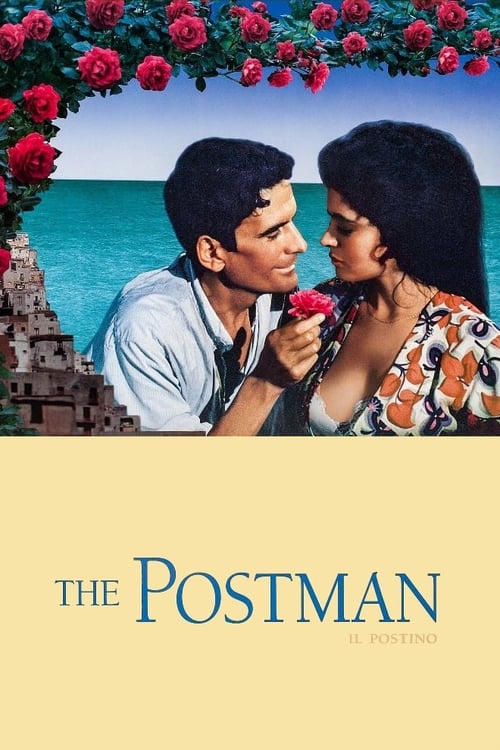
The Postman
1994 · Michael Radford
For a tender night in when you want to fall in love — with a person, a place, or language itself. Comfort viewing that will likely leave you misty; keep a tissue nearby.
What it's about
On a small Italian island in the early 1950s, a famous exiled Chilean poet — Pablo Neruda — arrives to wait out his banishment, and a shy fisherman's son named Mario takes a job as his personal postman. Pedaling letters up the hill each day, Mario slowly absorbs poetry, and with it the nerve to court Beatrice, the most beautiful woman in the village. A friendship grows that will quietly change how he sees words, love, and his own island.
The experience
Warm, gentle, and sun-drenched, with humor that sneaks up on you and an ache that arrives late and stays. It's unhurried in the best way — a film that teaches you to notice things, then rewards you for it.
Performances
Massimo Troisi is heartbreaking as Mario — hesitant, funny, and luminous with feeling — a performance made more poignant by the fact that it was his last. Philippe Noiret matches him with wry, fatherly warmth as Neruda.
The craft
The filmmaking is simple on purpose: sunlit island landscapes, patient two-hander scenes, and Luis Bacalov's beloved, Oscar-winning score doing the emotional heavy lifting. The script turns lessons about metaphor into flirtation, comedy, and quiet political awakening without ever feeling like a lecture.
Why it matters
A word-of-mouth phenomenon that became one of the most widely seen foreign-language films of the 1990s and a rare subtitled crossover hit with mainstream Oscar recognition.
Snapshot
The Postman—released internationally under its Italian title Il Postino—is a deceptively modest fable about poetry, friendship, and political awakening that became one of the most widely seen foreign-language films of the 1990s. Adapted from the Chilean writer Antonio Skármeta's novel Ardiente paciencia (later reissued as El cartero de Neruda), the film transplants its source from Skármeta's native Chile to a sun-bleached Italian island in the early 1950s, where the exiled Chilean poet Pablo Neruda takes temporary refuge. The story belongs to Mario Ruoppolo, an unemployed fisherman's son who takes a job delivering mail to the island's single famous resident and, through their tentative friendship, discovers metaphor, desire, and a dawning political consciousness. The film is inseparable from the circumstances of its making: its star, co-writer, and animating spirit, the beloved Neapolitan comic Massimo Troisi, postponed urgent heart surgery to complete the shoot and died of a heart attack the day after filming wrapped. That biographical shadow lends the finished work an almost unbearable poignancy and has shaped its reception ever since. Nominated for five Academy Awards—including Best Picture and a posthumous Best Actor nod for Troisi—and a winner for Luis Bacalov's score, Il Postino stands as a late high-water mark of the international art-house crossover, an unashamedly sentimental humanist picture that nonetheless treats its subjects—poetry, Communism, the inarticulate longings of an ordinary man—with disarming sincerity.
Industry & production
Il Postino was an Italian-French-Belgian co-production, assembled through a constellation of European companies (the principal Italian producers were associated with Cecchi Gori Group Tiger Cinematografica, with Mario and Vittorio Cecchi Gori among the producing figures, alongside French and other partners). The project originated with Troisi, who had read Skármeta's novel and acquired the rights, intending it as a vehicle for himself; his production company Esterno Mediterraneo Film was central to its development. The decision to bring in the British director Michael Radford—an Anglo-Italian filmmaker who spoke Italian and had earlier directed Another Time, Another Place and the well-regarded Nineteen Eighty-Four (1984)—gave the production a cross-cultural authorship unusual for an Italian literary adaptation.
The defining production fact is medical. Troisi was gravely ill with a congenital heart condition; he had reportedly been advised to undergo a transplant or surgery but chose to delay it until the film was finished, working a restricted schedule with a body double used for some physically demanding shots and long-lens setups. He died on 4 June 1994, the day after principal photography concluded. The film was therefore completed and edited in the knowledge of its star's death, and released posthumously. The American distribution by Miramax—then at the height of its powers as a marketer of foreign and independent film for Oscar contention—was decisive in turning a small European picture into a global success and a multiple Academy Award nominee, an outcome that itself became a case study in how aggressive specialty distribution could reshape the fortunes of an art film.
Technology
Il Postino is, technologically, a conventional mid-1990s 35mm production, and its restraint is part of its character. There is no ostentatious technical apparatus; the film relies on traditional photochemical cinematography, available and naturalistic lighting weighted toward the Mediterranean sun, and location sound supplemented by the standard Italian practice of post-synchronized dialogue. The film predates the digital-intermediate era, and its visual texture—warm, grainy, slightly faded, like a sun-worn postcard—derives from film stock and printing rather than digital grading. If there is a "technology" worth naming, it is the discreet logistical engineering required by Troisi's condition: the scheduling, doubling, and coverage strategies that allowed an ailing actor to carry a leading role. The record on the precise technical accommodations is thin, and beyond the well-documented use of a double for certain shots, one should not overstate specifics.
Technique
Cinematography
The cinematography by Franco Di Giacomo is the film's most consistently praised craft element. Di Giacomo renders the island in a palette of bleached blues, ochres, and dusty terracottas, favoring wide compositions that set the small human figures against sea, sky, and volcanic rock. The camerawork is unhurried and classical—long takes, gentle reframings, an avoidance of montage-driven energy—matching the film's tempo to the slow rhythms of island life and the patient cadence of Mario's education. Light is treated as a near-thematic element: the glare of midday, the gold of late afternoon, the way sun on water becomes a visual rhyme for the "metaphors" Neruda teaches Mario to see. The filming locations—chiefly the Aeolian island of Salina and, for some sequences, Procida in the Bay of Naples—supply a landscape that is both specific and mythic, a generalized Mediterranean South rather than a documentary place.
Editing
Roberto Perpignani's editing serves the film's deliberate, conversational pace. Scenes are allowed to breathe; the cutting privileges the rhythm of dialogue and the slow ripening of the friendship between postman and poet over any imposed dramatic acceleration. The editing's tact is also, inevitably, an act of reconstruction: assembling a complete performance from an actor who could only work in limited bursts, and shaping a coherent, emotionally legible whole in the aftermath of Troisi's death. The seamlessness of the result—the absence of any sense of compromise or patchwork in the finished performance—is itself a quiet achievement of the cutting room.
Mise-en-scène / staging
The film's visual world is built from a handful of recurring spaces: the dusty road and the bicycle; Neruda's rented villa with its terrace over the sea; the village trattoria where Beatrice works; the post office; the rocky coves and beaches. Production design keeps everything period-plausible for the early 1950s without fetishizing detail, and the staging tends toward two-handed intimacy—Mario and Neruda walking, sitting, talking—interrupted by the communal life of the village. The bicycle, the mailbag, and eventually a reel-to-reel tape recorder (with which Mario records the island's sounds for the absent poet) function as recurring objects that organize the staging and carry the film's emotional freight.
Sound
Sound is thematically foregrounded to an unusual degree. The film's most celebrated conceit—Mario recording the sounds of the island, "the waves, large and small," the wind, the church bells, his unborn child's heartbeat—turns ambient sound into an expression of love and a kind of folk poetry, a poignant inversion of Neruda's literary art. In keeping with Italian convention, dialogue is largely post-synchronized, and the film's auditory texture is carefully composed rather than raw. Above all, sound means Luis Bacalov's score (see below), whose principal theme is among the most recognizable in 1990s art-house cinema.
Performance
The film is, finally, an actors' picture, and its center is Troisi. His Mario is a study in inarticulacy made expressive: a slumped, shy, faintly hangdog figure whose face registers wonder, confusion, and longing in tiny increments. Knowledge of the actor's illness inflects every frame—the visible fragility, the economy of movement—but the performance is never merely a matter of pathos; Troisi's gift for understated comedy keeps Mario human and funny, and his timing as a writer-performer shapes the role from within. Opposite him, Philippe Noiret's Neruda is genial, worldly, and warm, a benevolent giant whose patience with Mario carries the film's faith in the democratizing power of poetry. (Noiret, a French actor, was dubbed into Italian.) Maria Grazia Cucinotta's Beatrice supplies the earthy object of Mario's desire, and Linda Moretti, as her watchful aunt, provides comic ballast.
Narrative & dramatic mode
The film's dramatic mode is the Bildung-fable: a simple protagonist undergoes an education of the sensibility through contact with a mentor. Its engine is conversation rather than incident, and its structure is a gentle accumulation of small encounters—mail deliveries that become lessons in metaphor, language, and feeling. The central irony, played for both comedy and tenderness, is that Mario uses the poet's gift to woo Beatrice, "stealing" Neruda's metaphors before learning to make his own. Beneath the romance runs a quieter, political coming-of-age: Mario's growing identification with the working-class and Communist sympathies that Neruda embodies, culminating in an off-screen tragedy whose restraint—the film withholds and reports rather than dramatizes its climax—gives the ending its devastating force. The tonal register is bittersweet comedy modulating into elegy, and the film earns its sentiment largely through specificity and underplaying rather than overt manipulation, though it is unembarrassed by emotion.
Genre & cycle
Il Postino sits at the intersection of romantic comedy, literary-historical drama, and the "mentor and pupil" inspirational film. It belongs to a recognizable cycle of 1980s–90s European art films that achieved international crossover by combining nostalgia, accessible humanism, and picturesque regional settings—company that includes Cinema Paradiso (1988), Mediterraneo (1991), and the broader vogue for sun-warmed Italian nostalgia that Miramax and other specialty distributors successfully marketed to English-language audiences. It also participates in the durable subgenre of films about the encounter between a great artist and an ordinary person, and in the tradition of literary biopic-adjacent fictions that use a real cultural figure (here Neruda) as a catalyst for an invented protagonist's story.
Authorship & method
Authorship of Il Postino is genuinely shared. Michael Radford directed and is credited as a co-writer; his bilingual, cross-cultural sensibility shaped the adaptation, and he completed the film after Troisi's death. But the project's originating author is Massimo Troisi, who brought the material to the screen, co-wrote it, and is inseparable from Mario. The screenplay is credited to a team that included Radford, Troisi, Anna Pavignano (a longtime Troisi collaborator), and the veteran screenwriters Furio Scarpelli and Giacomo Scarpelli—Furio Scarpelli being one of the great names of Italian screenwriting, a pillar of the commedia all'italiana tradition through his decades-long partnership with Age. The source is Antonio Skármeta's novel, itself rooted in the historical fact of Neruda's European exile in the early 1950s, though Skármeta's original was set in Chile; the relocation to Italy is the film's central act of adaptation.
Among collaborators, the composer Luis Bacalov—an Argentine-Italian who had scored spaghetti Westerns and worked within Italian popular cinema—contributed the score that won the film's sole competitive Oscar, its mandolin-and-strings theme functioning almost as a second narrator of melancholy. Cinematographer Franco Di Giacomo and editor Roberto Perpignani (the latter a distinguished figure who had cut films for Bertolucci and the Taviani brothers, among others) round out a crew of seasoned Italian craftspeople. The method, then, blends an outsider-director's framing with deep roots in Italian filmmaking tradition.
Movement / national cinema
The film is best understood within Italian national cinema's late-century turn toward accessible, emotionally generous, internationally legible storytelling—a sensibility sometimes characterized (not always admiringly) as a "new Italian humanism" that followed the exhaustion of the postwar auteurist and neorealist traditions. Its lineage reaches back, in spirit if not in style, to neorealism's attention to ordinary working people and Southern landscapes, and to commedia all'italiana by way of the Scarpelli pedigree and Troisi's own background as a Neapolitan comic. Yet it is not a neorealist film: its world is gentler, more lyrical, and more nostalgic, closer to the affectionate mythologizing of the South found in Cinema Paradiso. As a co-production with a British director, it also belongs to the increasingly transnational European art cinema of the period, designed—successfully—to travel.
Era / period
Il Postino is doubly periodized. As an artifact, it is a film of the mid-1990s, the era of the Miramax-driven foreign-language crossover and the prestige specialty release. As a depicted world, it is set in the early 1950s, anchored to the historical moment of Pablo Neruda's exile from Chile and his sojourn in Italy (he stayed on Capri in this period). The 1950s setting matters thematically: it places Mario's political awakening against the backdrop of postwar Italian Communism and class struggle, and it lends the film a layer of mid-century nostalgia—the bicycles, the fishing economy, the not-yet-modernized island—that is integral to its emotional appeal. The film treats this period with affectionate, slightly idealized distance rather than rigorous historical reconstruction.
Themes
The film's governing theme is poetry as a democratic and transformative force—the idea that metaphor and language belong not to the educated elite but to anyone who learns to see. From this flow its other concerns: love and desire (Mario's courtship of Beatrice); friendship across the boundaries of class and culture (the postman and the world-famous poet); and political awakening, as Mario's aesthetic education becomes inseparable from a solidarity with the laboring poor and the Communist ideals Neruda represents. Sound and nature recur as motifs—the island's recorded "music" as a form of love and memory. And running beneath everything is mortality and absence: the poet's departure, the protagonist's fate, and—unavoidably, for any viewer who knows the story of its making—the death of Troisi himself, which the film seems to anticipate and absorb into its elegiac final movement.
Reception, canon & influence
Critically and commercially, Il Postino was a substantial success, particularly in the English-speaking market, where Miramax's campaign and the human-interest power of Troisi's story propelled it to rare prominence for a subtitled film. It received five Academy Award nominations—Best Picture, Best Director (Radford), Best Actor (Troisi, awarded posthumously, an unusual honor), Best Adapted Screenplay, and Best Original Dramatic Score—and won for Luis Bacalov's score. That Best Picture nomination for a foreign-language film was, at the time, a notable rarity and a marker of the film's crossover reach. It also drew significant attention at the BAFTAs and other awards bodies; the precise tally there I would not want to assert from memory, but its strong showing in the 1995–96 awards season is well established.
The influences on the film run backward to Skármeta's novel and the historical Neruda, to the humanist and neorealist strains of Italian cinema, to the commedia all'italiana tradition carried by Scarpelli and Troisi, and to the immediate commercial model of Cinema Paradiso's international success. Its influence forward is more about consolidation than innovation: it confirmed and intensified the mid-1990s market for warm, nostalgic, prestige-marketed foreign-language films and demonstrated the power of specialty distribution to win mainstream awards recognition for subtitled cinema. Its most enduring legacy, however, may be cultural rather than strictly cinematic—it introduced a vast international audience to Pablo Neruda, reportedly driving renewed interest in his poetry, and it became permanently entwined with the story of Massimo Troisi's sacrifice, so that the film endures less as a stylistic landmark than as a beloved, tender monument to its dying star.
A Deleuzian reading
Near the end, the poet is gone, and the postman wants to send him a gift.
The full Deleuzian reading of The Postman →
Reception
A word-of-mouth arthouse phenomenon in 1995 that rode a legendary Miramax campaign to five Oscar nominations — including Best Picture, almost unheard of for a foreign-language film — it's now remembered less as an awards juggernaut and more as a gentle, grief-tinged classic inseparable from its star's death.
How The Postman was received, from release to now →
Influences: the films it descends from and the films it influenced
- Cinema Paradiso (1988) — Supplies the working template Il Postino follows—a mentor-pupil bond between a weathered older man and a naive youth, underscored by a sentimental mandolin/strings theme functioning as a 'second narrator,' packaged as nostalgic prestige foreign-language crossover.
- Bicycle Thieves (1948) — Establishes the neorealist method of dignifying a humble working man through real-location shooting and drama built from small daily errands and recurring objects rather than plot, the humanist substrate Mario the postman descends from.
- La Terra Trema (1948) — Models shooting a Southern Italian island fishing community on actual locations with near-nonprofessional rhythms and wide coastal landscape compositions, the visual grammar of Procida that Di Giacomo's camera inherits.
- I soliti ignoti (Big Deal on Madonna Street) (1958) — Furio Scarpelli's commedia all'italiana screenwriting method—mining pathos and dignity from inarticulate, gently comic underdogs—is the same authorial DNA Scarpelli brings to the character of Mario.
- Il Sorpasso (1962) — The commedia all'italiana two-hander in which a worldly, voluble mentor reshapes a shy, reticent younger man across a sun-struck coastal landscape—the relational engine of Neruda and Mario.
- We All Loved Each Other So Much (1974) — Scarpelli's bittersweet humanism, where comedy curdles into melancholy and loss, prefigures Il Postino's withheld, mournful climax beneath its warm surface.
- L'avventura (1960) — Pioneers the Mediterranean-island long-take and wide landscape composition organized around a deliberately displaced, withheld climax—the formal device behind Mario's off-screen fate.
- Ricomincio da tre (1981) — Troisi authors here the hesitant, mumbling, understatedly inarticulate Neapolitan everyman persona—the performance grammar he carries directly into Mario.
- Love and Anarchy (1973) — Built as a late showcase for Giannini's tender comic-melancholic screen presence, extending the Wertmüller-honed use of his expressive close-up face in a love-versus-politics register.
- Life Is Beautiful (1997) — Extends Il Postino's fusion of commedia all'italiana tenderness with looming tragedy to win major Academy recognition for a subtitled film, consolidating the prestige-foreign market Il Postino opened.
- Malèna (2000) — Continues the nostalgic Italian-island bildung fable filtered through a boy's coming-of-age gaze, with a Morricone score deployed as narrating voice in the manner Il Postino reinforced.
- The Gospel According to St. Matthew (1964) — Luis Bacalov's scoring craft—folk-inflected melodic lines acting as an emotional narrator—originates in his work here and resurfaces as Il Postino's Oscar-winning theme.
- Django (1966) — Bacalov's spaghetti-western scoring method of a single plaintive, hummable theme carrying the film's grief is the same compositional approach he applies to Mario's melancholy.
- Padre Padrone (1977) — Editor Roberto Perpignani cuts a rural island fable of a near-mute, illiterate man acquiring language and selfhood, the dialogue-paced, pedagogical rhythm he later brings to Il Postino.
- The Night of the Shooting Stars (1982) — Perpignani's editing of lyrical rural Italian humanism—memory-shaped reconstruction and unhurried landscape cutting—shares the craftsman's hand that shaped Il Postino's tempo.
- The Crow (1994) — The same-year case of posthumous reconstruction—completing a film around a star who died during production via doubles, dubbing, and editorial sleight—exactly the technical problem Radford solved after Troisi's death.
- Dead Poets Society (1989) — The mentor-pupil drama in which poetry awakens an inarticulate young man, the charismatic-tutor structure paralleling Neruda's tutelage of Mario.
- Mediterraneo (1991) — A contemporaneous new-Italian-humanism Oscar winner trading on sun-drenched island light and gentle ensemble warmth, the same crossover register Il Postino exploits.
Similar films
- Cinema Paradiso (1988) — influence & lineage · same viewing thread
- We All Loved Each Other So Much (1974) — influence & lineage · same viewing thread
- Mediterraneo (1991) — influence & lineage
- Life Is Beautiful (1997) — influence & lineage
- Bicycle Thieves (1948) — influence & lineage
- The Hand of God (2021) — same viewing thread
- Call Me by Your Name (2017) — same viewing thread
- Nostalgia (1983) — same viewing thread
All the films related to The Postman →
Watch it with: curated runs of related films
- The Past Is a Foreign Country — A run of films that reach back through memory — lost summers, vanished friends, the golden light of a place you can never return to — best watched in a row when you're in the mood to ache a little.