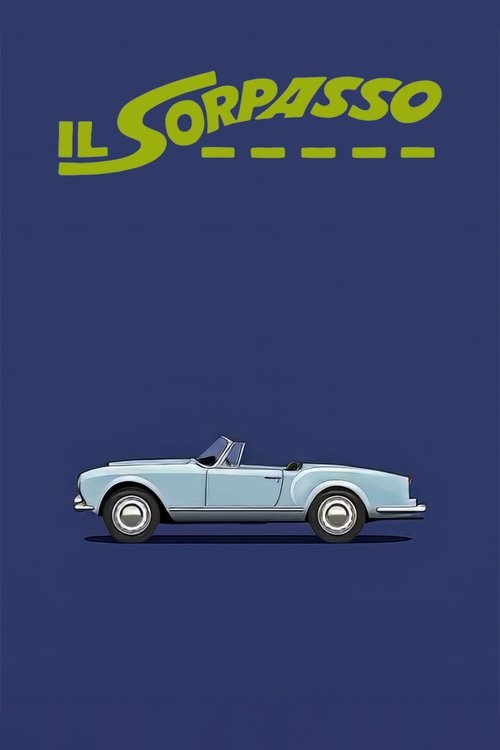
Il Sorpasso
1962 · Dino Risi
For when you want summer in a bottle — a fast, funny ride with real weight hiding in the trunk. Choose it when you're up for a comedy that isn't only a comedy.
What it's about
On a deserted August holiday weekend in Rome, Roberto, a shy law student, is swept up by Bruno, a loud, charming, forty-year-old force of nature in an open sports car. What starts as a favor becomes an impromptu road trip up the coast — bars, beaches, flirtations, family visits — as the two men's opposite natures rub against each other mile after mile.
The experience
For most of its running time it's sun-drunk and effortlessly funny, all speed and chatter and seaside light — but something melancholy keeps flickering underneath, and the film's high spirits gradually reveal their cost. It leaves a mark you don't see coming.
Performances
Vittorio Gassman is magnetic as Bruno — a life-of-the-party performance with self-delusion visible around the edges — and Jean-Louis Trintignant's quiet, watchful Roberto is the perfect foil, saying with a glance what Bruno drowns in talk.
The craft
Risi shoots the open road with irresistible momentum — the Lancia convertible, pop songs blasting from the dashboard, black-and-white coastline flying past — while the script keeps sharpening its comedy into social observation. The tonal control, letting farce and sadness share the same frame, is the film's real feat.
Why it matters
A cornerstone of the great Italian comedy tradition and the defining road movie of Italy's postwar boom years, its two-mismatched-men-on-the-highway blueprint echoes through decades of road films that followed.
Snapshot
Il Sorpasso ("The Overtaking," released in English variously as The Easy Life) is the defining road movie of the Italian economic miracle and one of the cornerstone works of commedia all'italiana. Over a single Ferragosto weekend in a deserted August Rome, the brash, middle-aged Bruno Cortona (Vittorio Gassman) sweeps up the shy, bookish law student Roberto Mariani (Jean-Louis Trintignant) and carries him off on an impromptu drive up the Tyrrhenian coast in an open Lancia Aurelia convertible. What begins as sunlit farce — chatter, flirtation, food, twist records blaring from the dashboard — curdles into a study of Italian character and self-delusion, and ends in a sudden, brutal death that retroactively darkens everything that preceded it. Dino Risi's film crystallized the genre's signature move: comedy that laughs its way toward a genuinely tragic reckoning. Its central Lancia, its pop-song soundtrack, and its abrupt ending have become touchstones, and the film is now widely regarded as one of the greatest Italian films of its decade.
Industry & production
Il Sorpasso was produced within the robust, commercially confident Italian studio system of the early 1960s, a moment when Cinecittà-era production companies were turning out both prestige art cinema and popular genre comedy at high volume. The film was made by producers associated with the era's mid-budget comedy output (Mario Cecchi Gori is the producer most commonly credited with the picture), the kind of production geared to a domestic audience but attentive to the star power that could travel. Its economics were those of the popular commercial cinema rather than the international art-house circuit that Antonioni or Fellini occupied, though Il Sorpasso has since crossed decisively into the canon.
Casting was central to the film's design. Vittorio Gassman, by 1962 already a major star who had reinvented himself from classical stage tragedian into the comic register with Mario Monicelli's I soliti ignoti (1958), was the film's engine. Opposite him, the young French actor Jean-Louis Trintignant supplied the passive, watchful counterweight; as was near-universal Italian practice at the time, Trintignant performed in his own language on set and was dubbed into Italian for release, a production convention worth noting because so much of Roberto's character lives in reaction and internal voice-over rather than dialogue. Catherine Spaak, then a rising teenage star, plays Bruno's estranged daughter Lilli. The precise budget and box-office receipts are not something I can state with confidence, and I will not invent figures; what is securely established is that the film was a domestic success and helped consolidate Risi as a leading commercial director.
Technology
The film was shot on 35mm black-and-white stock in the standard spherical, roughly 1.85:1 flat widescreen idiom of Italian commercial features of the period, rather than in an anamorphic scope process or in color. Its most consequential "technology," however, is the automobile itself: the Lancia Aurelia B24 convertible is less a prop than a co-star and a piece of period engineering that carries the film's meaning. The open cabin makes possible the film's essential visual arrangement — two men side by side, exposed to the landscape and the wind, the camera riding with them — and the car's mechanical presence (its acceleration, its aggressive overtaking, and its famous multi-tone horn) is bound into Bruno's character. Location shooting along real roads, using the actual vehicle in motion, gives the film a documentary immediacy that studio process work could not have matched.
Technique
Cinematography
The photography is credited to Alfio Contini, an operator who would go on to a distinguished career (later shooting for Antonioni and others). His work here is notable for its mobility and its integration of performance with real space. Much of the film is staged in and around the moving car, requiring rigging that keeps two actors in frame while the Italian coast and countryside stream past behind them; the black-and-white cinematography renders the glare of the August sun and the emptiness of the holiday-abandoned city with a bright, exposed clarity that suits the comedy while leaving room for the tonal darkening to come. The camera is characteristically loose and observant, following Bruno's restless energy rather than imposing a rigid classical grid.
Editing
Cut by Maurizio Lucidi, the film's structure is episodic and picaresque — a chain of encounters and detours strung along the drive — held together by the rhythm of the journey itself. The editing sustains a buoyant comic tempo across the middle stretches, then executes the film's most famous formal gesture: the ending arrives with almost no cushioning. The final crash is abrupt and curt, and the refusal to soften or extend the moment of catastrophe is precisely what gives it its force. The film's power lies substantially in this editorial withholding.
Mise-en-scène / staging
Risi's staging exploits two contrasting spaces: the cramped, intimate two-shot of the car interior, where the whole social drama between the extrovert and the introvert plays out at conversational range; and the open landscapes and roadside stops — cafés, beaches, a relative's country house, a dance floor — that punctuate the drive. The recurring composition of Bruno and Roberto side by side, facing forward, visually states the film's central relationship: two men pointed in the same direction who understand the trip entirely differently. The deserted Rome of the opening, emptied for Ferragosto, is a staging coup in itself, turning the city into an eerie stage for Bruno's prowling.
Sound
Sound is one of the film's defining pleasures. Beyond Riz Ortolani's score, the film is saturated with the pop music of the moment — the twist and Italian light pop of the early boom years — issuing from the car radio and dance halls and functioning as the sonic signature of the era's consumerist optimism. Edoardo Vianello's "Guarda come dondolo" is among the tracks strongly associated with the film's soundscape. Equally characteristic is Bruno's car horn, an aural leitmotif that announces his aggression and bravado. As noted above, the dialogue track reflects the standard Italian post-synchronization practice of the period.
Performance
The film is a two-hander built on opposed acting styles. Gassman gives one of the great performances of Italian comedy: expansive, physical, verbally torrential, charming and appalling by turns, a man whose bonhomie masks selfishness, evasion, and a hollow core. Trintignant plays the inverse — contained, hesitant, mostly reactive, his inner life carried by voice-over and by the flicker of judgment and longing across a quiet face. The comedy and, ultimately, the tragedy depend entirely on the calibration between these two registers; Roberto's gradual seduction by Bruno's vitality is the film's emotional throughline, which is what makes the ending land as it does.
Narrative & dramatic mode
Structurally the film is a picaresque road narrative unfolding across a compressed span (a single holiday weekend), organized as a series of episodes bound by forward motion. Its dramatic mode is the genre's signature hybrid: sustained comedy shadowed by an accumulating melancholy, resolving in tragedy. The film withholds any conventional moral payoff or redemption; instead it uses Roberto's interiority — his tentative admiration, his private reservations — to build sympathy, then extinguishes it. The ending functions as an ironic reversal that reframes the entire journey: the "easy life" Bruno models is revealed as reckless and finally lethal, and the quiet young man who let himself be swept along pays the price. This bitter closural turn is the essence of the film's dramatic construction.
Genre & cycle
Il Sorpasso sits at the center of commedia all'italiana, the cycle of satirical comedies that dominated Italian popular cinema from roughly the late 1950s through the early 1970s and that distinguished itself from lighter, more escapist comedy by grounding its laughter in social criticism, moral ambiguity, and often unhappy endings. The cycle's founding works are usually located in Monicelli's I soliti ignoti (1958) and Pietro Germi's Divorzio all'italiana (1961); Il Sorpasso stands with these as one of its purest and most influential statements, and it is frequently identified as the genre's definitive road-movie variant. Risi returned repeatedly to the mode across the decade (notably in I mostri, 1963), and Gassman became one of its emblematic performers.
Authorship & method
Il Sorpasso is a Dino Risi film in the fullest sense, but it is also the product of a distinctively collaborative screenwriting culture. Risi directed and shares screenplay credit with Ettore Scola and Ruggero Maccari, two of the most important writers of the Italian comedy tradition — Scola would soon become a major director in his own right, and the Scola–Maccari partnership was among the era's most fertile. The script's method is characteristic of the genre: it builds character through incident and through the friction between two social types rather than through tight plot mechanics, and it embeds sharp observation of contemporary Italian mores into an apparently loose comic structure.
Key collaborators reinforce this authorship. Cinematographer Alfio Contini supplied the mobile, sun-struck photography; editor Maurizio Lucidi shaped the episodic rhythm and the shock of the close; composer Riz Ortolani — an internationally active film composer of the period — provided the score, working alongside the diegetic pop songs that do so much of the film's cultural signaling. Above all, Risi's method here is the marriage of a star performance (Gassman's) to a precisely observed social moment, letting character comedy carry a critique that the film never states didactically.
Movement / national cinema
The film is a landmark of Italian national cinema at a pivotal juncture. It inherits from neorealism — location shooting, contemporary social subject matter, attention to ordinary Italian life — but redirects that inheritance toward satire and entertainment, trading neorealism's compassion for the poor for a sardonic anatomy of the new consumer class. In this it belongs to the broader post-neorealist turn of Italian cinema in the late 1950s and early 1960s, running parallel to (and commercially outpacing) the art cinema of Fellini and Antonioni. It is a defining artifact of how Italian popular film metabolized the country's rapid transformation.
Era / period
Il Sorpasso is inseparable from the Italian economic miracle (il boom) of the late 1950s and early 1960s, the period of explosive industrial growth, mass motorization, and new consumer prosperity. The film's very title carries the period's meaning: il sorpasso, the overtaking maneuver on the road, doubles as a metaphor for a society racing to overtake its own past and its European neighbors, driven by the same heedless acceleration that Bruno embodies behind the wheel. The Ferragosto setting — the mid-August holiday when Italians decamp to the coast and the cities empty — situates the story precisely in the leisure culture the boom created. The car, the coastal resorts, the pop music, and the restless mobility are all diagnostic of the moment, and the film reads that moment with an ambivalence bordering on foreboding.
Themes
At its core the film contrasts two responses to modern Italian life: Bruno's improvisational hedonism, superficial charm, and refusal of responsibility against Roberto's cautious, studious passivity — and it declines to fully endorse either. It is a study of male friendship and of seduction, tracing how vitality can be intoxicating and corrosive at once. It anatomizes the myth of the "easy life," exposing the emptiness and evasion beneath Bruno's bravado (his broken family ties with his daughter and ex-wife quietly indict him). And it offers a critique of the economic miracle itself — its speed, its heedlessness, its human cost — with the sorpasso as the governing image of an acceleration that ends in catastrophe. The abrupt death that closes the film converts these themes from comic observation into moral judgment.
Reception, canon & influence
Il Sorpasso was a popular success in Italy on release and did much to establish the road-movie strain of commedia all'italiana; I will not cite specific box-office or awards figures, as I cannot verify the details, but its commercial and critical standing at the time is well established. Its reputation has grown steadily, and it is now firmly canonized as one of the essential Italian films of the 1960s, a status confirmed by its restoration and international re-release (including a Criterion Collection edition, for which the American director Alexander Payne — a noted admirer whose own films frequently take road-trip form — provided an appreciation).
Looking backward, the film draws on the neorealist tradition of location shooting and social observation and on the character-comedy foundations laid by Monicelli's I soliti ignoti and Germi's Divorzio all'italiana, refracting Gassman's newly comic star persona through that lineage. Looking forward, its influence runs along two channels. Within Italy, it helped fix the template for the socially critical, tragicomic road film and confirmed the Risi–Gassman and Scola–Maccari collaborations as central to the genre. Internationally, it is regularly invoked as a formative influence on the modern road movie, cited by later filmmakers (Payne prominent among them) for its pairing of comic buoyancy with a devastating turn, its use of the automobile as a vehicle of character, and its willingness to let a laughing story arrive at a genuinely tragic destination. Its final image of the overtaking-gone-wrong remains one of the most quoted endings in Italian cinema.
A Deleuzian reading
August, and Rome has emptied out.
The full Deleuzian reading of Il Sorpasso →
Reception
A massive box-office hit in boom-era Italy that critics long filed under 'mere comedy' while neorealism and the art-house auteurs got the prestige — decades later it's canonized as THE definitive commedia all'italiana, with the 2014 Criterion release finally giving it the international standing Italians always knew it deserved.
How Il Sorpasso was received, from release to now →
How to watch Il Sorpasso: what to notice on a first viewing
- Watch the camera ride alongside the car as the coast streams by. Much of the film is rigged and shot from inside or beside the moving Lancia, keeping both men in frame while real landscape rushes past behind them. You ride with them at their speed, which is exactly how the film wants you seduced by the trip.
- Listen for Bruno's car horn playing its own little tune. The multi-tone horn announces Bruno before he arrives, alongside a soundtrack of twist records and pop songs streaming from the dashboard radio. Bruno's whole style, the patter, the music, the horn, is borrowed and secondhand, and the film treats it that way.
- Watch Roberto mostly listen and watch rather than act. Trintignant plays Roberto as contained and reactive, his interior life carried by voice-over and small flickers across a quiet face while Gassman's Bruno does all the talking. Roberto is watching this trip happen to him more than living it, and the film keeps its camera close to his eyes.
- Notice the two men always framed side by side, facing forward. Risi returns again and again to the same composition, Bruno and Roberto in the open car pointed the same direction, which states their bond while hiding how differently each one understands the trip. Same drive, two different trips: a lark for one man and something closer to an education for the other.
The whole guide to watching Il Sorpasso, with the keys for a rewatch →
Influences: the films it descends from and the films it influenced
- I soliti ignoti (1958) — Established the commedia all'italiana method of building comedy from an ensemble of sharply drawn social types and incident-driven friction rather than gag mechanics — the character-comedy foundation Risi refracts through Gassman.
- Divorzio all'italiana (1961) — Pioneered the tragicomic tonal register where satire of Italian mores is carried by a star's ironic performance and arcs toward a mordant reversal, licensing Risi's laugh-into-tragedy tonal gamble.
- Ladri di biciclette (1948) — Model of neorealist location shooting and observational social documentation across a city journey — the on-the-road, real-streets social observation Risi inherits and speeds up by putting it inside a car.
- La strada (1954) — Post-neorealist itinerant two-hander whose episodic road structure and pairing of comic buoyancy with underlying desolation prefigure Il Sorpasso's picaresque architecture.
- Il mattatore (1960) — Earlier Risi–Gassman collaboration that forged Gassman's newly comic, protean-swindler star persona — the exact performance instrument Risi weaponizes as Bruno Cortona.
- The Great War (1959) — Perfects the Gassman-led two-hander and the abrupt lethal tonal reversal — hours of buoyant comedy annihilated by a sudden death in the final seconds — the structural gamble The Great War proved viable.
- Il gaucho (1964) — Reprises the Risi–Gassman brash-charmer-in-motion formula and the diegetic-pop, sun-struck travel comedy that curdles, directly continuing Sorpasso's tonal and staging template.
- C'eravamo tanto amati (1974) — Scola, graduating from co-writer to director, extends the Scola–Maccari friendship-and-disillusion mode — friends measured against a changing Italy — inherited straight from the Sorpasso screenwriting culture.
- Profumo di donna (1974) — Later Risi–Gassman road-journey two-hander built on a car/travel relationship between mismatched men arcing to emotional rupture, a direct maturation of the Sorpasso two-shot dynamic.
- Y tu mamá también (2001) — Male-friendship road trip whose seductive comic buoyancy is undercut by mortality and a devastating coda, explicitly working the Sorpasso two-men-in-a-car-toward-tragedy template.
- Sideways (2004) — Payne, an avowed Sorpasso admirer, builds a two-hander road comedy from the friction between opposed social types and lets character comedy carry social critique without didacticism — his stated debt to Risi's method.
- About Schmidt (2002) — Uses the automobile as a vehicle of character and self-exposure across an episodic journey, extending Sorpasso's technique of revealing a man through his conduct behind the wheel.
- Nebraska (2013) — Picaresque cross-country two-hander that mines comedy from mismatched companions while accreting melancholy, continuing Sorpasso's marriage of loose comic structure to social observation.
- Thelma & Louise (1991) — Road movie whose comic-liberation momentum accelerates into an iconic terminal-image at speed, echoing Sorpasso's editing strategy of arriving at an unforgettable, fatal overtaking-gone-wrong close.
- The Trip (2010) — Two-men-in-a-car comedy of dueling social personae and improvised friction over a scenic journey, sustaining Sorpasso's staging of character revealed through the car-interior two-shot.
- The Postman (1994) — The commedia all'italiana two-hander in which a worldly, voluble mentor reshapes a shy, reticent younger man across a sun-struck coastal landscape—the relational engine of Neruda and Mario.
- A Special Day (1977) — The commedia all'italiana two-hander whose comic surface conceals tragic social critique — the exact tonal template Scola strips of comedy while keeping its intimate character-pairing structure.
- My Friends (1975) — Risi's picaresque of male flight — a road of gags propelled by a buoyant score that suddenly turns lethal — models the pleasure-then-mortality reversal and the charismatic-cad archetype Tognazzi's Mascetti extends.
- Una vita difficile (1961) — Companion Risi social tragicomedy tracking the economic-miracle years through a single flawed man, using the same technique of embedding critique of consumerist Italy into loose episodic incident.
- I mostri (1963) — Extends Risi's Scola–Maccari-scripted method of exposing Italian mores through discrete satirical episodes and Gassman's chameleon performance, the sketch analog to Sorpasso's road episodes.
- Easy Rider (1969) — Independently codifies the modern road movie's fusion of pop-soundtracked freedom-on-the-highway with an abrupt fatal highway ending — the same structural bet Sorpasso made on the automobile plus a shock death.
- La Dolce Vita (1960) — The core commedia all'italiana sibling: Risi maps the same Italian economic miracle aimlessness through a passive male protagonist adrift in conspicuous prosperity, using an episodic road-movie structure without teleological resolution and scene construction that lets moments breathe past their comedic purpose into something darker.
- I Vitelloni (1953) — Extends the same commedia all'italiana anatomy of male arrested development, including Vitelloni's signature tragicomic swerve from comic drift into a sudden bleak ending.
- Mafioso (1962) — The definitive commedia all'italiana structure of a sunlit comic journey that snaps into sudden death at the last minute, the same withheld-then-detonated tonal reversal Mafioso engineers.
- The Organizer (1963) — Contemporary sibling in the genre's darkest register, engineering the same trap Monicelli sets — a warm, funny world built expressly so a sudden tragic turn registers as devastating anti-catharsis.
Similar films
- Bicycle Thieves (1948) — influence & lineage
- La Strada (1954) — influence & lineage
- We All Loved Each Other So Much (1974) — influence & lineage
- Big Deal on Madonna Street (1958) — influence & lineage
- The Intouchables (2011) — same viewing thread
- Salvatore Giuliano (1962) — often watched together
- Pierrot le Fou (1965) — shared sensibility
- Weekend (1967) — shared sensibility
All the films related to Il Sorpasso →
Watch it with: curated runs of related films
- Strangers Who Change Each Other — Watch these back-to-back when you want the warmth of two people who shouldn't have met becoming each other's whole world — a ladder from the multiplex hit down to its arthouse ancestors.