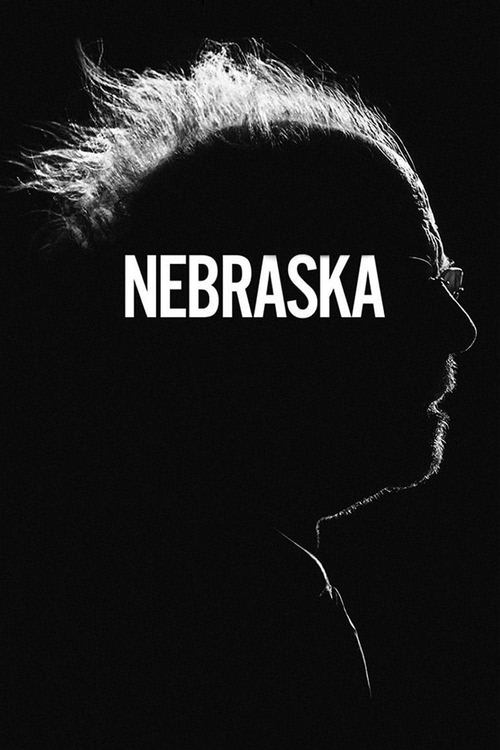
Nebraska
2013 · Alexander Payne
For a quiet, reflective evening when you want something bittersweet about parents, aging, and where you come from — a gentle watch that earns its lump in the throat. Comfort with an ache in it.
What it's about
A stubborn, booze-fogged old man in Billings, Montana receives a magazine sweepstakes mailer, decides he's won a million dollars, and starts walking to Lincoln, Nebraska to collect. His grown son, half out of pity and half out of curiosity, agrees to drive him — a trip that detours through the father's fading hometown, where old relatives, old grudges, and old debts come out to meet the rumor of money.
The experience
Deadpan and unhurried, with a dry Midwestern humor that keeps sneaking up on real sadness. It's funny in a way that makes you wince, and tender in a way that never announces itself.
Performances
Bruce Dern, who won Best Actor at Cannes, plays the father as a man worn down to pure stubbornness, and June Squibb steals every scene as his gloriously unfiltered wife. Will Forte is a lovely surprise in a straight dramatic role as the son.
The craft
Shot in stark black-and-white widescreen by Phedon Papamichael, the film turns empty highways and small-town main streets into something monumental and mournful at once. Alexander Payne directs Bob Nelson's spare script with total patience, letting long silences and bad haircuts do the talking.
Why it matters
Six Academy Award nominations and the capstone of Bruce Dern's long career, it stands among the defining portraits of the rural American Midwest in modern cinema.
Snapshot
An old man in Billings, Montana receives a magazine-sweepstakes mailer, mistakes it for a fortune, and starts walking to Lincoln to collect. His son eventually drives him. That is nearly the whole plot of Nebraska, and the film's method is to treat the thinness of the errand as its subject: the emptier the quest, the more room there is for the country it crosses and the family it reopens.
Made from Bob Nelson's screenplay — the first feature Alexander Payne directed without having written or co-written it — and shot in monochrome anamorphic widescreen by Phedon Papamichael, Nebraska is a road picture that stalls deliberately in the middle, parking its characters in a fictional town called Hawthorne for most of its second act. It premiered in competition at Cannes in 2013, where Bruce Dern won Best Actor, and received six Academy Award nominations — Picture, Director, Actor, Supporting Actress (June Squibb), Original Screenplay, and Cinematography — converting none. Its reputation now rests on three things: Dern's late-career performance of near-total withholding; a black-and-white image that argued, at the moment 35mm distribution was expiring, that digital cinema could carry a deliberately archaic surface; and a portrait of the depopulated Great Plains that arrived a few years before "flyover country" became a national argument.
Industry & production
The film's production history is a study in how long a small script can wait. Nelson, who had worked as a writer and performer on the Seattle sketch-comedy program Almost Live!, wrote Nebraska in the early 2000s; Payne read it around the time of About Schmidt and wanted to make it almost immediately, with the black-and-white photography attached as a condition rather than an option. That condition, along with the material's lack of stars and lack of incident, kept it unmade for close to a decade while Payne made Sideways (2004), took an unusually long hiatus from features, and then made The Descendants (2011). The Oscar success of The Descendants is what unlocked Nebraska: Payne came to it with maximum leverage and spent that leverage on a small, monochrome, largely star-free film.
It was produced by Albert Berger and Ron Yerxa of Bona Fide Productions — Payne's collaborators since Election — and released by Paramount Vantage, the studio's specialty arm. Budgeted modestly by studio standards (trade reporting at the time put it in the low eight figures; the precise figure is not authoritatively fixed), it was designed to work as a specialty release rather than a wide one, and it performed accordingly: a slow platform rollout amplified by Cannes, festival play, and the awards season.
The most-discussed industrial conflict around the film concerns its color. By Payne's own account in interviews, and in contemporaneous trade coverage, the studio would have preferred a color version available for ancillary and international markets, and Payne had to secure the black-and-white release contractually. The record here is largely Payne's own testimony rather than documented studio correspondence, and it should be read as such — but the underlying commercial logic is real and long-standing: monochrome has been treated as a sales liability by distributors since the 1960s.
Casting followed Payne's habitual mix. The leads are professionals cast against their public images; the peripheral roles — the bar crowd, the townspeople, the silent relatives ranged in front of a television — were filled substantially with non-actors recruited locally, a practice Payne has explicitly linked to Miloš Forman's Czech films.
Technology
Nebraska was shot digitally, on Arri's Alexa, and finished as black and white in the digital intermediate. This is the technological fact that organizes the whole film, and it cuts two ways.
First, capture. The Alexa's exposure latitude let Papamichael work at very low light levels in practical interiors — the bar, the karaoke room, the motel, the unlit farmhouse — without the lamp counts and grip infrastructure a comparable film negative would have demanded. That permissiveness is why the interiors feel found rather than lit, and why the crew could move through real Nebraska businesses with a small footprint.
Second, conversion. Because the sensor records color, monochrome becomes a grading decision rather than a chemistry decision: the balance of channels determines how skin, sky, denim, and dead corn render in gray. This is a degree of tonal control that panchromatic stock never offered, and it is closer in principle to choosing an emulsion than to desaturating a photograph. To keep the department heads from designing for a color image nobody would see, Payne and Papamichael monitored in black and white on set, so that costume, production design, and lighting choices were assessed as tonal values from the first day of shooting.
There is a third technological condition, easy to overlook: by 2013 the North American exhibition base had converted almost entirely to digital projection. A monochrome release no longer required striking and shipping black-and-white prints, a cost and quality-control problem that had helped make studio monochrome uneconomic for decades. Nebraska's look was, in a narrow sense, made affordable by the same transition that ended film distribution.
Technique
Cinematography
Papamichael shoots in anamorphic widescreen — roughly 2.35:1 — which is the film's central formal joke and its central formal argument. Scope is the format of spectacle; here it is used on a landscape with almost nothing in it. Horizons run edge to edge, uninterrupted; grain elevators, water towers, and telephone poles become the only vertical events in the frame. Human figures are frequently placed small and low, with three-quarters of the image given over to sky.
The gray scale is soft and slightly flattened rather than high-contrast: this is not the inky expressionism of neo-noir monochrome but something closer to a mid-century newspaper photograph or a farm-bureau documentary. Papamichael favors longer lenses for the road material, compressing the highway into a stack of planes, and steadier, wider setups indoors. Camera movement is sparing and motivated; there are few crane flourishes and no handheld agitation. The most memorable images are static: Woody walking the shoulder of an interstate; the family arrayed in silence before a football game; the derelict boyhood farmhouse, entered and toured like a museum with no docent.
Editing
Kevin Tent, Payne's editor since Citizen Ruth (1996), cuts for patience. Scenes are allowed to run past the point of information, which is where the comedy lives — the silence in the living room is funny only because it lasts too long, and the ritual recitation of car models and travel times among the Grant men is funny because nobody edits it down. The film's rhythm is deliberately arrhythmic: the road structure implies forward motion, and Tent repeatedly halts it, letting the Hawthorne material accumulate as a set of encounters rather than a chain of consequences. Reaction shots are frequently withheld; Payne and Tent often stay on a wide two-shot where coverage would offer a close-up, forcing the audience to find the emotional beat in the frame rather than be handed it.
Mise-en-scène / staging
Production designer Dennis Washington and costume designer Wendy Chuck (another long-term Payne collaborator) build a world of accumulated, unstyled surfaces: paneled rec rooms, formica, church-basement lighting, windbreakers, feed-store caps. The staging is documentary-adjacent but rigorously composed — Payne likes symmetrical, frontal arrangements of family members, which turns ordinary gatherings into something between a portrait and a lineup.
Locations do the heaviest lifting. The film shot across Nebraska — Norfolk, Plainview, Osmond, Elgin, Lincoln and surrounding towns — plus Billings, Rapid City, and Mount Rushmore, and it uses real, unrepaired main streets whose vacancy rates are visible in the frame. Hawthorne is a composite, and its emptiness is not set dressing.
Sound
The sound design is notably subtractive. Wind, tire hum, refrigerator hum, the television murmuring under conversation, the dead acoustic of a small-town tavern: the track is built from absences and low-level continuous noise, so that the few loud events — a bar argument, a slapped face — land hard. Detailed crew attribution for the sound departments is not well documented in accessible sources, and I won't guess at it.
Mark Orton's score is the film's one overt lyricism. Orton, a founding member of the chamber-Americana trio Tin Hat, wrote for a small acoustic ensemble — guitar, resonator and dobro-family instruments, strings — drawing on the idiom of his own group's catalog, which Payne had used as temp music. The score's dropped-third, slightly out-of-tune sweetness supplies the tenderness the dialogue refuses to state, and it does so without folk-revival kitsch or pedal-steel sentimentality.
Performance
Dern's Woody is a performance built almost entirely from refusal. A New Hollywood veteran associated for decades with volatility and menace — The Wild Angels, Silent Running, The King of Marvin Gardens, Coming Home — he is directed here toward opacity: a shuffling gait, a floating white shock of hair, a gaze that may be deafness, drink, dementia, stubbornness, or nothing at all. The film never diagnoses him, and Dern never editorializes. Its power comes from the fact that the actor's known capacity for eruption is withheld for two hours.
Will Forte, then known for Saturday Night Live and MacGruber, plays David as a straight man in the technical sense: he absorbs, he watches, he supplies almost no comic energy of his own. It is a genuinely difficult piece of casting-against-type, and it works because Forte declines every opportunity to be funny.
June Squibb — a stage veteran who had appeared in About Schmidt as Jack Nicholson's wife — plays Kate as the film's release valve, profane and unfiltered, and her scenes in the Hawthorne cemetery are the picture's most reliable laugh. Stacy Keach, another 1970s survivor, gives Ed Pegram a genial small-town menace. Bob Odenkirk, Rance Howard, Devin Ratray, and Angela McEwan (quietly devastating as the newspaperwoman Peg Nagy) fill out an ensemble in which the professionals are pitched to match the non-professionals rather than the reverse.
Narrative & dramatic mode
The film is picaresque in shape and chamber drama in practice. Nelson's screenplay uses the road-movie skeleton — departure, episodes, arrival, return — but hollows out the middle, converting the journey into a stay. The sweepstakes letter is a pure MacGuffin: everyone in the audience knows it is worthless within ninety seconds, so suspense is impossible and the film substitutes a different question — not will he get the money but what is he actually asking for.
The dramatic mode is deadpan tragicomedy, and its engine is humiliation. Nearly every sequence exposes someone: Woody exposed as deluded, David exposed as unmoored, the cousins exposed as idle, the town exposed as broke and grasping the moment word of the "million" spreads. Payne's control problem across his whole career is the distance between derision and compassion, and Nebraska stakes its position in the final movement, when the film pays off a character who has said almost nothing with an act of restitution rather than a speech — David putting his father behind the wheel of a truck and ducking below the dashboard so the town sees only Woody. The catharsis is entirely visual and entirely material: a truck, an air compressor, a cap.
Genre & cycle
Nebraska sits at the intersection of three traditions. It is a road movie, drawing on the American strain in which travel produces recognition rather than escape — Paper Moon, Harry and Tonto, The Straight Story. It is a regional realist drama in the Midwestern-gothic register, concerned with towns whose economic reason for existing has lapsed. And it belongs to what might be called the late-style showcase: a film organized around an elderly actor's face, in the lineage of Richard Farnsworth in The Straight Story and, later, Harry Dean Stanton in Lucky.
Within Payne's own filmography it completes a Nebraska cycle begun with Citizen Ruth (1996), Election (1999), and About Schmidt (2002) — four films in which the state functions less as setting than as a moral climate.
Authorship & method
Payne's method is legible in every department: shoot on real locations in sequence where possible; cast faces over résumés; block wide and let scenes run; refuse underscoring of emotional beats; find comedy in duration and silence. What distinguishes Nebraska within that method is the authorship question itself. Payne, who had written or co-written everything before it — mostly with Jim Taylor — here served purely as director on another writer's script, and the result is a film with less verbal wit and more structural austerity than the Taylor collaborations. It set a precedent he would repeat with The Holdovers (2023), directed from David Hemingson's screenplay.
The key collaborators are the constants: Kevin Tent editing, Wendy Chuck on costume, Berger and Yerxa producing. Papamichael, who had shot Sideways and The Descendants, supplies the one radical variable. Mark Orton is the newcomer, and his score is the film's clearest instance of Payne importing a pre-existing musical sensibility wholesale rather than commissioning a generic one.
Movement / national cinema
The film is American independent cinema of the post-Sundance, studio-specialty-division era — made inside a major, financed like an indie, exhibited like an art film. Its deeper affiliations are European. Payne has consistently cited Italian neorealism and the Czech New Wave, particularly Forman, and the debt is concrete: non-professional casting, comedy derived from real faces and real rooms, an ethnographic patience with community ritual. There is also a clear line to the 1970s American cinema of Ashby, Rafelson, and Bogdanovich — a lineage Payne makes explicit by casting Dern and Keach, two of that period's working actors.
Era / period
2013 is a hinge year. Film distribution effectively ended; digital projection became universal; streaming was beginning to reorganize the specialty market that films like Nebraska depended on; and the studio specialty divisions that had incubated Payne's generation were contracting. The film is also a post-recession document. Its Hawthorne is not nostalgic — it is a town of foreclosed farms, closed storefronts, adult children living at home, and neighbors who will litigate a forty-year-old debt over a rumored windfall. Released three years before rural economic grievance became the dominant frame in American political coverage, it registers the condition without theorizing it.
Themes
The governing theme is dignity in the absence of achievement. Woody wants the money for a truck he cannot drive and an air compressor he no longer needs, and the film treats this as a legitimate final claim rather than a punchline: the objects are proxies for having something to leave behind. Around that sit the sweepstakes as a debased form of American grace; alcoholism as a lifelong solvent that has dissolved most of a personality; the unreliability of a past that different relatives narrate incompatibly; and the inarticulacy of Midwestern men, which the film presents as both a comic register and a genuine deprivation. The abandoned farmhouse sequence — Woody walking through his own childhood rooms and naming almost nothing — is the thematic center: memory here is not retrieval but weather.
Reception, canon & influence
Critical reception was strong and specific: praise concentrated on Dern, Squibb, Papamichael's photography, and Payne's restraint. Cannes gave Dern its Best Actor prize; the Academy nominated the film six times without awarding it; Nelson's screenplay was widely honored on the independent circuit. The significant dissent was the recurring charge against Payne — that his framing of rural Midwesterners, particularly the mute cousins and the grasping relatives, shades from observation into condescension. That argument, which has followed him since Citizen Ruth, was made seriously and has not been settled; a related, smaller complaint held that the monochrome was an affectation rather than a necessity.
Backward, the film's debts are unusually traceable: Bogdanovich's The Last Picture Show (1971) and Paper Moon (1973) for black-and-white small-town Americana in widescreen; Lynch's The Straight Story (1999) for the elderly Midwestern quest; Mazursky's Harry and Tonto (1974) for the old-man picaresque; Forman's Czech films for the ensemble method; neorealism for the location ethic.
Forward, its influence is real but diffuse. It belongs to — and helped legitimize — the 2010s wave of digitally captured prestige monochrome that runs through Frances Ha (2012), Ida (2013), and on to Roma (2018), The Lighthouse (2019), Mank (2020), Passing (2021), and Belfast (2021), establishing that black and white was now a director's option rather than a distributor's veto. It contributed to the ongoing practice of casting comic performers in dramatic leads, with Forte's turn as a frequently cited example. It restored Bruce Dern to leading-man visibility late in life, and it launched a genuine late career for June Squibb, whose lead role in Thelma (2024) is routinely traced back to it. And it marked the beginning of Payne's willingness to direct other writers' scripts — a shift whose most successful result, The Holdovers, returns to Nebraska's scale, its tolerance for silence, and its interest in people who have run out of prospects but not out of claims.
A Deleuzian reading
An old man is walking on the shoulder of an interstate.
The full Deleuzian reading of Nebraska →
Reception
It premiered at Cannes 2013 to warm reviews (Bruce Dern took Best Actor there), then went 0-for-6 at the Oscars and got filed away as 'minor Payne' — but it's quietly climbed since, with plenty of fans now calling it his most humane film.
How Nebraska was received, from release to now →
How to watch Nebraska: what to notice on a first viewing
- Watch how much sky fills each outdoor frame. Papamichael's anamorphic frames give three-quarters of the image to sky, leaving Woody small and low near the bottom edge on empty roads and streets. The emptiness is the point: Deleuze calls a space that stops serving action and simply radiates feeling an any-space-whatever.
- Listen for the wind, tire hum, and refrigerator noise. The soundtrack stays built from continuous low-level noise rather than music or dialogue, so the few loud moments land hard when they finally arrive. Subtractive sound design makes silence itself carry weight instead of just filling space around the talk.
- Notice how families sit in straight, frontal rows. Payne repeatedly arranges relatives symmetrically facing the camera, turning ordinary gatherings into something between a formal portrait and a police lineup. The blocking exposes who these people are to each other without anyone needing to explain it.
- Watch Bruce Dern's face for what it refuses to do. Dern, an actor known for eruption, plays Woody through blankness. No drink, deafness, dementia, or stubbornness is ever confirmed or explained. You read an aging body across time instead of an expression, what the reading calls a cinema of the body.
- Notice when a scene keeps running after its point is made. Kevin Tent lets scenes overrun the information they deliver, so the comedy and feeling live in the leftover time rather than in a punchline. Duration itself becomes a technique here, not just texture around the story.
The whole guide to watching Nebraska, with the keys for a rewatch →
Influences: the films it descends from and the films it influenced
- The Last Picture Show (1971) — Robert Surtees' deep-focus monochrome shot on a real dying town (Archer City) with locals filling out the ensemble established the template Papamichael works from: overcast flat light, storefronts and horizon lines held in static wides, faces cast for wear rather than résumé.
- Paper Moon (1973) — László Kovács' red-filtered black-and-white Plains landscapes — huge skies compressed above a two-hander stuck in a car crossing Kansas and Nebraska — is the direct visual precedent for the road passages, including the habit of letting a whole scene play in one wide with both figures dwarfed by the flatness.
- Harry and Tonto (1974) — The episodic old-man picaresque structured as a series of arrivals among relatives who each want something, carried by a comic performer (Art Carney) cast in a dramatic lead — the exact structural and casting logic Payne reuses with Dern in Hawthorne and with Forte opposite him.
- The Straight Story (1999) — Freddie Francis holds elderly Midwestern travel in unhurried static landscape wides and refuses reaction cutaways during Richard Farnsworth's monologues, forcing the audience to read an old face across duration — the withheld-reaction grammar Kevin Tent applies to Dern.
- The Firemen's Ball (1967) — Forman's method of casting non-professionals as themselves and covering a room in sustained wides, mining humiliation comedy from how long an unremarkable event is allowed to continue, is the direct model for the living-room tableaux of silent cousins and the Hawthorne reunion scenes.
- Stranger Than Paradise (1984) — Locked-off single-take scenes in drab Midwest winter monochrome, with comedy generated by holding on inert bodies well past the point a conventional cut would arrive, is the deadpan-duration grammar Payne and Tent adopt wholesale.
- Kings of the Road (1976) — Robby Müller's black-and-white widescreen road film about two mismatched men in a dying provincial landscape proves the anamorphic monochrome frame can hold empty horizontal space as the subject — the compositional bet Papamichael makes on Nebraska's highways and main streets.
- Bicycle Thieves (1948) — The neorealist location ethic — a non-professional lead, real streets shot in available light, a father-and-son walk whose plot is a pointless errand — supplies the working rule Payne states as method: shoot where it actually is, cast faces over actors.
- About Schmidt (2002) — Payne's first Nebraska road picture strips a star (Nicholson) of his tics and parks him in flatly frontal wides of banal interiors, with Tent cutting away from rather than into the emotional beat — the performance and editing discipline Dern's late style extends.
- Sideways (2004) — Papamichael's first film with Payne set the anamorphic two-hander road structure and the practice of blocking wide and letting a scene run without coverage, so that comedy arrives from timing within the frame rather than from cutting.
- Wild Strawberries (1957) — Payne directly invokes Wild Strawberries' visual grammar — Academy-ratio black-and-white cinematography for an elderly protagonist's road journey as moral self-assessment — as an explicit citation of Bergman's fusion of road film format with elegiac retrospection on a life's emotional failures.
- Election (1999) — Pushes the regional-specificity and anamorphic-widescreen portraiture of American ambition further, applying Election's unsentimental gaze to heartland delusion in stark black-and-white scope.
- Roma (2018) — Shot on the Alexa 65 with a monochrome-graded DI and reference-monitored in black-and-white on set, it inherits the digital-capture-to-monochrome pipeline Papamichael normalized, applied at large-format scale.
- Mank (2020) — Erik Messerschmidt shot with a de-Bayered monochrome Alexa and monitored in black-and-white on set so lighting could be judged in the final tonal space — the on-set monochrome-monitoring practice Nebraska helped establish as standard rather than eccentric.
- The Lighthouse (2019) — Jarin Blaschke's custom cyan filtration to emulate orthochromatic response demonstrates the post-Nebraska condition in which monochrome is an authored, engineered choice with a specified look, not a nostalgic default.
- Lucky (2017) — Builds an entire film around a nonagenarian character actor's late style (Harry Dean Stanton) in a real small town, using static wides of diners and bars and comedy drawn from a stubborn old man's silences — Dern's Woody Grant transposed to the desert.
- The Holdovers (2023) — Payne again directing another writer's script with Kevin Tent cutting, returning to the same scale: real locations, scenes blocked wide and allowed to run, emotional beats left unscored, and a pre-existing musical sensibility imported rather than commissioned.
- Thelma (2024) — Hands June Squibb a lead built on the same premise Nebraska proved viable — an elderly person's stubborn, semi-delusional errand played straight, with comedy from the duration of ordinary physical tasks rather than from gags cut around them.
- A Real Pain (2024) — Models the elegiac homeland-return road trip built on regional location realism, where a journey to an ancestral place becomes the frame for reckoning with family and lineage.
- Frances Ha (2012) — Sam Levy captured digitally and graded to black-and-white in the DI rather than shooting monochrome stock — the same post-based route to monochrome, arriving the same season, that made the format a director's choice instead of a distributor's veto.
- Ida (2013) — Static locked-off monochrome tableaux with figures pushed low in frame, following a young protagonist on a car journey with a difficult older relative whose history is withheld from dialogue — the same year's proof that composed stillness plus digital monochrome could carry a road film.
- The Blue Trail (2025) — Wrings dark comedy from an elderly protagonist's stubborn, quixotic road quest, the same picaresque-odyssey-plus-deadpan-tone register.
- A Man Called Ove (2015) — The stubborn, near-mute elderly man whose fixed obstinacy is mined simultaneously for deadpan comedy and buried filial pathos — the same tragicomic register on a curmudgeon lead.
- A Man Called Otto (2022) — Deploys a taciturn, difficult old man whose interiority surfaces through flashback and a younger caretaker's persistence — the interleaved-past-reveals-tenderness method Otto uses on Treviño.
Similar films
- Paper Moon (1973) — influence & lineage · same viewing thread
- Sideways (2004) — influence & lineage
- The Last Picture Show (1971) — influence & lineage
- The Straight Story (1999) — influence & lineage
- Little Miss Sunshine (2006) — same viewing thread
- O Brother, Where Art Thou? (2000) — same viewing thread
- A Real Pain (2024) — shared sensibility
- No Country for Old Men (2007) — shared sensibility
All the films related to Nebraska →
Watch it with: curated runs of related films
- Misfits on the American Backroads — A run of journeys across the American map, each hauling someone who doesn't fit — a con man and his maybe-daughter, a losing family in a yellow bus, two outlaws outrunning the century, and a pair of lovers who eat people — watch them near each other and the road itself starts to feel like the family.