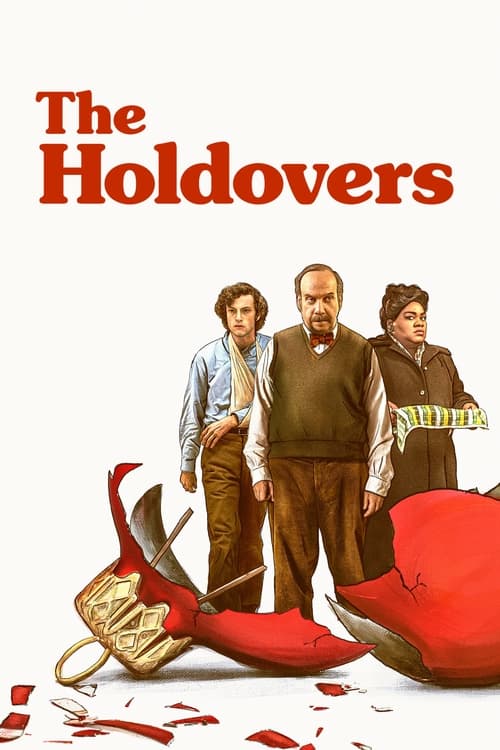
The Holdovers
2023 · Alexander Payne
The ideal melancholy-holiday film — for a winter night when you want to laugh and get a lump in your throat in the same scene. Comfort viewing for people who like their comfort with a little ache in it.
What it's about
Christmas break, 1970, at a New England boarding school: a curmudgeonly classics teacher nobody likes is stuck on campus babysitting the boys with nowhere to go. He's left with one damaged, whip-smart troublemaker and the school's head cook, who has just lost her son in Vietnam. Three stranded people, an empty snowbound campus, and two weeks with no one else to talk to.
The experience
Warm and wounding in equal measure — it's genuinely funny, with insult-comedy crackle between teacher and student, but the grief underneath keeps surfacing when you least expect it. It moves at the unhurried pace of a snowed-in holiday and leaves you feeling like you've spent the break with these people.
Performances
Paul Giamatti gives one of his great performances as the teacher, prickly and wounded in the same breath, and Da'Vine Joy Randolph won an Oscar for playing Mary's grief with an almost offhand dignity that sneaks up on you.
The craft
Alexander Payne shoots it like a lost film from 1970 — period grain, vintage studio logos, slow zooms and old-fashioned dissolves — but the pastiche serves feeling, not nostalgia. David Hemingson's script gives all three leads real interior lives, so the jokes and the sorrow come from character, never formula.
Why it matters
It marked Payne's return to form and reunited him with Giamatti two decades after Sideways, and it's already settling into rotation as a modern Christmas perennial for people who find most holiday movies too sweet.
Alexander Payne's homecoming — to Paul Giamatti, his Sideways collaborator, and to the humane, rueful comedy of stranded souls that made his name. A despised classics teacher at a New England boarding school is stuck babysitting the boys with nowhere to go over Christmas 1970, alongside a grieving cafeteria manager; from this chamber-piece premise Payne builds something like a lost film of the era it depicts. The commitment is total: Eigil Bryld's cinematography adds period grain and gate weave, the studio logos are vintage, the dissolves and slow zooms belong to Hal Ashby's world. But the pastiche serves feeling rather than nostalgia — David Hemingson's script gives all three leads real interior lives, and Da'Vine Joy Randolph's Oscar-winning performance as Mary carries the film's deepest grief with almost offhand dignity. Giamatti, wall-eyed and fluent in Latin invective, delivers a curmudgeon whose armor the film removes one plate at a time. In an American cinema starved of mid-budget character drama, it landed like a care package. Payne has always trusted that comedy and sorrow share a border; here he builds his whole snowbound world on it.
A Deleuzian reading
The movie starts by lying to you.
The full Deleuzian reading of The Holdovers →
Reception
Landed at Telluride 2023 as Alexander Payne's comeback after Downsizing, rode warm reviews to five Oscar nominations — and then did something rarer: within a single year it settled into the annual Christmas-rewatch canon, an 'instant classic' arc most films need decades to earn.
How The Holdovers was received, from release to now →
Influences: the films it descends from and the films it influenced
- The Last Detail (1973) — The reluctant-chaperone structure — a profane, tender institutional lifer forced to escort a young charge — plus Ashby's loose, humanist two-shot blocking that Payne and Hemingson openly emulate.
- Harold and Maude (1971) — Ashby's intergenerational-misfit bond carried by folk-singer needle-drops (Cat Stevens), a scoring strategy The Holdovers copies down to using Stevens' 'The Wind.'
- Being There (1979) — Deadpan comic melancholy sustained through patient, unhurried long takes rather than joke-cutting — the tonal register Giamatti's Hunham inhabits.
- The Last Picture Show (1971) — Meticulous period recreation and elegiac small-community loneliness, shot with a restrained, near-monochrome austerity that models Holdovers' 'made-in-1970' surface.
- Five Easy Pieces (1970) — The BBS-era character study of a caustic, intellectually superior misanthrope, built from naturalistic reframing zooms and quiet observational scenes.
- Paper Moon (1973) — The mismatched-pair dynamic between a sour adult and a sharp kid, staged as period Americana with a deliberately dated black-and-white-adjacent look.
- The Paper Chase (1973) — The prestige-academic milieu and John Houseman's imperious classical-education tyrant — the professor archetype Giamatti's washed-up classicist both channels and deflates.
- Nebraska (2013) — Payne's deadpan intergenerational-care road structure shot in a deliberately archaic monochrome — the same period-texture-as-emotion move Holdovers makes in color.
- St. Vincent (2014) — The curmudgeon-reluctantly-mentors-a-lonely-boy dramedy resolved by a redemptive holiday arc — the Holdovers formula in contemporary dress.
- C'mon C'mon (2021) — A contemporary black-and-white, period-textured chamber study of an ambivalent adult and a difficult child, foregrounding reticent grief through intimate two-handers.
- Tony (2026) — Supplies Dominic Sessa's specific performance instrument — defensive erudition delivered fast and flat, then broken by a beat of visible need — and the mentor-and-boy two-hander rhythm built on the older actor underplaying against it.
- Sideways (2004) — Payne + Giamatti's first pairing establishing the self-loathing, wine-soaked erudite loser rendered with tender comedy — the exact register recycled for Hunham.
- About Schmidt (2002) — Payne's study of a lonely older man's melancholic reckoning, framed with static, unshowy compositions and a bittersweet late-arriving warmth.
- Election (1999) — Payne's school-institution satire built on snap slow-zooms and acid voiceover, seeding the campus-microcosm staging Holdovers softens into pathos.
- Rushmore (1998) — The prep-school insular world and a prickly outsider protagonist played against symmetrical institutional backdrops with deadpan comic timing.
- Dead Poets Society (1989) — The New England boarding-school transformative-teacher genre, whose autumnal prestige aesthetic Holdovers deliberately honors and then inverts (the teacher stays broken).
- The Squid and the Whale (2005) — 1970s-80s academic period recreation on grainy 16mm-feel stock, populated by self-important literary men — the same textured-nostalgia-plus-bitter-intellect combination.
Similar films
- Sideways (2004) — influence & lineage
- Nebraska (2013) — influence & lineage
- All of Us Strangers (2023) — same viewing thread
- Ghostlight (2024) — same viewing thread
- Sorry, Baby (2025) — same viewing thread
- Close (2022) — shared sensibility
- People We Meet on Vacation (2026) — shared sensibility
- Another Round (2020) — shared sensibility
All the films related to The Holdovers →
Watch it with: curated runs of related films
- Funny Because It Aches — A run of tender, deadpan dramedies where love, grief, and the panic of becoming yourself all get metabolized through jokes — watch these when you want to laugh and cry in the same scene.