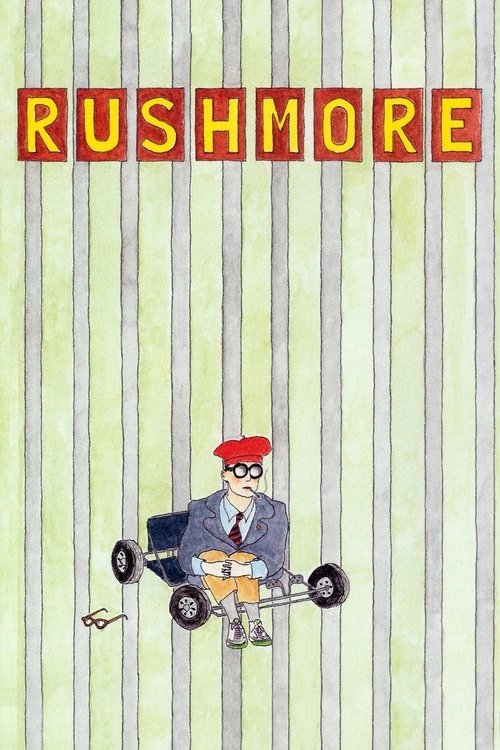
Rushmore
1998 · Wes Anderson
His style became so recognizable it turned into a TikTok filter trend and AI-parody genre, prompting discourse about whether pastiche had swallowed the artist; Asteroid City and The Phoenician Scheme kept the "self-parody or late-style depth" argument alive. Finally won his first Oscar for a Roald Dahl short.
For when you want to laugh at heartbreak instead of wallowing in it — a stylish, bittersweet comedy that works equally as a pick-me-up or a melancholy rewatch. Comfort viewing with a bruise under it.
What it's about
Max Fischer is fifteen, king of every club at his elite prep school, and flunking every class. When a beautiful widowed first-grade teacher arrives, Max falls hopelessly in love and recruits a sad, rich industrialist — the father of two classmates — as his mentor and wingman. Then the mentor falls for her too, and best friends become rivals in an escalating, ridiculous war.
The experience
Deadpan-funny and secretly sad — it plays like a caper but keeps brushing against grief and loneliness, and the mix is what makes it sing. Fast, quotable, and oddly comforting.
Performances
Bill Murray's Herman Blume relaunched his career as a great melancholy character actor — every slump of his shoulders is funny and sad at once. Jason Schwartzman, in his screen debut, makes Max's delusional confidence somehow lovable.
The craft
This is where Wes Anderson's signature crystallized: symmetrical frames, chapter cards, slow motion set to British Invasion records, and Owen Wilson's co-written script balancing absurdity with real feeling. The needle drops alone are worth good speakers.
Why it matters
It established Anderson as one of the defining stylists of his generation and reintroduced Bill Murray to a second act of acclaimed dramatic work.
Snapshot
Rushmore is Wes Anderson's second feature, a comedy of arrested ambition about Max Fischer, a fifteen-year-old scholarship student at an elite Houston prep school who excels at everything except the coursework that would let him stay. Co-written with Owen Wilson, the film pairs Max (Jason Schwartzman, in his screen debut) with Herman Blume (Bill Murray), a disenchanted self-made industrialist, and Rosemary Cross (Olivia Williams), a widowed first-grade teacher both men come to love. From a slender love-triangle premise the film builds a study of grief, class, and the consolations of self-invention. It is the picture on which Anderson's now-familiar signature crystallized — symmetrical framing, chapter cards, slow-motion set to British Invasion records — and the one that reintroduced Bill Murray as a melancholy character actor. Modest at the box office, it became one of the defining American independent films of its decade and a cornerstone of Anderson's reputation as an auteur.
Industry & production
Rushmore was produced for Touchstone Pictures, the Disney-owned label, and released by Buena Vista — an unusually well-resourced home for a sophomore director whose debut, Bottle Rocket (1996), had been a commercial failure despite admirers (notably James L. Brooks, who had championed it at Columbia). Brooks's continued advocacy helped Anderson and Wilson secure backing; the producers of record include Barry Mendel and Paul Schiff. The budget was modest by studio standards, and while figures around $10–20 million circulate, the precise number is not something I can state with confidence, so I leave it approximate.
The film was shot largely in Houston, Anderson's hometown. Rushmore Academy is played by St. John's School, the private school Anderson himself attended — a biographical seam that runs through the project, since Anderson and Wilson drew on their own adolescences and on the texture of Texas prep-school life. Casting Murray was the pivotal coup: he reportedly responded directly to the script and committed to it for a fraction of his usual fee, a decision often described as career-redefining. Schwartzman, a first-time actor (and a member of the Coppola family), was discovered through a casting search and effectively built around. The supporting bench — Brian Cox as the headmaster Dr. Guggenheim, Seymour Cassel as Max's barber father, Mason Gamble and Sara Tanaka as classmates — rounded out an ensemble that mixed unknowns and veterans in the manner Anderson would make habitual.
Technology
Rushmore is a film of conventional late-1990s 35mm production technology, but Anderson's specific choices matter. It was photographed in anamorphic widescreen at roughly 2.35:1 — a deliberately "big," classical format applied to an intimate story, which lends Max's small-scale schemes an epic frame. The film predates the digital-intermediate era; its look was achieved photochemically, through lens choice, lighting, and production design rather than post-production color grading. The elaborately mounted stage plays Max directs (a Serpico adaptation, and the climactic Vietnam war play "Heaven and Hell") are practical theatrical effects executed in-camera, consistent with Anderson's lifelong preference for handmade, analog illusion over optical or digital trickery. There is nothing technologically novel here; the interest is in the disciplined, almost antiquarian use of standard tools.
Technique
Cinematography
Robert Yeoman, who shot Bottle Rocket and would photograph nearly all of Anderson's live-action films, established the house style here. The anamorphic frame is composed with a strong centering instinct: characters placed dead-center, architecture squared to the lens, a planimetric flatness in which the camera faces walls and rows head-on rather than raking across them at an angle. Yeoman and Anderson deploy the snap whip-pan to connect adjacent spaces, the slow lateral track, and the emphatic dolly-in on a face at a moment of decision. Color is saturated and schematic — Rushmore's heraldic crimson and forest green, the blazers, the autumnal palette. The most-discussed images are the slow-motion sequences, in which the camera elevates a trivial gesture (Max surveying his domain, Blume diving into a pool) into mock-heroic spectacle.
Editing
Cut by David Moritz, Rushmore organizes itself around intertitle chapter cards — calendar pages turning to mark the school year — that segment the narrative into discrete movements and impose a storybook structure. The editing rhythm alternates briskly comic exchanges with sudden, held stillnesses. Montage is used both for exposition (the famous early sequence cataloging Max's extracurricular societies) and for emotional compression. The set-piece syntheses of image, cut, and music — needle-drop montages timed to the beat — function as the film's punctuation, and Moritz's cutting is essential to making Anderson's tonal whiplash between farce and sorrow feel controlled rather than erratic.
Mise-en-scène / staging
This is where the film most decisively announces a sensibility. Production designer David Wasco and costume designer Karen Patch build a densely art-directed world of crests, club banners, equipment, and uniforms; the frame is a vitrine of carefully chosen objects. Anderson stages in tableaux, frequently using a proscenium logic that rhymes with Max's theatrical vocation — the film is full of literal stages, and the whole movie behaves as if reality were a production Max is directing. The recurring motif of characters presented frontally, addressing the lens or arranged in symmetrical rows, treats human beings as elements in a composed picture without draining them of feeling.
Sound
The soundtrack is inseparable from the film's identity. Anderson assembles a curated run of British rock — songs by the Kinks, the Rolling Stones, the Who ("A Quick One, While He's Away"), Cat Stevens, John Lennon, and the Faces' "Ooh La La," which closes the film over a slow-motion dance — used not as period wallpaper but as expressive scoring. Mark Mothersbaugh's original cues, built on harpsichord and toy-like Baroque figures, supply the connective tissue between needle drops and give the film its faux-antique, music-box warmth. The interplay of curated source music and original score became a template Anderson and his collaborators would refine for years.
Performance
Schwartzman plays Max with an unblinking, blazer-buttoned gravity that makes the character's pretensions both ridiculous and oddly dignified; the performance refuses to wink. Murray's Blume is the film's revelation — a study in deadpan exhaustion and buried tenderness, the comic actor's timing redirected toward pathos. The two leads play rivalry and reconciliation as a genuine, asymmetric friendship across a thirty-year gap. Olivia Williams grounds Rosemary as a grieving adult who is neither prize nor caricature, and the supporting players (Cassel's gentle barber, Cox's beleaguered headmaster) work in the same precisely calibrated register of underplaying.
Narrative & dramatic mode
The structure is a coming-of-age comedy bent toward fable. Its engine is a romantic triangle, but the love story is finally a decoy for a double portrait of mentorship and its collapse: a boy who wants to be a man and a man who envies the boy's conviction. The chapter-card design borrows the cadence of an illustrated children's book, while the content stages adult disappointment — divorce, bereavement, professional defeat. Anderson's dramatic mode is ironic but not cynical; the film withholds judgment on Max's delusions and instead tracks his slow education in humility and empathy, culminating in the staged play that lets him sublimate, rather than resolve, his feelings. Tonally it lives in a deliberate instability between farce and elegy, a register that would become Anderson's permanent address.
Genre & cycle
Rushmore sits at the intersection of the prep-school film, the romantic comedy, and the American indie character study. It arrives in the late-1990s wave of stylistically assertive independent cinema — the post-Sundance, post-Pulp Fiction moment when distinctive authorial voices found studio specialty-label backing. Within the prep-school subgenre it inverts convention: where Dead Poets Society (1989) idealizes the inspiring teacher, Rushmore makes its precocious student the would-be inspirer and treats institutional belonging as both refuge and trap. It also belongs to a small lineage of films about adolescent monomaniacs and to the broader cycle of "quirky" American comedies whose aesthetic it helped to define and name.
Authorship & method
Rushmore is the film on which "a Wes Anderson film" became a legible category. The screenplay is a true collaboration with Owen Wilson, Anderson's writing partner from Bottle Rocket; their script balances Max's grandiloquent diction against Blume's terse despair. Robert Yeoman's anamorphic photography, Mark Mothersbaugh's harpsichord scoring, David Wasco's collectible-dense production design, Karen Patch's emblematic costumes, and David Moritz's chaptered cutting together constitute the first full assembly of Anderson's repertory craft team and method — a method defined by exhaustive pre-visualization, controlled symmetry, curated music chosen early, and a stock company of actors. Crucially, the partnership with Bill Murray begins here; Murray would appear in every subsequent Anderson feature, becoming the director's totem performer. The film demonstrates Anderson's authorial signature not as decoration but as a worldview: a belief that meticulous arrangement is itself a form of feeling, a way of holding chaos and grief at bay.
Movement / national cinema
The film is American independent cinema of the specialty-label era, but its allegiances are conspicuously transatlantic and cinephilic. Anderson openly works in dialogue with the French New Wave — François Truffaut above all, whose Antoine Doinel films (beginning with The 400 Blows) stand behind Max as a portrait of a resourceful, self-mythologizing boy. The British Invasion soundtrack performs a parallel act of cultural borrowing, importing a 1960s English pop sensibility into a Texas setting. The result is a distinctly American story told in a European art-cinema accent — a hybrid that became central to Anderson's identity as a director whose nationality is, in a sense, cinephilia itself.
Era / period
Though set in a roughly contemporary late-1990s present, Rushmore is studiously unmoored from its moment. The wardrobe, music, technology, and décor evoke an indeterminate past — a curated, nostalgic timelessness closer to the 1960s and 1970s than to 1998. This anachronistic layering is purposeful: it removes the film from the texture of its actual production era and places it in the private, retrospective world of Anderson's sensibility. As a document of its time, it nonetheless marks a specific industrial era — the brief window when major studios funded idiosyncratic auteurs through boutique divisions — and it stands as one of that window's signal achievements.
Themes
The governing theme is self-invention as both gift and affliction: Max builds an entire identity from clubs, plays, and borrowed adult mannerisms to fill an absence — the death of his mother, the modesty of his real origins as a barber's son. Class runs beneath everything, in Max's scholarship-boy precarity and his concealment of his father's trade, and in his attraction to the institutions and women who represent a world above him. Grief and loneliness bind Max, Blume, and Rosemary, each mourning a loss (a mother, a marriage, a husband). Mentorship and its betrayals structure the central relationship, while the recurring motif of theater proposes art as the arena where unmanageable feeling can be staged, controlled, and finally released. Underlying all of it is a tender study of failure — academic, romantic, professional — and the grace of carrying on regardless.
Reception, canon & influence
Rushmore was warmly received by critics, who recognized it as a leap beyond Bottle Rocket and singled out Murray's performance as a career renaissance. Murray collected a string of critics'-group awards for the role from major U.S. critics' associations — recognition widely noted at the time for being passed over by the Academy. Commercially the film was modest, earning in the neighborhood of the high-teens of millions domestically (I keep the figure approximate rather than cite a precise gross), a performance more respectable than spectacular that nonetheless cemented Anderson's standing with the industry and the cinephile press.
Its influences flow backward to a well-documented set of touchstones: Truffaut's Doinel cycle; Mike Nichols's The Graduate (1967), echoed in the May–December romantic confusion and the pop-scored alienation; Hal Ashby's Harold and Maude (1971), in its cross-generational love and deadpan morbidity; and the literary world of J.D. Salinger, whose precocious, wounded young protagonists prefigure Max. The British Invasion records locate the film in a 1960s pop imagination that Anderson treats as a usable past.
Forward, its legacy is large. Rushmore established the template — visual, musical, structural — that Anderson would elaborate across The Royal Tenenbaums, The Grand Budapest Hotel, and beyond, and it launched both Jason Schwartzman's acting career and the enduring Anderson–Murray partnership. It reinvented Bill Murray as the patron saint of melancholy indie comedy, directly enabling the run of performances that includes Lost in Translation (2003). More broadly, its aesthetic of symmetry, chapter cards, curated soundtracks, and bittersweet whimsy became one of the most imitated — and parodied — styles in twenty-first-century American film, shaping a generation of "twee" independent comedy. Its enshrinement in the Criterion Collection confirmed its canonical status as a modern classic and as the keystone of one of contemporary cinema's most recognizable bodies of work.
A Deleuzian reading
Watch Herman Blume climb the high board at his sons' birthday party.
The full Deleuzian reading of Rushmore →
Reception
A modest box-office performer in 1998 that critics adored, it's since been fully canonized — now routinely ranked among Wes Anderson's best films and credited with launching both his signature style and Bill Murray's celebrated indie second act.
How Rushmore was received, from release to now →
Influences: the films it descends from and the films it influenced
- The 400 Blows (1959) — Anderson builds Max Fischer on Truffaut's Antoine Doinel — the precocious, institution-defying boy whose forged notes and petty schemes mask wounded longing — and borrows the New Wave habit of letting a child's-eye delinquency carry adult melancholy.
- Zéro de conduite (1933) — The template for the lyrical, anarchic boarding-school revolt — slow-motion pillow-fight reverie and the boy-rebel-vs-pompous-administration structure that Rushmore's expulsion and stage-war plot directly inherit.
- if.... (1968) — The prep-school-as-microcosm film with chaptered, episodic titling and a surreal collision of pageantry and insurrection — a direct ancestor of Rushmore's chapter-card structure and theatricalized campus warfare.
- The Graduate (1967) — Supplies the pop-scored generational drift and the older-woman/younger-man romantic confusion; Anderson lifts Nichols's method of cutting alienation montages to a pre-chosen curated soundtrack rather than original underscore.
- Harold and Maude (1971) — Source of the deadpan-morbid, cross-generational love story scored wall-to-wall by a single curated pop catalog (Cat Stevens), the exact tonal recipe — whimsy braided with grief — Rushmore adopts.
- A Hard Day's Night (1964) — Model for the British-Invasion needle-drop montage as kinetic storytelling unit — Lester's cut-to-the-record sequences prefigure Anderson's Creation/Kinks/Cat Stevens set-pieces and slow-motion hero walks.
- Barry Lyndon (1975) — The locus classicus of frontal, symmetrical, centered tableau framing and chapter-titled narration in anamorphic widescreen — the compositional grammar Yeoman and Anderson formalize into the 'Anderson shot.'
- Bottle Rocket (1996) — Anderson and Owen Wilson's first co-written feature, establishing the dreamer-with-elaborate-plans protagonist and the writing partnership Rushmore refines into a fully art-directed, repertory-crewed method.
- Paper Moon (1973) — Builds a comic world on deadpan precocious-child performance and flat, frontal two-shot staging, a self-acknowledged inheritance of Bogdanovich's classical compositional manner.
- Trust (1990) — Carries forward the repertory-company method, frontal/symmetrical composition, and deadpan delivery that masks intense feeling — the affectless-surface-over-strong-emotion contract of Trust.
- Pee-wee's Big Adventure (1985) — Extends the planimetric frontal tableau, proscenium blocking, and meticulously art-directed props-as-character, with a uniformed protagonist treated as a graphic emblem and the comedy played deadpan against the design rather than through reaction.
- Stolen Kisses (1968) — Restages Doinel's occupation-and-enthusiasm montages and his courtly crush on an unavailable older woman as chaptered deadpan comedy, with a period pop needle-drop performing exactly the emotional-key function Trenet's chanson performs here.
- The Royal Tenenbaums (2001) — Directly elaborates the Rushmore kit — chapter cards, symmetrical vitrine framing, slow-motion needle-drop finale, Mothersbaugh score, and Murray as melancholy totem — onto a multi-generational family canvas.
- Moonrise Kingdom (2012) — Returns Rushmore's precocious-child-in-love fable to its purest form, scaling up the proscenium staging, hand-made props, and pageant-theater climax that Max Fischer's productions pioneered.
- The Grand Budapest Hotel (2014) — Pushes Rushmore's chaptered structure and centered symmetry to a nested-narration extreme, with Ralph Fiennes inheriting the grandiloquent-diction-meets-pathos register Schwartzman's Max originated.
- Submarine (2010) — An avowed Rushmore homage: chapter-card structure, a lovelorn pretentious schoolboy, deadpan voiceover, and a single-artist curated soundtrack (Alex Turner) standing in for Anderson's British Invasion playlist.
- Lost in Translation (2003) — Cashes in Rushmore's reinvention of Bill Murray as the patron saint of melancholy comedy — building an entire film around the rueful, deadpan-pathos register Anderson first unlocked in Murray's Herman Blume.
- Napoleon Dynamite (2004) — Extends the same deadpan, frontally framed, art-directed-suburbia comedy of arrested adolescence — flat symmetrical compositions and rigorously controlled tableaux played for bittersweet absurdity.
- Igby Goes Down (2002) — A parallel descendant of the Salinger lineage Rushmore revives — the verbally precocious, prep-school-fleeing wounded adolescent navigating older lovers and parental dysfunction with armored wit.
- The Life Aquatic with Steve Zissou (2004) — Anderson's own prototype for the music-cued montage set piece, the repertory ensemble, and Bill Murray's wounded deadpan, all scaled up here.
- Fantastic Mr. Fox (2009) — The planimetric flat-on symmetrical framing, whip-pans, and chapter-card structure of Anderson's live-action grammar are imported wholesale into Fox, proving the 'authorship' facet survives the switch to miniatures.
- The Perks of Being a Wallflower (2012) — The literary, theatrical outsider whose amateur stage performance becomes the vehicle of self-actualization — the same conceit as Charlie's friends performing Rocky Horror.
- Lady Bird (2017) — Stages the precocious, overreaching adolescent's social-climbing ambition and unrequited longing with deadpan affection, a comic register Gerwig softens but keeps.
- Emma. (2020) — Its deadpan comic editing — cutting on precisely composed centered inserts and chapter-card structure — is the rhythmic model for Emma.'s clipped comic timing and intertitle season-cards.
- Juno (2007) — Carries Rushmore's twee-indie DNA — hyper-articulate young protagonist, chapter-like seasonal titling, and a curated indie/pop needle-drop soundtrack used as emotional connective tissue.
- The Squid and the Whale (2005) — By Anderson's eventual co-writer, it shares the Salingerian precocious-youth-amid-adult-failure terrain and the literate, status-anxious dialogue that balances comic diction against quiet devastation.
- Election (1999) — The twin late-90s text of the melancholy high-school comedy centered on a monomaniacal overachiever, sharing deadpan cutaway gags and a precisely controlled tone between humiliation and tenderness.
- Buffalo '66 (1998) — Shares the frontal-symmetrical framing, theatrical tableau staging, and curated period needle-drops deployed as a precise authorial signature.
- The Holdovers (2023) — The prep-school insular world and a prickly outsider protagonist played against symmetrical institutional backdrops with deadpan comic timing.
- Dinner in America (2020) — Source of the precise, centered, storybook-symmetrical cinematography that keeps volatile emotional material formally contained — the visual discipline that stops abjection from curdling into mere ugliness.
- Groundhog Day (1993) — Extends the depressive Murray unlocked here — the flattened affect, the suicide gag played straight, the comedian used as a repository of unspoken grief — into a register that becomes the actor's second career.
Similar films
- Moonrise Kingdom (2012) — influence & lineage · same viewing thread
- The Graduate (1967) — influence & lineage · same viewing thread
- The Royal Tenenbaums (2001) — influence & lineage
- The Grand Budapest Hotel (2014) — influence & lineage
- Harold and Maude (1971) — influence & lineage
- The Squid and the Whale (2005) — influence & lineage
- if.... (1968) — influence & lineage · same viewing thread
- Dazed and Confused (1993) — same viewing thread · often watched together
All the films related to Rushmore →
Watch it with: curated runs of related films
- Restless Youth, Rigid Walls — Watch these as one long walk through the school years — the teachers who crack you open, the friends who pull you off the sidelines, the first loves and the institutions you push against — where a beloved tearjerker and a surreal boarding-school revolt turn out to be cousins.