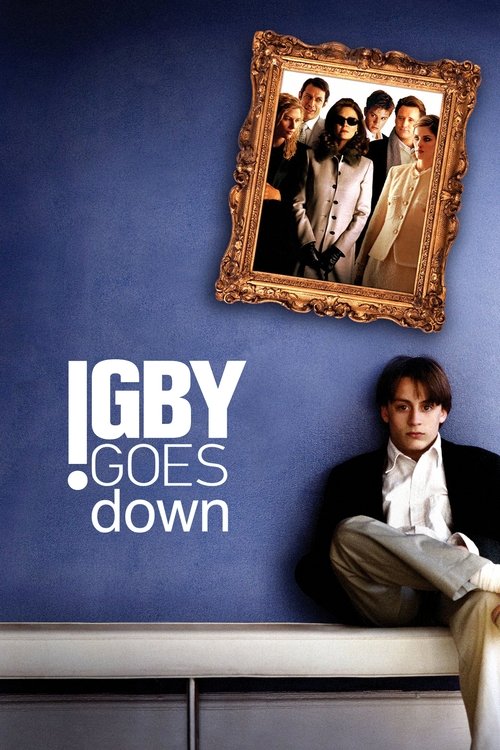
Igby Goes Down
2002 · Burr Steers
For when you're feeling misanthropic and want a smart, spiky coming-of-age story that refuses to hug you — catnip if you love privileged-family dysfunction dissected with a scalpel.
What it's about
Igby Slocumb, seventeen and serially expelled, is at war with the old-money Manhattan world he was born into: a schizophrenic father, a self-absorbed mother, and an ambitious young-Republican older brother. He bolts into a semi-adult limbo of borrowed apartments, older women, and bad decisions, looking for any life that isn't the one he inherited.
The experience
Acid-tongued and quotable, with real sadness pooling under the wit — it's a comedy about damage, and the laughs keep catching in your throat. The tone is prickly, literate, and unsentimental.
Performances
Kieran Culkin is the whole engine — wounded, funny, and impossibly precocious without ever being cute. Around him, Susan Sarandon's imperiously toxic mother and Jeff Goldblum's silky, dangerous godfather figure are standouts in an unusually deep ensemble.
The craft
Burr Steers's debut script is the star: dense, novelistic dialogue where every character gets a blade, delivered by a cast that knows exactly what to do with it. The structure circles a dark family reckoning and doubles back to show how everyone arrived there.
Why it matters
A cult favorite of the early-2000s indie wave that announced Kieran Culkin as a serious actor and became a touchstone for a certain kind of caustic rich-kid coming-of-age story.
Snapshot
Igby Goes Down is the feature directorial debut of Burr Steers, a literate, acid-tongued coming-of-age comedy-drama about a teenager in flight from the rotting world of East Coast old money. Kieran Culkin plays Igby Slocumb, a serially expelled seventeen-year-old whose schizophrenic father (Bill Pullman), narcissistic mother (Susan Sarandon), and coldly ambitious "young Republican" brother Oliver (Ryan Phillippe) supply both the privilege he despises and the dread he cannot outrun. The film opens, notoriously, with the two brothers suffocating their dying mother, then doubles back to trace how Igby arrived at that moment — a structure that frames the whole picture as a mordant reckoning with inheritance, both financial and genetic. Built around an unusually deep ensemble (Jeff Goldblum, Claire Danes, Amanda Peet, Bill Pullman, Jared Harris, Rory Culkin as the young Igby), it stands as one of the defining specimens of the early-2000s American "dysfunctional-WASP-family" cycle, openly indebted to The Catcher in the Rye and The Graduate and adjacent to the Wes Anderson vein of literate, deadpan family comedy. It announced Steers as a promising writer-director, though his subsequent career turned toward studio commercial work rather than further developing this idiom.
Industry & production
Igby Goes Down was an independent production distributed in the United States by United Artists, then under the MGM umbrella, positioning it as a specialty/awards-season release rather than a wide commercial play. It was produced through Atlantic Streets Pictures, with producers including Marcus Viscidi and Lisa Tornell. The film premiered on the 2002 festival circuit and opened in limited release in the autumn of 2002, the standard platform-release pattern for a dialogue-driven adult drama hoping to build on reviews and performances.
The project is inseparable from Steers's own biography. He belongs to the Auchincloss–Vidal orbit of the American patrician class — he is a nephew of Gore Vidal and connected by family to the Auchincloss-Bouvier world — and the film reads as an insider's satire of a milieu he knew firsthand rather than an outsider's caricature. That authenticity of social texture is the production's signal asset. Steers had worked as an actor in the 1990s (small roles in films such as Pulp Fiction and The Last Days of Disco) before turning to writing and directing, and Igby grew out of his own screenplay.
Commercially the film was a modest performer typical of its release tier — a critical and ensemble-prestige success more than a box-office one. I won't assign a specific gross here, as I can't verify the exact figure with confidence; the honest characterization is that it earned respectable specialty-release numbers and outsized critical attention relative to its scale. Its real industrial value was as a calling card: a showcase that elevated Kieran Culkin from "Macaulay's brother" to a leading actor in his own right and confirmed Steers as a filmmaker studios would hire.
Technology
Igby Goes Down is a conventional early-2000s 35mm production with no notable technological ambitions — and that conservatism is itself meaningful. Made at the moment digital acquisition was just beginning to penetrate independent film, it belongs firmly to the photochemical tradition, favoring the warmth and grain of celluloid for a story steeped in faded patrician interiors and autumnal New York exteriors. There are no significant visual-effects, no formal experiments with then-emerging digital tools; the technological "stack" is essentially classical narrative cinema. Where the film's craft lives is not in apparatus but in writing, performance, and the photography of real locations. Any claim of technological innovation would be invented; the record shows a film deliberately analog and unflashy in its means.
Technique
Cinematography
The cinematography is credited to Wedigo von Schultzendorff, a German-trained director of photography. The visual approach is observational and character-forward rather than showy: handheld and loosely framed in the picaresque street and apartment sequences, more composed in the moneyed interiors that imprison Igby. The palette leans toward muted, autumnal tones — the browns, golds, and grays of brownstone Manhattan and country estates — visually equating old money with decay and exhaustion. The camera tends to stay close to Culkin, privileging reaction and the flicker of contempt or fear across a young face, which keeps the film tethered to Igby's subjectivity even in an ensemble structure.
Editing
The film was edited by William Anderson, a veteran whose long association with Peter Weir (across films such as Witness and Dead Poets Society) brought a seasoned hand to the picture's tricky architecture. The cutting's central task is managing the non-linear frame: the opening matricide and the extended flashback that explains it. Anderson keeps the episodic, almost novelistic procession of scenes legible while sustaining the film's brittle comic rhythm, where a sardonic line lands and the film moves on before the joke curdles into self-satisfaction. The pacing is brisk and elliptical, trusting the audience to bridge gaps in time and motive.
Mise-en-scène / staging
Production design (credited to Kevin Thompson) does heavy thematic work. The film stages two Americas in collision: the embalmed propriety of Slocumb family wealth — formal apartments, prep schools, the godfather's corporate-baronial spaces — versus the bohemian disorder of the downtown loft worlds Igby flees into, where artists, junkies, and dropouts live. Costume and set dressing mark class and allegiance precisely; Oliver's buttoned, conservative presentation against Igby's deliberately disheveled rebellion is a visual argument as much as a sartorial one. The staging consistently boxes Igby within the geometry of privilege and then releases him into looser, messier frames as he escapes.
Sound
The score is credited to Uwe Fahrenkrog-Petersen, the German musician best known as a member of Nena and co-writer of "99 Luftballons" — an unexpected pedigree for an American indie. The musical strategy pairs original scoring with a curated selection of pop and rock needle-drops, in keeping with the era's soundtrack-as-attitude convention. Sound design is naturalistic and unobtrusive; the film's aural identity is carried by dialogue and song rather than by any sculpted soundscape, which suits a movie whose primary instrument is its screenplay's voice.
Performance
Performance is where Igby Goes Down is richest and most enduring. Kieran Culkin's Igby — wounded, witty, defensively ironic — anchors the film and earned him a Golden Globe nomination for Best Actor in a Musical or Comedy, the recognition that marked his arrival as a serious adult performer. Susan Sarandon's Mimi is a tour de force of brittle, theatrical narcissism; Bill Pullman, cast against his usual affable type, gives a raw, frightening turn as the schizophrenic father whose collapse haunts the film. Jeff Goldblum brings reptilian charm to the corrupt godfather D.H., Ryan Phillippe sharpens Oliver into a study of bloodless ambition, and Claire Danes and Amanda Peet supply the two poles of Igby's romantic education. The ensemble's coherence — every actor pitched to the same key of arch despair — is the film's defining achievement.
Narrative & dramatic mode
The film operates in a picaresque, episodic register descended from the literary coming-of-age novel. Its hero drifts through a series of encounters — schools, lovers, surrogate father figures, the city's underbelly — accumulating disillusionment rather than pursuing a tight goal-driven plot. The dramatic mode is tragicomic: scenes are written for the laugh of a savage one-liner but underwritten by genuine grief over mental illness, neglect, and the impossibility of escaping one's blood. The non-linear frame — beginning with the mother's death and circling back — converts the whole narrative into an explanation and, ambiguously, a justification or indictment of that act. Voice and wit do the work elsewhere reserved for suspense; we keep watching less to learn what happens than to hear how Igby will narrate his own descent.
Genre & cycle
Igby Goes Down sits squarely within the early-2000s cycle of literate, ensemble-driven comedies about the dysfunction of the privileged American family — a vein that includes Wes Anderson's Rushmore (1998) and The Royal Tenenbaums (2001), and reaches back to The Graduate (1967) as a founding text of the alienated-young-man-against-his-elders subgenre. It is simultaneously a coming-of-age film and a comedy of manners aimed at the WASP aristocracy, satirizing a class while mourning its human casualties. Within that cycle it is distinguished by a sharper political edge (the explicit critique of the moneyed conservative establishment in Oliver and D.H.) and a darker undertow (matricide, schizophrenia) than the more whimsical Anderson register.
Authorship & method
The dominant authorial voice is Burr Steers, who both wrote and directed — the film is unmistakably a writer-director's picture, its identity carried by the screenplay's verbal precision and the social specificity only an insider to old-money New York could supply. Steers's method here is to weaponize autobiography-adjacent material into satire, using a milieu he knew to lend the caricatures genuine flesh.
His key collaborators reinforce that craft-forward approach: cinematographer Wedigo von Schultzendorff, whose subdued, character-tracking photography keeps the film intimate; editor William Anderson, whose Weir-honed structural discipline holds the non-linear frame together; composer Uwe Fahrenkrog-Petersen, supplying an idiosyncratic musical sensibility; and, crucially, a cast directed to a single unified tone of elegant despair. Notably, Steers did not continue in this auteurist vein; his later features — 17 Again (2009), Charlie St. Cloud (2010), Pride and Prejudice and Zombies (2016) — are studio genre pictures, which has tended to frame Igby in retrospect as a singular, personal early statement rather than the opening of a sustained authorial project.
Movement / national cinema
The film belongs to American independent cinema of the early 2000s, specifically the prestige-indie stream that flourished under specialty divisions of the major studios. It is not affiliated with any formal movement or manifesto; rather, it participates in a loose tradition of New York–set, dialogue-driven, literary independent filmmaking. Its sensibility is distinctly East Coast and patrician — a counterpoint to the regional or working-class registers of much American indie — and its closest cinematic kin are domestic rather than international, drawn from the American satirical-comedy lineage rather than any European or world-cinema school.
Era / period
Igby Goes Down is a product and portrait of the turn-of-the-millennium American moment. Released in 2002, it shares the early-decade indie scene's appetite for ironic, ensemble family dramas and its soundtrack-driven aesthetic. Thematically it engages a contemporary America: the critique of the entitled conservative class embodied in Oliver and D.H. reads as a pointed comment on the wealth and politics of its time. The film is also a late inheritor of a much older anxiety — the post-1960s suspicion of inherited privilege and bourgeois "phoniness" — updated for an era in which that critique had become, itself, a comfortable genre convention.
Themes
The film's governing theme is inheritance in its double sense: the money and status Igby is born into, and the schizophrenia he fears he has inherited from his father. The dread that he might "go down" the way his father did gives the title its second meaning and supplies the film's tragic spine beneath the comedy. Around this cluster authenticity versus phoniness (the Holden Caulfield inheritance), rebellion against a stifling establishment, the corruption of the American moneyed class (the godfather as capitalist predator, the brother as soulless conformist), parental failure and narcissism, and the search for genuine connection amid emotional bankruptcy. Mercy, cruelty, and complicity converge in the framing matricide, which the film refuses to resolve into either simple love or simple horror.
Reception, canon & influence
Critically, Igby Goes Down was well received, with praise concentrated on its screenplay's wit and the depth of its ensemble. Kieran Culkin's performance drew the strongest notices and a Golden Globe nomination for Best Actor in a Musical or Comedy, the film's most prominent awards recognition and the marker of his transition to leading roles; Sarandon, Pullman, and Goldblum were also singled out. Some critics found the film's cleverness a touch arch or its debts to Catcher in the Rye and The Graduate too visible, but the consensus was favorable toward a confident, intelligent debut.
The influences on the film are clear and largely literary-cinematic: Salinger's The Catcher in the Rye (the alienated, articulate adolescent narrator raging against phoniness), Mike Nichols's The Graduate (the young man adrift among predatory elders), and the contemporaneous Wes Anderson family comedies that established the marketplace for ironic, ensemble portraits of upper-class dysfunction.
Its legacy forward is more modest and diffuse. The film did not spawn a school or a wave; its primary, concrete influence was on careers — above all Kieran Culkin's, whose later acclaim (including his celebrated work decades later) can be traced in part to the reputation Igby built. As a cultural object it has settled into the status of a well-regarded early-2000s indie touchstone, frequently cited within the dysfunctional-WASP-family cycle and retaining a durable cult appreciation among admirers of literate American comedy. Honest assessment requires noting that the record of any direct, traceable influence on subsequent filmmakers is thin; its lasting mark is as an exemplary entry in its cycle and as the platform that launched its lead actor, rather than as a film that reshaped what came after.
A Deleuzian reading
A pillow, two brothers, a dying woman who seems to half-consent to what they're doing to her.
The full Deleuzian reading of Igby Goes Down →
Reception
In 2002 it landed as a well-reviewed but modest indie, endlessly tagged 'the Catcher in the Rye update.' Two decades later Succession sent a wave of Kieran Culkin fans back to it, and it's now cherished as the original Culkin-plays-a-damaged-rich-kid text.
How Igby Goes Down was received, from release to now →
Influences: the films it descends from and the films it influenced
- The Graduate (1967) — Steers lifts Nichols's template of a young man adrift among predatory elders — including the affair with an older woman — and his use of a pop-song needle-drop score as ironic counterpoint to bourgeois drift.
- Harold and Maude (1971) — Supplies the deadpan death-obsessed privileged-youth tragicomedy and the strategy of scoring morbid comic material with melancholic singer-songwriter needle-drops to undercut the gallows tone.
- Annie Hall (1977) — Models the fractured non-linear chronology framed and narrated retrospectively by a self-aware, verbally hyperarticulate protagonist — the structural device holding Igby's flashback frame together.
- Ordinary People (1980) — Establishes the icy, withholding upper-class WASP mother (Mary Tyler Moore's chill prefiguring Sarandon's poisonous Mimi) and the autumnal Northeastern palette as the emotional register of repressed family rot.
- Metropolitan (1990) — Pioneers the dialogue-forward comedy of manners rendered from inside old-money Manhattan, using verbal precision and class-specific argot to give privileged caricatures genuine flesh — Steers's exact insider method.
- Kicking and Screaming (1995) — Sets the template of over-educated young men wielding literate wit as defensive armor, the ensemble comedy where cleverness masks paralysis and arrested development.
- Rushmore (1998) — Provides the precocious, articulate prep-school misfit at war with the adult world, plus the deadpan tragicomic tonal control and curated needle-drop scoring.
- The Royal Tenenbaums (2001) — Creates the immediate marketplace for the ironic ensemble portrait of upper-class WASP dysfunction, including cast-against-type stunt casting and a chaptered literary framing device.
- The Squid and the Whale (2005) — Extends the autobiographical-satire method — weaponizing one's own literate dysfunctional family — with handheld 16mm intimacy and an autumnal palette directing the ensemble to a unified tone of rueful despair.
- Running with Scissors (2006) — Carries forward the autobiography-into-satire framing of a grotesque dysfunctional household, narrated by an alienated adolescent and staffed with against-type ensemble casting.
- The Savages (2007) — Inherits the tragicomedy of inheritance and decaying parents among educated, verbal siblings, sustaining elegant despair without tipping into either farce or melodrama.
- Submarine (2010) — Directly continues the Catcher-descended precocious adolescent narrator, the chaptered literary frame, and the melancholic curated needle-drops over a coming-of-age built on phoniness-versus-authenticity.
- Wonder Boys (2000) — Shares the picaresque literate tragicomedy structure, wry retrospective voiceover, and the cast-against-type lead (Douglas) carrying a wandering, episodic narrative of dysfunction.
- Ghost World (2001) — Parallel portrait of an ironic adolescent waging deadpan war on phoniness and adult hypocrisy — the Salinger-descended alienation rendered as caustic comedy.
- Roger Dodger (2002) — Same-year verbose Manhattan two-hander built on handheld character-tracking photography and the cynical corruption/mentorship of a younger man by a worldly elder.
- Tadpole (2002) — Same-year precocious, over-articulate privileged New York adolescent infatuated with an older woman, played as an intimate literate comedy of manners.
Similar films
- The Squid and the Whale (2005) — influence & lineage
- The Royal Tenenbaums (2001) — influence & lineage
- A Real Pain (2024) — shared sensibility
- Dìdi (弟弟) (2024) — shared sensibility
- The Banshees of Inisherin (2022) — shared sensibility
- Ghostlight (2024) — shared sensibility
- What's Eating Gilbert Grape (1993) — shared sensibility
- The Outsiders (1983) — shared sensibility