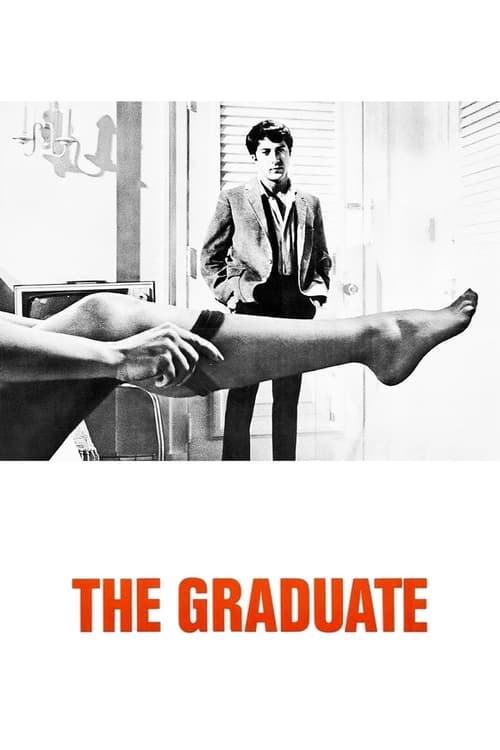
The Graduate
1967 · Mike Nichols
For when you feel stuck — between school and life, or a job and a self — and want a film that gets the drift and makes it funny. Comfort viewing with a sting in the tail.
What it's about
Benjamin Braddock comes home from college to his parents' sunlit Los Angeles suburb with a degree, a sports car, and no idea what to do with his life. Into that drift steps Mrs. Robinson, the wife of his father's business partner, who seduces him into a secret affair — and then he meets her daughter. What starts as farce about a bored young man becomes a tangle of desire, rebellion, and panic about becoming your parents.
The experience
Funny in a squirmy, deadpan way, then quietly sad underneath — the comedy of a kid saying the wrong thing to adults gives way to real ache. It moves briskly but leaves an aftertaste of restlessness that lingers longer than the laughs.
Performances
Dustin Hoffman's breakout: awkward, mumbling, radiating panic behind polite answers. Anne Bancroft matches him as Mrs. Robinson, playing world-weary seduction with a bitterness that turns a punchline of a character into someone wounded and formidable.
The craft
Mike Nichols shoots suburban comfort like a trap — bodies framed through fish tanks, pool water, and doorways, with bold cuts that jump between fantasy and routine. The Simon & Garfunkel songs aren't decoration; they carry the emotion the characters can't say, and helped invent the pop-song soundtrack as we know it. It looks gorgeous in widescreen and the music deserves good speakers.
Why it matters
A defining film of the New Hollywood moment — it gave a young generation its first screen antihero, made Hoffman a star, and changed how movies use pop music forever.
Snapshot
Mike Nichols's second feature is a wry, formally restless anatomy of postwar American prosperity and the generation inheriting it. Benjamin Braddock returns from an undistinguished East Coast education to a sunlit Los Angeles suburb populated by parents who own things and say nothing — and is promptly seduced by one of them. The film's genius is to treat this as farce and elegy simultaneously, leaving its final image — two young people on a bus, smiles curdling into vacancy — as one of cinema's most withering open endings. The Graduate arrived at precisely the moment American studio cinema was fracturing: it helped break the old Production Code consensus, established the pre-existing pop song as a legitimate scoring device, and gave the emerging New Hollywood its first generationally legible antihero.
Industry & production
The property originated with Charles Webb's 1963 debut novel, a lean, deadpan satirical narrative that attracted producer Lawrence Turman, who spent several years assembling financing. Embassy Pictures, the independent outfit operated by Joseph E. Levine, ultimately backed the project. Turman's persistence in attaching Nichols — who had just completed his directorial debut, Who's Afraid of Virginia Woolf? (1966), to critical and commercial acclaim — was decisive in securing the deal and the budget latitude the film required.
Casting was protracted and consequential. Numerous leading men were reportedly considered for Benjamin Braddock; Robert Redford's name appears frequently in accounts of the search, with Nichols reportedly feeling he was "too handsome" — that audiences would not accept him as a social misfit. Dustin Hoffman, then known primarily from New York stage work and minor screen appearances, was an improbable choice for a film aimed at mainstream distribution. His casting became a statement about the kind of physical and psychological register the film was after. Anne Bancroft, already an Academy Award winner for The Miracle Worker (1962), brought genuine star power and a willingness to play against glamour. Katharine Ross completed the central triangle.
The screenplay credits are Calder Willingham and Buck Henry. Willingham, a novelist and experienced Hollywood hand, worked on early drafts; Henry, then emerging as a comic writer, substantially shaped the dialogue's mordant ironies and the screenplay's tonal balance. Their contributions were not always harmonious and their respective weights in the final script have been characterized differently by various participants — the record on the precise division of labor is not fully settled.
Technology
Robert Surtees, ASC, served as director of photography, working with anamorphic Panavision. The production made conspicuous use of long telephoto lenses throughout — not merely as an occasional stylistic flourish but as a systematic grammar of alienation and distance. The lenses flatten spatial planes, compress figures against their backgrounds, and strip conventional cinematic depth from the frame. This was technically demanding in the late 1960s; the lenses available were bulkier and less optically refined than those of later decades, and coordinating movement within telephoto compositions required precise rehearsal.
The penultimate chase sequence — Benjamin running along a Pasadena street toward the church where Elaine's wedding is underway — was filmed with an extremely long telephoto lens that creates the optical illusion of a figure running in place, making no progress against a fixed background. This "treadmill effect," generated entirely in-camera, became one of the sequence's most discussed formal choices. Whether it was planned or discovered during production is a detail the available accounts do not fully clarify.
Technique
Cinematography
Surtees and Nichols developed a visual system organized around enclosure: the frame-within-frame via doorways, car windows, and aquarium glass; figures dwarfed by or trapped within architectural interiors; and the recurrent motif of transparent barriers separating Benjamin from the world. The Robinson family's fish tank appears with pointed regularity, its glassy confinement rhyming with Benjamin's own. The famous sequence of Benjamin floating in the family pool on an inflatable raft is shot to maximize his passivity — a body adrift in affluent geometry. Surtees's exposure choices favor a clean, even high-key light for suburban interiors and a cooler register for the Berkeley sequences, marking a shift in the film's emotional temperature.
Editing
Sam O'Steen edited the film, and his work here is as important as any other technical contribution. O'Steen was then known primarily as an editor of thrillers — he had cut The Hustler (1961), Cool Hand Luke (1967), and several Sydney Pollack productions — and he brought to The Graduate a willingness to cut against narrative convention. The sequence compressing Benjamin's affair with Mrs. Robinson across multiple hotel visits is edited as a rapid montage that deliberately scrambles spatial and temporal continuity, individual shots colliding rather than flowing, the hotel room dissolving into the pool dissolving into the lobby in overlapping rhythms that mime Benjamin's numbed, repetitive experience. These passages have the feel of European art cinema more than classical Hollywood continuity; the influence of Alain Resnais and the French New Wave is legible.
Mise-en-scène / staging
Nichols, trained in improvisation and stage direction (his collaborations with Elaine May and his Broadway productions of Barefoot in the Park and Luv preceded his film work), approaches scenes as behavioral units rather than illustrated plot mechanics. The physical staging of the seduction scenes — Mrs. Robinson's precise spatial maneuvering against Benjamin's fidgeting uncertainty — is calibrated to comedic rhythm while keeping the psychological power dynamic genuinely uncomfortable. The Robinson home is staged as a showroom of upper-middle-class aspiration: every surface polished, every object chosen to signal arrival, the human inhabitants nearly decorative. The Taft Hotel functions as its seedier mirror, both spaces emptied of warmth.
Sound
The decision to score the film predominantly with pre-existing Simon & Garfunkel recordings rather than a conventional underscore was one of the most influential choices in the film's production history. "The Sound of Silence," "Scarborough Fair/Canticle," "April Come She Will," and the hook from an early, incomplete draft of "Mrs. Robinson" were licensed and placed against picture, creating a counterpoint between the folk idiom's elegiac register and the visual absurdism of Benjamin's predicament. The complete "Mrs. Robinson" did not exist in finished form during production; the version in the film is essentially a fragment, and the completed recording appeared on Simon & Garfunkel's Bookends album in 1968. Dave Grusin provided limited incidental scoring for passages where no song placement worked. The use of pop music as structural score rather than background decoration had precedents — Richard Lester's Beatles films among them — but The Graduate's commercial and cultural impact normalized the practice and established it as a viable mode for serious American cinema.
Performance
Hoffman's performance operates in an unusual register for 1967 Hollywood: naturalistic, hesitant, physically awkward, and largely reactive. Benjamin Braddock rarely initiates; he is acted upon. Hoffman's approach — drawn partly from his stage training and from the Method tradition, though his relationship to that tradition was eclectic — gives Benjamin an interiority communicated through withholding rather than expression. Bancroft's Mrs. Robinson is his precise foil: every gesture controlled, sexuality deployed with strategic deliberateness, loneliness surfacing only in unguarded beats. The scene in which Benjamin attempts to have an actual conversation with her is among the film's finest, Bancroft's disdain and Hoffman's bewilderment generating genuine pathos. Katharine Ross carries the structural burden of being both idealized object and, finally, collaborator in flight — a less internally complex role, but Ross brings an elusive, grounded quality that prevents Elaine from collapsing into function.
Narrative & dramatic mode
The film adapts Webb's novel's satirical detachment while adding tonal instability — it tips in and out of farce, romantic comedy, and something bleaker without fully settling. Nichols maintains ironic distance through much of the film and then, in the final minutes, permits something like sincerity to enter, only to undercut it immediately with the closing bus shot. The narrative follows a classic comic arc — young man escapes social fate, claims his desired object — but the final exchange of glances suggests the escape has led nowhere new. This refusal of resolution, with comic structure and ironic denouement held simultaneously, was unusual in American studio cinema of the period.
Genre & cycle
The Graduate sits at the confluence of the romantic comedy, the coming-of-age film, and the social satire. Its immediate cycle is the late 1960s cycle of anti-establishment comedies targeting suburban conformity and parental hypocrisy — it anticipates and partially generates the market for such films. More broadly, it belongs to the wave of American films from 1967–1975 that renegotiated the social contract of Hollywood narrative: Bonnie and Clyde (1967) and Easy Rider (1969) are its closest contemporaries in spirit, though their generic homes are quite different. All three center on protagonists who reject dominant social formations and are punished or disoriented for it, though The Graduate alone registers this as comedy rather than tragedy.
Authorship & method
Nichols brings the sensibility of a stage director to film grammar: acute attention to actors, sharp instincts for behavioral rhythm, a deep comfort with irony. His background in improvisational comedy with Elaine May gave him an ear for subtext and deflection — dialogue meaning its opposite, characters speaking past one another. His film technique in The Graduate is demonstrably influenced by European art cinema. The discontinuous editing of the hotel montages, the telephoto alienation, and the refusal of cathartic closure all point to engagement with Resnais, Antonioni, and the French New Wave. Surtees's contributions as a Hollywood veteran gave the film a technical fluency that European-influenced ambitions sometimes lacked. O'Steen's editing is the hidden architecture of the film's emotional logic. Buck Henry's screenplay provides the verbal wit that keeps the film from becoming purely impressionistic.
Movement / national cinema
The Graduate is a pivotal text in the emergence of New Hollywood, the loosely defined movement of the late 1960s and 1970s in which American commercial cinema absorbed European art cinema influences, relaxed its moral and narrative conventions, and permitted a new generation of directors substantial creative control. The film's commercial success — extraordinary for its production scale — demonstrated to the studios that this kind of tonal and formal experiment was not commercially suicidal, and it helped underwrite the climate in which Easy Rider, Midnight Cowboy, Five Easy Pieces, and the early films of Coppola and Altman became possible. Nichols himself is not a founding figure of the movement in the way that Bogdanovich or Cassavetes might be, but The Graduate is one of its founding texts.
Era / period
The film belongs to the transitional moment of 1966–1968, when the studio system's Production Code was effectively dead and the MPAA rating system (introduced in November 1968) had not yet been formalized — a regulatory vacuum that permitted the film's frank sexuality and cynicism. It also catches the American counterculture just before its radicalization: Benjamin Braddock's rebellion is inarticulate and personal rather than political, his rejection of plastics-era prosperity not yet coded as protest. By 1968 the Berkeley setting would have been legible as explicitly political territory; in the film it remains vaguely emancipatory rather than insurgent.
Themes
The film's central thematic coordinates are affluence as emptiness and the failure of inherited social scripts. The "plastics" exchange — Benjamin offered a one-word summary of his future by a family acquaintance — became the era's most quoted synecdoche for postwar American hollowness precisely because the film earns it: every visual and behavioral detail of the Robinson world supports that diagnosis. Sexual transgression functions not as liberation but as another form of drift. The Oedipal structure is deliberate and acknowledged; Benjamin's triangulation between Mrs. Robinson and Elaine maps onto anxieties about becoming one's parents and escaping their world simultaneously. The ambiguous ending refuses the comfort of a completed escape: the film argues, finally, that you cannot improvise your way out of a culture from inside it.
Reception, canon & influence
Backward: influences on the film. The formal debts are primarily to European art cinema: Antonioni's alienated protagonists and compositional compression, Resnais's elliptical editing and temporal disruption, the French New Wave's license to break Hollywood continuity conventions. The use of music as counterpoint rather than illustration has roots in the French New Wave (Godard's use of non-diegetic sound) and in earlier American genre films that deployed popular song ironically. Nichols's theatrical background in satire and improvisation is a direct compositional source.
Contemporary reception. The Graduate was a substantial critical and commercial success on release. Nichols won the Academy Award for Best Direction; the film received seven nominations including Best Picture. Mainstream critics were largely admiring, responding to its wit and formal intelligence. It was among the highest-grossing American films of its release year, a commercial performance that confounded the studios' assumptions about what aesthetically ambitious work could earn. Some dissenting voices found it facile in its generational critique, and the Cahiers du Cinéma critical tradition was cooler than the American mainstream — the film's irony was read by some European critics as a comfortable substitute for genuine formal or political risk.
Canonization. The film has been continuously canonical since its release. It appears on the American Film Institute's various ranked lists, was selected for preservation in the Library of Congress's National Film Registry, and remains a standard text in film studies curricula. Pauline Kael, who was a significant critical voice of the period, offered a complicated assessment that acknowledged the film's craft while questioning its depth — a response that has aged interestingly given the film's durability.
Forward: legacy. The pop-song scoring model that The Graduate normalized became the dominant mode of American film music within a decade, visible everywhere from Easy Rider through the John Hughes films of the 1980s and into contemporary practice. The passive, alienated young male protagonist became a template: the film is a direct ancestor of a line of ambivalent coming-of-age works that runs through Harold and Maude (1971), Risky Business (1983), and beyond. The ambiguous ending — comedy refusing to close — influenced later filmmakers who wanted to use genre structure while refusing its consolations. The film also contributed substantially to Dustin Hoffman's subsequent career trajectory, helping to authorize a style of less conventionally heroic American screen performance. Anne Bancroft's Mrs. Robinson entered the cultural lexicon as a figure for predatory older sexuality and has been quoted, parodied, and analyzed in popular culture to an extent that somewhat overdetermines how the film is now viewed — the archetype she created has in some respects eclipsed the complexity of her performance.
A Deleuzian reading
A young man lies on an inflatable raft in a backyard pool, sunglasses on, going nowhere.
The full Deleuzian reading of The Graduate →
Reception
A genuine phenomenon in 1967 — one of the biggest hits of its decade and the film that made Dustin Hoffman a star — it's since shifted from 'voice of a generation' to a movie each new generation re-reads: modern viewers tend to find Benjamin far less sympathetic than 1967 audiences did.
How The Graduate was received, from release to now →
Influences: the films it descends from and the films it influenced
- L'Avventura (1960) — Surtees's telephoto compression of Benjamin against crowd backgrounds directly adopts Antonioni's technique of flattening figures against environment — beach, architecture, open landscape — to externalize psychological alienation through spatial depth, making the lens itself the instrument of estrangement.
- Hiroshima Mon Amour (1959) — The discontinuous hotel montages collapsing Benjamin's affair into associative fragments apply Resnais's method of non-chronological cutting within a single location, making duration subjective and erasing the boundary between one visit and the next.
- Breathless (1960) — O'Steen's discontinuous cutting within scenes imports Godard's jump-cut license to break Hollywood spatial continuity — specifically the technique of fragmenting a single behavioral stretch into mismatched angles without eyeline correction.
- Blow-Up (1966) — Shot the year before, Antonioni's English-language film demonstrated that telephoto-alienation aesthetics and a passive, observation-driven protagonist could hold mainstream commercial audiences — providing Nichols and Surtees a proof-of-concept for the synthesis they attempted.
- La Notte (1961) — The frame-within-frame compositions trapping characters inside architectural apertures — windows, doorways, reflective surfaces — that Surtees deploys throughout comes from Antonioni's systematic use of this device to convert bourgeois domestic space into a staging of psychological captivity.
- 8½ (1963) — Nichols inherits Fellini's structural device of a passive, self-unaware male protagonist surrounded by women who function as screens for his projected anxieties rather than autonomous agents — the harem fantasy sequence is the direct template for Benjamin's oedipal triangulation between Mrs. Robinson and Elaine.
- Darling (1965) — Schlesinger's formal strategy of positioning the protagonist as the unknowing object of the film's own satire — a character who cannot read the irony the camera directs at them — establishes the mode Nichols imports wholesale into the American social comedy.
- The Apartment (1960) — Nichols and cinematographer Robert Surtees used extreme telephoto compression to make Braddock household interiors feel institutionally crushing in exact correspondence to Wilder's forced-perspective Consolidated Life offices; the depth-of-field grammar of spatial entrapment passes directly from The Apartment into The Graduate's visual system.
- A Place in the Sun (1951) — DP Robert Surtees extended Mellor's telephoto grammar — compressing two faces into a single shallow-focus frame to render romantic obsession as an almost abstract proximity — and the lyrical montage sequences with Simon and Garfunkel holding the same structural counterpoint role as Waxman's score are a direct formal inheritance Surtees discussed in interviews about the film's visual approach.
- A Man and a Woman (1966) — Surtees' extreme long lenses shooting through aquarium glass, car windscreens and hotel doors, plus the pool/hotel montage cut to complete pre-existing Simon & Garfunkel tracks rather than to picture — the American absorption of Lelouch's glass-barrier long lens and song-length montage block.
- Harold and Maude (1971) — Ashby adopts The Graduate's precise scoring model — deploying a single artist's existing catalog (Cat Stevens) as a counterpoint landscape rather than commissioned underscore — treating the songs as emotional commentary on action rather than illustration of it.
- The Heartbreak Kid (1972) — May — Nichols's comedy partner — applies telephoto behavioral enclosure and ironic social observation to romantic pursuit with the same formal logic: compressing the protagonist inside suburban and hotel spaces that foreground entrapment, the irony generated by the gap between character intent and audience perception.
- Annie Hall (1977) — Allen adapts The Graduate's structural irony — the romantic comedy that refuses its own consolations — building the ambiguous non-resolution ending and the sardonic counterpoint use of popular music directly on the precedent Nichols established.
- Risky Business (1983) — Brickman directly inherits The Graduate's template: telephoto compression of affluent suburban architecture to create behavioral enclosure, a passive teenager as vector for adult transgression, and an ironic electronic score (Tangerine Dream) functioning as emotional counterpoint rather than dramatic illustration.
- American Beauty (1999) — Mendes and Conrad Hall revisit Surtees's specific technique of telephoto compression to flatten characters against manicured suburban surfaces, using the lens's depth-collapsing effect as the visual argument for affluence-as-emptiness — the same shot grammar made ideological.
- Lost in Translation (2003) — Coppola inherits both structural pillars of The Graduate simultaneously: telephoto compression within hotel corridors to produce behavioral enclosure, and pre-existing music (My Bloody Valentine, Phoenix) as emotional counterpoint rather than illustration — the two techniques functioning together to produce the same mood of immobilized yearning.
- Butch Cassidy and the Sundance Kid (1969) — Nichols and editor Sam O'Steen legitimized the anachronistic pop score in American prestige filmmaking — Simon & Garfunkel's contemporary folk-pop playing against images it was not written for — establishing the tonal contract Burt Bacharach's 'Raindrops Keep Fallin' on My Head' directly extends.
- Fear and Loathing in Las Vegas (1998) — Simon & Garfunkel's 'Sound of Silence' deployed as elegy-counterpoint to a generation's impending disillusionment — the dossier explicitly cites Nichols as origin point for the strategy of familiar period music operating ironically against visible catastrophe, a lineage Gilliam's soundtrack extends.
- Being There (1979) — Nichols and DP Robert Surtees use anamorphic Panavision to compositionally isolate a passive, blank protagonist within the architectural frames of upper-class American life, foregrounding environmental meaning over facial expression — the compositional logic Deschanel inherits directly for his wide framings of Sellers.
- Charlie Wilson's War (2007) — Nichols's technique of effacing the camera behind performance and using clean, functional framing so satire emerges from behavior rather than directorial flourish is the template for this film's restrained classicism.
- Election (1999) — New Hollywood satire of suburban ambition built on alienating long-lens compositions and ironic counterpoint scoring — the predatory-zoom-and-wink-of-the-score idiom Payne and Rolfe Kent inherit.
- Catch-22 (1970) — Same Nichols–Henry–O'Steen team; Catch-22 carries forward Sam O'Steen's elliptical comic cutting and Buck Henry's method of compressing a difficult novel into deadpan staged set-pieces.
- Easy Rider (1969) — The Graduate's deployment of Simon and Garfunkel's pre-existing tracks as a replacement for composed underscore directly licensed Hopper's decision to score attitude and movement entirely through pre-existing rock recordings, establishing the template that replaced Hollywood orchestral scoring for a generation.
- Five Easy Pieces (1970) — Rafelson extends Nichols's reactive-withholding performance grammar — Nicholson's Bobby Dupea maintains the same behavioral opacity as Hoffman's Benjamin, deflecting rather than expressing, with the film refusing cathartic resolution on the same structural principle.
- The Last Picture Show (1971) — Bogdanovich and László Kovács deploy New Hollywood telephoto work and discontinuous editing to fracture a coming-of-age arc that refuses resolution, both films ending on faces emptied of the emotions the genre promised — the treadmill-effect of characters arriving nowhere structuring both films' final beats.
- Bonnie and Clyde (1967) — Nichols placed pre-existing Simon & Garfunkel folk-rock recordings anachronistically over his drama as a way of introducing ironic tonal distance between image and emotion — exactly the function Flatt & Scruggs's contemporary bluegrass performs in Bonnie and Clyde.
- Petulia (1968) — Robert Surtees's persistent use of long telephoto lenses compresses California consumer environments — suburban pools, hotel lobbies, church pews — into suffocating spectacle, a strategy identical to Roeg's in Petulia; both films use the telephoto's flattened depth-of-field to make consumer architecture feel inescapable, trapping performers against backgrounds that refuse recession.
- Midnight Cowboy (1969) — Shares Dustin Hoffman's interior, anti-leading-man performance method and the New Hollywood use of pop song (Simon & Garfunkel / Nilsson's 'Everybody's Talkin'') as ironic emotional counterpoint to image.
- Who's Afraid of Virginia Woolf? (1966) — Direct descendant — Nichols' immediate follow-up, carrying forward the same actors'-director sensibility and the O'Steen/Sylbert creative ensemble first assembled here, now applied to expressive cutting and framing.
- Lolita (1962) — Builds a satire of American culture on an illicit intergenerational seduction scored with pointedly ironic pop music—the tonal recipe of comedy-over-discomfort Lolita pioneered for the subject.
- The Swimmer (1968) — Nichols turns the backyard pool into a psychological aquarium and shoots suburban running on long lenses that flatten forward motion into a treadmill — the same optic and the same joke as Ned's telephoto-compressed sprints across lawns.
Similar films
- Annie Hall (1977) — influence & lineage
- Five Easy Pieces (1970) — influence & lineage
- American Beauty (1999) — influence & lineage
- Easy Rider (1969) — influence & lineage
- The Last Picture Show (1971) — influence & lineage
- Harold and Maude (1971) — influence & lineage
- American Graffiti (1973) — same viewing thread
- Rebel Without a Cause (1955) — same viewing thread
All the films related to The Graduate →
Watch it with: curated runs of related films
- Restless Youth, Rigid Walls — Watch these as one long walk through the school years — the teachers who crack you open, the friends who pull you off the sidelines, the first loves and the institutions you push against — where a beloved tearjerker and a surreal boarding-school revolt turn out to be cousins.