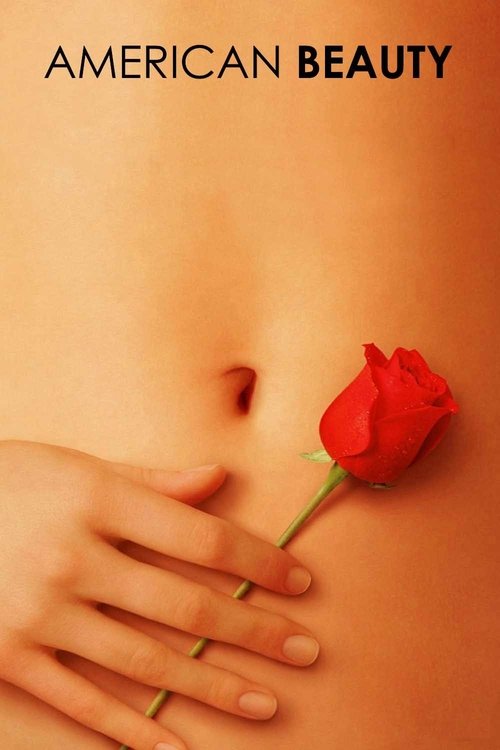
American Beauty
1999 · Sam Mendes
For when you want a film to chew on for days — one that satirizes ordinary life and then asks whether the satire is fair. Not a comfort watch; reach for it when you're in the mood to be needled about jobs, marriages, and what 'having it all' costs.
What it's about
Lester Burnham is a numbed suburban dad in a dead marriage and a deader job — and he tells you in the opening minutes that within a year he'll be gone. What jolts him awake is an infatuation with his teenage daughter's friend, and from that spark he starts torching his old life: quitting his job, buying the car he always wanted, refusing to play along. Meanwhile his wife chases real-estate success and an affair, and his daughter drifts toward the strange, watchful boy who's moved in next door with a video camera.
The experience
A dark comedy that keeps curdling into something sadder and stranger — funny, uncomfortable, and dreamlike by turns. It provokes as much as it entertains, and it's built to be argued about afterward.
Performances
Kevin Spacey's Oscar-winning turn swings from deadpan sarcasm to raw yearning, and Annette Bening is extraordinary as his wife — a brittle, striving performance that finds real pain inside a woman the film could easily have mocked.
The craft
Sam Mendes, directing his first film straight from the theater, gives suburbia a composed, painterly menace — most famously in the rose-petal fantasies — while Conrad Hall's cinematography and Thomas Newman's chiming, marimba-flecked score became instantly recognizable and endlessly imitated. Alan Ball's script balances savage one-liners with genuine ache.
Why it matters
It swept the Oscars including Best Picture, launched Mendes's film career, and crystallized 1999's wave of suburban-discontent cinema; its reputation has been fiercely re-debated since, which is itself part of its legacy. Newman's score alone echoed through a decade of film and TV.
Snapshot
American Beauty is the story of Lester Burnham, a numbed suburban advertising functionary who, jolted out of his stupor by an infatuation with his teenage daughter's friend, begins systematically dismantling the life he has come to despise — quitting his job, blackmailing his boss, buying a sports car, smoking marijuana, lifting weights — while his wife Carolyn chases real-estate success and an affair, and his daughter Jane drifts toward the watchful neighbor boy next door. Narrated from beyond the grave by Lester himself, who tells us in the opening minutes that he will be dead within the year, the film is at once a midlife-crisis comedy, a portrait of suburban anomie, and a self-conscious meditation on beauty and seeing. It arrived as the prestige debut of theater director Sam Mendes and the first produced screenplay by television writer Alan Ball, and it became the signature awards film of the 1999–2000 season, winning five Academy Awards including Best Picture, Director, Actor, Original Screenplay, and Cinematography. It has since become one of the more contested Best Picture winners — a film whose craftsmanship is rarely disputed but whose thematic profundity, and whose lead actor, have been heavily reassessed.
Industry & production
The film was produced by DreamWorks SKG, the studio founded in 1994 by Steven Spielberg, Jeffrey Katzenberg, and David Geffen, and it functioned as a prestige showcase for a young company still establishing itself in adult drama. Producers Bruce Cohen and Dan Jinks shepherded Alan Ball's spec script, which had circulated as a coveted property. The decision to hand a relatively modest, dialogue-driven domestic drama to Sam Mendes — a celebrated London and Broadway stage director (Donmar Warehouse, the Cabaret revival) who had never directed a feature — was a notable bet, reportedly supported by Spielberg's enthusiasm. The budget was modest by studio standards, generally reported in the area of $15 million, and the production shot in 1998 around the Los Angeles area, using suburban tract housing and a backlot to construct its anonymous American "Anytown." Mendes has spoken in interviews about an unusually generous (for a first-timer) rehearsal period and about reshooting portions after early dailies underwhelmed him, an arrangement enabled by the studio's confidence. The film opened in limited release in September 1999 and expanded into wide release, becoming a substantial commercial success well out of proportion to its cost; precise grosses I won't quote from memory, but it was among the more profitable specialty-to-wide rollouts of its year.
Technology
American Beauty was a photochemical production of the late-celluloid era, shot on 35mm color negative and finished by traditional means rather than the digital intermediate pipelines that would become standard only a few years later. Its technological interest lies less in novel apparatus than in disciplined classical tools: anamorphic and spherical lensing, dolly and crane moves, and carefully controlled lighting by a veteran cinematographer. The film does incorporate a recurring diegetic-video conceit — Ricky Fitts's handheld camcorder footage, including the famous shot of a plastic bag dancing in the wind — which stages consumer video as a way of seeing within the fiction; that footage's lower-resolution, intimate texture is set against the polished 35mm frame. Beyond that, the film predates the era when CGI or digital compositing would routinely shape a domestic drama, and its effects (the rose-petal fantasy imagery, for instance) were achieved through in-camera and practical photographic means combined with optical/post work rather than as a digital set piece.
Technique
Cinematography
The photography by Conrad L. Hall is the film's most universally praised element and won him his second competitive Academy Award (decades after Butch Cassidy and the Sundance Kid). Hall built a precise, symmetrical, almost architectural visual scheme: centered compositions, strong verticals and horizontals (doorframes, blinds, banisters) that box the characters into the geometry of their houses, and a restrained palette punctuated by saturated red — the American Beauty roses of the title, Carolyn's pruning shears, Lester's fantasies. The celebrated motif renders Lester's desire for Angela as showers and beds of red rose petals, a stylized interior subjectivity. Hall favored soft, naturalistic sources and a cool, controlled light that turns suburban interiors slightly clinical, then warms and loosens as Lester reawakens. The compositional rigor — frames within frames, reflective surfaces, rain on glass — visually argues the film's thesis that beneath ordered surfaces lies something stranger and more alive.
Editing
The film was cut by Tariq Anwar and Christopher Greenbury. The editing's central task is to braid several modes — Lester's retrospective voiceover, "present"-tense domestic scenes, fantasy interludes, and Ricky's video footage — into a coherent tonal register that slides between satire, melancholy, and suspense. The cutting is generally unhurried and classical, holding on performances and on Hall's compositions rather than fragmenting them, while the fantasy sequences are marked off by their own rhythm and imagery. The film's framing device — opening with foreknowledge of Lester's death and closing on the event — gives the edit an architecture of dramatic irony that the cutting sustains across the runtime.
Mise-en-scène / staging
Mendes's theatrical training is most visible here. Interiors are dressed to characterize: Carolyn's compulsively coordinated dining table and matching gardening clogs, the Burnham house's tasteful sterility, the Fitts household's military severity. Staging exploits thresholds, windows, and the gap between adjacent suburban homes (Jane and Ricky watching each other across the divide). Color-coded production design and props (the red door of the Burnham house, roses everywhere) function as a running visual commentary. The blocking repeatedly isolates characters within the frame even when they share a room, dramatizing estrangement through physical arrangement rather than dialogue.
Sound
Thomas Newman's score is among the film's most influential legacies — a spare, percussive, marimba-and-mallet-driven palette with pulsing minimalist patterns that reads as quizzical, light, and faintly melancholy rather than emotive in a conventional Hollywood manner. It became one of the most imitated scoring styles of the 2000s, widely copied in trailers, indie comedies, and television. The sound design supports the film's between-states tone, and the soundtrack also deploys curated songs (including period and classic-rock cues for Lester's regression to adolescence). Newman's main themes have entered the cultural shorthand for "wry suburban indie."
Performance
The ensemble acting is central to the film's reputation. Kevin Spacey, as Lester, modulates from deadened sarcasm to a kind of liberated, dangerous boyishness, anchoring the film's voiceover and its moral arc; the performance won the Best Actor Oscar. Annette Bening's Carolyn is a high-wire blend of brittle striving and pathos — the realtor's mantra, the controlled breakdowns — and is regarded by many critics as the film's finest performance. Thora Birch and Wes Bentley give the teenage storyline a watchful gravity; Mena Suvari plays Angela's bravado and underlying fragility; and Chris Cooper's Colonel Frank Fitts and Allison Janney's catatonic Mrs. Fitts supply the film's darkest register. The performances are pitched to hold satire and sincerity simultaneously.
Narrative & dramatic mode
The film's defining structural choice is its posthumous first-person narration: Lester announces his imminent death in the prologue, so the entire story unfolds under the sign of dramatic irony and elegy. This frames the comedy of midlife rebellion as something already mourned, and it primes the audience to read the action as a meditation on mortality and attention ("look closer," the tagline). The mode is tragicomic and ironic — a satire of suburban consumerism and self-deception that turns, in its final movement, toward a sincere, almost mystical affirmation (Lester's closing voiceover about gratitude and beauty). Multiple plotlines (Lester's awakening, Carolyn's affair, Jane and Ricky's romance, the Fitts family's repression) converge on the night of Lester's death, with the screenplay deploying misdirection about who will pull the trigger.
Genre & cycle
American Beauty sits within the long American tradition of suburban critique — narratively descended from Death of a Salesman and the domestic novels and films that anatomize the discontents beneath middle-class comfort. As a 1999 release it belongs to a remarkable cluster of millennial American films interrogating suburbia, masculinity, and the unreality of consumer life, alongside Fight Club, The Virgin Suicides, Magnolia, Election, and Being John Malkovich. It hybridizes midlife-crisis comedy, family melodrama, coming-of-age romance, and a faint thriller framework. It is also a paradigmatic "prestige indie-adjacent studio drama" of its moment — adult, writer-driven, awards-calibrated.
Authorship & method
The film is a meeting of three distinct authorial sensibilities. Alan Ball, the screenwriter, brought a television dramatist's structural control and a satirist's ear; the script's voice, its braided plots, and its tonal oscillation between cruelty and tenderness are recognizably his, and the film launched a career that would crest with HBO's Six Feet Under and True Blood — work that shares American Beauty's preoccupation with death, suburban facade, and repressed desire. Sam Mendes, the director, imported the precision, rehearsal discipline, and compositional control of the prestige theater; the film inaugurated a film career marked by formal rigor and frequent collaboration with great cinematographers (Road to Perdition, again with Conrad Hall; Jarhead; Skyfall; 1917). Conrad L. Hall, the cinematographer, was a senior figure of American cinematography whose contribution shaped the film's meaning as much as its surface; American Beauty and the subsequent Road to Perdition (for which he won a posthumous Oscar) capped a landmark career. Thomas Newman, scion of the Newman film-music dynasty, contributed a score whose idiom became era-defining. The collaboration is genuinely distributed: the film is as much Ball's and Hall's as Mendes's.
Movement / national cinema
The film is firmly within mainstream American studio filmmaking, not a formal avant-garde, but it draws on the European-influenced art-cinema sensibility that a theater-trained director and a contemplative cinematographer bring to a Hollywood frame. Its lineage runs through the American suburban-critique tradition and through the New Hollywood's earlier reckonings with middle-class malaise (The Graduate is an obvious antecedent in its satire of generational and erotic discontent). It is a quintessential product of late-1990s Hollywood's appetite for "smart," literate adult drama positioned for awards.
Era / period
American Beauty is deeply a film of the turn-of-the-millennium American moment: the late-Clinton economic boom, the real-estate-and-self-improvement culture (embodied in Carolyn), the anxieties about masculine purpose and consumer emptiness that recur across 1999 cinema. Its contemporary suburban setting is essentially timeless-generic by design — an "Anytown" meant to read as universal American middle-class life — yet its concerns (corporate downsizing, the commodification of self, surveillance via camcorder, repressed homophobia) are specific to its end-of-century vantage. It now also functions as a period document of pre-2017 Hollywood, given how thoroughly its reception has been complicated by subsequent events around its lead.
Themes
The film's governing themes are seeing and beauty — the tagline "look closer," the rose imagery, Ricky's video as a practice of attention, and Lester's final epiphany that beauty saturates ordinary life. Beneath that runs a sustained critique of suburban conformity and consumerism, the performance of a successful life over an empty one. Midlife crisis and the recovery (or regression) of desire drives Lester's arc, shading uncomfortably into the film's treatment of an adult man's fantasy about a teenage girl — material the film both indulges and ultimately retreats from when Lester declines to act. Repression, especially repressed sexuality, culminates in Colonel Fitts, whose violent homophobia masks his own desire. Imprisonment and liberation, appearance versus reality, and mortality (the posthumous narration) complete the thematic field. The film's ambivalent attitude toward its own ideas — whether its "beauty in everything" ending earns its sincerity or settles for an easy uplift — is precisely what later critics have debated.
Reception, canon & influence
Backward — influences on the film. American Beauty draws on the suburban-discontent canon (Arthur Miller, John Cheever's milieu, The Graduate), on the posthumous/retrospective narrator (most famously Sunset Boulevard, narrated by a dead man), and on the European-inflected art-house sensibility filtered through a studio frame. Alan Ball has cited the everyday-observation impulse — the famous plastic-bag image as an emblem of finding the extraordinary in the mundane — as a generative idea.
Initial reception. The film was a major critical success on release and swept the 1999–2000 awards season, winning five Academy Awards (Picture, Director for Mendes, Actor for Spacey, Original Screenplay for Ball, Cinematography for Hall) and numerous critics' and guild prizes. It was widely hailed as a defining film of its year and a triumphant feature debut.
Forward — legacy and reassessment. Its influence is most concrete in three areas: Thomas Newman's scoring idiom, which became ubiquitous in subsequent indie and television work; its visual vocabulary of symmetrical, color-accented suburban unease, widely imitated; and its consolidation of the "prestige suburban-malaise drama" as a recognizable mode. Sam Mendes's career launched directly from it. Critically, however, American Beauty has undergone one of the more pronounced canonical demotions of any modern Best Picture winner. Over the 2000s and 2010s a revisionist line argued that its satire was facile, its "look closer" wisdom glib, and its treatment of the teenage-fantasy material self-flattering. That reassessment intensified sharply after 2017, when allegations of sexual misconduct against Kevin Spacey effectively ended his Hollywood career and retroactively colored readings of both the film and his Lester. The film thus occupies an unusual position: technically esteemed (Hall's cinematography and Bening's and the ensemble's performances retain their reputation) yet culturally diminished, a fixture of arguments about how a celebrated film's standing can shift with critical fashion and with the offscreen fate of its star. Where the historical record is genuinely contested — particularly on whether the film's final sincerity is earned or hollow — that contest is itself the most durable part of its legacy.
A Deleuzian reading
Start with the plastic bag.
The full Deleuzian reading of American Beauty →
Reception
In 2000 it swept the Oscars — five wins including Best Picture — and was hailed as the defining American film of its moment; today it's the go-to example of a Best Picture winner whose reputation collapsed, its suburban-malaise satire widely re-read as smug and its standing further damaged by the allegations against Kevin Spacey.
How American Beauty was received, from release to now →
Influences: the films it descends from and the films it influenced
- Sunset Boulevard (1950) — Establishes the posthumous narrator — a protagonist who frames his own life story from beyond death — the exact retrospective device Lester's voiceover adopts to drench the film in dramatic irony.
- The Graduate (1967) — Pioneers the suburban-entrapment frame-within-frame (Ben shot through doorways, glass, and the older woman's leg), the same compositional language of repressed desire boxed inside affluent interiors that Hall and Mendes deploy.
- In Cold Blood (1967) — Conrad Hall's own earlier landmark — its expressionistic deep-focus naturalism and motivated-source lighting are the cinematographic grammar he refines into American Beauty's clean symmetry.
- Blue Velvet (1986) — Codifies the saturated-red motif and the manicured-suburb-as-mask premise, the surface/rot dialectic that American Beauty's rose-petal imagery and 'look closer' thesis directly inherit.
- Ordinary People (1980) — Template for the theater-director's prestige suburban-family drama built on rehearsed, blocking-precise ensemble performance — the actor's-medium approach Mendes imports from the stage.
- Short Cuts (1993) — Model for the braided, converging multi-household plotlines drifting across a single suburban geography, the structural weave Alan Ball compresses into one cul-de-sac.
- The Ice Storm (1997) — Shares the color-coded production design and chilled, glassy symmetry used to render affluent suburban anomie and sexual dysfunction as a designed visual system.
- Happiness (1998) — Parallel exercise in tonal oscillation between cruelty and tenderness around repressed suburban sexuality, the satirist's-deadpan register Ball's script shares.
- The Apartment (1960) — Conrad Hall's wide-angle compositions habitually place Lester Burnham at the physical margins of corporate and domestic spaces in visual quotation of Wilder's staging of Baxter — lone figure dwarfed by institutional depth — extending The Apartment's grammar of corporate emasculation-through-spatial-marginalization into the suburban professional landscape.
- Lolita (1997) — Runs the same two devices together — a posthumous confessional voice-over structuring the film, and a middle-aged man's fantasy of a teenage girl rendered in saturated advertising imagery (Conrad Hall's petal reveries) that visually endorses the desire the narration later disavows.
- The Swimmer (1968) — Mendes shoots the suburb in high-key daylight as a stage set with a crime behind it and organizes it around a middle-aged man's regression into his own body, restoring the retrospective narration that gives the audience the certainty Ned never gets.
- Road to Perdition (2002) — Direct continuation of the Mendes–Conrad Hall partnership, extending the same frames-within-frames symmetry and motivated chiaroscuro into Hall's final, posthumously-Oscared work.
- Far from Heaven (2002) — Pushes the color-coded suburban-melodrama design and red-accented mise-en-scène of repression into full Sirkian stylization, the same palette-as-meaning method.
- The Hours (2002) — Builds on the Thomas Newman scoring idiom and the converging-timelines-bound-by-death structure, a prestige drama in American Beauty's exact tonal and musical key.
- Little Children (2006) — Inherits the ironic omniscient narration laid over manicured suburbia and the dramatic-irony gaze at repressed adult desire, extending the prestige suburban-malaise mode.
- Revolutionary Road (2008) — Mendes returns to suburban-conformity-as-suffocation with the same theatrical two-hander blocking and symmetrical-interiors visual scheme, a direct stylistic sequel.
- Six Feet Under (2001) — Ball's own extension of the film's DNA — death-framed narration, suburban facade, and repressed desire braided across an ensemble, carrying his screenwriting voice into long-form.
- Jarhead (2005) — The Mendes/Thomas Newman/first-person-voiceover template: a detached narrator framing an individual hollowed out by a total institution, rendered in cool symmetrical compositions — suburban malaise restaged as the Marine Corps.
- Skyfall (2012) — Mendes's theater-trained method — performance, motivation, and thematic coherence foregrounded, scored by Thomas Newman — is the authorial sensibility he transplants onto Bond.
- The Lovely Bones (2009) — A dead suburban narrator delivering retrospective, elegiac voiceover over a candy-lit domestic world, pairing the posthumous-narration device with tonal shifts between menace and reverie.
- Magnolia (1999) — Contemporary in its converging-plotlines architecture and its scored, operatic treatment of dread and revelation among damaged suburban lives.
- The Virgin Suicides (1999) — Same-year companion in filtering teenage erotic fantasy through a hazy, idealizing male gaze and a soft suburban-dream palette, paired with retrospective narration.
- The Shawshank Redemption (1994) — Earlier showcase of Thomas Newman's hushed piano-and-celesta idiom of yearning under voiceover — the scoring signature American Beauty made era-defining.
- In the Bedroom (2001) — Shares Thomas Newman's minimalist, textural, emotionally reticent scoring idiom used sparingly against suburban-American malaise — the same restraint-by-subtraction in the music.
- Lolita (1962) — Narrates a middle-aged suburbanite's obsession with a teenage girl from beyond the grave, fusing the dead/doomed-narrator frame with Lolita's satire of American domestic respectability.
- Meet Joe Black (1998) — Newman's defining percussive-minimalist score (marimba and mallet ostinatos under suburban domestic ritual) — the immediate next chapter of his late-90s sound that Joe Black helped popularize.
- Erin Brockovich (2000) — Showcases Thomas Newman's contemporaneous signature-scoring method — sparse ostinato piano and percussion textures providing emotional undertone without overstatement, the same idiom he brings to Erin.
Similar films
- The Graduate (1967) — influence & lineage
- Happiness (1998) — influence & lineage
- Road to Perdition (2002) — influence & lineage
- The Hours (2002) — influence & lineage
- Blue Velvet (1986) — influence & lineage
- American Psycho (2000) — shared sensibility
- Synecdoche, New York (2008) — shared sensibility
- Annie Hall (1977) — shared sensibility
All the films related to American Beauty →