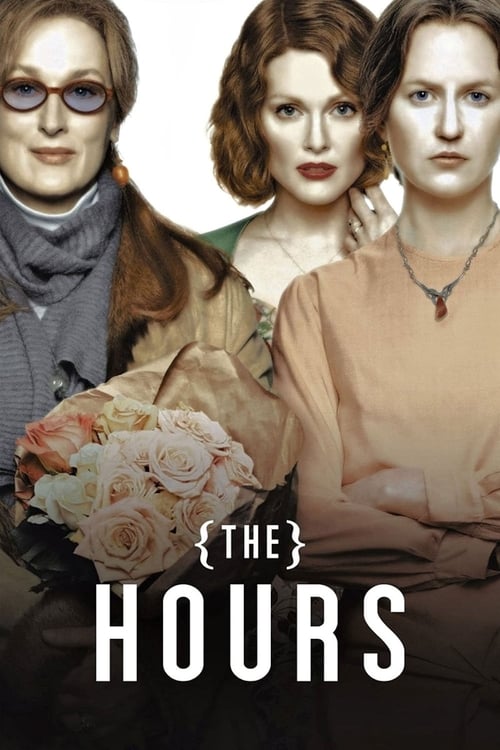
The Hours
2002 · Stephen Daldry
For when you need a good cry, or a film that takes inner life seriously — a challenging, grown-up drama for a reflective evening, not a light one. Reach for it when you want to feel deeply and think about it for days.
What it's about
Three women in three eras, bound by one novel. In 1923 England, Virginia Woolf begins writing Mrs Dalloway while chafing against her quiet convalescence; in 1951 Los Angeles, a pregnant housewife reads it and feels her carefully arranged life closing in; in 2001 New York, an editor plans a party for a dying poet friend who long ago nicknamed her Mrs Dalloway. Across a single day in each life, their stories echo and entwine.
The experience
Somber, elegant, and quietly devastating — it moves like music, cutting between the three timelines on rhymes of gesture and feeling, with an undertow of sadness that builds toward real catharsis. It asks you to sit with hard questions about depression and the lives we choose.
Performances
Nicole Kidman won the Oscar for her transformed, fiercely intelligent Virginia Woolf, and she's matched by Julianne Moore's heartbreaking portrait of a housewife suffocating behind a perfect smile and Meryl Streep's brittle, busy grief — three leads, three eras, all at full power.
The craft
David Hare's screenplay, from Michael Cunningham's Pulitzer-winning novel, braids the timelines so each woman's day illuminates the others, and Daldry's cutting between them is precise as clockwork. Philip Glass's rippling, repeating score is the film's connective tissue — it binds the three eras into one continuous current of feeling.
Why it matters
A defining prestige drama of its moment, it swept awards season on the strength of its three lead performances and stands as one of the rare literary adaptations to find a truly cinematic form for a novel's interior life.
Snapshot
The Hours is a prestige literary adaptation that braids three women's lives across three eras around a single novel — Virginia Woolf's Mrs Dalloway. In 1923 Richmond, Woolf (Nicole Kidman) begins writing the book while convalescing under her husband's anxious care; in 1951 Los Angeles, pregnant housewife Laura Brown (Julianne Moore) reads it and contemplates abandoning her family; in 2001 Manhattan, editor Clarissa Vaughan (Meryl Streep) — nicknamed "Mrs Dalloway" by her dying poet friend Richard — plans a party that collapses into grief. Directed by Stephen Daldry from David Hare's screenplay, adapted from Michael Cunningham's 1998 Pulitzer Prize–winning novel, the film is a study of suicidal ideation, repression, and the cost of choosing one's own life. It opens and closes with Woolf's 1941 drowning. Scored by Philip Glass and anchored by Kidman's Oscar-winning performance, it became one of the defining "quality" dramas of the early-2000s awards economy.
Industry & production
The film sits squarely in the specialty-division prestige model that dominated American art-house distribution around the turn of the millennium. It was produced by Scott Rudin and Robert Fox, co-financed and released by Paramount Pictures and Miramax — a pairing that reflects the era's appetite for mid-budget literary adaptations engineered for both critical seriousness and awards traction. Cunningham's novel arrived with strong cultural cachet (the Pulitzer and the PEN/Faulkner Award), and the project assembled an unusually deep cast for a chamber drama: alongside Kidman, Moore, and Streep, the ensemble includes Ed Harris as Richard, Toni Collette, Claire Danes, Allison Janney, John C. Reilly, Stephen Dillane (as Leonard Woolf), Miranda Richardson, and Jeff Daniels.
Daldry came to the film as a celebrated stage director — long associated with London's Royal Court Theatre — whose debut feature Billy Elliot (2000) had been a critical and commercial hit. The Hours was his second feature, and the choice signaled an intent to translate his theatrical instincts toward intimate, performance-driven cinema. The decision to engage David Hare, one of Britain's foremost playwrights, as screenwriter rather than a journeyman adapter underscored the project's literary ambitions; Hare's task was to find a cinematic architecture for a novel built on interior consciousness and intertextual echo.
The film premiered in late 2002 and was a strong performer within its category — a commercial success relative to its modest budget and a major awards contender. I won't cite precise box-office figures, as I can't verify exact numbers, but it was widely understood as a profitable specialty release. It received nine Academy Award nominations, winning Best Actress for Kidman; nominations spanned Best Picture, Director, Adapted Screenplay, Supporting Actor (Harris), Supporting Actress (Moore), Editing, Costume Design, and Original Score. At the Berlin International Film Festival, its three leads shared the Silver Bear for Best Actress as an ensemble.
Technology
The Hours is not a technically innovative film, and it would be misleading to present it otherwise. It was shot photochemically on 35mm in a classical register, with no significant reliance on digital effects, novel camera systems, or experimental capture. Its most conspicuous "technology" is prosthetic makeup: the false nose, altered brow, and subtly coarsened features applied to Kidman to evoke Woolf became one of the most discussed transformations of the period — a reminder that the film's craft investment went into performance and physical embodiment rather than spectacle. The triptych structure is achieved through editing and production design rather than any technical apparatus. In this sense the film belongs to a tradition of adaptation that treats cinema's resources conservatively, trusting montage, performance, and music to carry consciousness.
Technique
Cinematography
Seamus McGarvey's photography differentiates the three timelines through controlled shifts in palette, light quality, and camera temperament. The 1923 Woolf material tends toward a cool, gray-green English restraint; the 1951 Los Angeles sequences lean into a hard, slightly oppressive brightness — the saturated domestic perfection of postwar suburbia rendered as a kind of trap; the 2001 New York strand is more mobile and contemporary. McGarvey favors close framing and shallow focus that isolate faces, keeping the film's true terrain — interior states — legible across cuts. The camera is generally unobtrusive, attentive to gesture and threshold (doorways, mirrors, windows), in keeping with a drama about women contemplating the boundary between staying and leaving.
Editing
Peter Boyle's editing is the film's structural engine and earned an Oscar nomination. The film's central conceit is rhyme: actions, objects, and emotional beats are matched across the three periods so that a gesture in 1923 dissolves into its counterpart in 1951 or 2001 — a cracked egg, a kiss between women, the act of arranging flowers, the making and refusing of a life. Boyle's cross-cutting compresses a single day in each timeline into a unified flow, so that the three women seem to inhabit one continuous consciousness. The match-cuts are not merely decorative; they argue the film's thesis that these lives are bound by the same questions across eighty years. The withholding and late revelation of how the strands connect — particularly the identity of Laura Brown — is an editorial as much as a screenwriting achievement.
Mise-en-scène / staging
Production designer Maria Djurkovic builds three meticulously distinct domestic worlds, each a portrait of confinement. The Woolfs' Richmond house at Hogarth Press is shadowed and watchful; Laura Brown's pastel California home is suffocatingly immaculate, every surface a performance of normalcy; Clarissa's loft is cluttered with the texture of a real, busy life. Daldry, drawing on his theatrical training, stages scenes around charged domestic rituals — baking a birthday cake, hosting a party, a meal — so that ordinary actions carry the weight of survival or surrender. Ann Roth's costumes, also Oscar-nominated, reinforce period and psychology, dressing repression and aspiration alike.
Sound
The defining sonic element is Philip Glass's score, discussed below; it is nearly omnipresent and functions almost as connective tissue, binding the three timelines into one rhythmic continuum. Beyond the music, the film's sound design is restrained and naturalistic, attentive to the small domestic noises — running water, the river, a kettle — that mark the texture of a single day. The recurring motif of water, culminating in Woolf's drowning, is as much an aural as a visual presence.
Performance
Performance is where the film concentrates its resources. Kidman's Woolf — twitchy, fierce, physically transformed — won the Academy Award and became the film's signature; her stillness and sudden intensity convey a mind both brilliant and besieged. Moore's Laura Brown is the film's most quietly devastating turn, a woman performing contentment while drowning inwardly, her crisis legible almost entirely in restraint. Streep's Clarissa carries the contemporary strand's grief with a busy, brittle competence that finally breaks. Ed Harris's Richard is raw and unsparing as a poet ravaged by AIDS. The supporting work — Collette's neighbor, Janney, Richardson, Dillane's tender, exhausted Leonard — sustains the chamber-drama intimacy.
Narrative & dramatic mode
The film's mode is the interwoven-triptych "network" drama compressed into the unity of a single day within each era — a deliberate echo of Mrs Dalloway's own one-day structure. Hare's adaptation translates Woolf's and Cunningham's stream-of-consciousness interiority into externalized action and parallel montage, trusting cross-cutting to do the work that prose does through free indirect discourse. The dramatic engine is convergence: three apparently separate stories revealed, late, to be causally and thematically linked, so that the film withholds its full design until a final-act recognition. It is melodrama in the serious, classical sense — a drama of women, domestic spaces, and unspoken interior lives — elevated by literary pedigree and formal rigor.
Genre & cycle
The Hours belongs to several overlapping cycles. It is a prestige literary adaptation in the lineage of awards-season drama that flourished in the 1990s and 2000s. It is a "woman's film" in the tradition of domestic melodrama, foregrounding female interiority, marriage, and the question of self-abnegation. And it participates in a turn-of-the-century vogue for the multi-strand, time-spanning ensemble narrative — films that distribute a single thematic argument across separated characters and periods. Its frank treatment of queer desire and of AIDS also locates it within a body of mainstream cinema that, by 2002, was beginning to integrate such material into the prestige register.
Authorship & method
The film is best understood as a confluence of strong authorial sensibilities rather than a single auteur's vision. Stephen Daldry, the director, brings a theater-trained attention to performance, domestic staging, and the emotional architecture of scenes; his method favors actors and the charged rituals of everyday life over directorial flourish. David Hare, the screenwriter, supplies the dramatic engineering — the challenge of converting Cunningham's intertextual, consciousness-driven novel into legible parallel action — and his playwright's ear for compressed, weighted dialogue. Seamus McGarvey, cinematographer, differentiates and unifies the three worlds through light and color. Peter Boyle, editor, realizes the film's rhyming structure shot by shot. Philip Glass, composer, provides the connective pulse. Behind them stands Cunningham's source novel and, beneath that, Woolf herself — making The Hours an unusually layered act of adaptation, a film about a book that is itself an homage to another book.
Movement / national cinema
The film is a transatlantic production — a British director and screenwriter working with a largely American cast under American studio financing — and it resists tidy national classification. It can be read as part of a strain of British literary filmmaking, the tradition of refined, intelligent adaptation associated with figures like Daldry and Hare, exported into the American prestige system. It is not a movement film in any avant-garde sense; its affiliations are with a transnational mode of "quality" cinema rather than a national school. Glass's score connects it to the American minimalist tradition, grounding the film's sensibility partly in late-twentieth-century American art music.
Era / period
The Hours arrived at the height of the early-2000s prestige-drama economy, when specialty divisions like Miramax had perfected the machinery of awards campaigning around literate, performance-driven films. It reflects that moment's confidence that serious adult drama could be both commercially viable and a critical event. Its contemporary strand is also explicitly post-1980s in its concern with AIDS and its losses, situating the present-day story within the long shadow of that epidemic. The film's release in late 2002 places it among a cohort of dramas competing in a particularly rich awards season.
Themes
At its core, The Hours is about the choice to live — the daily, recurring labor of deciding to continue, and the legitimacy and cost of refusing. Suicide frames the film (Woolf's drowning bookends it) and shadows every strand: Woolf's illness, Laura's contemplation, Richard's final act. Repression and the unlived life run through all three women, each pressing against the constraints of marriage, motherhood, and social expectation. The film foregrounds female interiority and the tension between domestic duty and selfhood — Laura's decision to leave her family is presented as both a betrayal and an act of survival, refusing easy moral judgment. Queer desire surfaces across timelines (the kisses Woolf shares with her sister Vanessa, Laura with her neighbor, Clarissa's life with her partner Sally), framed less as scandal than as another current of unrealized or compromised longing. Above all the film insists on the continuity of these struggles across a century: the same questions, asked by different women, in different rooms, on a single recurring day.
Reception, canon & influence
Critically, The Hours was received as a serious, accomplished, deeply acted drama, with particular and near-universal praise for its three leads. Kidman's transformation and Oscar win became the film's headline, though many critics argued Moore's quieter performance was equally fine. Some reviewers and later commentators registered reservations — that the film's relentless gravity and Glass's insistent score tipped toward the lugubrious, or that its literary self-seriousness could feel airless — but the dominant verdict was admiring. Its nine Academy Award nominations and the Berlin ensemble prize confirmed its standing as a major film of its year.
Looking backward, the film's lines of influence are explicit and layered: it descends directly from Cunningham's novel, which is itself a structural and thematic homage to Woolf's Mrs Dalloway (1925), borrowing that novel's single-day form, its party motif, and its meditation on mortality and the ordinary. Woolf's own modernist project — the rendering of consciousness, the dignity of a single unremarkable day — is the film's deepest inheritance. The convention of the multi-strand, time-spanning ensemble drama also informs its architecture.
Looking forward, the film's most durable legacies are arguably Philip Glass's score, which became one of his most widely recognized film works and a touchstone for the use of minimalist, arpeggiated piano-and-strings music to convey emotional flow in drama; and its reinforcement of the prestige template that the cross-cut, multi-era literary adaptation could be both an awards vehicle and a popular success. Kidman's prosthetic transformation entered the broader cultural conversation about performance and "deglamorization" in the pursuit of serious roles. As a canonical early-2000s drama, The Hours remains a reference point for adaptations of interior, consciousness-driven literature and for ensemble films that distribute a single existential question across separated lives. Beyond these, the record of its specific influence on later filmmakers is genuinely modest, and I won't overstate it.
A Deleuzian reading
A woman fills her coat pockets with stones and walks into a river.
The full Deleuzian reading of The Hours →
Reception
A prestige juggernaut in 2002 — nine Oscar nominations and a Best Actress win — it was then filed away by some as peak middlebrow Miramax awards bait; two decades on it's been warmly reclaimed, especially by queer cinephiles, and Philip Glass's once-divisive score is now treated as one of the great modern film scores.
How The Hours was received, from release to now →
Influences: the films it descends from and the films it influenced
- Mishima: A Life in Four Chapters (1985) — Pioneers using a Philip Glass score as the connective pulse binding otherwise discontinuous strands of a life into one emotional throughline — the exact function Glass's music serves cutting between Daldry's three women.
- The Truman Show (1998) — Adopts the Glass pulsing-minimalist score as the film's primary emotional architecture, scaling the diegetic-counterpoint scoring method into a structural through-line.
- The English Patient (1996) — Extends the associative-cut, multi-timeline literary-prestige form, using sound and gesture rhymes to suture three eras into one emotional argument the way the film sutures past and present.
- American Beauty (1999) — Builds on the Thomas Newman scoring idiom and the converging-timelines-bound-by-death structure, a prestige drama in American Beauty's exact tonal and musical key.
- Billy Elliot (2000) — Daldry extends his theatrical actor-direction and parallel-montage method — intercutting separate timelines into emotional rhyme — refining the cross-cut structure he used between Billy's dancing and the strike.
- The Cider House Rules (1999) — Extends the Miramax-era literary-prestige template into interwoven life-stories braided by editing, paired with a delicate minimalist score — the polished adaptation machine Cider House helped consolidate.
- Damage (1992) — David Hare reapplies the Damage mode: desire treated as a moral catastrophe with historical weight, scenes entered late and left early across time frames, and the outcome announced before it is dramatized.
- The French Lieutenant's Woman (1981) — Cross-era transitions matched on gesture and object, with a single continuous score (Glass) used as the connective tissue between timelines the way Davis's romantic theme binds the two eras here.
- The Currents (2025) — Dramatizes Woolf's stream-of-consciousness through cross-cut parallel lives bound by water and drowning imagery — a precedent for fusing the water motif to feminine interior crisis.
- The Imitation Game (2014) — Daldry's three-strand temporal crosscutting across separate historical periods, unified by Philip Glass's mechanical-ostinato score — a repetitive motif functioning as connective tissue between timelines — is the formal model for both Tyldum's tripartite structure and Desplat's Bombe-derived mechanical score.
- The Iron Lady (2011) — Bequeathed the associative cross-temporal editing and the use of subtle prosthetic transformation on a major actress (Kidman) in a Streep-led prestige ensemble.
- Origin (2023) — Uses a book/idea as connective tissue to cross-cut three separated timelines bound by a single argument — the parallel-lives structure Origin adopts to make Wilkerson's caste thesis dramatically legible.
- A Single Man (2009) — Glass's arpeggiated string minimalism binding a single-day-and-a-suicide structure is the exact functional model for Korzeniowski's score, which likewise uses a cycling minimalist figure as the connective tissue a fragmented day cannot supply narratively.
- Mrs Dalloway (1997) — The film's structural template — collapsing a life's reckoning with mortality into a single day organized around a party, with present action porously interrupted by remembered scenes — is taken directly from this prior screen Woolf adaptation that Cunningham's novel and Hare's script both answer.
- Orlando (1992) — Establishes the screen grammar for rendering Woolf's interior consciousness — suspended, present-tense gazes and a heroine moving through eras as a continuous sensibility — that Daldry adopts for Woolf's own depicted point of view.
- Brief Encounter (1945) — Codifies the 'unlived life' melodrama of restraint: respectable domestic interiors, suppressed longing legible only through held faces and small ritual gestures rather than spoken declaration — the performance register Moore and Streep work in.
- All That Heaven Allows (1955) — Source of the technique whereby a coded, world-specific color palette and over-lit domestic mise-en-scène externalize a woman's repression — McGarvey color-keys Laura Brown's 1950s strand on exactly this Sirkian logic.
- The Godfather Part II (1974) — The model for cross-cutting between two widely separated time periods so that an action in one era rhymes with and comments on the other, the editing creating thematic continuity across a temporal gap.
- Koyaanisqatsi (1982) — Establishes the Glass idiom of minimalist, arpeggiated cyclic figures as a register of inexorable emotional flow over montage — the template Glass returns to for The Hours' connective scoring.
- Short Cuts (1993) — The multi-strand ensemble architecture that distributes a single mood and existential question across separated lives intercut without their plots ever fully merging.
- Magnolia (1999) — Refines the cross-cut ensemble so that distinct stories are bound less by plot than by a shared existential pressure and synchronized emotional beats — the convergent-feeling, non-convergent structure The Hours inherits.
- Far From Heaven (2002) — Contemporary sibling in deglamorized domestic melodrama: a 1950s housewife's repression rendered through Sirkian color design and performance of held composure, the same year applying the same period-melodrama craft.
- The Reader (2008) — Daldry repeats his own method — a prestige literary adaptation built on a time-spanning cross-cut structure, theatrical attention to performance, and a deglamorized physical transformation as the awards-bearing center.
- Atonement (2007) — Shares cinematographer Seamus McGarvey, who again differentiates time strands through light and color, and extends the cross-era prestige-literary-adaptation template anchored in domestic confinement and an act witnessed across decades.
- Revolutionary Road (2008) — Extends the staging of mid-century domestic confinement and the 'unlived life' theme, building dread through repeated household ritual and two restrained leads suffocating inside a tasteful suburban interior.
Similar films
- Far from Heaven (2002) — influence & lineage
- Orlando (1992) — influence & lineage
- Amour (2012) — shared sensibility
- The Notebook (2004) — shared sensibility
- Closer (2004) — shared sensibility
- The Remains of the Day (1993) — shared sensibility
- In the Mood for Love (2000) — shared sensibility
- Howards End (1992) — shared sensibility