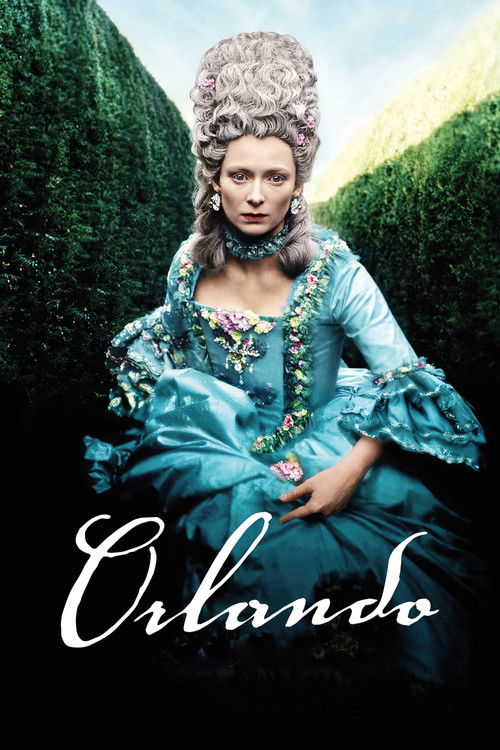
Orlando
1992 · Sally Potter
For when you want something sumptuous and clever at once — a costume drama that winks instead of stiffening up. Great for a night when you'd like your beautiful images served with mischief and a little food for thought about who you get to be.
What it's about
England, 1600: a beautiful young nobleman with a weakness for poetry is commanded by the dying Queen Elizabeth I never to grow old — and obeys. Orlando drifts through four centuries of English history, chasing love, art, and status through frozen courts, Ottoman embassies, and literary salons, and midway through wakes up transformed from man to woman, unbothered, to discover how differently the world now treats them.
The experience
Playful, gorgeous, and sly — it moves like a picture book you can't stop turning, with a deadpan wit that keeps the philosophy light on its feet. Orlando's glances straight into the camera make you a co-conspirator; you come out amused and quietly moved.
Performances
Tilda Swinton is the whole gamble and she wins it — serene, funny, and utterly convincing as both man and woman across four hundred years, with a raised eyebrow to camera that says more than pages of dialogue. Quentin Crisp's Queen Elizabeth I is inspired casting, regal and touching in a few short scenes.
The craft
Every frame is composed like a painting — candlelit banquets, a frost fair on the frozen Thames, topiary mazes — with lavish period costumes that treat clothing as destiny. Potter structures the centuries as titled chapters and punctuates them with direct address, keeping a novel's worth of ideas moving at a trot; it's a feast on a big screen.
Why it matters
The film that made Tilda Swinton an icon and proved a supposedly unfilmable Virginia Woolf novel could become ravishing cinema — it remains a touchstone for how movies talk about gender as costume, performance, and inheritance.
Snapshot
Orlando is Sally Potter's adaptation of Virginia Woolf's 1928 novel Orlando: A Biography, the mock-biography Woolf wrote as a love letter to Vita Sackville-West. The film follows a young Elizabethan nobleman (Tilda Swinton) who is commanded by the dying Queen Elizabeth I never to grow old, and who then lives across some four centuries — passing, midway through, from man to woman without apparent trauma or explanation ("Same person. No difference at all. Just a different sex"). Structured as a series of dated chapters — Death, Love, Poetry, Politics, Society, Sex, Birth — it is at once a costume spectacle, a philosophical comedy about English identity, and an essay-film on gender as performance and inheritance. Its combination of painterly tableau, deadpan direct address to camera, and a protagonist who serenely outlives every historical regime made it one of the defining art-house successes of the early 1990s and a foundational text for later screen thinking about androgyny and trans experience.
Industry & production
Orlando was produced by Potter's own company, Adventure Pictures, with Christopher Sheppard producing, and it exemplifies the pan-European co-production model that sustained ambitious art cinema after the collapse of the Eastern Bloc opened new sources of talent and location. Financing and production partners spanned Britain, Russia, France, Italy, and the Netherlands, drawing on public and broadcast funds (including British Screen and Channel 4's involvement in the era's independent film ecology) alongside continental co-producers. The film had been years in the making: Potter, who came from experimental film, dance, and performance rather than the mainstream industry, had struggled to raise money for a project widely regarded as uncommercial — a period fantasy with a sex-changing protagonist, adapted from a novel long considered unfilmable.
The budget was modest for a film of such visible scale — a few million dollars, stretched by shooting in inexpensive but spectacular real locations rather than on sound stages. The production famously exploited its cross-border reach: Central Asian sequences were filmed in Uzbekistan (the ancient city of Khiva standing in for Orlando's diplomatic posting in Constantinople), and Russian crew and locations, opened up in the immediate post-Soviet moment, supplied both the frozen Thames "Great Frost" set-pieces and the film's remarkable cinematographer. Exact budget and box-office figures I won't assert with precision, but the film is generally understood to have performed strongly relative to its cost, particularly in the United States, where it became an unexpected specialty-market hit and Swinton's international breakthrough.
Technology
Orlando was shot photochemically on 35mm, in the pre-digital regime where its lavish look had to be achieved entirely in-camera and through physical production. There is no significant use of optical or digital visual effects; the film's transitions across four centuries are managed through editing, art direction, costume, and Swinton's continuity of presence rather than through trickery. The one place technology becomes thematically visible is the film's ending, which pushes Orlando into the contemporary present: the final movement incorporates the imagery of late-twentieth-century media — Orlando's child holds a camcorder, and the film folds its own moment of production (the early 1990s) into the diegesis, closing the historical circuit that began in 1600. The film thus registers technological change less as a production tool than as subject matter — successive eras marked by their material cultures, from ruffs and candlelight to motorbikes and video.
Technique
Cinematography
The film's images were made by the Russian cinematographer Aleksei Rodionov, best known for Elem Klimov's harrowing Come and See (1985). Rodionov brings a distinctly non-British sensibility to English heritage material: rather than the soft, nostalgic naturalism typical of the period drama, he composes in cool, frontal, painterly light, often organizing the frame around symmetry, planar depth, and saturated but controlled color. The Great Frost sequences on the frozen river, the candlelit interiors, and the blinding white of the Central Asian exteriors are handled as a sequence of distinct chromatic and tonal "worlds," each keyed to its century. The camera is frequently patient and formal, holding on tableaux, then punctuated by Orlando's turn toward the lens — a photographic strategy that keeps the spectator conscious of looking and of being looked at.
Editing
Edited by Hervé Schneid, the film's cutting is organized around its chaptered, elliptical structure. Rather than dramatizing the mechanism by which Orlando fails to age, the editing simply leaps decades and centuries between titled sections, trusting the audience to accept the discontinuity. The most celebrated cut is the sex change itself: Orlando falls into a deep sleep and wakes transformed, the transition presented as a serene, almost matter-of-fact passage rather than a rupture. Schneid's editing also sustains the film's tonal balance, holding compositions long enough to register their painterly design while keeping the four-century sweep brisk and legible.
Mise-en-scène / staging
Visually, Orlando is inseparable from its production design by Ben Van Os and Jan Roelfs — the Dutch duo who had shaped the rigorous, tableau-like worlds of Peter Greenaway's films — and its costume design, with Sandy Powell among the key figures dressing the film. The mise-en-scène favors frontal, theatrical, often symmetrical arrangements: courtiers posed like figures in a group portrait, formal gardens and mazes, grand interiors treated as stages. Costume does much of the film's argument, since Orlando's identity is repeatedly constructed by what the period requires him or her to wear — the vast panniered gowns of the eighteenth century literally impede movement in the "Society" section, staging femininity as physical constraint. The staging's deliberate artifice keeps the film from ever settling into transparent realism; it is always visibly a construction, a series of historical pictures.
Sound
The score was composed by Potter herself with David Motion, with contributions from the experimental musician Fred Frith, and it moves between period pastiche and a more spare, modern minimalism. The film's most striking sonic gesture is its use of a high, disembodied countertenor/falsetto voice — performed by Jimmy Somerville — most memorably in the closing sequence, where Somerville also appears on screen as a golden singing angel hovering above the present-day landscape. The voice's ambiguous register (neither conventionally male nor female) rhymes precisely with the film's themes. Elsewhere the sound design leans on silence, wind, and the acoustic of large empty rooms, reinforcing the sense of a solitary figure moving through emptied historical spaces.
Performance
The film rests almost entirely on Tilda Swinton, on screen in nearly every frame, whose performance is built on stillness, a pale androgynous presence, and the recurring device of the direct look and aside to camera. Swinton plays Orlando as watchful, wry, and faintly bewildered by the roles history assigns, using minimal external change to carry the transition between sexes so that continuity of self overrides the change of body. The casting of Quentin Crisp — the celebrated gay writer and self-described "stately homo of England" — as Queen Elizabeth I is the film's other great performance coup, a piece of cross-gender casting that turns the film's argument into flesh at the outset. Billy Zane appears as the American adventurer Shelmerdine and Charlotte Valandrey as the Russian princess Sasha, Orlando's early-film object of desire.
Narrative & dramatic mode
Orlando operates in a self-conscious, essayistic mode rather than conventional dramatic realism. Its governing device is the mock-biography inherited from Woolf: a life narrated across centuries, punctuated by chapter headings, in which the "plot" is really a sequence of thematic meditations. Direct address is central — Orlando repeatedly breaks the fourth wall to share a glance, a raised eyebrow, or a wry line with the viewer, positioning the audience as confidant and collapsing the distance between period spectacle and modern reflection. The tone is ironic and comic even when the material is melancholy; the film treats immortality and sex change with a light, quizzical touch rather than melodrama. Causality is deliberately loosened — we are never told how or why Orlando lives so long or changes sex — so that the fantastic premise functions as a thought experiment about what remains constant in a self as everything around it (era, gender, status, costume) changes.
Genre & cycle
The film sits at the intersection of several genres it simultaneously honors and subverts. It is a costume/heritage drama in its lavish period detail, yet it cuts against the heritage film's characteristic nostalgia and realism with irony, artifice, and a critical view of English class and empire. It is a fantasy in its immortal, sex-changing protagonist, though it strips fantasy of spectacle-driven effects. And it belongs to the tradition of the literary art-film adaptation and the feminist essay-film. Within the early-1990s cycle, it is often grouped with the surge of formally adventurous, queer-inflected art cinema — contemporaneous with the New Queer Cinema moment and with other stylized literary adaptations — while remaining singular in its explicitly feminist authorship and its refusal of conventional narrative drive.
Authorship & method
Orlando is a director's film in the fullest sense: Sally Potter wrote the screenplay, co-composed the music, and shaped every element toward a unified vision, and it stands as her breakthrough into international recognition after a career rooted in avant-garde film (Thriller, 1979) and performance. Her method is one of radical distillation — she reduced Woolf's discursive novel to a spare, image-led structure and invented cinematic equivalents for the book's literary irony, above all the direct-address device. Her key collaborators are essential to the result: cinematographer Aleksei Rodionov, whose formal, non-nostalgic image-making defines the film's look; production designers Ben Van Os and Jan Roelfs, importing the tableau discipline of Greenaway's cinema; costume designer Sandy Powell, for whom the film was an important early showcase; editor Hervé Schneid; and composer David Motion alongside Potter and Fred Frith. The casting of Quentin Crisp and, above all, Tilda Swinton — with whom Potter forged one of the era's defining director-actor collaborations — completes the authorship as a genuinely collective, though tightly controlled, enterprise.
Movement / national cinema
Orlando belongs to British art cinema but resists the dominant heritage-film idiom of its national moment, aligning instead with the more experimental, intellectually ambitious strand associated with figures like Peter Greenaway and Derek Jarman (whose stylized, queer, painterly period films are close cousins) — a lineage reinforced by Potter's shared personnel with Greenaway. At the same time its production identity is emphatically transnational: a European co-production drawing Russian, French, Italian, and Dutch talent and locations, it embodies the post–Cold War internationalization of art film. It is also a landmark of feminist and queer cinema, extending a British countercultural and avant-garde tradition into the international art-house mainstream.
Era / period
Made and released in 1992, Orlando arrived at a specific cultural conjuncture: the immediate aftermath of the Cold War (which materially enabled its Russian collaborators and locations), the height of the AIDS crisis and the activist politics that shaped New Queer Cinema, and a growing academic and popular interest in gender as performance and social construction — ideas then crystallizing in feminist and queer theory. The film's serene treatment of sex change and its critique of fixed gender roles landed as unusually timely. Its diegesis spans roughly four centuries, from Elizabethan England around 1600 to the present day of the early 1990s, and the film explicitly delivers Orlando into that present, making its own moment the endpoint of the historical journey.
Themes
The film's central theme is the constancy of the self across the mutability of gender, time, and role: Orlando remains recognizably the same essential person whether man or woman, Elizabethan courtier or modern mother, insisting that gender is a costume history hands us rather than a fixed core. From this flow its other concerns — gender as performance and constraint, dramatized through costume and the differing freedoms afforded to Orlando as man versus woman (property law, courtship, mobility); a critique of English identity, class, and empire, as Orlando drifts through poetry, diplomacy, war, and inheritance; love and loss across successive incompatible eras; immortality and time as both privilege and estrangement; and the relationship between art, writing, and the self, since Orlando's constant across the centuries is a devotion to poetry. Underlying all of it is Woolf's, and Potter's, wry proposition that identity is something continually made and remade rather than given.
Reception, canon & influence
On release, Orlando was widely praised as a bold, visually ravishing, and intellectually serious adaptation, and it became a substantial art-house success — notably in the United States — that established Sally Potter as a major director and made Tilda Swinton an international figure. The film earned significant recognition in the awards ecology of the period, including Academy Award nominations in craft categories (art direction and costume design) reflecting the acclaim for its design work; I'd flag that I'm not certain of the film's complete festival and awards record and won't enumerate specific wins I can't verify.
Backward influences on the film are clear and acknowledged: first and above all Virginia Woolf's 1928 novel and, behind it, the figure of Vita Sackville-West; the English literary tradition of biography and satire the novel parodies; the painterly, tableau-driven art cinema of Peter Greenaway (via shared designers) and the queer period stylizations of Derek Jarman; and Potter's own avant-garde and feminist filmmaking practice.
Forward influence has been considerable and durable. Orlando became a touchstone for subsequent cinema and criticism concerned with androgyny, gender fluidity, and trans experience, frequently cited as a landmark screen representation that treated sex change with matter-of-fact grace rather than pathology. It cemented the Potter–Swinton collaboration and helped define Swinton's later career as an icon of androgynous, art-cinema performance. Its formal strategies — chaptered structure, direct address in period settings, casting across gender — have been echoed widely, and the film retains a strong presence in academic film and gender studies. Its critical standing has, if anything, risen with time, as its concerns have moved from the margins toward the center of cultural conversation.
A Deleuzian reading
A young nobleman in ruff and hose stands reciting under English light, and then — as if he has felt us in the room — turns and looks straight down the lens.
The full Deleuzian reading of Orlando →
Reception
A well-reviewed art-house hit in 1992 (two Oscar nominations, and the film that made Tilda Swinton a star), it has since grown far beyond that — now embraced as a foundational queer and trans cinema touchstone, its stature rising with each anniversary and restoration.
How Orlando was received, from release to now →
How to watch Orlando: what to notice on a first viewing
- Watch for Orlando turning to look straight at the camera. Swinton breaks the fourth wall repeatedly with a raised eyebrow or a dry glance, treating the audience as a private confidant. The look collapses the distance between the costume spectacle and you, right from the first scene.
- Watch how each century gets its own distinct color and light. Rodionov composes in cool, frontal, planar light, keying the Great Frost, the candlelit interiors, and the blinding Central Asian exteriors to their own chromatic world. The shifting palette marks time passing more clearly than any date on screen could.
- Watch how often people are arranged like a formal group portrait. Van Os and Roelfs stage courtiers, gardens, and interiors as flat, theatrical pictures, so every scene announces itself as a construction rather than real life. The artifice keeps reminding you that history, here, is being staged, not simply recorded.
- Watch how much the huge gowns restrict Orlando's movement later on. The vast eighteenth-century dress physically impedes her, staging femininity as a costume that constrains the body wearing it. The clothes argue the film's whole point about gender before a single line of dialogue does.
- Listen for a high, disembodied singing voice in the score. Jimmy Somerville's falsetto sits in a register that reads as neither conventionally male nor female. The voice itself embodies the film's whole argument about gender without saying a word about it.
The whole guide to watching Orlando, with the keys for a rewatch →
Influences: the films it descends from and the films it influenced
- The Draughtsman's Contract (1982) — Establishes the frontal, symmetrical period tableau — restoration costume-and-garden compositions shot as framed paintings — that Ben Van Os and Jan Roelfs imported directly into Orlando's staging discipline.
- The Cook, the Thief, His Wife & Her Lover (1989) — Van Os and Roelfs' color-coded, theatrically lit interiors and costume-as-architecture design method is the same production-design school Potter drew on for Orlando's chapter-by-chapter chromatic worlds.
- Caravaggio (1986) — Queer period stylization that treats history as anachronistic tableau vivant with painterly lighting, modeling Orlando's non-nostalgic, deliberately artificial approach to costume-drama pastness.
- The Last of England (1988) — Tilda Swinton's Jarman apprenticeship in stylized, gesture-forward performance directly formed the androgynous art-cinema screen presence Potter built Orlando around.
- Thriller (1979) — Potter's own avant-garde feminist deconstruction of a canonical narrative — interrogating authorship and the female subject — is the practice she distilled into Orlando's ironic address to the viewer.
- Barry Lyndon (1975) — The in-camera period look built from available/candlelit-feeling naturalism and formal, painterly framing is the antecedent for Rodionov's non-electric-looking, canvas-referencing period photography.
- Tom Jones (1963) — Pioneers the costume protagonist who breaks the fourth wall to wink at the audience, the direct-address-in-period device Potter reinvented as Orlando's central ironic engine.
- Persona (1966) — The frontal, held close-up of a face addressing the lens as an instrument of identity destabilization prefigures Swinton's to-camera glances that puncture Orlando's diegesis.
- The Draughtsman's Contract (1982) — Uses baroque falsetto/countertenor-adjacent and Nyman's formalist scoring against period image; Orlando's David Motion/Fred Frith countertenor cue works in the same estranging music-against-tableau tradition.
- The Color of Pomegranates (1969) — Carries the multi-role androgyny and gender-crossing portraiture (à la Chiaureli) across composed frontal tableaux that address the camera directly.
- The French Lieutenant's Woman (1981) — Extends the reflexive heritage film — a single performer carries one identity across centuries and breaks the Victorian proscenium by addressing camera, doing openly what the modern frame does structurally.
- Elizabeth (1998) — Rejects heritage-film cosiness for painterly symmetrical tableaux and costume-as-power staging of the Elizabethan court, extending Orlando's non-nostalgic period image-making.
- Orlando (Potter's later collaborations) — The Favourite (2018) — Frontal symmetrical court tableaux, elliptical chaptered structure with intertitles, and gender/power-as-performance staging descend from Orlando's formal costume-drama subversion.
- Marie Antoinette (2006) — Anachronistic, arch period design where costume argues a thesis about performed selfhood, and elliptical mood-chapters over plot, continue Orlando's ironic-tableau costume-drama mode.
- I Am Love (2009) — Built entirely around Swinton's post-Orlando persona of controlled, transnational androgynous art-cinema performance, extending the Potter-forged actor as compositional instrument.
- Portrait of a Lady on Fire (2019) — Painterly frontal tableaux, the gaze returned directly to camera, and a queer-feminist essayistic treatment of a period woman's interiority carry forward Orlando's craft program.
- The Danish Girl (2015) — Inherits Orlando's landmark of playing a matter-of-fact change of sex as grace rather than pathology, staged through painterly period design and costume as the site of transformation.
- Gattaca (1997) — Jan Roelfs's production design for Potter's film — rendering identity performance through material surface, costume, and architecturally coded space — develops the specific design methodology Roelfs brings to Gattaca, where the amber-toned interiors of the genetic elite's world similarly encode the film's argument about the body as a legible, changeable costume.
- Cinderella (2015) — Sandy Powell's costume-as-character method — using silhouette and fabric to fix period and psychology — is the approach behind the stepmother's hard 1940s glamour set against Cinderella's watercolor blue.
- Predestination (2014) — Sustained a single performer as one continuous character across a change of sex and centuries of period, signaling era entirely through costume, wig and surface rather than exposition — the same period-by-surfaces method and single-body continuity Snook's performance depends on.
- Rose (2026) — Swinton's knowing looks to camera and the ironic framing of gender as a performance learned over centuries anticipate Rose's view of masculinity as observable behavior.
- The Adventures of Baron Munchausen (1988) — Shares Sandy Powell's early-career maximalist costume-as-argument approach, where garments carry the era's ideology rather than mere authenticity — the design logic she extended in Orlando.
- Edward II (1991) — Contemporary Swinton-led queer period film that likewise flattens history into anachronistic tableau and stakes gender/power as performed spectacle, a parallel British art-cinema experiment.
- Prospero's Books (1991) — Same Van Os/Roelfs-lineage design and layered painterly compositions treating literary adaptation as image-catalog, the tableau-as-illustration method Orlando adopts for Woolf.
- The Piano (1993) — Alexei Rodionov's cool desaturated period photography and Tilda Swinton's systematically non-verbal physical performance — restrained to gesture, gaze, and breath — constitute a simultaneous feminist arthouse parallel to The Piano's project of using constrained female embodiment as both subject matter and cinematic form.
- The Favourite (2018) — Earlier queer-inflected, ironic period revisionism using direct estrangement and arch performance to interrogate gendered power across English history rather than embalm the past.
- The Hours (2002) — Establishes the screen grammar for rendering Woolf's interior consciousness — suspended, present-tense gazes and a heroine moving through eras as a continuous sensibility — that Daldry adopts for Woolf's own depicted point of view.
Similar films
- Prospero's Books (1991) — influence & lineage
- Barry Lyndon (1975) — influence & lineage
- Caravaggio (1986) — influence & lineage
- Portrait of a Lady on Fire (2019) — influence & lineage
- Marie Antoinette (2006) — influence & lineage
- The Draughtsman's Contract (1982) — influence & lineage
- The Favourite (2018) — same viewing thread
- Bram Stoker's Dracula (1992) — same viewing thread
All the films related to Orlando →
Watch it with: curated runs of related films
- Drunk on Design — Watch these together for the rush of maximalist, color-drenched cinema where a woman is made, remade, or consumed by an art form — ballet, fashion, gothic desire — and the production design does half the storytelling.