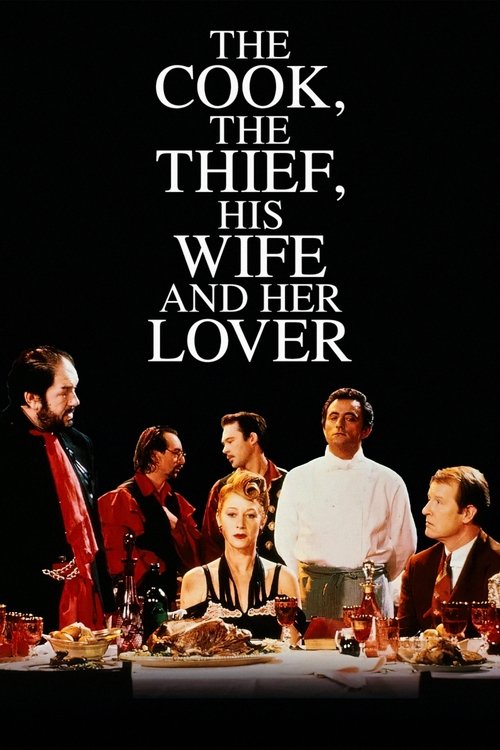
The Cook, the Thief, His Wife & Her Lover
1989 · Peter Greenaway
For when you want cinema as a full-body provocation — an art film with the impact of a horror movie. Emphatically not a comfort watch; save it for a night you want to be pushed.
What it's about
A vulgar, terrifying gangster has bought himself a grand French restaurant in London and holds court there every night, humiliating his wife and terrorizing the staff. Under his nose, his wife begins a wordless affair with a quiet bookseller who dines alone, their trysts hidden in the kitchen's pantries and cold rooms while the chef covers for them. It's a revenge tragedy staged as a nightly dinner service, where appetite — for food, sex, and power — is the whole world.
The experience
Overwhelming and deliberately confrontational: gorgeous and grotesque in the same frame, tender in its love scenes and genuinely brutal elsewhere. You leave it rattled, dazzled, and probably arguing about it.
Performances
Michael Gambon is volcanic as the thief, a monster of nonstop talk and sudden violence, while Helen Mirren gives Georgina a slow-gathering dignity and daring that becomes the film's soul.
The craft
Every element is heightened: the restaurant unfolds as a procession of color-coded rooms, the camera gliding between them as costumes change hue mid-walk, with Michael Nyman's pounding score and Jean-Paul Gaultier's costumes completing the spectacle. It's one of the most sumptuously designed films ever made, and it demands the biggest screen you can give it.
Why it matters
A scandal on release — its violence and explicitness fought the ratings system and won notoriety — and now a landmark of art-house transgression, the film that carried Peter Greenaway's painterly extremism to its widest audience.
Snapshot
Peter Greenaway's The Cook, the Thief, His Wife & Her Lover is a Jacobean revenge tragedy refitted as a baroque, theatrical, deliberately repellent allegory of consumption — gastronomic, sexual, and political. Across the loading bay, kitchen, dining room, and lavatory of a French haute-cuisine restaurant called Le Hollandais, a brutal gangster (Albert Spica, played by Michael Gambon) holds court nightly, terrorizing staff and patrons. His wife Georgina (Helen Mirren) conducts a wordless affair with a quiet bookseller, Michael (Alan Howard), among the kitchen's hanging meat; when Spica discovers it and has Michael murdered, Georgina exacts a famously literal revenge. The film is structured as a procession through color-coded rooms, scored by Michael Nyman and costumed by Jean-Paul Gaultier, and it became a cause célèbre over its extremity — gluttony, coprophagia, cannibalism — and over the censorship battles that followed it, particularly in the United States. It remains one of the defining art-cinema provocations of its decade and Greenaway's most widely seen film.
Industry & production
The film was an Anglo-French art-cinema co-production, produced by Kees Kasander and Denis Wigman through their Allarts company (a long-running Greenaway partnership) with French involvement, and it sits within the late-1980s ecosystem in which Greenaway's increasingly elaborate features were financed across European sources, broadcasters, and arts bodies rather than through conventional studio channels. By 1989 Greenaway had built a reputation on The Draughtsman's Contract (1982), A Zed & Two Noughts (1985), and The Belly of an Architect (1987), works that combined intellectual rigor, painterly composition, and minimalist music into a recognizable house style; The Cook, the Thief both extended and popularized that brand.
The production's most consequential afterlife was at the level of distribution and classification. In the United States the film became a landmark in the rating debate: rather than accept the commercially fatal X rating then assigned to sexually or violently explicit work, its American distributor released it unrated, and the controversy fed directly into the discourse that produced the NC-17 rating in 1990. Precise budget and box-office figures are not something I can state reliably here, and I will not invent them; what is securely established is that the film performed unusually well for a transgressive art film and that its censorship saga amplified its visibility far beyond the usual art-house audience.
Technology
The film was shot on 35mm in a widescreen anamorphic-scale aesthetic suited to its friezelike, lateral compositions, and its technical signature is less about novel apparatus than about the orchestration of conventional film technology toward an extreme of artifice. Its most discussed "technological" device is in fact a design-and-lighting strategy: each principal space is keyed to a dominant color — the blue-green of the exterior loading bay/car park, the green of the kitchen, the saturated red of the dining room, the clinical white of the toilets — and characters' costumes change hue as they cross thresholds, an effect achieved through coordinated production design, costuming, and lighting rather than optical trickery. This required tight control of the set as a continuous, stage-like architecture so that the camera could track laterally from room to room in long movements. The film predates the digital-compositing era, so these transformations are practical, which is part of their uncanny force.
Technique
Cinematography
The cinematographer was Sacha Vierny, the great French director of photography associated above all with Alain Resnais (Hiroscima mon amour, Last Year at Marienbad) and a recurring Greenaway collaborator. Vierny's work here is defined by long, stately lateral tracking shots that treat the restaurant as a horizontal stage, by deep, theatrically lit tableaux composed with overt reference to seventeenth-century painting, and by the rigorous color separation of the set. The framing is frontal and symmetrical, favouring the proscenium over the eyeline; the camera glides rather than cuts, producing a sense of inexorable, almost liturgical procession. The visual model most often invoked — and which Greenaway himself has cited as an explicit reference — is Dutch and Flemish painting, with the dining-room scenes evoking Frans Hals's group portraits (a large reproduction of Hals's Banquet of the Officers of the St George Militia Company hangs in the dining room).
Editing
Editing, by Greenaway's longtime collaborator John Wilson, is subordinated to the architectural logic of the spaces and the durational logic of Nyman's music. Rather than fragment action, the cutting tends to preserve the integrity of the long take and to articulate the movement between color-zones; transitions across thresholds are emphasized, sometimes with costumes visibly changing color at the cut or during the move. The rhythm is processional and accretive, building through repetition — the nightly dinners, the recurring routes through the kitchen — toward the catastrophic climax.
Mise-en-scène / staging
This is the film's dominant register. The production design (by Ben van Os and Jan Roelfs, another core Greenaway team) builds a single continuous set whose rooms read as acts in a stage play. Everything is heightened: the scale of the kitchen, the operatic length of the banquet table, the heaped still-life abundance of food, rotting meat, and refuse. The staging is frankly theatrical and Jacobean, drawing on the revenge-tragedy tradition of Webster, Tourneur, and Middleton — a world of gluttony, lust, and grotesque retribution. Jean-Paul Gaultier's costumes are integral to the mise-en-scène, both in their exaggerated couture silhouettes and in the color-shifting conceit that binds clothing to room.
Sound
Michael Nyman's score is one of the most celebrated elements. Built on his characteristic insistent, minimalist-derived motor rhythms and harmonic ostinatos, its centerpiece is Memorial — music Nyman had originally written in memory of those who died at the 1985 Heysel Stadium disaster — which lends the film's processions a funereal, ceremonial grandeur. The score's relentlessness mirrors the film's themes of cyclical consumption. The boy kitchen-hand's high, pure singing of a Miserere threads liturgical lament through the brutality, sharpening the sacred-profane contrast. Beyond music, the sound design foregrounds the visceral textures of eating, cooking, and the body.
Performance
The performances are pitched to the theatrical scale of the conception. Michael Gambon's Albert Spica is a tour de force of vulgar menace — verbose, bullying, grotesquely articulate — a portrait of appetite without restraint. Helen Mirren's Georgina moves from numb endurance to erotic awakening to implacable avenger, anchoring the film's emotional reality amid its stylization. Alan Howard's Michael is deliberately reserved, a man of books and silence whose physical tenderness contrasts with Spica's noise. Richard Bohringer plays Richard, the dignified chef whose kitchen becomes sanctuary and conspirator. The ensemble's stage-trained diction suits the Jacobean cadence of the dialogue.
Narrative & dramatic mode
The film's dramatic mode is allegory cast as revenge tragedy. Its narrative is spare and ritualistic: a situation (the gangster's nightly occupation of the restaurant) repeated until it ruptures. Greenaway organizes the story as a procession of dinners, using the recurring meal as both structuring device and central metaphor. The mode is anti-naturalistic — characters speak in tirades and set-pieces, space behaves theatrically, and the action builds toward a single, monstrous symbolic act. The arc is classically tragic in shape (transgression, discovery, retribution) but its meaning is emblematic: the characters function as embodiments of appetite, refinement, love, and power rather than as psychologically rounded individuals, even as Mirren's performance grants Georgina genuine pathos.
Genre & cycle
Nominally a crime drama, the film is better understood as art-house transgressive cinema crossed with the English revenge-tragedy tradition. It belongs to the cycle of late-1980s and early-1990s "extreme" art films that tested the boundaries of acceptable screen content and provoked censorship responses, and it is frequently grouped with the body- and taboo-focused European art cinema of its moment. Within Greenaway's own oeuvre it forms part of a loose cycle of films obsessed with cataloging, the body, decay, food, and number — A Zed & Two Noughts and The Belly of an Architect among them. Its blend of haute design and grotesque content also makes it a touchstone for later "elevated" transgressive cinema.
Authorship & method
Greenaway is the film's controlling author in the strongest auteurist sense: trained as a painter, he conceives films as structured visual systems — built on lists, grids, colors, and conceptual schemes — and as extensions of fine-art and theatrical traditions rather than of classical Hollywood storytelling. The Cook, the Thief exemplifies his method: the color-coded architecture, the painterly tableaux, the use of food and the body as catalog and metaphor, the refusal of psychological realism, and the political subtext he has described as a response to the Thatcher-era Britain of crude, acquisitive power consuming culture and refinement.
His method is inseparable from a stable repertory of collaborators, and the film is in real terms a collective authorship of that ensemble: cinematographer Sacha Vierny, whose painterly lighting and tracking define the look; composer Michael Nyman, whose driving minimalism had by this point become the sonic identity of Greenaway's cinema (their long partnership effectively ended after this film); editor John Wilson; production designers Ben van Os and Jan Roelfs; and costume designer Jean-Paul Gaultier, whose couture sensibility fused fashion and set into a single chromatic scheme. Greenaway wrote the screenplay himself.
Movement / national cinema
The film occupies an unusual position in British cinema. It is British in language, setting, and the national-allegorical thrust of its politics, yet European in financing, sensibility, and collaborators (a French cinematographer, a French co-star, French haute cuisine as its arena, a French couturier). It belongs to the 1980s British art-cinema flourishing that also produced Derek Jarman and the early Channel 4 era, but Greenaway's continental, painterly, intellectual mode set him apart from British social realism. He is best understood as part of a pan-European art cinema of the period, with deep affinities to the formalist French tradition (via Vierny and Resnais) and to the gallery and avant-garde worlds as much as to the commercial film industry.
Era / period
Made and set at the end of the 1980s, the film is widely read as a political allegory of late-Thatcherite Britain: Spica's vulgar, violent acquisitiveness — buying culture he cannot appreciate, brutalizing those around him, consuming without taste — has been taken by many critics, and by Greenaway in interviews, as an emblem of an era of conspicuous, philistine wealth. Its period also shaped its reception history: it arrived at the moment when the American ratings system was under acute strain, and it became one of the catalysts for the 1990 introduction of NC-17. Aesthetically it crowns the high-design, music-driven art cinema of the decade.
Themes
The film's governing metaphor is consumption in every sense — eating, sex, money, and power as overlapping appetites. Food and the body are inseparable: the kitchen as a place of creation and the dining room and toilet as sites of ingestion and expulsion map a cycle from production to waste, culminating in the cannibalistic climax that collapses love, revenge, and consumption into one act. Power and brutality are figured through Spica as a tyrant of pure appetite, and the film reads as a meditation on how crude power devours refinement, art, and tenderness — its politics being an allegory of philistine wealth consuming culture. Sexuality and love appear as the only forms of grace, located in the silent, bookish affair conducted amid raw meat, set against marital cruelty. Throughout, Greenaway works the sacred and the profane together — the boy's Miserere, the funereal score, the ritual structure — and stages a recurring opposition between high culture and barbarism (books, paintings, cuisine versus violence and excrement). Decay, rot, and mortality pervade the imagery.
Reception, canon & influence
Critically, the film was divisive in the most productive way: widely recognized as a major, formally dazzling achievement and as Greenaway's most powerful and accessible work, while also condemned in some quarters as gratuitously disgusting. It drew particular praise for Gambon's and Mirren's performances, for Vierny's cinematography, for Nyman's score, and for the audacity of its design. Much of its public profile, especially in the United States, came from the censorship battle: the standoff with the MPAA over the X rating, the decision to release it unrated, and the film's role in the debate that produced NC-17 made it a reference point in any history of American film classification.
The influences on the film are openly avowed and run backward through high culture rather than cinema: Jacobean revenge tragedy (Webster, Middleton, Tourneur) for its dramatic mode and moral grotesquerie; seventeenth-century Dutch and Flemish painting — Frans Hals above all, whose militia banquet hangs on the dining-room wall — for its compositions and palette; and the formalist French art cinema of Resnais, transmitted directly through Vierny's camera. Nyman's minimalism and the European theatrical tradition complete the lineage.
Its forward legacy is substantial. The film cemented Greenaway's international reputation and remains his best-known work; it confirmed Michael Nyman's score-writing as a defining art-cinema sound and helped propel his wider career; and it stands as a foundational text for later "elevated" or design-forward transgressive cinema that marries impeccable aesthetics to extreme content. Its censorship history left a lasting institutional trace in the American ratings system. Beyond film, its fusion of couture (Gaultier), cuisine, painting, and music has made it a recurring reference in fashion, design, and gallery contexts — a film that helped legitimize the idea of the movie as total, painterly art object. Mirren's and Gambon's performances are routinely cited among the strongest of their careers, and the closing tableau remains one of the most discussed final images in modern art cinema.
A Deleuzian reading
A man steps from the blue dark of the loading bay into the green kitchen, and his clothes change color as he walks.
The full Deleuzian reading of The Cook, the Thief, His Wife & Her Lover →
Reception
It arrived in 1989 as a scandal — its US distributor released it unrated rather than take an X, right in the middle of the ratings firestorm that soon produced the NC-17 — and reviewers split between 'masterpiece' and 'repulsive.' Today it's settled in as Greenaway's most beloved film and the definitive Thatcher-era allegory of greed dressed up in gorgeous excess.
How The Cook, the Thief, His Wife & Her Lover was received, from release to now →
Influences: the films it descends from and the films it influenced
- Last Year at Marienbad (1961) — Sacha Vierny's slow lateral tracking shots gliding through frozen, ornately staged spaces are the exact camera grammar he later transplanted into Greenaway's restaurant corridors.
- Hiroshima mon amour (1959) — Vierny's foundational Resnais work established the formalist, painterly lighting and decoupled-from-psychology image that he carried directly into the seed film.
- The Draughtsman's Contract (1982) — Greenaway's earlier feature codified his rigid frontal tableaux, conceptual grid structure, and Michael Nyman's driving minimalist score as the house style the seed perfects.
- A Zed & Two Noughts (1985) — First Greenaway–Vierny collaboration that built symmetrical Vermeer-derived compositions and the body-as-catalog motif extended into the dinner-procession structure.
- Barry Lyndon (1975) — Composes shots as tableaux lifted from period canvases, using slow reverse-zoom and Old Master candlelit palette — the prototype of cinema as moving painting the seed pushes to color-block extreme.
- The Conformist (1970) — Vittorio Storaro's color-coded architecture, where saturated blue/white/red rooms carry political meaning, is the precedent for staging Thatcherite allegory through chromatic set design.
- Cries and Whispers (1972) — Sven Nykvist's all-crimson chamber interiors pioneered the single-hue color-coded room as psychological and theatrical space that Greenaway systematizes across four colored zones.
- The Hypothesis of the Stolen Painting (1978) — Sacha Vierny's painterly, tableau-framed cinematography — Frans Hals palette, frontal composed rooms — directly continues the Marienbad/Ruiz line of shooting the frame as an old-master painting.
- Prospero's Books (1991) — Extends the seed's total-art-object ambition into layered painterly framing, calligraphy, and Nyman-adjacent scoring as a fully cataloged visual system.
- The Pillow Book (1996) — Carries forward the body-as-text-and-catalog conceit and the fusion of couture, calligraphy, and frontal staging into a single chromatic design.
- Titus (1999) — Stages Jacobean-adjacent Roman revenge tragedy at theatrical scale with color-coded design and couture costume, ending on a tableau of cannibal consumption echoing the seed's final image.
- The Fall (2006) — Eiko Ishioka's couture costuming fused with color-block production design renders the film as a painterly total art object in the seed's Gaultier-driven tradition.
- The Grand Budapest Hotel (2014) — Builds entire spaces as color-coded rooms shot in frontal symmetry and lateral whip-tracking, treating total chromatic design as narrative system in Greenaway's mode.
- The Favourite (2018) — Marries impeccable period couture and theatrical-scale cruelty to an elevated, formally precise design — the 'design-forward transgressive' art cinema the seed founded.
- The Lobster (2015) — Deploys deadpan allegorical structure and rigidly composed staging to deliver grotesque social critique, extending the seed's marriage of formal control to moral grotesquerie.
- Estômago: A Gastronomic Story (2008) — Models the restaurant kitchen as an arena where culinary skill translates directly into class power and bodily violence, culminating in a cannibalistic reckoning—Estômago's exact structural endpoint.
- Orlando (1992) — Van Os and Roelfs' color-coded, theatrically lit interiors and costume-as-architecture design method is the same production-design school Potter drew on for Orlando's chapter-by-chapter chromatic worlds.
- Drowning by Numbers (1988) — Companion Greenaway–Nyman film whose list/counting architecture and lush green-gold painterly palette run in immediate parallel to the seed's color-coded scheme.
- Suspiria (1977) — Uses practical saturated primary-color lighting as architecture, treating each room as a chromatic stage set — the same painterly-horror approach to color design.
- Caravaggio (1986) — British art-cinema staging of painterly tableaux vivants directly from Old Master canvases, the contemporary counterpart to Greenaway's Frans Hals–derived banquet compositions.
- The Belly of an Architect (1987) — Direct descendant that cashes in Belly's reputation, escalating the frontal proscenium staging, framed color-coded chambers, and the body as the site where appetite and mortality collide.
- Tampopo (1985) — Greenaway stages the same explicit equation of food with desire and mortality inside an obsessively designed restaurant, the dark twin of Tampopo's food-as-eros-and-death motif.
- Babette's Feast (1987) — Pushes feast-as-moral-allegory into painterly excess — the kitchen-to-dining-room mise-en-scène as a deliberate canvas — an opposite-tempered descendant of the same food-as-meaning conceit.
Similar films
- Prospero's Books (1991) — influence & lineage
- A Zed & Two Noughts (1985) — influence & lineage
- The Draughtsman's Contract (1982) — influence & lineage
- Titus (1999) — influence & lineage
- Caravaggio (1986) — influence & lineage
- Suspiria (1977) — influence & lineage · often watched together
- The Fall (2006) — influence & lineage · often watched together
- The Menu (2022) — shared sensibility
All the films related to The Cook, the Thief, His Wife & Her Lover →