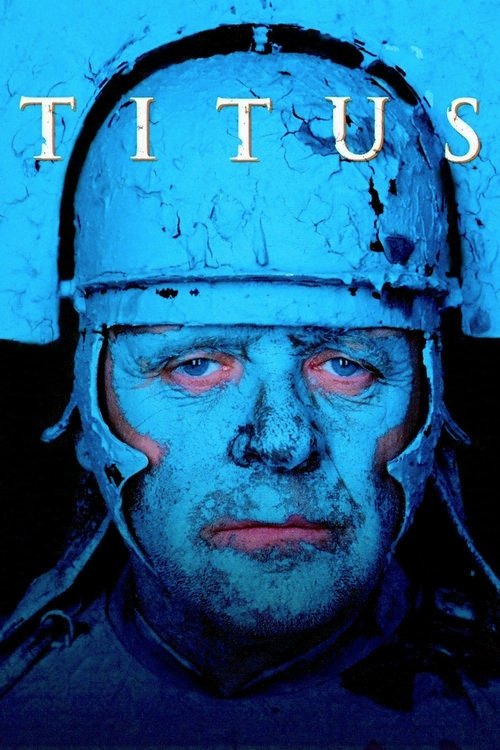
Titus
1999 · Julie Taymor
For when you want to be challenged, not comforted — a bold, confrontational art film for a night you're up for Shakespeare with the safety off. Absolutely not a casual watch.
What it's about
A victorious Roman general returns from war having buried most of his sons, and makes one merciless decision that sets an empress on a path of retribution against his entire family. Shakespeare's earliest and bloodiest tragedy becomes a cycle of atrocity and answer, staged in a world where ancient Rome, fascist-era architecture, and modern junk coexist in the same frame.
The experience
Overwhelming by design — operatic, grotesque, and visually delirious, swinging from horror to pitch-black absurdity. It's brutal viewing, but the brutality is the point: the film wants you to feel how revenge consumes everyone it touches.
Performances
Anthony Hopkins gives Titus a terrifying arc from rigid soldier to broken, dangerously unpredictable old man, and Jessica Lange matches him as Tamora, making a vengeful empress seductive, wounded, and lethal all at once.
The craft
Julie Taymor, coming from a celebrated theater career, treats every frame like stage design unbound — deliberate anachronism, ritualistic tableaux, costumes and sets that mash Roman antiquity into Mussolini-era modernism. The imagery is so dense and painterly that it rewards a big screen, even when it's hard to look at.
Why it matters
A fearless feature debut that reclaimed Shakespeare's most dismissed play, it staked out the far experimental edge of the 1990s Shakespeare-on-film wave and announced Taymor as a singular visual stylist in cinema, not just theater.
Snapshot
Titus is Julie Taymor's feature directing debut, a baroque, deliberately anachronistic screen adaptation of Shakespeare's Titus Andronicus — the playwright's earliest and bloodiest tragedy, long regarded as an embarrassment or apprentice work. Taymor, already celebrated as a theater and opera director (and at the time fresh from her Tony-winning stage version of The Lion King), had previously staged the play off-Broadway for Theater for a New Audience in 1994; the film is an outgrowth of that production. Starring Anthony Hopkins as the Roman general Titus and Jessica Lange as his captive-turned-empress nemesis Tamora, the film collapses Roman antiquity, Mussolini-era fascist modernism, and contemporary detritus into a single timeless arena of violence. It belongs to the 1990s wave of ambitious Shakespeare cinema but stands apart for its theatrical audacity and its insistence that the play's cartoonish brutality is, in fact, a meditation on spectacle, revenge, and the manufacture of cruelty. A commercial disappointment on release, it has since become a touchstone in Shakespeare-on-film scholarship.
Industry & production
The film emerged from the late-1990s confluence of prestige literary adaptation and independent financing. It was produced under Clear Blue Sky Productions — the company funded by Microsoft co-founder Paul Allen — together with Overseas Filmgroup and Taymor's own Urban Landscapes, with Conchita Airoldi's Italian outfit Clear Blue Sky's partners facilitating the European shoot. Fox Searchlight handled the U.S. release, opening the film at the end of December 1999 to qualify for awards consideration before a wider art-house run in 2000.
Production was based in Italy, exploiting both the resources of Cinecittà Studios in Rome and a range of striking real locations: the Roman Colosseum, the ancient ruins of Hadrian's Villa, and — crucially — the rationalist fascist architecture of Rome's EUR district, including the Palazzo della Civiltà Italiana (the so-called "Square Colosseum" built under Mussolini). Some sequences were filmed in Croatia (the Pula Arena, a remarkably preserved Roman amphitheater). The marriage of genuine antiquity with 1930s totalitarian monumentalism is not incidental but the film's organizing visual thesis.
The budget is generally reported in the region of $20 million — substantial for a Shakespeare adaptation but modest for the scale of its design — and the film recouped little of it theatrically; it was, by any commercial measure, a flop. Its reputation has been sustained instead by home video, classroom use, and critical reassessment rather than box-office success. The casting of Hopkins (then at the height of his post-Silence of the Lambs stardom) and Lange gave the project marquee weight, while the supporting ensemble — Alan Cumming, Harry Lennix, Jonathan Rhys Meyers, Laura Fraser, Colm Feore, Angus Macfadyen — drew on stage-trained talent.
Technology
Titus was made on 35mm film at the close of the celluloid era, before digital intermediate finishing became standard, so its dense color and texture were achieved largely through photochemical and in-camera means rather than extensive digital grading. The film does, however, use optical and early digital effects sparingly for its surreal interludes — Taymor's "Penny Arcade Nightmares," stylized dream-vision sequences that visualize trauma and memory through layered, hallucinatory imagery (superimposition, slow motion, composited symbolic figures). These are deliberately handcrafted in feel, closer to theatrical projection and collage than to seamless CGI spectacle. The production's technological signature lies less in any cutting-edge tool than in the integration of practical scenic design, elaborate makeup and prosthetics (notably Lavinia's mutilation), and the photographic command of a veteran cinematographer working in widescreen.
Technique
Cinematography
The film was shot by the Italian master Luciano Tovoli, whose credits include Antonioni's The Passenger and, decisively for Titus, Dario Argento's Suspiria — a lineage of saturated, expressionistic color and unnerving spatial control. Tovoli gives the film a hard, sculptural light: classical Roman scenes bathed in stone-gray and gold, fascist interiors rendered in cold marble and black, the gore staged with a painter's deliberateness rather than naturalistic squalor. The widescreen compositions emphasize architecture as oppression — figures dwarfed by monumental staircases, colonnades, and arenas. Tovoli's camera alternates between formal, frieze-like tableaux and sudden mobile incursions, matching the play's lurches between ceremony and atrocity.
Editing
Editing is by Françoise Bonnot, the French editor best known for her long collaboration with Costa-Gavras (including the Oscar-winning Z). Across roughly two-and-a-half hours, Bonnot manages the film's most difficult problem: modulating between sustained theatrical scenes of spoken verse and the fragmentary, associative montage of the Penny Arcade Nightmares. The cutting is patient with Shakespeare's language where it counts and aggressively rhythmic in the surreal passages, allowing the film to oscillate between stage-time and dream-time without losing dramatic legibility.
Mise-en-scène / staging
This is the film's defining stratum. Production designer Dante Ferretti — a Fellini and Scorsese veteran — and costume designer Milena Canonero (a multiple Oscar winner) construct a deliberately unstable world in which togas coexist with leather military coats, chariots with motorcycles and period automobiles, swords with microphones and a child's video game. The anachronism is systematic rather than decorative: Saturninus's court evokes decadent fascist glamour; the Goth captives suggest a punk underclass; Roman ritual and 20th-century totalitarian pageantry rhyme. The framing device — a modern boy (Osheen Jones, as Young Lucius) playing violently with toy soldiers at a kitchen table, then swept by an explosion into the Colosseum — stages the whole film as a meditation on how children absorb and reproduce a culture of violence. Lavinia's appearance after her rape and mutilation, posed on a tree stump with bare branches for severed hands, is the film's most famous image, consciously evoking the myth of Daphne and Renaissance painting.
Sound
The soundscape integrates Elliot Goldenthal's eclectic score (see below) with a stylized sound design that heightens the theatrical artifice — amplified ceremony, the mechanical clamor of the arena, sudden silences around acts of cruelty. The spoken verse is delivered with stage clarity, and the film trusts Shakespeare's text to carry long passages without underscoring, reserving its more aggressive sonic effects for the nightmare sequences.
Performance
Hopkins anchors the film with a Titus who moves from rigid martial authority through grief into a curdled, blackly comic madness — the late scenes, including the infamous cannibal banquet, played with a chilling, almost vaudevillian glee. Lange's Tamora is imperious and sensual, a study in vengeful maternal fury. Harry Lennix's Aaron is the film's moral wild card, charismatic and unrepentant, given perhaps the play's most arresting verse. Alan Cumming makes Saturninus a petulant, decadent tyrant; Laura Fraser's Lavinia carries the film's most harrowing wordless suffering; and Osheen Jones's silent watching boy functions as the audience's appalled conscience. The acting registers are intentionally mixed — naturalism, grand theatricality, and grotesque comedy — mirroring the film's collision of tones.
Narrative & dramatic mode
Taymor preserves the architecture of Shakespeare's revenge tragedy: Titus's return from war, the ritual sacrifice that sets the cycle of vengeance in motion, the rape and mutilation of Lavinia, the false accusations and the severing of Titus's hand, and the escalating retribution culminating in the banquet at which Tamora unknowingly eats her own sons. The dramatic mode is consciously hybrid — part classical tragedy, part grand guignol, part political allegory. The framing device and the Penny Arcade Nightmares introduce a self-aware, almost Brechtian layer: the film both immerses us in atrocity and steps back to ask why we crave its spectacle. The ambiguous ending, in which Young Lucius carries the captured infant (Aaron and Tamora's child) out of the arena toward a dawning light, offers a fragile, non-textual gesture toward the possibility of breaking the cycle.
Genre & cycle
Titus sits within the 1990s renaissance of Shakespeare on film — a cycle that includes Kenneth Branagh's Henry V (1989), Much Ado About Nothing (1993), and Hamlet (1996); Baz Luhrmann's Romeo + Juliet (1996); Richard Loncraine and Ian McKellen's Richard III (1995), set in a 1930s fascist Britain; and the Oscar-winning Shakespeare in Love (1998). Within that cycle Taymor's film is the most formally extreme, closest in spirit to Luhrmann's pop-eclecticism and to McKellen's fascist transposition, but more avant-garde than either. It also belongs to a broader tradition of stylized cinematic violence and the "revenge tragedy," and its anachronistic design connects it to the operatic, period-collapsing impulse of directors like Ken Russell and Derek Jarman.
Authorship & method
The film is unmistakably an auteur work, but one built on a stable creative family. Julie Taymor brought to it the visual vocabulary of her theater practice — masks, puppetry, ritual, and bold scenographic abstraction — and her prior 1994 stage staging of the same play. Her method treats Shakespeare's least respected tragedy as a serious anatomy of violence rather than a juvenile excess to be apologized for. Central to the project is her long-term collaboration with composer Elliot Goldenthal (her partner), whose score promiscuously mixes operatic grandeur, jazz, martial brass, and dissonant modernism to match the film's temporal collage. The film's craft pillars are European veterans: cinematographer Luciano Tovoli, production designer Dante Ferretti, costume designer Milena Canonero, and editor Françoise Bonnot — a roster that lends Taymor's theatrical vision cinematic heft and Old-World craftsmanship. Taymor also adapted the screenplay herself, making the decisions about cutting, framing, and the invented visual interludes that define the film's interpretation.
Movement / national cinema
The film resists a single national category. It is an American-financed, English-language production with a British and American lead cast, made in Italy with a predominantly Italian and European technical crew, drawing deeply on Italian architecture, design tradition, and cinematic heritage (Cinecittà, Ferretti, Tovoli). In this sense it is a transnational art film as much as an Anglophone Shakespeare adaptation — its aesthetic owes as much to Italian opera and cinema as to the British Shakespearean stage. It can also be read within a tradition of director-as-designer filmmaking that prizes total scenographic control.
Era / period
Made at the very end of the 1990s, Titus reflects that decade's confidence that Shakespeare could be a viable commercial and artistic proposition for a broad audience, while also anticipating a more skeptical, post-millennial interrogation of violence-as-entertainment. Its most pointed temporal gesture is to refuse a single period: by fusing ancient Rome with the iconography of 20th-century fascism, it argues that the appetite for ritualized cruelty is not confined to a "barbaric" past but is a recurring structure of power. The presence of the watching child and the contemporary kitchen frame ties this argument explicitly to the late-20th-century anxiety about media violence and its effect on the young.
Themes
The film's governing themes are the cyclical, self-perpetuating nature of revenge; violence as public spectacle and entertainment; and the transmission of cruelty across generations. Subsidiary threads include the corruption of political authority and the theatricality of power; race and otherness (embodied in Aaron the Moor and the Goth outsiders); the violation and silencing of women (Lavinia's mutilation literalizes the cutting-off of female voice); and grief's capacity to tip into madness. The Penny Arcade Nightmares externalize trauma and guilt, while the framing device frames the whole as a question posed to the viewer: what do we do with our hunger for these images?
Reception, canon & influence
On release the film drew sharply divided reviews and disappointing attendance. Many critics admired its visual daring and the performances of Hopkins and Lange, while others found its length, tonal extremity, and stylistic excess exhausting or self-indulgent — a split that has largely persisted. Canonero's costumes and the overall design earned admiration even from skeptics, and the film attracted some awards-season recognition for its craft, though no major industry prizes.
Its influences run backward to Taymor's own avant-garde theater and to a tradition of stylized cinematic violence and anachronistic Shakespeare; the fascist-era transposition invites direct comparison with the McKellen/Loncraine Richard III (1995), and its pop-eclectic collage with Luhrmann's Romeo + Juliet (1996). Behind it lie Italian operatic cinema and the design sensibilities of Fellini-school collaborators.
Looking forward, Titus established Taymor as a film director and led to Frida (2002), Across the Universe (2007), and her later The Tempest (2010), which reunited her with the same Shakespearean and theatrical instincts. More durably, the film transformed the critical fortunes of Titus Andronicus itself: by taking the play seriously as a coherent tragedy of spectacle, it helped rehabilitate a text once dismissed as juvenilia and made it a fixture of Shakespeare-on-film scholarship and university teaching. Its central images — particularly Lavinia on the tree stump and the boy carried toward the dawn — have become reference points in discussions of how cinema renders Shakespearean violence. Its broader influence on mainstream filmmaking is harder to measure and the record here is genuinely thin; its legacy lies less in imitators than in its standing as the boldest, most fully realized interpretation of one of Shakespeare's most intractable plays.
A Deleuzian reading
A boy sits at a kitchen table, a paper bag pulled over his head, smashing toy soldiers through a pool of ketchup.
The full Deleuzian reading of Titus →
Reception
A box-office bomb with baffled, split reviews in 1999, it's since been reclaimed as one of the boldest Shakespeare films ever made — the 'they don't make them like this' pick for maximalist Shakespeare on screen.
How Titus was received, from release to now →
Influences: the films it descends from and the films it influenced
- Richard III (1995) — Transposes a Shakespeare tragedy into a 1930s fascist-state milieu using totalitarian architecture and uniforms as the visual engine of menace — the exact 'systematic anachronism + fascist staging' strategy Taymor extends.
- The Cook, the Thief, His Wife & Her Lover (1989) — Revenge-and-cannibalism staged as symmetrical theatrical tableau with a wall-to-wall operatic score, the design-as-oppression and violence-as-banquet motif Titus literalizes in its final feast.
- Henry V (1989) — Taymor pushes the visceral, elegiac screen-Shakespeare Branagh legitimized into stylized slow-motion battlefield ritual and tableau.
- Prospero's Books (1991) — Extends radical Shakespeare into maximalist, anti-naturalist tableau staging with anachronistic layering, treating the text as a pretext for orchestrated visual spectacle.
- Hamlet (1996) — Extends the lavish period-transposition strategy — relocating a Shakespeare tragedy into an eclectic designed era of costume and architecture — as the engine of cinematic spectacle, following Branagh's 19th-century reframing.
- Romeo and Juliet (1968) — Design-saturated, operatic Shakespeare-as-spectacle descending from Zeffirelli's theater-and-opera-into-film staging, meaning built through costume, space and music.
- Romeo + Juliet (1996) — Pioneers the pop-eclectic collage approach to Shakespeare — clashing period registers, anachronistic props, and operatic theatrical artifice cut at MTV velocity — the temporal-mashup grammar Titus inherits.
- Henry V (1944) — Establishes Brechtian self-aware framing in Shakespeare-on-film by opening on a literal stage and dissolving theatrical artifice into cinematic space, the device Taymor reworks with the boy/Roman-arena frame.
- Throne of Blood (1957) — Models Shakespeare adapted through non-naturalistic theatrical abstraction (Noh masks, stylized gesture, ritualized violence) rather than psychological realism — the mask-and-ritual lineage from Taymor's stage practice.
- Suspiria (1977) — Luciano Tovoli's own precedent: hyper-saturated color and architecture deployed as engulfing, oppressive force around the figure — the widescreen-space-as-threat cinematography he brings to Titus.
- Z (1969) — Françoise Bonnot's Oscar-winning associative political montage — rapid juxtaposition of memory, image and motive — is the editing method she carries directly into Titus's fractured visual interludes.
- Salò, or the 120 Days of Sodom (1975) — Dante Ferretti's design school: fascist-era setting and coolly composed tableaux that stage atrocity as formal spectacle, the 'violence-as-spectacle' design grammar Ferretti reprises for Taymor.
- A Clockwork Orange (1971) — Milena Canonero's costuming of stylized brutality — violence rendered as designed, choreographed performance — is the costume-driven aestheticization of cruelty she extends in Titus.
- Fellini Satyricon (1969) — The Italian operatic-cinema template: Roman antiquity rebuilt as a dreamlike, grotesque studio pageant of pure design, the Cinecittà 'director-as-designer' sensibility behind Titus's craft team.
- The Damned (1969) — Operatic decadence staged inside fascist iconography, treating political horror as lush theatrical spectacle — the Italian operatic-cinema register Goldenthal's score and Taymor's pageantry echo.
- Frida (2002) — Taymor's next film extends her director-as-designer method — paintings dissolving into living tableaux and puppet/animation interludes — the same invented visual-interlude vocabulary developed in Titus.
- Across the Universe (2007) — Builds entire sequences from associative, music-driven montage and surreal staged interludes, scaling up the Goldenthal-scored collage logic Taymor first realized in Titus.
- The Tempest (2010) — Reunites Taymor's Shakespearean-theatrical instincts with effects-driven scenographic abstraction, directly continuing the stage-to-screen adaptation method of Titus.
Similar films
- Throne of Blood (1957) — influence & lineage · same viewing thread
- Richard III (1995) — influence & lineage · same viewing thread
- The Cook, the Thief, His Wife & Her Lover (1989) — influence & lineage
- Suspiria (1977) — influence & lineage
- Macbeth (1971) — same viewing thread · often watched together
- Hamlet (1996) — same viewing thread
- Ran (1985) — same viewing thread
- Henry V (1989) — same viewing thread
All the films related to Titus →
Watch it with: curated runs of related films
- Shakespeare's Kings and Killers — Watch these near each other and the same machinery keeps turning in new tongues — the murdered king, the usurped crown, the prophecy and the ambition that curdles into slaughter — as Olivier, Welles, Kurosawa, Polanski and Branagh each bend Shakespeare to the screen.