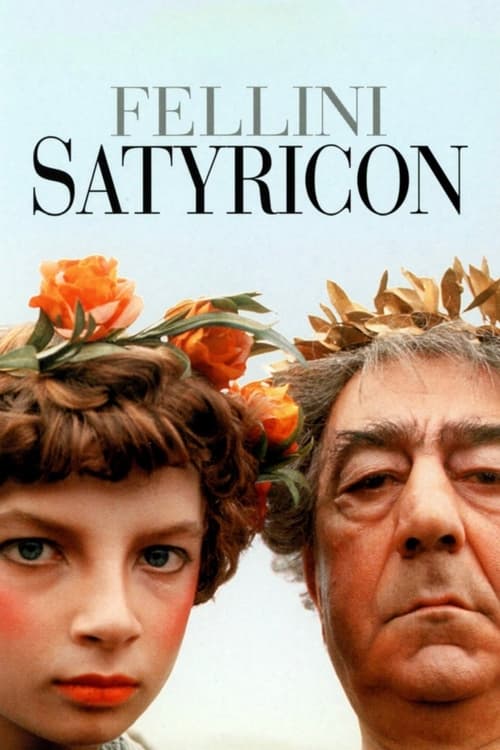
Satyricon
1969 · Federico Fellini
For when you want to be transported somewhere genuinely strange and don't need a plot to hold your hand — an art-house deep end for an adventurous night. Come curious; this one rewards surrender more than analysis.
What it's about
In Nero's Rome, a young man named Encolpio loses his beautiful lover Gitone to a rival, and an earthquake shatters his world before he can act on his despair. What follows is a wandering odyssey through an ancient world imagined as utterly alien: banquets of grotesque excess, shipwreck and slavery, a labyrinth, an oracle, brothels and theaters — one bizarre, gorgeous episode after another. Adapted from a Roman novel that survives only in fragments, the film keeps the gaps in.
The experience
Like walking through a stranger's dream of antiquity — episodes start midstream and end unresolved, faces are painted and staring, and the whole thing feels less watched than visited. It's sensuous, grotesque, sometimes darkly funny, and it deliberately never lets you get comfortable.
The craft
Fellini turns the fragmentary source into a formal principle: scenes are broken off like the torn edges of an ancient manuscript. The production design and color are staggering — crumbling frescoes, theatrical skies, crowds of unforgettable faces — an entire civilization invented from scratch on studio stages. It's one of the great feasts for the eyes in European cinema and begs for the biggest screen you can find.
Why it matters
A landmark of late-'60s European art cinema and the boldest statement of Fellini's turn from realism into pure spectacle and dream, it reset how movies could imagine the ancient world — not as marble-and-sandals pageantry but as something alien and unknowable.
Snapshot
Fellini Satyricon — the director's name was prepended to the title to distinguish it from a competing Italian adaptation released the same year — is among the most deliberately disorienting films in the European art cinema canon. Loosely derived from Petronius Arbiter's fragmentary first-century Latin novel, it follows the young Roman Encolpio through a succession of picaresque episodes: pursuit of the beautiful boy Gitone, shipwreck and enslavement, a visit to a poet's villa, an encounter with the hermaphrodite oracle, the banquet of the nouveau-riche Trimalchio, and a series of darkening confrontations with eroticism, violence, and mortality. Fellini treats the gaps in the Petronian source — the novel survives only in lacunae — not as a defect to be papered over but as the film's formal governing principle. Scenes begin without orientation and end without resolution; the connective tissue of classical narrative is ostentatiously absent. The result is a cinema that aspires to the condition of a dream remembered imperfectly: vivid in texture, elusive in logic, finally irreducible to paraphrase.
Industry & production
The film was produced by Alberto Grimaldi through PEA (Produzioni Europee Associate) and distributed internationally by United Artists. Grimaldi was at this moment one of the most powerful producers in Italian cinema, having backed Sergio Leone's late Spaghetti Westerns and Pasolini's Teorema (1968); his willingness to absorb a large-scale prestige production with no conventional story arc reflects both the commercial confidence of the Italian industry at the end of the 1960s and the unusual latitude Fellini commanded after 8½ (1963) had won the Academy Award for Best Foreign Language Film. Principal photography took place almost entirely at Cinecittà in Rome, the studio complex with which Fellini had a decades-long creative partnership, allowing him the total environmental control he required for sequences that had no location equivalent in the real world. The competing film — Gian Luigi Polidoro's Satyricon, also Italian, also released in 1969 — prompted Fellini to insist on the possessive title credit, a gesture that underlined his claim of personal authorship over the material.
The screenplay was developed with Bernardino Zapponi, a Roman writer who had collaborated with Fellini on the Poe-derived episode "Toby Dammit" for Histoires extraordinaires (1968) and who shared the director's appetite for the grotesque and the oneiric. Their adaptation proceeds by selection and compression rather than invention: most of the named episodes have Petronian sources, though the film reorders them freely and supplements with material from other ancient texts. The production was notably expensive by Italian standards of the period, driven primarily by Danilo Donati's monumental design work.
Technology
Fellini Satyricon was shot in 35mm anamorphic widescreen, exploiting the wide frame to compose images of organized chaos — crowds of extras, elaborately tiered interiors, frieze-like processional scenes — that resist the eye's natural attempt to find a stable focal point. Giuseppe Rotunno, working with Fellini for the third feature, developed a lighting approach built around artificial source control: torchlight, lamplight, and deliberately theatrical illumination that produces warm ochre and amber shadows punctuated by occasional sharp, cold intrusions. The color palette was calibrated to feel neither archaeologically accurate nor straightforwardly fantastical; Fellini spoke in interviews of wanting the ancient world to look as strange as a distant planet, and Rotunno's chromatic choices serve this estrangement rather than the warm Mediterranean tones of the peplum genre. Post-synchronisation of dialogue, standard Italian practice in this period, gave the sound team additional latitude in mixing, though it also contributes to the film's characteristic sense of slight dissociation between image and voice.
Technique
Cinematography
Rotunno's camera favors the long lens and the held position over the tracking shot, so that figures move into and across a static frame rather than being followed. This produces a quality of spectatorship closer to watching a frieze than a stage: the viewer observes rather than accompanies. Occasional sudden zooms — common in European art and genre cinema of the late 1960s — punctuate the stillness with violence. The film's most striking compositional habit is its treatment of the face: extreme close-ups of eyes, mouths, and skin textures interrupt the wide tableaux without psychological motivation, presenting the body as strange material rather than expressive surface. Lighting is often theatrical to the point of implausibility, faces lit from below or from sources that make no spatial sense, reinforcing the sense that the film takes place in a space governed by dream logic rather than physical law.
Editing
Ruggero Mastroianni, who edited a number of Fellini's major films of the period, cut Satyricon in a way that literalises the fragmentary condition of the source text. Hard cuts with no establishing transition drop the viewer into the middle of a scene; other scenes end on images that supply no narrative conclusion. The rhythm is neither the fluid continuity of classical Hollywood nor the deliberate dissonance of Godardian interruption; it is closer to the logic of a dream in which events succeed one another by associative rather than causal links. There is no attempt to conceal the cuts as in invisible editing; nor are they foregrounded for reflexive effect as in Godard. They are simply accepted as the natural grammar of a narrative that has always already been fragmentary.
Mise-en-scène / staging
Danilo Donati's production and costume design is the film's most immediately overwhelming element. Having recently won the Academy Award for his work on Franco Zeffirelli's Romeo and Juliet (1968), Donati brought to Satyricon a ferocious material intelligence: sets built not to archaeological specification but to psychological affect. The Trimalchio banquet sequence deploys a cavernous space of tiered galleries filled with hundreds of figures, the visual grammar borrowed less from Roman sources than from Pompeian wall paintings and the bas-reliefs of Egyptian monuments. The hermaphrodite's grove, the ship of Lichas, the labyrinthine insula collectives — each creates a self-contained world with its own spatial and chromatic logic. Costume follows the same principle: garments are layered, draped, and dyed in ways that suggest ancient practice without reproducing it, and the frequent near-nudity reads not as erotic spectacle but as a condition of being in a world where the body is simply not yet private. Staging exploits the studio scale freely: Fellini groups figures into frieze arrangements, processional lines, and circular patterns that read as compositional rather than behavioral choices.
Sound
The film's score is notably more experimental than Nino Rota's characteristic work for Fellini. Rota composed certain sequences in his familiar vein, but Satyricon also incorporates contributions from composers including Ilhan Mimaroglu, Tod Dockstader, and Andrew Rudin, whose work draws on electronic and musique concrète traditions. The result is a sound world in which melodic material is interrupted by atonality, and recognizable instruments give way to noise and processed sound. Diegetic sound is often uncanny — crowd noise that feels too uniform, ritual chanting that approaches abstraction — and the post-synchronised dialogue carries a slight temporal float that denaturalises speech. The overall effect reinforces the film's project of defamiliarisation: music, like architecture, cannot be mapped onto a familiar cultural geography.
Performance
Fellini cast deliberately against professional acting training. The lead, Martin Potter, was a young British actor without major screen credits; Hiram Keller, as Ascilto, was American, primarily a stage performer. Max Born, playing Gitone, was effectively a non-actor chosen for physical type. The supporting cast is polyglot, drawn from across Europe, and the actors' evident differences in training and national style contribute to the film's sense of a world without a common cultural code. Alain Cuny and Capucine bring a conventional screen presence to their roles that makes them feel anomalous in their own scenes. Fellini's direction of performance has been described as sculptural: he positioned and moved bodies, coached expressions in terms of physical states rather than psychological motivation, and used the wide frame and the long lens to prevent the kind of intimate psychological identification that characterizes the Hollywood performance tradition.
Narrative & dramatic mode
The film operates in the register of the picaresque — a wandering protagonist encounters a series of loosely connected episodes without a teleological arc — but radicalizes the mode by stripping away the ironic moral intelligence that typically anchors the picaresque narrator. Encolpio is not a Candide figure through whose incomprehension we understand the world; he is himself incomprehensible, his desires and distresses opaque. The dramatic mode is closer to the ancient ritual pattern Northrop Frye identified in the classical sources — a descent, a series of trials, a partial and ambiguous return — than to the novel of character. Death is frequent and treated as flat fact rather than dramatic climax. Sexuality is pervasive and polymorphous, depicted with neither prurience nor celebration but the same neutral matter-of-factness as eating or sleeping. The episodic structure has the quality of a dream log rather than a plot: events are vivid, their significance unclear, their sequence arbitrary.
Genre & cycle
The film occupies an uncomfortable position relative to genre. It is nominally a peplum — the Italian tradition of ancient-world epic that ran from the Hercules films of the late 1950s through the early 1960s — but its relationship to that tradition is one of deliberate inversion. Where the peplum offered muscular heroism, clean moral conflict, and spectacular but legible action, Satyricon offers physical grotesquerie, moral opacity, and spectacle that defeats narrative function. It is closer to the European art cinema of the 1960s: the fragmented episodism of Buñuel, the oneiric image-logic of early Pasolini, the treatment of desire as philosophical problem. It also participates in the late-1960s wave of sexually explicit European cinema permitted by the relaxation of censorship regimes in Italy, France, and Germany, though its treatment of sexuality is notably detached compared to more commercially motivated contemporaries.
Authorship & method
By 1969 Fellini had developed a production method that was unusually director-centred even by auteurist standards. He was known to revise or abandon screenplay material during shooting, to cast on instinct during extended audition processes that sometimes resembled ethnographic research, and to work with his designers in a manner closer to collaboration between artists than the studio relationship of director and head of department. His creative partnership with Danilo Donati was essential to Satyricon in a way that exceeds the normal scope of a production designer's contribution: Donati's visual conception of the ancient world as a place of organized excess, alien to classical serenity, is inseparable from the film's effect.
Zapponi's contribution as co-writer was primarily structural — finding the Petronian episodes, establishing the sequence, drafting dialogue grounded in the ancient register — while Fellini's intervention transformed the material in production. Rotunno's cinematographic intelligence shaped the film's visual ontology. The score's unusual plural authorship reflects Fellini's openness, at this moment in his career, to collaborative experiment in areas where his previous films had been more singular.
Nino Rota's role here deserves a note of qualification: Rota's melodic genius — central to the emotional effect of films from La Strada through Amarcord — is deliberately muted. Satyricon is the record of Fellini seeking a sound world that his most trusted collaborator could not fully provide alone.
Movement / national cinema
The film belongs to Italian art cinema's second major wave, which followed neorealism and was associated with the generation of directors — Fellini, Antonioni, Visconti, Pasolini — who had come to international prominence in the 1950s and 1960s. By 1969 this cinema was in a phase of radical self-questioning: the political upheaval of 1968 had put pressure on the aestheticist tendencies of the movement, and filmmakers were negotiating between political engagement and formal experiment. Fellini's response was characteristically personal — not engagement with the present but a flight into a past so distant it became alien — and Satyricon can be read as an oblique meditation on decadence, empire, and the limits of secular pleasure that speaks to the late 1960s without addressing it directly.
The film's international co-production structure, its use of non-Italian actors, and its distribution through United Artists placed it within a transnational European art cinema market whose principal audiences were urban intellectuals in Western Europe and North America. Italy's domestic censorship regime had been liberalized sufficiently to permit the film's sexual content; the export market in the United States remained more constrained, and the film received an X rating on its American release.
Era / period
The late 1960s were a period of maximum ambition and maximum permissiveness for European art cinema: large production budgets were available to established auteurs, censorship was loosening across Western Europe and in the United States, and the international festival and art-house circuit provided distribution infrastructure for challenging work. Satyricon is a product of this moment in its scale, its frankness, and its confidence that a film of radical formal difficulty could find an audience. The brief window in which such projects were commercially viable would close in the early 1970s as both the Italian industry and the international art-house market contracted.
Themes
The film's dominant thematic concern is the radical otherness of the pre-Christian world — a pagan culture in which the categories that organize modern (and specifically Christian) experience of the body, death, and meaning are simply absent. Encolpio moves through a world without interiority in the modern sense: sexuality is undifferentiated by gender, death is omnipresent but not weighted with transcendent significance, and the self has no core to which experience accumulates as wisdom. This is not presented nostalgically; it is presented as strange, and its strangeness is the film's primary affective content.
Related to this is the theme of physical existence at the limit: hunger, satiation, desire, exhaustion, illness, and violent death are rendered with equal attentiveness, without the hierarchy that grants some bodily states moral significance over others. The Trimalchio banquet sequence — the film's centerpiece — develops this into a meditation on excess as existential strategy: if the body will die, consume more. The figure of the hermaphrodite oracle, treated as sacred in the ancient world and exploited as a commodity by the film's characters, crystallizes Fellini's interest in the body as a site of meaning that exceeds the categories available for interpreting it.
Fragmentation — of narrative, of the source text, of the self — runs through the film as both form and theme. The lacunae in Petronius become, in Fellini's reading, an honest acknowledgement that the past cannot be recovered; we have only shards, and the attempt to construct a seamless ancient world is a fiction more dishonest than admitted incompleteness.
Reception, canon & influence
Backward: influences on the film. The most fundamental source is Petronius's novel itself, known primarily through the Trimalchio episode (the Cena Trimalchionis) preserved in medieval manuscripts. Fellini drew on Roman wall painting — particularly the Pompeian frescoes, with their flattened perspective and dense figural crowds — as a visual model, and on Egyptian monumental art for the film's most imposing architectural compositions. The Italian peplum cycle provided a genre he was consciously subverting. Within his own filmography, the oneiric logic had been developed in 8½ and Juliet of the Spirits (1965), while the use of documentary-like casting from non-professional sources traces back to his neorealist associations. Jung's psychology of the unconscious and archetypal imagery, which Fellini had engaged with seriously in preparation for Juliet of the Spirits, continues as a structural influence.
Critical reception. The film premiered at the Venice Film Festival in September 1969 and received divided notices. Some critics found its formal radicalism exhilarating; others found its narrative opacity a form of mystification, and its depiction of antiquity aesthetically overwhelming but intellectually evasive. The X rating in the United States limited its commercial reach. Over the following decades critical reappraisal moved in the film's favour: as the consensus around Fellini's importance in world cinema solidified, Satyricon came to be seen as one of his most uncompromising and formally coherent achievements, even if it remains less widely seen than 8½ or Amarcord.
Forward: legacy and influence. The film's most direct descendants are the works of directors who shared its project of defamiliarising ancient or mythological material through oneiric formal strategies. Derek Jarman's Sebastiane (1976) and Caravaggio (1986) engage with the ancient and pre-modern world in a similarly anti-archaeological spirit. Pasolini's Trilogy of Life (1971–74) and Arabian Nights (1974) share the use of sexuality as a register for a world before modern subjectivity, though Pasolini's politics give his films a more polemical frame. The film's influence on production and costume design for ancient-world projects has been widespread: its demonstration that antiquity could be rendered as visually alien rather than visually familiar opened a design vocabulary that persists in prestige film and television.
More diffusely, Satyricon belongs to a body of work — including Antonioni's Blow-Up (1966) and Last Tango in Paris (1972) — that established for subsequent filmmakers the possibility of European art cinema as a space of radical formal and thematic ambition financed at serious scale. The film's treatment of sexuality, queerness in particular, as simply part of the texture of existence rather than as transgression or pathology was notable for 1969 and remains one of the aspects of the film that critics have returned to as its cultural moment has shifted.
A Deleuzian reading
You remember the eyes before you remember the story.
The full Deleuzian reading of Satyricon →
Reception
Divisive from its 1969 Venice premiere — some critics hailed a visionary fever dream, others saw gorgeous, empty excess — it's since been canonized as one of Fellini's boldest films, the 'science fiction of the past' he claimed it to be.
How Satyricon was received, from release to now →
Influences: the films it descends from and the films it influenced
- La Dolce Vita (1960) — Otello Martelli's CinemaScope crowd compositions established the Rome-as-spectacle picaresque episode structure and the habit of arranging extras as frieze-tableaux — the Trimalchio banquet's pictorial logic directly descends from the Caracalla party sequence.
- Juliet of the Spirits (1965) — Rotunno's first Fellini collaboration introduced the theatrically arbitrary color lighting system — warm amber practical sources punctuated by impossible cold fills — and the method of staging costumed bodies as decorative spectacle within anamorphic frames; Satyricon extends this grammar from female fantasy to ancient violence.
- The Gospel According to St. Matthew (1964) — Danilo Donati's costume design — ancient-world textiles sourced ethnographically rather than archaeologically reconstructed — and Tonino Delli Colli's long-lens static procession shots established the frieze-composition vocabulary and non-actor bodily stillness that Fellini specifically hired Donati to bring to Satyricon.
- Oedipus Rex (1967) — Donati's second ancient-world collaboration with Pasolini, treating Greek antiquity as alien ethnographic culture via Moroccan location staging; Fellini recruited Donati directly after this film, adopting Pasolini's strategy of defamiliarizing the ancient world through textural authenticity rather than Hollywood archaeological fantasy.
- The Exterminating Angel (1962) — Buñuel's editing strategy of scenes that follow associative rather than causal logic — with social ritual collapse unexplained, episodes refusing to bridge into one another — is the direct structural model for Satyricon's lacunary grammar, and the explicitly cited Buñuel influence in Fellini's interviews points specifically here.
- Viridiana (1961) — The grotesque feast staged as a frieze-composition parody of the Last Supper — bodies arranged as pictorial tableau, held in a wide static frame without dramatic staging — directly prefigures the Trimalchio banquet sequence, where Donati's design organizes the space as a picture to be read rather than a scene to be followed.
- The Decameron (1971) — Pasolini's direct structural response to Satyricon applies the same lacunary picaresque method to Boccaccio: non-actor casting directed for sculptural rather than psychological effect, post-synchronization creating slight voice-body dissociation, and episodes joined associatively with no causal bridging tissue.
- Roma (1972) — Rotunno's theatrical lamplight renders the underground Roman fresco sequence as both direct sequel to Satyricon and meditation on its governing theme — ancient imagery dissolving at the moment of contact — while the overall lacunary city-portrait structure is Satyricon's episodic grammar applied to autobiography.
- Arabian Nights (1974) — In the Trilogy of Life, Pasolini systematizes what Satyricon demonstrated: ancient-source picaresque episodes joined associatively, non-actors directed as sculptural presences, post-synchronization producing slight dissociation; this is the most direct iterative refinement of Satyricon's formal model applied to a different premodern source corpus.
- Barry Lyndon (1975) — John Alcott's development of candlelit theatrical illumination and Kubrick's systematic use of very long telephoto focal lengths to produce static frieze-compositions of costumed figures in historical interiors constitutes the non-Italian parallel development of Satyricon's core cinematographic vocabulary, arriving at near-identical visual results by independent means.
- Salò, or the 120 Days of Sodom (1975) — Donati's production and costume design — the same designer, the same enclosed theatrical space approach, the same strategy of costuming bodies as pictorial objects — and the frieze-composition of victims arranged in tableaux apply Satyricon's peplum-inversion logic to Italian Fascism, replacing Roman antiquity with Salò's villa.
- Casanova (1976) — Donati returns as production designer, applying the same monumental enclosed-space construction to 18th-century Venice; Fellini directs Sutherland with the same sculptural detachment first applied in Satyricon — actor as physical object moving through episodic picaresque encounters, stripped of psychological interiority.
- Prospero's Books (1991) — Greenaway's anamorphic theatrical lighting — explicitly artificial torchlight and candelabra — and the staging of costumed bodies as frieze-compositions within wide frames descends directly from Satyricon; the treatment of Shakespeare's fragmentary island-text as structural logic rather than dramatic scaffolding replicates the lacunary-source method Fellini developed from Petronius.
- Carnal Knowledge (1971) — Cinematographer Giuseppe Rotunno carries his European-art-cinema palette and sculpted anamorphic compositions directly into Carnal Knowledge, lending its American material a Continental, friezelike formality.
- The Adventures of Baron Munchausen (1988) — Rotunno's wide-angle grotesque faces and frescoed frontal tableaux, strung as an unrepaired episodic picaresque with deliberate narrative lacunae between fragments — the lighting and structural model Rotunno carried directly into Munchausen.
- Jabberwocky (1977) — Episodic drift through a teeming grotesque world where makeup and casting turn every extra into a caricature — the model for Jabberwocky's picaresque shape and its background freakery.
- Medea (1969) — Pasolini's same-year treatment of the ancient world as alien culture uses Maria Callas as a sculptural physical presence among non-actor performers and Morricone's quasi-musique-concrète score — the identical strategy of casting non-psychological bodies against constructed ancient environments rather than dramatizing myth psychologically.
- The Conformist (1970) — Vittorio Storaro's anamorphic theatrical lighting — art deco interiors lit from implausible directional sources, warm amber against cold shadow — and Bertolucci's habit of staging political ceremony as symmetrical frieze-compositions directly parallel Satyricon's cinematographic strategy, transposed from ancient Rome to Fascist Europe.
- Death in Venice (1971) — Pasqualino De Santis's use of long telephoto lenses holding Bogarde static against slowly moving Venice crowds achieves the same frieze-quality spectatorship — viewer observing rather than accompanying — that Rotunno cultivates throughout Satyricon; historical period made alien through aestheticized stillness rather than dramatic action.
- Titus (1999) — The Italian operatic-cinema template: Roman antiquity rebuilt as a dreamlike, grotesque studio pageant of pure design, the Cinecittà 'director-as-designer' sensibility behind Titus's craft team.
Similar films
- Roma (1972) — influence & lineage
- La Dolce Vita (1960) — influence & lineage
- Juliet of the Spirits (1965) — influence & lineage
- Medea (1969) — influence & lineage
- The Exterminating Angel (1962) — influence & lineage
- 8½ (1963) — shared sensibility
- Nights of Cabiria (1957) — shared sensibility
- Salò, or the 120 Days of Sodom (1976) — shared sensibility
All the films related to Satyricon →