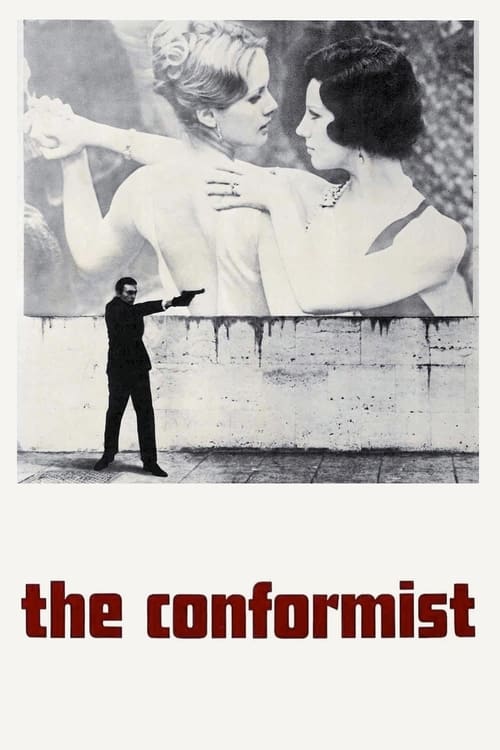
The Conformist
1971 · Bernardo Bertolucci
For when you want a film to chew on for days — something beautiful, adult, and morally uncomfortable. A challenge watch, best when you're in the mood to think about why ordinary people go along with terrible things.
What it's about
Rome, 1938. Marcello Clerici wants one thing above all: to be normal — a respectable marriage, a government job, no visible edges. To prove his loyalty to the fascist state, he accepts a mission on his Paris honeymoon: help arrange the assassination of his old philosophy professor, now an anti-fascist exile. The trip becomes a slow collision between the man he's performing and the buried childhood episode he's running from.
The experience
Seductive and chilling at once — every frame is gorgeous while the story curdles. It moves like a dream, sliding between past and present, and it leaves you implicated rather than reassured.
Performances
Jean-Louis Trintignant is extraordinary as Marcello — a performance of suppression, all darting eyes and stiff shoulders, a man visibly editing himself in real time. Dominique Sanda and Stefania Sandrelli orbit him with dangerous vitality he can't allow himself.
The craft
Vittorio Storaro's cinematography is one of the most influential ever shot — slanting light through blinds, cold blues against fascist marble, a camera that tilts and glides like a conscience. The production design turns 1930s architecture into psychology. This one genuinely demands the biggest, best screen you can find.
Why it matters
A foundational influence on the look of 1970s American cinema — a generation of directors and cinematographers openly studied it — and the film that made Bertolucci an international name.
Snapshot
A formally ravishing and morally harrowing portrait of political self-erasure, The Conformist follows Marcello Clerici — a neurotically ordinary Italian functionary — as he travels to Paris in 1938 to arrange the murder of his former university professor, now an anti-fascist exile. The assignment is also, for Marcello, an act of psychological self-cauterization: he hopes that participation in state violence will permanently bury the traumatic, sexually ambiguous episode of his childhood and install him once and for all inside the anonymous mass of the conforming crowd. Bertolucci adapted the 1951 novel Il conformista by Alberto Moravia and turned it into one of cinema's defining meditations on fascism as psychology rather than merely as politics — and, simultaneously, one of the most dazzling exercises in cinematographic craft in postwar European film. The collaboration between Bertolucci and cinematographer Vittorio Storaro produced a visual language that would reverberate through world cinema for decades.
Industry & production
The film was an international co-production — primarily Italian, with French and West German partners — released in Italy in 1970 and internationally in 1971. Produced under the banner of Mars Film (Rome) in association with Marianne Productions (Paris) and Maran Film (Munich), it was part of a broader pattern of pan-European art-cinema co-productions that allowed ambitious Italian directors to access French financing and Paris locations while retaining creative control. Bertolucci was at this point a politically engaged filmmaker aligned with the Italian Communist Party, and the project carried unmistakable ideological intent: a psychoanalytic dissection of the bourgeois personality type that had enabled fascism from within. The film was shot partly in Rome — including Cinecittà studio work for interior sequences — and extensively on location in Paris, where the Musée d'Orsay's forecourt and the streets of the 16th arrondissement provided the period-appropriate Haussmannian grandeur Bertolucci required. The production was not a major commercial enterprise by industry standards, but it benefited from the relatively permissive European co-production framework of the era and from Bertolucci's growing prestige following Before the Revolution (1964) and Partner (1968). Specific box-office figures for the original release are not reliably documented in accessible sources.
Technology
The Conformist was shot on 35mm, and Vittorio Storaro's approach to the film stock represented a decisive evolution in his practice. Working with Techniscope — a two-perforation anamorphic system that yielded a 2.35:1 aspect ratio while using less film stock than standard anamorphic processes — Storaro exploited its slightly coarser grain structure as a textural resource rather than treating it as a limitation. The system was common in lower-budget Italian genre production (particularly spaghetti westerns), but Storaro deployed it with the controlled precision of a painter, using the wide frame to construct compositions of geometric rigor. He experimented with colored gels and unconventional lighting instruments to produce the film's characteristic warm-amber and cold-blue tonal registers, creating a visual rhetoric in which the temperature of light carries ideological weight. The optical printing techniques available in 1970 allowed for the layered dissolves and superimpositions that stitch together the film's non-linear flashback structure; Franco Arcalli's editing exploited these technologies to build sequences that feel simultaneously fragmented and inexorable.
Technique
Cinematography
Storaro's work on The Conformist is frequently cited as the watershed moment in his career — the film in which he moved from technical competency to a fully articulated personal philosophy of light. His central conceptual framework, which he would later articulate in interviews and writing as a theory of light as moral and psychological force, is here expressed through a rigorous chiaroscuro vocabulary derived from painting — specifically the Italian Baroque, Caravaggio's raking side-light and the Dutch tradition of high-contrast illumination against dark grounds. Marcello is repeatedly photographed in partial shadow, his face bisected by bars of light that literalize his divided self; the architecture around him — colonnades, arches, long corridors — creates geometric cages that the camera frames with almost clinical deliberateness. The Paris sequences, bathed in a warm, slightly smoky amber, contrast with the cooler, more bleached light of Italian interiors. The extended sequence in the fascist Ministry building — all massive scale, marble emptiness, and tiny isolated human figures — uses the deep space of the wide frame to render the individual as an architectural irrelevance. The famous dance sequence in the Paris ballroom, where Dominique Sanda's Anna takes the floor with Stefania Sandrelli's Giulia, is lit with a theatrical warmth that renders it at once intimate and exhibitionistic, the camera circling the dancers in a slow, entranced orbit.
Editing
Franco Arcalli (credited as "Kim"), Bertolucci's regular editor on films of this period, built the film's temporal architecture from what is structurally a series of nested analepses. The narrative begins in media res — Marcello in a Paris hotel room, on the morning of the assassination — and unfolds through a layered series of flashbacks that are themselves non-chronologically ordered. Rather than conventional match-cuts, Arcalli favored associative juxtapositions that rhyme images across time: the adult Marcello's postures echo those of his childhood self; the light falling through an asylum window rhymes with light through a fascist-era office blind. The editing rhythm is largely unhurried by the standards of the era, privileging the long take and allowing Storaro's compositions to register, but it accelerates brutally in the film's final forest sequence, where the cutting achieves an almost unbearable staccato pulse.
Mise-en-scène / staging
Bertolucci's staging consistently externalizes psychology through spatial geometry. In the Fascist Ministry sequence, Clerici crosses a vast marble floor alone — a staging choice that reduces him to near-invisibility within the frame, making legible his deepest wish: to be absorbed, to disappear into an institution. By contrast, Professor Quadri's Parisian apartment is staged with bohemian warmth and physical proximity, the intellectual intimacy of the space placing Marcello in a physical comfort he cannot consciously acknowledge. Bertolucci was deeply conversant with the French New Wave — he had been closely associated with Jean-Luc Godard — and the stagings carry traces of that influence in their self-conscious theatricality and occasional Brechtian distanciation, though The Conformist is ultimately more emotionally immersive than Godard's practice permitted. The fascist-era architecture used throughout — EUR in Rome, the grandiose public spaces of Mussolini's Italy — functions as a found prop for the ideology being examined.
Sound
Georges Delerue composed the score, contributing string-led cues of melancholy irony that underline the film's emotional doubling: romantic warmth over political horror, bourgeois normalcy over moral catastrophe. Delerue's lush, somewhat period-inflected idiom creates a deliberate aesthetic friction with the violence toward which the narrative moves. Source music — tangos, dance-hall pieces — punctuates the Paris sequences and functions diegetically while also commenting from outside. The sound design overall is relatively conventional for the period, with the score doing most of the affective heavy lifting; the film does not share the systematic sound-design innovations of contemporaneous works by Kubrick or Tati.
Performance
Jean-Louis Trintignant's performance as Marcello is one of the great portraits of moral nullity in European cinema — a face of studied blankness that the viewer is invited to read as repression, cowardice, or the void at the center of conformism itself. He speaks calmly, moves quietly, and maintains a surface of bourgeois reasonableness that never cracks except in flickering moments of panic quickly suppressed. Dominique Sanda, as Anna Quadri, generates a contrasting energy: mercurial, sexually fluid, openly manipulative of Marcello's barely-acknowledged desire. Stefania Sandrelli plays Giulia with an uninflected vulgarity that is not contemptuous but genuinely curious — she is the conformist's ideal partner, asking nothing and noticing everything while performing ignorance. Enzo Tarascio as Professor Quadri brings a warmth and intellectual openness that makes his fate the more devastating. Bertolucci directed in both Italian and French depending on the scene's location, and the performances sustain their register across both languages.
Narrative & dramatic mode
The Conformist operates as psychological drama encoded in political allegory. Its structural logic is psychoanalytic: the entire narrative of adult complicity in fascist violence is presented as the consequence of a childhood trauma — a sexual encounter with a chauffeur, Lino, that Marcello believed (incorrectly) he had resolved by killing the man. The film's revelation, in its final passage following Mussolini's fall in 1943, is that Lino is alive, the childhood "murder" was never real, and Marcello's entire life of political conformism has been erected on a false foundation. This moment of dramatic irony — the audience watching the careful architecture of a man's self-justification collapse — is handled without melodrama; Bertolucci simply lets the logic play out. The mode is neither realist nor allegorical in a schematic sense: it is closer to a case study in which the particular and the historical illuminate each other without reducing either term.
Genre & cycle
The Conformist belongs to the tradition of the Italian political film that flourished in the late 1960s and 1970s — a cycle that includes Elio Petri's Investigation of a Citizen Above Suspicion (1970), Francesco Rosi's various exposés, and Pier Paolo Pasolini's increasingly extreme political allegories. Within this cycle, Bertolucci's film is distinctive for its psychoanalytic rather than sociological emphasis and for its investment in formal beauty as a rhetorical mode. It is also part of a broader European art-cinema tradition of historical revisionism — films made in the late 1960s and early 1970s that returned to the fascist period to excavate the psychological preconditions of collaboration and conformity, a tradition including Luchino Visconti's The Damned (1969) and, later, Liliana Cavani's The Night Porter (1974). These films share an interest in the eroticization of power and in bourgeois complicity that the postwar period had largely suppressed from official memory.
Authorship & method
Bernardo Bertolucci came to The Conformist from a background that was simultaneously literary (his father was the poet Attilio Bertolucci), cinematic (he had been Pasolini's assistant director on Accattone before making his own debut), and political. His method was eclectic and self-aware: he absorbed the French New Wave — particularly Godard — and explicitly filtered it through the Italian art-cinema tradition and through his own Marxist framework. On The Conformist, his working relationship with Storaro was central. By most accounts the collaboration was deeply dialogic, with Bertolucci open to Storaro's conceptual proposals while maintaining firm narrative and thematic control. Bertolucci wrote the screenplay himself, adapting Moravia's novel fairly freely — he compressed and rearranged the temporal structure and deepened the psychosexual dimension. Vittorio Storaro used the film as the proving ground for a philosophy of cinematography he would continue developing through Last Tango in Paris (1972), Apocalypse Now (1979), and Reds (1981). Franco Arcalli as editor developed with Bertolucci the associative, temporally fractured cut that would also characterize Last Tango in Paris. Georges Delerue's score provided emotional counterpoint throughout — his involvement was consistent with his broader role in French and Italian art cinema of the period, where he composed for Godard, Truffaut, and others.
Movement / national cinema
The film is a product of Italian cinema's politically engaged art-film mode of the late 1960s and early 1970s, a moment when the Italian industry was producing some of the most formally ambitious and politically explicit work in world cinema. Bertolucci was self-consciously situated within this movement while also resisting its documentary and neo-realist inheritances: The Conformist is conspicuously aestheticist, committed to visual pleasure in ways that his more austere contemporaries (Petri, Rosi) were not. It also reflects the particular Italian intellectual left's preoccupation with understanding fascism from within bourgeois psychology — a project with Gramscian overtones, concerned with hegemony and the manufacture of consent at the level of the individual subject.
Era / period
The film was made during a period of acute political crisis in Italy — the autunno caldo (hot autumn) of labor unrest in 1969 was still reverberating, and the anni di piombo (years of lead) of political violence were beginning. Bertolucci's return to the fascist period was not escapism but a diagnostic move: to understand the conformist personality that had enabled Mussolini was, implicitly, to understand the social pressures generating contemporary conformism and political violence. The film's release in 1970–71 placed it within a broader Western art-cinema moment shaped by the aftermath of 1968, when filmmakers across Europe were reckoning with the failure or partial failure of revolutionary politics.
Themes
The film's central preoccupation is the psychology of conformism as both personal pathology and political condition — the retreat from individuation into the anonymous safety of the mass as a response to unbearable psychic conflict. Bertolucci draws on Freudian and Reichian frameworks (Wilhelm Reich's The Mass Psychology of Fascism is a clear intertext) to suggest that Marcello's fascism is a symptom of sexual and existential panic, not a coherent ideology. The film is also a meditation on memory and self-deception: Marcello's entire life is constructed on a misremembered event, and fascism itself is presented as a collective act of self-deception, a willed normality that requires constant effort to maintain. Sexuality functions as a persistent counter-force — Anna's desire, Giulia's unconscious sensuality, and Marcello's suppressed homosexuality are elements the ideology cannot fully contain. The relationship between aesthetics and politics is also thematically present: the film's own beauty implicates the viewer in a seductive complicity analogous to the appeal of fascist spectacle.
Reception, canon & influence
Critical reception on initial release was strong in Europe and in international art-cinema circuits, though the film was not a major commercial event in any market for which reliable figures are available. It was recognized immediately as an exceptional work of cinematography and as an important political film. American critical reception was more mixed initially, with some discomfort at the film's aestheticism in the service of dark material, though influential critics including Pauline Kael engaged seriously with it.
Influences on the film (backward): Moravia's source novel provided the psychological and narrative skeleton. Visually, Storaro drew on the history of Western painting — Caravaggio's chiaroscuro, the Baroque tradition more broadly — as well as on Orson Welles's deep-focus compositional strategies and on German Expressionism's use of shadow as psychological index. Bertolucci's debt to Godard is present in the film's self-conscious formal games, though the emotional register is warmer than Godard's practice. The influence of Max Ophüls — in the film's circling camera movements and its ambivalent relationship to bourgeois milieu — is also plausible, though not documented with the specificity that Bertolucci's debt to Godard is.
Legacy and forward influence: The Conformist is among the most influential films in the history of cinematography. Storaro's collaboration with Francis Ford Coppola on The Godfather Part II (1974) and especially Apocalypse Now (1979) — and with Warren Beatty on Reds (1981), for which Storaro won the Academy Award — carried the visual language developed here into the American mainstream. Gordon Willis, the cinematographer of the first two Godfather films, was developing related approaches to underlit, shadow-heavy compositions in the same period, and the cross-influence between American and European cinematography in this moment is palpable. Martin Scorsese has repeatedly cited The Conformist as a formative influence on his visual sensibility. The film was restored and returned to wide circulation beginning in the 1990s, gaining a new generation of admirers; it regularly appears on canonical lists of the greatest films of the 1970s and of world cinema more broadly. Its influence extends beyond cinematography into narrative structure — the nested flashback architecture, the fragmented temporality organized by psychological rather than chronological logic — and into the thematic vocabulary of films dealing with political collaboration and moral complicity. Steven Soderbergh, among others, has cited it as a touchstone. It remains, alongside Last Tango in Paris and 1900, the foundational text of Bertolucci's mature career and one of the definitive statements of European political cinema's most ambitious period.
A Deleuzian reading
Marcello waits in a dark Paris hotel room for a telephone to ring, and across his face fall slats of light — bright bar, dark bar, bright bar — thrown by a window blind or a passing car.
The full Deleuzian reading of The Conformist →
Reception
Acclaimed on arrival in 1970 but trimmed for its US release, it was fully restored decades later and has since climbed from 'great Bertolucci film' to 'possibly the most beautiful film ever shot' — a canonization driven as much by cinematographers as by critics.
How The Conformist was received, from release to now →
Influences: the films it descends from and the films it influenced
- Citizen Kane (1941) — Welles's in-medias-res construction — the narrative begins at the moment of consequence and excavates backward through contradictory analepses narrated by unreliable witnesses — is the direct structural template Arcalli and Bertolucci inherit for Marcello's nested flashbacks, which similarly open in the Paris hotel room at the moment of political violence and spiral outward through layered retrospective memory.
- Senso (1954) — Visconti establishes the Italian political-cinema grammar of using erotic betrayal as the lens for class complicity — a protagonist's private passion enabling political catastrophe — which Bertolucci inherits as the structural and moral logic of Marcello's marriage and murder assignment, including the operatic counterpoint strategy of scoring scenes of betrayal with music pitched to a beauty the action desecrates.
- Hiroshima Mon Amour (1959) — Resnais and editor Anne-Marie Cottet pioneer the associative cut triggered by sensory rhyme rather than narrative logic — a touch on skin becomes a wartime corpse — which Arcalli directly adapts as the editorial principle by which adult Marcello's present-tense gestures involuntarily summon childhood trauma across the film's fractured chronology.
- L'Avventura (1960) — Antonioni's deployment of wide-ratio framing to reduce human figures to geometric incidents within monumental architectural and landscape space — the characters visually absorbed by stone, sky, and emptiness — models Storaro's approach to photographing Marcello inside the fascist Ministry's marble corridors, where the 2.35:1 Techniscope frame makes the individual an irrelevance of the architectural field.
- Last Year at Marienbad (1961) — Resnais and cinematographer Sacha Vierny deploy baroque palatial architecture — corridors, salons, formal gardens — as a spatial diagram of psychological indeterminacy, the building's geometry externalizing a mind that cannot distinguish memory from desire, which Bertolucci and Storaro directly transpose in their use of the fascist Ministry's colonnades as a literal spatial cage of the conformist psyche.
- The Leopard (1963) — Visconti's extended ballroom sequence — bourgeois aesthetics bathed in warm, dust-gold light while the aristocratic order they celebrate crumbles politically — serves as the direct formal model for The Conformist's Paris dance sequence, including the technique of a camera circling dancers with an amoral observing eye that aestheticizes what it should indict.
- Contempt (1963) — Godard and Raoul Coutard demonstrate in CinemaScope how the wide aspect ratio can stage psychological isolation by separating figures within the same frame to a degree impossible in the Academy ratio — characters sharing space but occupying irreconcilable psychological worlds — which Storaro translates into the Techniscope compositions that physically fragment Marcello from every human proximity.
- Jules and Jim (1962) — Storaro elaborates Coutard's Cameflex mobile-camera aesthetic into a more painterly chiaroscuro grammar, while the retrospective chronicle structure — a man reviewing the compromises of a life during a decisive journey — develops Jules and Jim's model of organizing historical period through intimate personal reckoning across a span of years.
- Shanghai Express (1932) — Storaro's pictorial design revives von Sternberg's mise-en-scène of light raked through layered foreground elements (blinds, leaves, fabric), where composition and texture become the subject.
- The Scarlet Empress (1934) — Storaro veils faces and rooms through slatted light, gauze and intervening objects, reviving Sternberg's chiaroscuro of partial concealment as psychological surface.
- The Trial (1962) — Storaro's low-angle monumentalizing of fascist architecture, the figure crushed beneath vast institutional geometry, directly continues Welles's compositional politics of scale.
- The Night Porter (1974) — Cavani's film occupies identical Italian political-cinema territory — fascist psychology examined through sadomasochistic retrospection, analepses revealing wartime complicity, a warm-interior light palette encoding the ambiguous warmth of perpetrator-victim intimacy — and cinematographer Alfio Contini's approach to shadow and enclosure develops the chiaroscuro-as-moral-indictment vocabulary in direct dialogue with Storaro's contemporaneous work.
- The Godfather (1972) — Gordon Willis independently arrives at the same Baroque-derived chiaroscuro doctrine Storaro codifies in The Conformist — faces emergent from deep shadow with foreheads and eyes lit, moral ambiguity rendered as incomplete illumination — demonstrating that the photographic vocabulary of fascism and criminality converge on the same visual grammar of light withheld.
- Last Tango in Paris (1972) — The immediately subsequent Bertolucci-Storaro Paris film extends the warm-amber interior lighting system first fully articulated in The Conformist, now deploying Storaro's light-source modeling to externalize a grieving protagonist's desire for anonymous self-erasure — the identical psychological impulse as Marcello's conformism, now pursued through erotic rather than political self-destruction.
- Chinatown (1974) — Polanski and cinematographer John Alonzo deploy warm-amber period reconstruction to give a retrospective beauty to a morally bankrupt world, while the narrative structure places the investigator in the structural position Marcello occupies — a figure whose formal competence and confident observation turn out to be the very mechanism of his entrapment, the active viewer revealed as already complicit.
- Novecento (1976) — Bertolucci and Storaro's direct extension of The Conformist's warm/cold color ideology at epic scale — the amber-lit pastoral versus the bleached, administrative cold — now explicitly encodes the Fascist/Communist moral opposition across 20th-century Italian class history, using the same Techniscope-derived widescreen grammar of human figures diminished by the architectural and agricultural spaces that determine their political fate.
- Apocalypse Now (1979) — Storaro's direct exportation of The Conformist's light-as-moral-force doctrine to an American production: the amber-gold descent into the jungle encodes Willard's psychoanalytic regression, while Kurtz's compound — lit entirely by candle and torch against deep shadow, faces half-erased — transposes the Ministry sequence's chiaroscuro to its formal extreme, the Baroque grammar of moral nullity now serving Conrad rather than Moravia.
- Once Upon a Time in America (1984) — Leone and editor Nino Baragli construct the most ambitious nested-analepsis structure in Italian cinema since The Conformist — the entire film is the opium-haze memory of a man whose defining act of betrayal is repeatedly deferred and finally revealed — while Morricone's elegiac score creates the same ironic counterpoint between nostalgic musical beauty and the acts of political and personal violence it accompanies.
- The Last Emperor (1987) — Bertolucci and Storaro's most monumental application of The Conformist's spatial-geometry-as-psychology method: the Forbidden City's corridors and courts are photographed in the same deep-field wide compositions, with the warm-amber/cool-blue opposition now mapping the passage from imperial splendor to Communist re-education, and the emperor's face repeatedly caught in the bisecting light that divided Marcello's — the individual face as the site where historical forces are inscribed.
- The English Patient (1996) — Minghella, editor Walter Murch, and cinematographer John Seale adapt The Conformist's temporal template directly — nested analepses structured around a dying body recalling an erotic entanglement during political catastrophe — applying Murch's principle (developed partly in dialogue with Arcalli's methods) that fragmented chronology is itself the aesthetic index of traumatized consciousness, not a stylistic ornament but the structural meaning.
- La Grazia (2025) — Codifies the placement of the human figure inside monumental fascist-modern architecture and 'drowned,' light-starved interiors — the black-drowned-interior cinematography D'Antonio reprises.
- The Godfather Part II (1974) — Storaro's cinematography externalizes Clerici's moral bankruptcy through shadow geometry and motivated darkness — a technique Willis absorbed and radicalized, establishing the principle that a character's ethical condition is expressed through the quality and angle of light falling on them.
- The Lives of Others (2006) — Bertolucci and Vittorio Storaro use fascist rationalist architecture — geometric Ministry corridors, grid-planned interiors — to externalize the protagonist's surrender of individuality to state ideology, establishing the formal principle that institutional space is a spatial argument about ideological conformity, which The Lives of Others maps directly onto its vertical attic/apartment binary.
- The Spider's Stratagem (1970) — Shot by Storaro in the Po Valley immediately before The Conformist, this film is the laboratory in which the cinematographic vocabulary of the subsequent film is developed: warm amber light that renders pastoral beauty ideologically complicit, Techniscope compositions that trap a protagonist within village geometry organized around a fascist-era myth, and the psychoanalytic structure of a son compelled to repeat his father's self-destruction.
- Z (1969) — Storaro's cinematography deploys spatial contrast between intimate interior compositions of fascist complicity and exposed exterior crowd sequences in the same dialectical register as Coutard's deliberate street-versus-room staging in Z, encoding political argument in camera placement.
- The Swimming Pool (1969) — Storaro's surveillance cinematography treats European architectural space and Mediterranean light as a system of moral exposure, while Trintignant's reptilian physical self-containment is a direct parallel to Delon's performance mode, with moral ambiguity around sexual violence and murder as the structural common ground.
- Amarcord (1973) — Storaro and Bertolucci's figure-to-architecture framing — characters dwarfed or geometrically constrained by fascist institutional spaces — works the identical craft problem as Amarcord's staging of individuals against the Grand Hotel lobby or the party secretary's office, using architecture as a register of ideological pressure.
- Satyricon (1969) — Vittorio Storaro's anamorphic theatrical lighting — art deco interiors lit from implausible directional sources, warm amber against cold shadow — and Bertolucci's habit of staging political ceremony as symmetrical frieze-compositions directly parallel Satyricon's cinematographic strategy, transposed from ancient Rome to Fascist Europe.
- Salvatore Giuliano (1962) — Extends the politically-charged Italian art film with non-chronological reconstruction of a compromised man, sharing the period anatomy of fascism-and-power assembled from temporally fragmented blocks.
- The Passenger (1975) — Shares editor Franco Arcalli's signature time-folding, elliptical cutting that braids past and present, the same associative structural method Arcalli brings to The Passenger.
- The Belly of an Architect (1987) — Vittorio Storaro's monumental fascist-era Roman architecture, deep symmetrical perspectives and the human figure dwarfed by built scale, supplies the visual rhetoric of permanence Belly interrogates.
- Death in Venice (1971) — Shares production designer Ferdinando Scarfiotti, whose period-decadent surfaces define both films; Bertolucci independently develops the geometry-of-looking through doorways and framed glances Visconti deploys on the Venice beach.
- Salò, or the 120 Days of Sodom (1976) — Bertolucci, Pasolini's protégé, mounts the same period-precise fascist-aesthetic critique through Delli Colli-era Italian craftsmanship, using immaculate design to expose the bureaucratic blandness of complicity.
- Mr. Klein (1976) — Complicity-as-administration: fascist collaboration dramatized as careerist bureaucratic drift, wrapped in a wintry, art-directed color scheme of guilt (Storaro's cold blues and grays).
- Investigation of a Citizen Above Suspicion (1970) — Fuses authoritarian politics with sexual pathology through Storaro's heightened expressionist stylization rather than neorealist naturalism — the same anti-naturalist route to the psychosexual-authoritarian theme.
Similar films
- 1900 (1976) — influence & lineage · same viewing thread
- The Leopard (1963) — influence & lineage · same viewing thread
- Last Tango in Paris (1972) — influence & lineage
- The Godfather (1972) — influence & lineage
- The Last Emperor (1987) — influence & lineage
- Investigation of a Citizen Above Suspicion (1970) — same viewing thread
- Obsession (1943) — same viewing thread
- The Conversation (1974) — often watched together
All the films related to The Conformist →
Watch it with: curated runs of related films
- Neorealism and Its Shadows — Watch these together to see Italy from the ground up — the unemployed, the sharecropped, the compromised — from neorealism's birth to its stylish, sinister heirs.