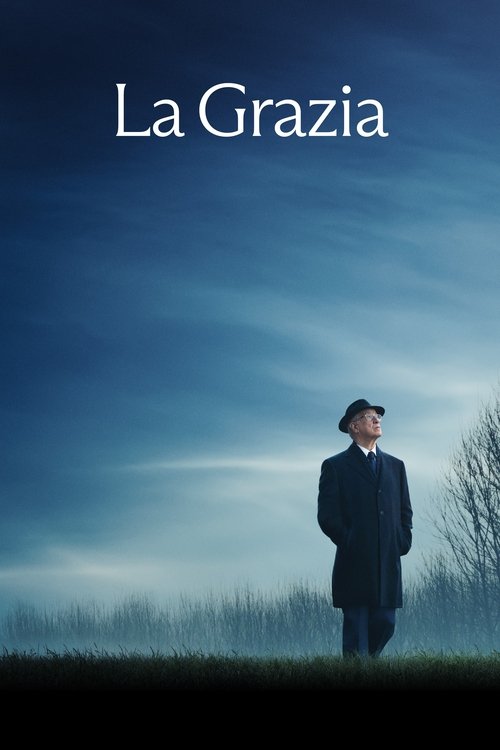
La Grazia
2025 · Paolo Sorrentino
When you want a film to chew on for days — questions of mercy, faith, and duty you'll carry out of the room — delivered with elegance rather than lecture. Contemplative, not heavy-handed.
What it's about
Mariano De Santis, a devout Catholic serving as President of Italy, is in the final months of his term when two burdens land at once: a bill legalizing euthanasia awaiting his signature, and petitions for clemency from two prisoners, each of whom killed a spouse. As he weighs law against faith and mercy against duty, his closest counsel is his daughter Dorotea, who serves as his legal adviser and his conscience's sparring partner.
The experience
Stately, wry, and quietly searching — a film of corridors, silences, and loaded conversations that keeps a surprising warmth under its formality. It makes you think without ever feeling like homework.
Performances
Toni Servillo, Sorrentino's career-long leading man, gives De Santis a beautiful gravity — a man of institutional restraint whose doubts flicker through the composure — with Anna Ferzetti sharp and moving as his daughter.
The craft
The title itself is the film's engine — grazia meaning both divine grace and the presidential pardon — and Sorrentino builds the whole drama around that double meaning with his signature visual sumptuousness and dry wit. The ceremonial spaces of the Italian presidency are photographed to be savored on a big screen.
Why it matters
Sorrentino's tenth feature renews one of modern cinema's great director-actor partnerships and joins the ongoing European conversation about faith, end-of-life law, and the loneliness of high office.
Snapshot
La Grazia is Paolo Sorrentino's tenth feature, an Italian-language political and moral drama built around Toni Servillo as Mariano De Santis, a fictional, devoutly Catholic President of Italy in the final months of his seven-year term. The Italian title carries a deliberate double charge: grazia means both "grace" in the theological sense and the presidential power of clemency — the pardon (grazia) that an Italian head of state may grant to convicted prisoners. The film braids two strands of conscience around that pun. De Santis must decide whether to sign into law a bill legalizing euthanasia in a Catholic country, and he must rule on two petitions for clemency, each involving a spouse who killed a partner. Threading both is his relationship with his daughter and chief legal adviser, Dorotea (Anna Ferzetti), and the lingering grief of his late wife. The film opened the 82nd Venice International Film Festival in competition on 27 August 2025, where Servillo took the Volpi Cup for Best Actor; it reached Italian theaters on 15 January 2026. Critically it was received as a notably restrained, late-style Sorrentino — less the operatic maximalist of The Great Beauty than a chamber moralist working in muted registers.
Industry & production
La Grazia was produced through Sorrentino's own company, Numero 10, with The Apartment Pictures (the prestige-cinema arm of the Fremantle group, long associated with producer Lorenzo Mieli) and Fremantle itself, with Sorrentino and Annamaria Morelli credited as producers. Italian distribution was handled by PiperFilm, with Warner Bros. Entertainment Italia involved in the release; the film runs 133 minutes. This places the project squarely within the European auteur-festival economy that has underwritten Sorrentino's career since his Netflix-era expansion: a director with international financing and streaming-adjacent backers who nonetheless continues to make Italian-language films premiering on the festival circuit. Choosing La Grazia as the Venice curtain-raiser — Sorrentino is a Venice fixture, and his Youth, The Hand of God, and Parthenope all had high-profile bows — signals the festival's continued investment in him as a flagship national auteur. Reported worldwide grosses were modest by blockbuster standards (in the low eight figures, the bulk earned domestically in Italy), consistent with a subtitled prestige drama whose commercial life runs through awards season and arthouse exhibition rather than wide release. As with reception specifics for any very recent film, granular budget and recoupment figures are not reliably in the public record, and I won't invent them.
Technology
Sorrentino has worked digitally for years, and La Grazia was captured and finished in that idiom, its images shaped substantially in the color grade — the velvety blacks, controlled contrast, and saturated nocturnes that have become a house signature. Cinematographer Daria D'Antonio and Sorrentino are repeatedly described as color-coordinating the frame, building interiors out of deep shadow and isolating figures against the night lights of Rome. Beyond that, the specific camera and lens packages are not something the public record makes clear, and I won't guess at model numbers. What is worth noting technologically is the score's character: rather than a traditional orchestral cue-sheet, the film leans on an electronic score (credited to Fabrizio Elvetico, Marco Messina, and Sacha Ricci) and incorporated contemporary Italian popular music, including an appearance by the rapper Guè as himself. The "technology" of the film, in other words, is as much about a synth-and-rap sound design rubbing against august widescreen images as about capture hardware.
Technique
Cinematography
D'Antonio, who became Sorrentino's director of photography on The Hand of God (2021) after the long Luca Bigazzi era and continued on Parthenope (2024), gives La Grazia the sharp, lacquered surface associated with the director while pulling the palette toward something more somber, even mournful. Reviewers single out interiors drowned in black, precise and frontal compositions, and a recurring motif of the President framed against the twinkling skyline of Rome — an image that lends the character an almost extraterrestrial isolation, a man sealed inside the Quirinale and inside his own deliberation. The camera is less restless than in Sorrentino's set-piece films; the grandeur is held in reserve and deployed sparingly, which several critics read as evidence of a more disciplined visual rhetoric.
Editing
Cristiano Travaglioli, Sorrentino's editor across virtually his entire filmography (from Il Divo onward), again cuts the picture. Sorrentino's editorial signature — abrupt, music-driven transitions, montage interludes that break from narrative time, sudden tonal pivots from solemnity to absurdist comedy — is present but, by consensus, dialed back. Some reviewers found the transitions and needle-drops occasionally jarring against the film's more elegiac passages, a sign of the friction between Sorrentino's montage instincts and the chamber-drama material.
Mise-en-scène / staging
The film's stage is the apparatus of the Italian presidency: official residences, ministerial chambers, the rituals of state, and the enclosed domestic world the widowed President shares with his daughter. Costume designer Carlo Poggioli dresses the institution with the tailored formality the milieu demands. Sorrentino stages much of the drama as conversation and deliberation — two people in a room weighing law against conscience — which is itself the mark of the more restrained mode, a retreat from the carnivalesque processions and parties of earlier work toward the intimate two-hander.
Sound
Sound is one of the film's most discussed and divisive elements. The decision to score a stately presidential drama with electronic textures, techno pulses, and Italian rap creates pointed tonal contrast; the score reportedly swells toward more classical grandeur in the emotional crescendos. For admirers, this is the Sorrentino frisson — the friction of high and low, sacred and profane. For detractors, the music selections sit uneasily with the film's lusher, more mournful imagery.
Performance
The performance ledger is dominated by Servillo, whose Volpi Cup-winning turn was widely called among the finest of his career. The praise centers on economy: where Sorrentino characters often declaim, De Santis is built from restraint, weariness, and a contained interior grace, the President's moral exhaustion legible in small gestures. Anna Ferzetti as Dorotea — daughter, confidante, and legal mind — functions as the film's second center of gravity and its moral interlocutor; her work was recognized with the Pasinetti Award at Venice. Massimo Venturiello plays the Minister of Justice Ugo Romani, with Orlando Cinque, Milvia Marigliano, and others in support.
Narrative & dramatic mode
The dramatic mode is deliberative rather than eventful: a film of decisions, not actions. Its engine is the moral dilemma, stated almost as a syllogism — on the euthanasia bill, the President frames his bind as "if I don't sign, I'm a torturer; if I sign, I'm a murderer." The two clemency petitions (a respected teacher who mercy-killed his suffering wife; a young woman convicted of murdering her husband) operate as parallel cases that pressure the gap between law and truth, mercy and justice. Sorrentino structures this less as a thriller of political maneuvering than as a sustained meditation, punctuated by his characteristic digressions, comic grace notes, and lyrical interludes. The father-daughter relationship supplies the emotional throughline: Dorotea's prison visit to one applicant reorients her — and the film's — sense of freedom and duty, and the President's grief for his late wife shadows every choice. It is, in form, closer to a contemplative late-style drama than to the propulsive Il Divo.
Genre & cycle
The film sits at the intersection of the political film and the intimate character study, with a strong undertow of the mortality drama that has run through Sorrentino's recent work (Youth, The Hand of God, Parthenope). Within his own output it belongs to a "men of Italian power" cycle alongside Il Divo (Giulio Andreotti) and Loro (Silvio Berlusconi) — but it inverts their satire. Where those films anatomized corruption and appetite, La Grazia imagines an essentially honest, principled head of state, a counter-portrait that several critics read as a wistful, even idealized vision of "what a politician should be." It is a political film with little interest in plot mechanics of power and great interest in the conscience that power burdens.
Authorship & method
Sorrentino wrote, directed, and co-produced the film, his customary total-authorship posture. The defining authorial fact of La Grazia is its reunion with Toni Servillo in a leading role — the actor who anchored The Consequences of Love, Il Divo, The Great Beauty, and Loro, and who appeared in smaller parts in The Hand of God and Parthenope. Servillo is Sorrentino's great instrument for depicting solitary, watchful, powerful men, and the President extends that gallery. The other key collaborators are longtime ones: editor Cristiano Travaglioli and cinematographer Daria D'Antonio, the latter representing the most significant craft evolution of Sorrentino's late period as she has carried forward and inflected the visual language established under Bigazzi. A notable departure from method is the music: rather than the orchestral/curated scores associated with his regular composer Lele Marchitelli, Sorrentino built the soundtrack around an electronic team (Elvetico, Messina, Ricci) and contemporary pop. The method overall is recognizably Sorrentino — a screenplay of aphorism and moral paradox, images of cool grandeur, tonal whiplash between the sublime and the everyday — applied at lower volume.
Movement / national cinema
La Grazia is a thoroughly Italian film, and Sorrentino remains the most internationally visible standard-bearer of contemporary Italian cinema after Matteo Garrone. His lineage is frequently traced to Federico Fellini — the processional spectacle and Roman melancholy of La grande bellezza made the comparison canonical — and the engagement with Italian political life recalls the cinema impegnato tradition of Francesco Rosi and Elio Petri, even as Sorrentino's irony and ornamentation set him apart from their austerity. Casting Anna Ferzetti, daughter of the actor Gabriele Ferzetti (of Antonioni's L'Avventura and Leone's Once Upon a Time in the West), threads a small filament back into that national-cinema heritage. The film's preoccupation with the Quirinale and the rituals of the Republic situates it firmly within an Italian conversation about the moral office of the presidency.
Era / period
The film arrives in the mid-2020s, a moment in which Sorrentino, having cycled through international English-language projects (This Must Be the Place, the Young/New Pope series) and a confessional autobiographical turn (The Hand of God), has settled into a reflective late phase. La Grazia extends the chastened, mortality-haunted register of that phase. Its subject — euthanasia, the right to die, the conscience of a Catholic state — is contemporary and pointed, engaging live debates in Italian law and the Church's continuing cultural weight. The period flavor also registers in its sound, where techno and Italian rap mark the film as a 2020s artifact even as its imagery reaches for timeless grandeur.
Themes
The governing theme is grace in its doubled sense: divine mercy and the sovereign's pardon, and the unbearable proximity of the two when a believer holds the power to forgive, to permit dying, and to refuse. From this flow the film's other concerns: the gap between law and truth, dramatized by clemency cases where legal guilt and moral reality diverge; mortality and mourning, embodied in a widower contemplating a euthanasia bill while grieving his wife; conscience versus office, the cost exacted on an honest man by the duty to decide; and fatherhood and inheritance, in the intellectual and moral partnership between De Santis and Dorotea. Underlying all of it is an idealist's question, unusual for Sorrentino's satirical politics — what integrity in public life might actually look like — answered through patience, fortitude, and restraint rather than spectacle.
Reception, canon & influence
Critical reception was broadly favorable and frequently framed around the word "restraint." Reviews aggregated to a strong majority-positive consensus, the throughline being that this is an atypically sober, mature Sorrentino reuniting him with the "majestic" Servillo, whose performance drew near-unanimous acclaim and the Venice Volpi Cup; Anna Ferzetti received the festival's Pasinetti Award, and Sorrentino's screenplay was later honored at the Chicago International Film Festival. Dissenting notices found the film hollow or inert beneath its polish, or faulted the music-image fit. The film competed for but did not win the Golden Lion.
Looking backward, the influences ON the film are legible: Fellini's Roman grandeur and melancholy; the Italian political-cinema tradition of Rosi and Petri, here softened and interiorized; and Sorrentino's own Il Divo and Loro, which La Grazia answers by inverting their portraits of venal power into a study of an honest one. Its late-style hush extends the lineage of Youth and The Hand of God. Looking forward, its legacy is by definition unsettled this close to release; what can be said responsibly is that it consolidates Sorrentino's late, quieter manner and reaffirms the Sorrentino–Servillo partnership as one of the defining director-actor collaborations of 21st-century European cinema. Whether La Grazia enters the durable canon alongside Il Divo and The Great Beauty or is remembered as a distinguished minor key is a judgment the historical record cannot yet make, and I won't pretend otherwise.
A Deleuzian reading
Start with the recurring shot the reviewers keep returning to: Mariano De Santis, President of Italy, framed small against the twinkling night skyline of Rome, sealed inside the Quirinale and inside his own deliberation.
The full Deleuzian reading of La Grazia →
Reception
Opened the 2025 Venice Film Festival to a four-minute ovation and a Volpi Cup for Toni Servillo, and quickly settled into its reputation as 'late-style Sorrentino' — the restrained, sober one that even some longtime Sorrentino skeptics found themselves admiring.
How La Grazia was received, from release to now →
How to watch La Grazia: what to notice on a first viewing
- Watch the President framed small against the Rome skyline at night. D'Antonio repeats this composition, sealing De Santis inside glass and darkness, a man who can see the whole city and act on almost none of it. The isolation of the shot tells you more about his position than any line of dialogue does.
- Notice how much of each interior sits drowned in black. D'Antonio pulls the palette toward something somber and mournful, precise frontal compositions carved mostly out of shadow rather than light. The darkness around him feels like the weight of the decisions he is carrying.
- Watch how little Servillo's face moves while he is deciding something enormous. The performance is built from restraint and weariness rather than declamation, his moral exhaustion legible only in small gestures. You have to read the weight of a decision on a face that refuses to show you much.
- Watch how often scenes are just two people in a room. Sorrentino stages the drama as conversation and deliberation rather than the processions and parties of his earlier films, a retreat into the intimate two-hander. The film trades spectacle for the quieter drama of two people weighing law against conscience.
- Listen for techno and rap under a scene set inside the presidency. The score leans on electronic textures and contemporary pop rather than the orchestral cues you would expect from a stately political drama. The mismatch between sound and setting keeps the film from ever feeling comfortably dignified.
The whole guide to watching La Grazia, with the keys for a rewatch →
Influences: the films it descends from and the films it influenced
- La Dolce Vita (1960) — Establishes the template of the solitary, watchful protagonist read against a melancholic Roman skyline — the 'figure-against-Rome' composition Sorrentino directly inherits via D'Antonio's framing.
- 8½ (1963) — Supplies the aphoristic, reverie-driven interiority and the structure of a powerful man weighing his life in paradoxes — the moral-paradox screenplay grammar Sorrentino reuses at lower volume.
- Roma (1972) — Models the processional, fresco-like rendering of Rome as a grand mournful organism, the tonal whiplash between sublime spectacle and the everyday that defines Sorrentino's image-making.
- Investigation of a Citizen Above Suspicion (1970) — Pioneers the cold, ritualized close study of a single man embedded in state power and institutional procedure — the political-portrait mode La Grazia softens and interiorizes.
- Salvatore Giuliano (1962) — Founds the Italian investigative political-cinema tradition of dissecting the machinery of office and clemency, the documentary-procedural backbone Sorrentino inherits and turns inward.
- The Conformist (1970) — Codifies the placement of the human figure inside monumental fascist-modern architecture and 'drowned,' light-starved interiors — the black-drowned-interior cinematography D'Antonio reprises.
- L'Eclisse (1962) — Origin of the restraint-economy register: performance pared to glances and pauses, deliberative stillness over event — the muted two-hander rhythm Servillo's President embodies.
- Il Divo (2008) — Its Servillo-led portrait of venal Italian political power, scored against pop and electronic cues, is the explicit film La Grazia answers by inverting into a study of an honest officeholder.
- Youth (2015) — Initiates Sorrentino's late-style hush — two-hander deliberation on aging, grace and death between contemplative men — the quieter manner La Grazia consolidates.
- Loro (2018) — Continues the Servillo power-portrait with contemporary techno/pop scoring over corridors of influence, the venal-power study La Grazia deliberately reverses.
- Il Caso Mattei (1972) — Extends Rosi's anatomy of institutional power and the moral cost of high office, the deliberative-procedural framework Sorrentino reworks into a chamber drama of clemency.
- The Consequences of Love (2004) — First crystallizes the Sorrentino–Servillo instrument: a solitary, controlled, watchful man whose power registers as economy and silence, the exact performance gallery La Grazia extends.
- The Great Beauty (2013) — Perfects the figure-against-Rome-skyline melancholy and Servillo as elegiac flâneur of mortality, the visual and tonal vocabulary La Grazia recombines.
- The Hand of God (2021) — Marks the autobiographical late-style hush and the handover of camera authorship to Daria D'Antonio, whose Bigazzi-descended light language La Grazia carries forward.
- The Young Pope (2016) — Templates the lonely, supremely powerful man framed in austere institutional spaces with anachronistic pop/electronic needle-drops — the music-against-power device La Grazia adopts wholesale.
- Parthenope (2024) — Immediate sibling in D'Antonio's evolving cinematography — figures against monumental Italian cityscape and lush, mortality-tinged grandeur — the visual evolution La Grazia shares.
Similar films
- The Hand of God (2021) — influence & lineage
- The Great Beauty (2013) — influence & lineage
- Investigation of a Citizen Above Suspicion (1970) — influence & lineage
- Conclave (2024) — shared sensibility
- Sundays (2025) — shared sensibility
- Corpus Christi (2019) — shared sensibility
- Graduation (2016) — shared sensibility
- Belén (2025) — shared sensibility