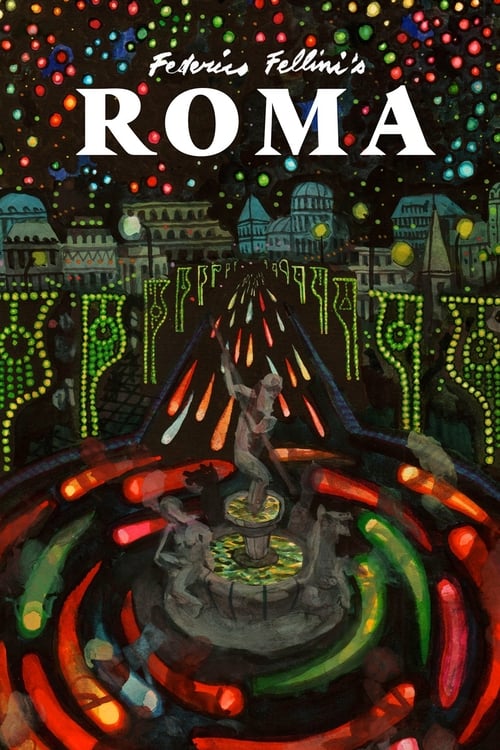
Roma
1972 · Federico Fellini
When you want to wander instead of being told a story — a film to soak in, ideal when you're craving spectacle, atmosphere, and the feeling of a place more than a plot.
What it's about
Fellini's portrait of Rome, told not as a story but as a cascade of episodes: a provincial boy absorbing the city as legend, a young man arriving by train in 1939 to a shrieking overcrowded boarding house, wartime variety theaters and brothels — intercut with Fellini's own 1972 film crew pushing a camera through traffic and down into the subway excavations beneath the streets.
The experience
Plotless by design and all the more intoxicating for it: gaudy, funny, grotesque, and suddenly haunting, like being swept through a city's memory at a carnival's pace. You surrender to it rather than follow it.
The craft
Enormous studio-built recreations of streets, theaters, and traffic jams give the city a heightened, dreamlike gaudiness, and the film glides between decades without warning or apology. It's a feast of color, noise, and crowd choreography that rewards the biggest screen available.
Why it matters
A landmark of the film-as-city-portrait, it dissolved the line between documentary and fantasy and showed that a director's memory of a place could be a movie's entire architecture.
Snapshot
Roma is Fellini's second explicitly "documentary" fiction and his most complete demolition of the boundary between the two. There is no plot, no protagonist who survives the whole film, and no consistent present tense. Instead there are episodes: a provincial boy in the 1930s absorbing Rome as a rumor of monuments and vice; a nineteen-year-old arriving at Termini in 1939 to lodge in a shrieking, overcrowded pensione; a wartime variety theater and two brothels; and, cutting against these, a 1972 film crew — Fellini's own, visible on screen — pushing a camera platform through a rainstorm on the ring road, descending into the subway excavation, and ending on a motorcycle gang tearing past the monuments into the dark. The film's organizing intuition is archaeological: Rome as a body of sediment in which every stratum is simultaneously present, and in which the past dies the instant it is exposed. That intuition produces the film's most famous sequence and one of the great images in postwar cinema — a Metro tunneling machine breaking into a sealed Roman villa whose frescoed faces fade and vanish in the inrush of modern air.
Made between I clowns (1970) and Amarcord (1973), Roma belongs to Fellini's late, essayistic, spectacle-driven manner: an autobiography with the self removed, a city portrait in which almost nothing was photographed on location.
Industry & production
Roma was produced by Turi Vasile for Ultra Film in Rome in co-production with the French company Les Productions Artistes Associés, with United Artists handling international distribution — a standard early-1970s arrangement in which an Italian auteur film was underwritten by an American major's appetite for the arthouse circuit that La dolce vita and 8½ had built. It premiered at the 1972 Cannes Film Festival out of competition and went out in Italy and abroad the same year, in the U.S. as Fellini's Roma, the possessive by then functioning as a genre label.
The film was shot essentially entirely at Cinecittà, where Fellini had worked since the 1950s and which he used less as a facility than as a private continent. The production's defining decision was to refuse the real city. According to production accounts, the ring-road sequence — the Grande Raccordo Anulare at night in the rain, trucks, protest banners, mounted police, cattle, a burning car — was staged on a purpose-built stretch of highway constructed on the Cinecittà lot, with rain towers and wind machines, rather than on the actual road. The same principle governs the underground sequence, the brothels and the palazzo. Fellini's Rome is a set; the documentary crew we watch filming it is itself a fiction.
Financially, the record is thinner than the film's reputation suggests: reliable budget and gross figures for Roma are not well established in the standard literature, and it would be irresponsible to assign numbers to it. What is clear is the industrial context. Italian production in 1972 was booming in volume and narrowing in kind — genre cycles (giallo, poliziottesco, late spaghetti western) were carrying the industry, while the international art film that had sustained Fellini's generation was entering a long contraction. Roma was an expensive, star-less, plotless picture greenlit almost purely on a director's name, and within a few years that proposition would become much harder to finance.
Technology
The film sits at the end of the era in which Italian cinema was made without synchronous sound. Nothing in Roma was recorded live: dialogue, crowd noise and the "interviews" were all constructed in post-production. This is not incidental. A documentary that has no recorded sound is a documentary that can be entirely invented, and Fellini exploits the fact structurally — the apparently observational Trastevere scenes have the same ontological status as the ecclesiastical fashion show.
The other technological substrate is real and public. Rome's Metro Line A was under construction through this period, a project notoriously slowed by the archaeology it kept striking, and it did not open until the end of the 1970s. Fellini takes that civic fact — a city that cannot dig without hitting itself — and builds around it a fantastic apparatus: a great mechanical mole boring through the substrata, pressurized chambers, engineers in hard hats speaking the language of tunnel gradients and hydrostatic pressure, and then the sudden hush of a painted room that has not seen air since antiquity. The sequence works because its machinery is plausible and its miracle is not.
Production design and costume were by Danilo Donati, whose workshop built and dressed everything from the wartime music hall to the phosphorescent vestments of the fashion show; the scale of fabrication involved — sets, painted "ancient" frescoes, hundreds of costumes and prosthetics — is the film's real technical achievement.
Technique
Cinematography
Giuseppe Rotunno, shooting his third consecutive Fellini after Satyricon and I clowns, gives the film two incompatible palettes and lets them collide. The 1930s material is warm, dense, tungsten-gold, heavy with faces lit from below and framed in wide-angle so that noses, jowls and hats press toward the lens. The 1972 material is cold, sodium-and-mercury, sluiced with rain and diffused through exhaust; the ring-road sequence is lit as an inferno and moves as one, the camera riding a crane platform that pans across trucks, buses and windshield-wipers in a single continuous churn.
Rotunno's control of artificial light is the film's constant. Because almost nothing is exterior in the documentary sense, every "night" is a designed night. The underground sequence exploits this most beautifully: worklight, torchbeam and the sudden flat illumination of the discovered room, where the frescoes are photographed frontally, like portraits, so that their dissolution reads as a death of persons rather than of pigment.
Editing
Ruggero Mastroianni, Fellini's editor from Satyricon onward, is faced with material that has no narrative spine and cuts it as rhythm rather than as story. Transitions between 1939 and 1972 are made without markers — no dissolves of memory, no fades — so that the two Romes read as adjacent rooms rather than as past and present. Within episodes the cutting is unusually patient for a film of this density: the fashion show, the pensione dinner and the brothel parades are allowed to accumulate, building by accretion of faces until the sequence tips into hysteria and is abandoned mid-crescendo. The film's characteristic gesture is the unresolved exit — a scene stops, rather than concludes, and another begins somewhere else in the city and the century.
Mise-en-scène / staging
Fellini stages in depth and in traffic. Nearly every set piece is a crowd organized into layers: foreground grotesques, a middle band of activity, a far register of arrivals and departures. The open-air trattoria dinner, the variety theater with its hecklers, the pensione corridors, the Trastevere festa — all are built so the eye can never settle, and so that no single figure claims the frame for long.
Casting is part of the staging. Fellini cast faces as design elements, filling his Rome with non-professionals and character players chosen for physiognomy, then dubbing them with voices selected for timbre. The ecclesiastical fashion show — roller-skating priests, nuns in vast winged headdresses, illuminated vestments, a skeletal papal apparition before an audience of aristocrats and prelates — is the extreme case: pure procession, no dialogue that matters, meaning carried entirely by silhouette, light and the ancient faces watching.
Sound
Nino Rota's score works less as accompaniment than as a second script: brass marches and waltzes for the Fascist-era episodes, period pastiche in the music hall, a lurching mechanical pulse under the ring road. Rota's habit of quoting popular idioms without irony gives the film its peculiar tenderness — the wartime Rome of blackouts and brothels is scored as though it were being remembered fondly, which is precisely Fellini's argument about memory.
Around the music, the post-synchronised soundtrack is dense to the point of abstraction: overlapping shouted Italian, horns, engines, thunder, animals, loudspeakers. Dialogue is frequently unintelligible by design. The film's only quiet is underground, and Fellini uses that silence as the frescoes' cue.
Performance
There is no lead performance. Peter Gonzales Falcon, an American newcomer, plays the young Fellini as an observer — watchful, largely reactive, and then simply gone from the film. The pensione and brothel sequences are carried by broad, near-vaudevillian playing pitched at caricature. Against this, two documentary-register appearances land with disproportionate weight: Gore Vidal, interviewed at a Trastevere table, offering Rome as the ideal city in which to wait out the end of the world; and Anna Magnani, glimpsed at night at her door, greeted by Fellini's voiceover as the emblem of the city and refusing the compliment before shutting the door on him. Magnani, who had been the face of Rome, Open City, died the following year; the exchange functions as both citation and farewell. Brief self-appearances by other figures of the Roman film world are also part of the sequence's texture.
Narrative & dramatic mode
Roma is an anthology film with a single author and no framing story. It operates in the essayistic mode Fellini had been developing since Fellini: A Director's Notebook (1969) — a television commission for NBC that already contained a subway-excavation episode — and I clowns: a film about making a film, in which the crew's presence guarantees authenticity while the entirely fabricated content withdraws it. The autobiographical thread is abandoned halfway through, which is the film's boldest structural move; having established a surrogate, Fellini declines to follow him, because the subject is not a life but a city's persistence.
Time is treated spatially. The 1930s do not precede 1972; they underlie it, in the same relation as the villa to the tunnel. Digression is the organizing principle rather than a lapse from one, and the ending — bikers circling the monuments and accelerating out of the frame — refuses summary in favour of dispersal.
Genre & cycle
The film descends from the 1920s city symphony (Ruttmann's Berlin, Cavalcanti's Rien que les heures, Vertov) but inverts its terms: where those films made poetry from documentary observation of a real city, Fellini manufactures the city entirely and calls the result documentary. It also belongs to the carnival-grotesque comedy that runs through his work, and to the confessional-spectacle cycle of 8½, Fellini Satyricon, I clowns, Roma and Amarcord — five films in which narrative is progressively replaced by procession.
Authorship & method
The screenplay is by Fellini and Bernardino Zapponi, his co-writer from Toby Dammit through City of Women (and, separately, a writer for Dario Argento on Deep Red). Their working method was closer to compiling than to plotting: episodes assembled from Fellini's memory, from Zapponi's Roman material, from newspaper and folkloric sources, sequenced by feel.
Fellini's on-set practice — well documented across his late career — was that of a ringmaster. He worked with music playing, directed audibly during takes, cast by photograph and face, and left dialogue to be fixed in the dubbing studio. The key collaborators are the same team that made Satyricon and would make Amarcord: Rotunno on camera, Ruggero Mastroianni cutting, Danilo Donati (twice an Academy Award winner for costume, for Romeo and Juliet and later Fellini's Casanova) designing, and Nino Rota scoring, in a partnership that ran from 1952 until Rota's death in 1979. Roma is unusually clear evidence that "Fellini" by this point names a workshop as much as a man.
Movement / national cinema
Fellini began inside neorealism — he co-wrote for Rossellini on Rome, Open City and Paisà — and Roma is best read as a deliberate settling of accounts with it. The title invites comparison with Roma città aperta; Magnani's appearance makes the invitation explicit; and the film's method is the exact negation of the neorealist program, substituting studio fabrication for street shooting, types for individuals, and spectacle for social witness. The claim implied is that a truthful portrait of Rome must be openly invented, because the city itself is a confection of self-images: imperial, papal, cinematic, touristic.
Era / period
1972 Rome is present in the film as pressure. The traffic is not a joke but a condition; the historic center is shown as choked, illegible, and increasingly occupied by outsiders — tourists, hippies on the Spanish Steps, protestors with banners. Italy was entering the years of political violence, and though Fellini takes no position, the ring-road sequence's police lines and burning car register the temperature. The ecclesiastical fashion show lands in a post-Vatican II decade of contested Church authority, from a director whose La dolce vita had already provoked ecclesiastical fury. And the Metro excavation is a precise image of a specific 1970s Roman predicament: a modernization that keeps colliding with the thing it is meant to serve.
Themes
The city as organism — fed, digestive, maternal, indifferent — is the governing metaphor, made literal in the pensione's warren of rooms and the tunnel's intestinal descent. Beneath it runs the film's central proposition about memory: that the past cannot be recovered, only reconstructed, and that exposure destroys it. The frescoes are the thesis; the studio-built Rome is the method that follows from it.
Around this cluster the recurrent Fellini preoccupations: the sacred and the carnal as a single continuous spectacle, with the Church staged as couture and the brothel staged as liturgy; the crowd as both comfort and terror; sexuality remembered as comedy and shame; Fascism rendered as childhood weather rather than as ideology, a choice that has drawn legitimate criticism and that Amarcord would take up more directly the following year. Finally, apocalypse as ambience — Vidal's remark about waiting for the end of the world is the film's driest statement of its own mood.
Reception, canon & influence
Reception in 1972 was genuinely divided, and the division was already familiar. Since 8½, the charge against late Fellini had been self-indulgence — films without discipline, coasting on virtuosity and personal mythology — and Roma, being plotless by design, drew it in concentrated form from both Italian and Anglophone reviewers. Its defenders argued that the looseness was the argument, not a failure of it, and that the film's set pieces represented the most inventive image-making then being done anywhere. The film has never entered the canon at the level of La dolce vita or 8½, and it was quickly overshadowed by Amarcord, which won the Academy Award for Best Foreign Language Film and remains the more beloved work. But the underground sequence has been detached from the film and canonized on its own, routinely cited as one of cinema's definitive images of memory and loss.
Looking backward, the film's sources are the city symphony tradition; Roman avanspettacolo and the touring variety circuit Fellini knew first-hand in the early 1940s; the caricaturist's eye he developed at the satirical weekly Marc'Aurelio; the archaeological-erotic imagination of Satyricon; the subterranean sublime often likened to Piranesi's Carceri; and neorealism, present as the thing being answered. The traffic-jam-as-inferno had also been claimed a few years earlier by Godard's Week-end, and the two sequences are usefully read against one another — Godard's a lateral tracking indictment, Fellini's an immersive descent.
Looking forward, Roma fed directly into Amarcord, its provincial mirror, and consolidated the essay-film-as-spectacle mode that later directors have drawn on freely. Its clearest descendant is Paolo Sorrentino's La grande bellezza (2013), which openly reworks Fellini's Rome — the nocturnal city, the procession of grotesques, the exhausted observer — and whose The Young Pope extends the ecclesiastical-spectacle vein of the fashion show; that sequence in particular has had a long afterlife in fashion imagery and music video, where it is now a stock reference. Filmmakers as different as Terry Gilliam, Emir Kusturica and Tim Burton have acknowledged Fellini's grotesque-procession grammar, and Martin Scorsese's advocacy for Italian cinema has kept the late films in circulation for Anglophone audiences. One clarification worth making, since the coincidence recurs: Alfonso Cuarón's Roma (2018) takes its title from the Colonia Roma district of Mexico City and is not an homage to Fellini's film, whatever the shared debt to memory as a subject.
A Deleuzian reading
A tunneling machine grinds through rock under Rome and breaks into a room.
The full Deleuzian reading of Roma →
Reception
Greeted in 1972 as baggy, plotless self-indulgence by critics who wanted another 8½, it's since been reclaimed as late-Fellini at his freest — the setpieces now get cited as some of the best things he ever shot.
How Roma was received, from release to now →
How to watch Roma: what to notice on a first viewing
- Watch the crowd sort into layers, near, middle, and far. Fellini builds nearly every scene as a crowd arranged in bands, grotesque faces up front, ordinary activity behind them, arrivals and departures further back, so your eye never settles on one person. The layered crowd keeps the city itself feeling like the main character, not any single face in it.
- Compare the color of scenes set decades apart. Rotunno lights the 1930s material warm and golden and the 1972 material cold and rain-soaked, and the film cuts between them without ever softening the clash. The color contrast tells you which decade you are in faster than any date or caption could.
- Notice the film jump decades with no dissolve or fade. Mastroianni cuts straight from one era to another with no visual signal that time has shifted, so the two Romes start to feel like adjacent rooms in the same building. The unmarked cuts make the past feel present rather than remembered from a safe distance.
- Listen for music playing under scenes instead of dialogue. Rota's marches and waltzes work like a second script, and the shouted Italian, horns, and engines around them are often deliberately unintelligible, so you are led by sound rather than words. The score and noise tell you how to feel about a scene before you can follow what anyone is saying.
- Watch faces chosen for how they look, not who they are. Fellini fills the frame with non-professional faces picked for their look, then dubs in voices chosen separately for timbre, so nobody on screen is quite who they sound like. The mismatch between face and voice makes even ordinary Romans feel manufactured, which is exactly the film's method.
The whole guide to watching Roma, with the keys for a rewatch →
Influences: the films it descends from and the films it influenced
- Berlin: Symphony of a Great City (1927) — Supplies the city-symphony armature Roma inherits and corrupts: a metropolis organized as rhythmic montage of anonymous types, traffic and hours rather than plot, with movement-matched cutting substituting for narrative causality.
- Rome, Open City (1945) — Fellini co-wrote it, and Roma cites it bodily by putting Anna Magnani on her Trastevere doorstep as herself — the neorealist street Rome quoted as a face, then refused, since Fellini rebuilds that street at Cinecittà.
- Bicycle Thieves (1948) — Establishes the doctrine of untrained casting and location sound that Roma answers by using the same non-professional physiognomies purely as caricature typage, chosen from photographs and wholly re-voiced in the dubbing studio.
- La dolce vita (1960) — First fixes the structure Roma strips of even its journalist-guide: a plotless chain of nocturnal Roman set pieces bound only by a drifting observer, Via Veneto crowds staged in depth on a rebuilt street, ecclesiastical spectacle as opening image.
- 8½ (1963) — Perfects the unmarked transition — memory, present and fantasy joined inside one continuous camera move rather than by dissolve or title — and the director-surrogate whose withdrawal Roma completes by abandoning the protagonist entirely.
- Toby Dammit (1968) — First Bernardino Zapponi script and the lab for Roma's designed night lighting: a hallucinated Rome of colored light pools, airport and roadway voids, and a car ride cut as a descent rather than a journey.
- Fellini Satyricon (1969) — Assembles the exact workshop (Rotunno's wide-angle grotesque, Ruggero Mastroianni's cutting, Danilo Donati's design, Rota's score) and the archaeological-erotic image Roma reprises literally — the ancient fresco that bleaches away the instant modern air reaches it.
- Amarcord (1973) — The provincial mirror made by the same unit — Rotunno, Ruggero Mastroianni, Donati, Rota — transposing Roma's memory-episode-plus-set-piece compilation onto Rimini and marking time only by season, never by plot.
- Fellini's Casanova (1976) — Takes Roma's studio fabrication to totality: the sea played by black plastic sheeting on a Cinecittà stage, and Donati's Oscar-winning costumes extending the ecclesiastical fashion show's logic of garment-as-apparition.
- And the Ship Sails On (1983) — Reprises Roma's film-crew-as-protagonist device and closes it, pulling back at the end to expose the hydraulic sea, the soundstage and the camera team — the fabrication confessed as the final shot.
- Intervista (1987) — Expands Roma's opening conceit — a documentary unit arriving to film the city — into a full feature about the crew, the tram to Cinecittà, and the aged faces of former players, with the shoot itself as the only narrative.
- Brazil (1985) — Gilliam's acknowledged debt to the grotesque-procession grammar: short-focal-length lensing that deforms extras into caricature, corridors of freaks filing past a passive functionary, and sets scaled to dwarf the figure in depth.
- Underground (1995) — Builds an entire buried society out of Roma's Metro-dig premise, driving it with a brass-band score used as continuous propulsive presence in the Rota manner and choreographing crowds through deep foreground-to-background traffic.
- La grande bellezza (2013) — Openly reworks the nocturnal procession of grotesques behind an exhausted observer, restages the ecclesiastical fashion show as clerical spectacle, and keeps the camera in the same unbroken crane-and-Steadicam drift through crowds staged in depth.
- Sacro GRA (2013) — Adopts the Grande Raccordo Anulare — the very orbital of Roma's rain-lit crane sequence — as organizing form, a plotless portrait strung from faces and vignettes along the ring road with no protagonist to follow.
- La Grazia (2025) — Models the processional, fresco-like rendering of Rome as a grand mournful organism, the tonal whiplash between sublime spectacle and the everyday that defines Sorrentino's image-making.
- Week-end (1967) — The rival solution to the same problem: gridlock as inferno rendered as a single lateral tracking indictment held at analytic distance, against Roma's immersive rain-and-headlight descent down the Grande Raccordo.
- The Decameron (1971) — Shares Danilo Donati as designer and the identical Roman method — faces recruited off the street for physiognomy alone, every line rebuilt in post-synchronised dubbing — producing a world assembled from grotesque typage rather than performance.
- F for Fake (1973) — The contemporaneous case for editing as argument: a compiled, first-person essay film whose form is digression and cutting rhythm over post-synched narration, with no story to interrupt.
Similar films
- La Dolce Vita (1960) — influence & lineage
- Amarcord (1973) — influence & lineage
- Satyricon (1969) — influence & lineage
- 8½ (1963) — influence & lineage
- Rome, Open City (1945) — influence & lineage
- The Great Beauty (2013) — influence & lineage
- Bicycle Thieves (1948) — influence & lineage
- The Decameron (1971) — influence & lineage