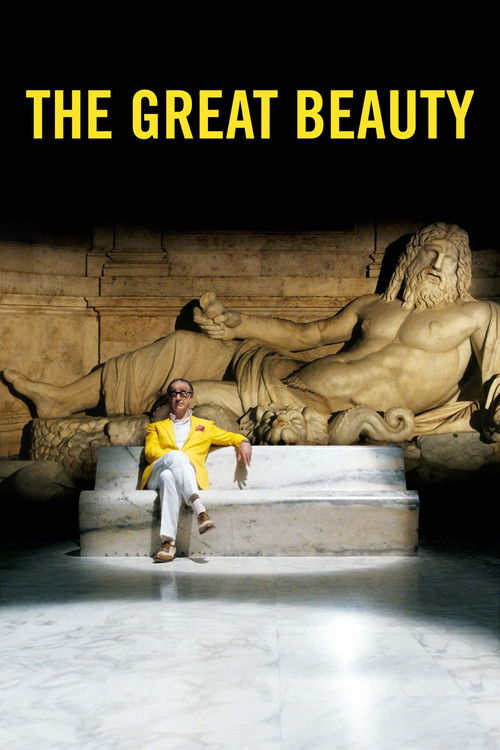
The Great Beauty
2013 · Paolo Sorrentino
For when you want to be swept away and left pleasantly haunted — a film to pour a drink with and let wash over you, then think about your own life at 2 a.m. A contemplative-night pick, not background viewing.
What it's about
Jep Gambardella wrote one celebrated novel forty years ago and has spent every night since as the king of Rome's party circuit — the man whose approval makes or breaks the city's socialites. Just after his sixty-fifth birthday, news about a woman he loved in his youth cracks his armor of irony, and he starts drifting through Rome — its terraces, ruins, convents, and dawn streets — asking what, in all that glitter, was ever actually beautiful.
The experience
A gorgeous, melancholy float: thumping rooftop parties smash-cut against silent ancient courtyards, savage wit giving way to sudden aches of feeling. It's long and unhurried and you surrender to it like a night that goes till sunrise — funny, sad, and ravishing, often within the same scene.
Performances
Toni Servillo is magnetic as Jep — all silk jackets, raised eyebrows, and buried tenderness — delivering withering put-downs one minute and letting decades of regret cross his face without a word the next. One of the great screen portraits of charming self-disgust.
The craft
Sorrentino's camera glides, swoons, and swirls through Rome like a guest at its own party, making the city itself the co-star — golden ruins by day, delirious dance floors by night. The soundtrack whiplashes between sacred choral music and Eurodance to devastating effect. Absolutely a big-screen, good-speakers film; it's one of the most sheerly beautiful movies of its decade.
Why it matters
Won the Academy Award for Best Foreign Language Film and vaulted Sorrentino into the international first rank, reviving the grand tradition of the Roman high-society fresco for a new century.
Snapshot
The Great Beauty (La grande bellezza) is Paolo Sorrentino's seventh feature and the film that carried him from respected European auteur to international prizewinner, culminating in the 2014 Academy Award for Best Foreign Language Film. It follows Jep Gambardella (Toni Servillo), a journalist and one-novel wonder who has spent forty years presiding over Rome's café-society nightlife. His sixty-fifth birthday, and news of the death of a woman he loved in his youth, open a fissure in the practiced irony through which he has held the world at arm's length. What follows is less a plot than a drift — a series of parties, encounters, funerals, and solitary dawn walks through a Rome rendered as both sacred reliquary and gilded mausoleum. The film is at once a portrait of a man, a satire of a decadent intelligentsia, and an elegy for a city and a civilization that no longer quite believe in themselves. Its explicit dialogue with Fellini makes it one of the most self-consciously canonical Italian films of its generation.
Industry & production
The film was produced by Nicola Giuliano and Francesca Cima's Indigo Film, Sorrentino's long-standing production home, in partnership with Medusa Film (the Mediaset-owned distributor) on the Italian side and the French companies Babe Films and Pathé, with Franco-Italian co-production support characteristic of mid-budget European art cinema of the period. This financing structure — an Italian auteur film underwritten partly by French capital and pan-European distribution muscle — is typical of how ambitious continental "prestige" pictures were assembled after the 2008 financial crisis, when domestic markets alone rarely sufficed. It premiered in competition at the 2013 Cannes Film Festival, where it left without a prize, before a slow-building international rollout that gathered momentum through the autumn festival and awards season. The specific budget and box-office figures I will not assert precisely, as the reliable published record is thinner than the film's later prominence might suggest; what is certain is that its awards success — the Oscar, a Golden Globe, a BAFTA, and multiple European Film Awards including Best Film — made it a commercial and reputational success far exceeding the usual reach of subtitled art cinema.
Technology
The Great Beauty was shot digitally, in the widescreen format that Sorrentino and his cinematographer Luca Bigazzi favor for its architectural sweep. By 2013 Bigazzi had largely moved to digital acquisition, and the film's clean low-light rendering of nocturnal terraces, its deep-focus interiors, and its saturated color are consistent with high-end digital workflow rather than photochemical origination; I will not name a specific camera or sensor, as I cannot verify the exact package used. Technologically the more salient point is the film's reliance on stabilized and motorized camera movement — extensive Steadicam, crane, and dolly work — which the production used to produce the gliding, unmoored perspective that is the picture's signature. Digital capture also enabled the film's controlled color grading, in which Rome's stone is warmed toward gold and its night skies deepened, turning the city into a designed palette rather than a documentary one.
Technique
Cinematography
Luca Bigazzi's photography is the film's most celebrated formal element and won him the David di Donatello. His camera rarely sits still: it cranes up over rooftop parties, tracks laterally through frescoed galleries, and executes slow, curving moves that detach the viewpoint from any single character and hand it to the city itself. The film opens with a near-abstract prologue — a chorus singing on the Janiculum, a cannon firing at noon, a Japanese tourist collapsing, apparently overcome by Rome's beauty — a sequence that announces the camera as an autonomous, wandering consciousness. Throughout, Bigazzi alternates this floating grandeur with intimate, shallow-focus close-ups of Servillo's face, so that the film's rhythm becomes a pulse between spectacle and interiority. The lighting favors warm ambers and the blue of Roman dawn, and the compositions are relentlessly organized around architecture: colonnades, staircases, terraces overlooking the Colosseum, the reflecting geometry of palazzo courtyards.
Editing
Cristiano Travaglioli, another core Sorrentino collaborator, cuts the film associatively rather than causally. Because the narrative is a drift, the editing must supply momentum that story does not, and it does so through rhythmic juxtaposition — a raucous party cross-cut against silence, a sudden match on movement or music, abrupt tonal pivots from farce to grief. The celebrated "trenino" (conga-line) sequence, in which Jep observes that Rome's parties have "the best conga lines" precisely because "they go nowhere," is an editorial set-piece that fuses image, motion, and music into a single ecstatic-then-hollow gesture. Travaglioli's cutting lets the film digress into vignettes — a child action-painter, a self-mythologizing performance artist, a Botox clinic run like a sacrament — and then reels the viewer back to Jep's consciousness.
Mise-en-scène / staging
Stefania Cella's production design turns real Roman locations into a curated theater of decadence. The film was shot in genuine palaces, gardens, and monuments — among them the terraces and villas of the historic center and grand aristocratic interiors — and the staging exploits their scale to dwarf and frame the characters. Jep's apartment overlooking the Colosseum is itself a thesis statement: private life staged against the ruin of empire. Sorrentino stages his crowd scenes as tableaux of grotesque vitality, costume and gesture pushed toward caricature, then isolates his protagonist within them. The recurring motif of processions, funerals, and religious ritual gives the mise-en-scène a liturgical undertone that pays off in the film's final movement.
Sound
The film's soundtrack is one of its defining achievements and works by deliberate contrast. Sorrentino juxtaposes pounding contemporary dance and club tracks — the music of the parties — against a compiled body of sacred and minimalist concert music that scores the film's moments of transcendence. Prominent among these are Vladimir Martynov's The Beatitudes (performed by the Kronos Quartet), David Lang's "I lie," and works in the devotional-minimalist vein associated with composers such as John Tavener, Henryk Górecki, and Zbigniew Preisner; original music was contributed by Lele Marchitelli, a frequent Sorrentino collaborator, though the score is best understood as curated compilation as much as composition. The effect of this collision — profane bass against sacred choir — is the film's argument in sonic form: the search for beauty amid noise.
Performance
Toni Servillo's Jep is the film's center of gravity and one of the great performances of contemporary Italian cinema. Servillo, who had already embodied Sorrentino's protagonists in The Consequences of Love and the Andreotti of Il Divo, plays Jep as a man whose exquisite tailoring and lethal wit are a defensive architecture around genuine grief. Much of the performance lives in the eyes and in a repertoire of small deflating smiles; his voiceover, wry and melancholic, threads the film. Around him, the ensemble is calibrated between satire and pathos: Carlo Verdone as Romano, the failed playwright who finally leaves Rome; Sabrina Ferilli as Ramona, the aging cabaret stripper whose tenderness pierces Jep's armor; and Giusi Merli as the ancient missionary "Saint," whose ascetic presence in the final act rebukes the film's earlier hedonism.
Narrative & dramatic mode
The film's dramatic mode is episodic, essayistic, and elegiac rather than dramatically plotted. There is no engine of goal and obstacle; instead there is a mood of reckoning triggered by mortality — the death of Jep's first love Elisa, and the revelation from her widower that she had loved Jep all her life. This unlocks a retrospective drift in which Jep re-examines the promise of his youth (a single acclaimed novel, The Human Apparatus, never followed by a second) and the decades of brilliant, wasted socializing that ensued. The film proceeds by accretion of vignettes, each exposing a facet of Roman cultural life — art, religion, celebrity, cosmetic self-improvement — and by the recurrence of images (the sea, a lighthouse, a shipwreck, the girl on the rocks of Jep's memory) that gradually assemble into a meditation on lost first love and the possibility of writing again. It is, in the truest sense, a film about disillusionment and the faint recovery of wonder.
Genre & cycle
Formally it is an art-cinema drama, but it belongs recognizably to a lineage of "decadence-and-disillusion" films centered on a male observer moving through a corrupt beau monde — the tradition of Fellini's La Dolce Vita, but also the broader European art film of ennui and spiritual searching. It is at once a city symphony (a portrait-of-Rome film), a satire of the cultural establishment, and a late-life crisis drama. Within Sorrentino's own body of work it inaugurates the most florid, baroque phase of his authorship, extending forward into Youth (2015) and the papal television dramas The Young Pope and The New Pope.
Authorship & method
Sorrentino co-wrote the screenplay with Umberto Contarello, his regular writing partner, and the film is the fullest expression of his method: a cinema of set-pieces, aphoristic dialogue, virtuoso camera movement, and abrupt shifts between the sublime and the grotesque. Sorrentino works with a repertory company, and The Great Beauty reunites his essential collaborators — Servillo as leading man, Bigazzi behind the camera, Travaglioli in the cutting room — a stable ensemble that lends his films their consistent signature. His method privileges image and rhythm over conventional narrative causality; he has often described his cinema as concerned with the gap between the surface performance of a life and its hidden emotional truth, and Jep is the near-perfect vehicle for that concern. The film's authorship is inseparable from its overt homage: Sorrentino positions himself as Fellini's heir, an act of ambition that critics read as either reverent continuation or presumptuous imitation.
Movement / national cinema
The film is a landmark of twenty-first-century Italian cinema and part of the international resurgence of Italian art film in the years around 2008–2015, alongside the work of Matteo Garrone. It stands in complex relation to the neorealist tradition that defined Italian cinema's global reputation: where neorealism sought the ordinary and the documentary, Sorrentino embraces spectacle, artifice, and the operatic — closer to the "second generation" of Fellini, Visconti, and Antonioni, who turned from postwar poverty to bourgeois and aristocratic malaise. In reviving the Roman city-film and the figure of the disenchanted intellectual, The Great Beauty consciously reclaims a national cinematic mythology at a moment when Italian film had lost much of its former international standing.
Era / period
Made and set in the early 2010s, the film is legible as a portrait of Italy in the long aftermath of the Berlusconi era and the 2008 financial crisis — a culture of televisual spectacle, cosmetic self-display, and inherited grandeur no longer matched by living achievement. The recurring satire of a self-important art world, of religious institutions grown worldly, and of a nightlife that "goes nowhere" reads as a diagnosis of a civilization coasting on the accumulated capital of its past. The film never states this as topical politics; it works instead as mood and metaphor, but its melancholy is unmistakably that of a specific national moment.
Themes
The film's governing theme is the search for authentic beauty — la grande bellezza — amid the seductive counterfeits of pleasure, status, and spectacle. Bound to this are aging and mortality (the birthday, the funerals, the ancient Saint); the failure of the artist and the paralysis of the second act (Jep's unwritten novel); the persistence of first love as the buried root of a life; and the tension between the sacred and the profane, staged through Rome's saturation in religious ritual. Above all there is disillusionment and its faint transcendence: the film's closing voiceover reframes the whole preceding parade as "blah, blah, blah," the noise beneath which "the great beauty" occasionally flickers, and it ends on the possibility — no more than that — of beginning to write again.
Reception, canon & influence
Critically, The Great Beauty was received as a major work, and its sweep of the 2013–14 awards season — the Oscar, Golden Globe, and BAFTA for foreign film, and the top European Film Award — sealed its canonical status; Servillo and Bigazzi were widely singled out. Yet its reception was not unanimous: a significant strand of criticism found the film derivative and hollow, a gorgeous but empty pastiche of Fellini whose satire of superficiality risked reproducing the very superficiality it condemned. This split — dazzled admiration versus the charge of beautiful vacancy — has followed the film into its afterlife and is itself part of its critical identity.
Its influences flow backward, unmistakably, to Federico Fellini: La Dolce Vita above all (the journalist-observer, the nocturnal Rome, the disenchantment beneath the glamour), but also the autobiographical Rome of Roma and the creative paralysis of 8½. Behind Fellini stand the bourgeois ennui of Antonioni and the aristocratic decay of Visconti. Forward, the film's legacy is most visible in Sorrentino's own subsequent career, which it liberated onto a larger international and English-language stage — Youth, the papal series, and the more intimate autobiography of The Hand of God. More broadly, it reasserted the viability of the lavish, auteur-driven Italian art film on the world market and became, for a generation of viewers, the default modern answer to the question of what a "Fellini film" looks like now — a canonization and a burden the film carries simultaneously.
A Deleuzian reading
A Japanese tourist steps away from his tour group on the Janiculum, lifts his camera toward the city below, and dies of the view.
The full Deleuzian reading of The Great Beauty →
Reception
Left Cannes 2013 empty-handed and got a notably chillier reception in Italy — where critics sniffed 'Fellini pastiche' — than abroad, where it swept the Oscar, BAFTA and Golden Globe for foreign-language film. A decade on it's settled in as the defining Italian film of the 2010s, the Fellini comparison now worn as a badge rather than an insult.
How The Great Beauty was received, from release to now →
How to watch The Great Beauty: what to notice on a first viewing
- Notice the camera moving with nobody. It drifts on its own. Luca Bigazzi cranes above rooftop parties and tracks sideways through frescoed galleries, attached to no character in the scene. The prologue on the Janiculum belongs to the city and to a tour group, not to anyone we will follow. Rome is not the place where the story happens. Rome is the thing happening to the people in it.
- Wait for the camera to stop and settle on Servillo's face. After all the floating, Bigazzi cuts to shallow-focus close-ups of Jep watching. The film pulses between enormous movement and a still man's eyes, over and over, for two hours. Those held faces are the actual events. Everything else is the parade they are watching.
- Listen for club bass giving way to a choir. Sorrentino sets pounding dance tracks against sacred minimalist concert music, including Martynov's Beatitudes and David Lang. The two never blend. One stops and the other starts. The film makes its argument audible before anyone speaks it. Beauty and noise are being placed side by side for comparison.
- Watch Toni Servillo's small deflating smile after each witty line. Jep is the most capable person at every party and his capability achieves nothing. Servillo plays the tailoring, the posture and the eyes as defensive architecture built over forty years of knowing better. A social position held that long has set into a body. The wit is armor, and you can see where it is bolted on.
- Notice a raucous party cut straight against silence. Cristiano Travaglioli joins scenes by rhythm and association rather than cause. A vignette arrives with no setup: a child hurled at a canvas, a clinic run like a sacrament, a performance artist explaining herself. With no plot pushing, the editing supplies the momentum. The film moves by juxtaposition rather than by consequence.
The whole guide to watching The Great Beauty, with the keys for a rewatch →
Influences: the films it descends from and the films it influenced
- La Dolce Vita (1960) — Supplies the master template Sorrentino rebuilds: an episodic nocturnal-Rome promenade guided by a disenchanted insider-journalist, and the sacred/profane collision of the opening (Christ statue airlifted over the city) that Jep's rooftop world directly answers.
- 8½ (1963) — Establishes creative paralysis staged as spectacle — the artist who cannot produce, rendered through fantasy, memory and present bleeding together; Jep's unwritten second novel is Guido's abandoned film transposed.
- Roma (1972) — Model for the city as autobiographical fresco punctuated by surreal set pieces; the ecclesiastical fashion parade is the direct precursor to Sorrentino's grotesque clerical tableaux and the '104-year-old saint.'
- La Notte (1961) — The all-night bourgeois party used as an instrument of spiritual accounting, with architecture and negative space doing the emotional work — the void beneath elegance that Jep's terrace revelry inherits.
- The Leopard (1963) — The crane-mobile grand-ballroom set piece and the patrician observer's elegiac contemplation of his own obsolescence and mortality — Servillo's Jep is heir to the Prince's aristocratic melancholy.
- The Conformist (1970) — Storaro's baroque tracking camera and expressionist architectural framing — sweeping moves keyed to interior décor — form the visual grammar Bigazzi and Sorrentino's gliding compositions descend from.
- The Consequences of Love (2004) — First Servillo collaboration that forges Sorrentino's signature rhythm — long stretches of formal stillness broken by a sudden gliding camera flourish and aphoristic voiceover — later scaled up to Rome's high society.
- Il Divo (2008) — Perfects the virtuoso Steadicam entrance, the pop-scored power tableau, and the grotesque-sublime portraiture that The Great Beauty applies to a party circuit instead of the Andreotti machine.
- The Hourglass Sanatorium (1973) — Deploys a roving, gliding camera through decadent, decaying interiors haunted by memory and mortality, carrying forward the Fellini-via-Has tradition of the wandering camera as an instrument of remembrance.
- We All Loved Each Other So Much (1974) — Explicitly reckons with the La dolce vita inheritance and a disillusioned Roman intelligentsia, extending the self-reflexive, cinema-conscious state-of-the-nation film into a new generation's disenchantment.
- Youth (2015) — Direct English-language extension of the method: an aging artist amid resort tableaux, the same associative set-piece montage and Servillo-style repose, now on an international stage the seed opened up.
- Loro (2018) — Reapplies the bacchanal set piece and floating crane camera to Berlusconi-era decadence, extending the seed's satire of spectacle-as-emptiness to political power.
- The Hand of God (2021) — Inverts the seed's ornate spectacle into intimate Neapolitan memoir, keeping the episodic-elegiac structure and grotesque-comic vignettes but stripping the virtuoso camera toward autobiography.
- The Young Pope (2016) — Carries the sacred/profane juxtaposition and clerical opulence of the seed into serial form, with the same slow processional camera through vast ecclesiastical interiors.
- The Tree of Life (2011) — Shares the associative, elegiac montage and a restless floating Steadicam that dissolves narrative causality, bridging the cosmic and the intimate the way Jep's memory-flights do.
- Holy Motors (2012) — An episodic nocturnal-city odyssey built from virtuoso set pieces, interrogating the gap between surface performance and hidden self — the same surface-vs-truth concern staged as Parisian transformations.
- Birdman (2014) — Uses a bravura continuous camera to move through a performance milieu while meditating on an artist's fading relevance and mortality — the same fusion of technical show-off and existential reckoning.
- Enter the Void (2009) — Its untethered, disembodied camera drifting over a neon nightlife metropolis is the cinematographic cousin to Bigazzi's floating crane sweeps across nocturnal Rome.
- The Belly of an Architect (1987) — Descendant deploying Rome's monumental neoclassical architecture in symmetrical, processional compositions to stage a memento-mori meditation on permanence and decay, a direct visual heir to Belly.
- La Grazia (2025) — Perfects the figure-against-Rome-skyline melancholy and Servillo as elegiac flâneur of mortality, the visual and tonal vocabulary La Grazia recombines.
- The Last One for the Road (2025) — Contemplative flânerie in which a wanderer's roving eye over a city becomes the subject, its ways-of-seeing gaze and bittersweet stagnation paralleling Sossai's meditation on looking.
Similar films
- 8½ (1963) — influence & lineage · same viewing thread
- The Hand of God (2021) — influence & lineage · same viewing thread
- La Dolce Vita (1960) — influence & lineage
- The Leopard (1963) — influence & lineage
- Roma (1972) — influence & lineage
- Cinema Paradiso (1988) — same viewing thread
- Amarcord (1973) — same viewing thread
- Call Me by Your Name (2017) — same viewing thread
All the films related to The Great Beauty →
Watch it with: curated runs of related films
- The Past Is a Foreign Country — A run of films that reach back through memory — lost summers, vanished friends, the golden light of a place you can never return to — best watched in a row when you're in the mood to ache a little.