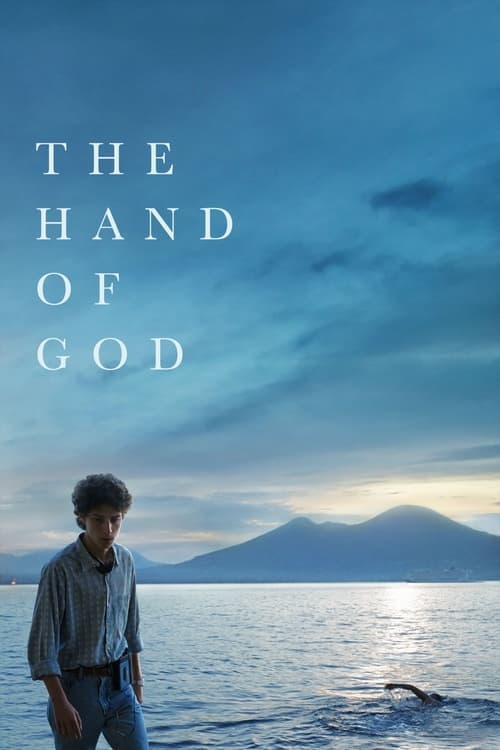
The Hand of God
2021 · Paolo Sorrentino
For when you want a film that feels like life — messy, funny, then suddenly devastating — and you're willing to be moved. It's comfort and heartbreak in one sitting, best when you have time to sit with it after.
What it's about
Naples in the mid-1980s, when the whole city is holding its breath over one question: will Diego Maradona really come play for them? In the middle of the frenzy is Fabietto, a shy, watchful teenager from a big, loud, affectionate family — a boy with no girlfriend, no clear future, and a habit of observing life rather than living it. Then a sudden tragedy splits his adolescence in two, and the film becomes about how a kid finds a reason — and a way — to keep going. It's Paolo Sorrentino's own story, told with names barely changed.
The experience
It moves like memory: sun-drunk and funny for a long stretch — family lunches, boat rides, ridiculous uncles — then it goes quiet and the grief lands hard. You come out tender and a little raw, the way you do after laughing and crying at the same dinner table.
Performances
Filippo Scotti carries it with a wide-open, unguarded face as Fabietto, and Toni Servillo brings enormous warmth as his father — playful and flawed in equal measure.
The craft
Sorrentino strips back his usual ornate style for something plainer and more personal, but Naples still looks ravishing — the bay, the terraces, the summer light all shot with real love. The family scenes have a loose, overlapping energy that feels documented rather than staged. It rewards a big screen for the seascapes alone.
Why it matters
It won the Grand Jury Prize at Venice and earned an Oscar nomination for Best International Feature, and it recast Sorrentino — the great ironist of Italian cinema — as a filmmaker capable of naked autobiography.
Snapshot
The Hand of God (È stata la mano di Dio) is Paolo Sorrentino's most nakedly personal film, a coming-of-age memoir set in the Naples of his adolescence in the mid-1980s. It follows Fabietto Schisa, a shy, watchful teenager whose life is cloven in two by a single catastrophe: while he stays behind in Naples to see Diego Maradona play, his parents die of carbon monoxide poisoning at the family's mountain house. Fabietto is spared because of his devotion to football — hence the title, which invokes Maradona's infamous handball goal against England at the 1986 World Cup as a private myth of deliverance and guilt. After a career of baroque spectacle and ironic distance (Il Divo, The Great Beauty, Youth), Sorrentino turns inward, trading his signature grandeur for something rawer and more grief-stricken. The film premiered at the 78th Venice Film Festival, where it won the Grand Jury Prize (the Silver Lion), and Filippo Scotti, playing Fabietto, took the Marcello Mastroianni Award for a young performer. Italy selected it as its submission for the Academy Award for Best International Feature, and it earned a nomination. Produced with Netflix, it marked a significant streaming-era release for an auteur historically associated with festival and theatrical circuits.
Industry & production
The Hand of God was produced by Sorrentino's longtime production home, The Apartment, part of the Fremantle group, in association with Netflix, which handled global distribution. This is the defining industrial fact of the film: a director of Sorrentino's festival prestige making an intimate, non-English-language memoir under the aegis of a global streamer. Netflix's willingness to fund and platform a deeply regional, Neapolitan-dialect drama reflected the company's mid-period strategy of acquiring auteur prestige titles to compete for awards and critical legitimacy, a strategy also visible in its backing of Cuarón's Roma and other international-auteur projects. The film received a limited theatrical release ahead of streaming, consistent with Netflix's awards-qualification practice, but its primary life was on the platform.
Sorrentino has been candid in interviews that the film is autobiographical: he lost both parents as a teenager to a carbon monoxide leak, and, as widely reported around the film's release, he was not with them because he had gone to see Maradona play for Napoli. The material is thus drawn from lived experience rather than adapted from an existing text. Shooting took place on location in and around Naples, grounding the film in the specific geography Sorrentino grew up in. Precise budget figures have not been prominently disclosed, and I will not invent them; as a Netflix-backed European production it operated well below Hollywood-blockbuster scale while affording the resources for extensive location work and a large ensemble cast.
Technology
The film was shot digitally, consistent with contemporary European auteur production and with the workflow of Sorrentino's regular collaborators. There is no evidence in the public record that the film pursued any exotic capture format or signature technological gimmick; its ambitions are compositional and emotional rather than technological. Distribution technology is arguably the more consequential story here: the film was engineered for streaming delivery to a global Netflix audience, with subtitling and platform encoding as the primary vectors reaching viewers, rather than a wide 35mm or DCP theatrical footprint. Where earlier Sorrentino films reached audiences chiefly through the festival-and-arthouse pipeline, The Hand of God reached most of its viewers through a login. Beyond this, I would be speculating to claim specific cameras, lenses, or post pipelines, and the detailed technical record is thin enough that I will not assert specifics.
Technique
Cinematography
The cinematography is by Daria D'Antonio, and her elevation to director of photography is one of the film's notable production facts. D'Antonio had long been part of Sorrentino's camera team, and here she took the lead role on his most personal project — a meaningful shift given that Sorrentino's earlier signature look was forged with cinematographer Luca Bigazzi. The result deliberately dials back the vertiginous, crane-driven bravura of The Great Beauty. There are still Sorrentino gestures — sweeping views of the Bay of Naples, a helicopter shot, water and horizon as recurring visual motifs — but the camera is more often held at the level of adolescent observation, watching family gatherings and domestic rooms with a patient, sometimes voyeuristic attention. The palette leans warm and sun-bleached in exteriors and shadowed in interiors, evoking memory rather than documentary reality. The film's most beautiful images are frequently the quietest: figures dwarfed by sea and sky, a solitary teenager framed against the vast indifference of the landscape.
Editing
The editor is Cristiano Travaglioli, a regular Sorrentino collaborator. The film's structure divides sharply into two movements — a densely populated, almost farcical family comedy before the tragedy, and a hushed, drifting elegy after it. Travaglioli's cutting supports this tonal fracture: the early scenes are busy with overlapping characters and comic incident, edited to sustain the churn of a large extended family, while the post-catastrophe passages slow markedly, letting silences and stillness accumulate. Compared with the propulsive, music-video velocity of parts of The Great Beauty, the editing here is more restrained, using the pivot at the center of the film as a structural hinge that reorganizes its whole rhythm.
Mise-en-scène / staging
Sorrentino stages the first act as a teeming ensemble portrait: the extended Schisa clan gathered around tables, at the beach, in cars, a comic chorus of aunts, uncles, and eccentrics. This staging establishes a world of noise, appetite, and belonging precisely so that its removal registers as devastation. The recurring figure of Aunt Patrizia, an object of Fabietto's adolescent fascination, is staged with a heightened, near-mythic sensuality that blurs desire, fantasy, and the surreal. Naples itself is a staged presence — its apartments, streets, and seascapes function less as backdrop than as the film's emotional substance. After the tragedy, the mise-en-scène empties out; rooms that were crowded become spaces of absence.
Sound
The score is by Lele Marchitelli, another frequent Sorrentino collaborator. As is characteristic of Sorrentino's soundtracks, the film also leans on pop and needle-drop selections to color period and mood, though I will not attribute specific tracks I cannot verify. The sound design is attentive to the textures of Neapolitan life — the babble of family, the roar of the San Paolo stadium crowd, the coastal quiet. Football, and specifically the collective ecstasy surrounding Maradona's arrival at Napoli, is rendered partly through sound as a communal delirium.
Performance
Filippo Scotti anchors the film as Fabietto, a performance of watchful reticence that earned him Venice's Mastroianni Award; he plays adolescence as a state of arrested spectatorship, a boy watching his own life before he knows how to enter it. Toni Servillo — Sorrentino's most important acting collaborator, the face of Il Divo and The Great Beauty — plays the father, Saverio, with warmth and a banked sadness. Teresa Saponangelo plays the mother, Maria, whose playfulness makes her loss unbearable; Luisa Ranieri plays the charged, troubled Aunt Patrizia. The ensemble is calibrated to shift from broad comedy to grief without a false seam.
Narrative & dramatic mode
The film's dramatic mode is memoiristic and episodic rather than tightly plotted. It proceeds through a series of loosely linked incidents — family lunches, sexual awakening, quarrels, absurd encounters — accumulating texture until the central catastrophe reorganizes everything. This is a bildungsroman structured around loss: the death of the parents is not a third-act twist but the fulcrum on which the whole narrative turns, converting a comedy of belonging into a study of orphaned solitude and vocation. In its final movement the film becomes explicitly about the birth of an artist, as Fabietto is nudged toward cinema — a metafictional turn in which the memoir acknowledges itself as the origin story of the filmmaker telling it. The title's conceit — that Maradona's "hand of God" saved Fabietto's life — frames the whole as a meditation on chance, guilt, and the arbitrary grace that determines who survives.
Genre & cycle
The Hand of God belongs to the autobiographical coming-of-age drama, and more specifically to the durable tradition of the director's-memoir film — the filmmaker returning to childhood or adolescence to excavate the origins of the artistic self. It sits within a broader cycle of such memory-films by established auteurs, and its 2021–2022 release coincided with a notable cluster of childhood-memoir films by major directors (Kenneth Branagh's Belfast, Alfonso Cuarón's earlier Roma as an obvious precedent, and Steven Spielberg's The Fabelmans arriving shortly after). Within Sorrentino's own filmography it represents a turn away from the political portrait (Il Divo) and the ironic ensemble grotesque (The Great Beauty) toward the confessional. It is also, in part, a football film and a Naples film, drawing on the specific mythology of Maradona's Napoli era.
Authorship & method
Sorrentino wrote and directed the film, and it is the most explicitly authored work of his career precisely because it is about his own life. His method here involves a deliberate stripping-back of the stylistic maximalism for which he became famous; where his signature had been irony, spectacle, and a camera in perpetual motion, The Hand of God risks sincerity. The continuity with his past work runs through his key collaborators. Toni Servillo, his defining screen actor, appears as the father, lending autobiographical weight. Editor Cristiano Travaglioli and composer Lele Marchitelli are longstanding members of his creative team. The most significant change is the cinematography: Daria D'Antonio steps up as director of photography, a shift from the Bigazzi partnership that had shaped Sorrentino's earlier visual identity, and her more grounded, less ostentatious eye suits the material. The film thus reads as an auteur using his established craft ensemble to make something formally humbler and emotionally more exposed than anything he had attempted before.
Movement / national cinema
The film is unmistakably a work of Italian national cinema, and specifically of a Neapolitan tradition. It draws on the long lineage of Italian film that treats family, region, and memory as central — the neorealist attention to place and the Fellini-esque appetite for the grotesque, the sensual, and the fantastic are both audible influences, with Sorrentino's carnival of relatives and his surreal figures owing an evident debt to Fellini (whose Amarcord is the obvious ancestor of this kind of remembered-adolescence film). Its Naples setting connects it to a contemporary wave of Neapolitan-set storytelling in Italian screen culture. At the same time, as a Netflix production it is a work of transnational streaming cinema, a specifically Italian and dialect-inflected film built for global distribution — a hybrid position increasingly typical of prestige European auteurs in the 2020s.
Era / period
The film is set principally in the mid-1980s, its period fixed by Maradona's transfer to Napoli in 1984 and the 1986 World Cup, when the "hand of God" goal occurred. That footballing moment is not incidental decoration but the film's temporal and emotional anchor: Maradona's near-divine status in Naples is the collective ecstasy against which the private tragedy plays out. The period is evoked through cars, clothes, television, and the texture of a pre-digital family life, but the film treats the 1980s less as nostalgic reconstruction than as the irrecoverable landscape of the director's own youth — a period rendered from the vantage of decades later, suffused with the distortions and tenderness of memory.
Themes
The film's central themes are grief, chance, and the making of an artist. It is preoccupied with survivor's guilt and the arbitrariness of fate — the idea that a boy's love of football, a trivial devotion, is what stands between him and his parents' death. Football itself functions as secular religion, with Maradona as a redeemer figure whose "hand of God" gives the film its title and its governing metaphor of undeserved grace. Adolescent sexuality and longing, embodied in Aunt Patrizia, run alongside the comedy of family and the shock of loss. Above all the film is about vocation: the discovery that art, and specifically cinema, might be a way to metabolize unbearable experience. In its closing movement it dramatizes the birth of the filmmaker, making creativity itself — the transmutation of grief into images — its ultimate subject. Naples, as both paradise and place to be fled, becomes the theme of home and departure.
Reception, canon & influence
Critical reception was broadly strong, with particular praise for its emotional sincerity, for Filippo Scotti's central performance, and for the way Sorrentino restrained his customary flamboyance in service of feeling; some critics noted the familiar unevenness of his episodic structure and a tonal split between comedy and elegy. Its major honors are a matter of record: the Grand Jury Prize (Silver Lion) at the Venice Film Festival, the Mastroianni Award for Scotti, selection as Italy's Oscar submission, and a nomination for the Academy Award for Best International Feature Film. Backward, the film's influences are legible: Fellini's Amarcord and its remembered-adolescence carnival, the broader Italian tradition of family-and-region memoir, and the direct autobiographical facts of Sorrentino's own life, including the loss of his parents and his formative relationship to Maradona's Naples. Forward, its legacy is best understood within the early-2020s wave of auteur childhood-memoir films and within Netflix's strategy of platforming international prestige cinema; it consolidated Sorrentino's reputation as a director capable of intimacy as well as spectacle. Given its recency, its longer-term canonical standing is still being established, and I will not overstate a settled legacy that the historical record cannot yet confirm.
A Deleuzian reading
Start with a table.
The full Deleuzian reading of The Hand of God →
Reception
Premiered at Venice 2021 to the warmest reviews of Sorrentino's career — the Grand Jury Prize, then an Oscar nomination for Best International Feature — with even his skeptics conceding the stripped-back memoir mode suited him; a few years on it's widely treated as the emotional key to his whole filmography.
How The Hand of God was received, from release to now →
How to watch The Hand of God: what to notice on a first viewing
- Watch how many relatives fill the frame at once. Sorrentino stages the Schisa family as a teeming ensemble around tables, at the beach, in cars, a comic chorus of aunts, uncles, and eccentrics all talking over each other. The noise and crowding make this family's world feel full.
- Watch Fabietto watching everyone else instead of talking. Filippo Scotti plays Fabietto as a boy who mostly observes, taking in his loud family the way you take in weather, rarely at the center of his own scenes. He is positioned at the edge of his own life from the start, which is worth watching for as the film goes on.
- Notice how small people look against the sea and sky. D'Antonio frames solitary figures dwarfed by the Bay of Naples, water and horizon recurring again and again. The landscape keeps dwarfing the people in it.
- Listen for the stadium crowd swelling whenever Maradona is mentioned. The roar of the San Paolo stadium and the babble of family life are given equal weight in the sound design, football rendered as a citywide, collective delirium. Naples sounds like it is holding its breath over one man's arrival, and the film lets that sound carry real weight.
- Notice the story moves through loose incidents with no clear plot. Family lunches, sexual awakening, petty quarrels, absurd encounters pile up one after another without building toward an obvious goal, just texture accumulating scene by scene. You are watching a life get lived before you are watching a plot get told, which is a different kind of attention.
The whole guide to watching The Hand of God, with the keys for a rewatch →
Influences: the films it descends from and the films it influenced
- Amarcord (1973) — Supplies the template of episodic small-town adolescent memoir built as a carnival of grotesque family and neighborhood 'chorus' vignettes rather than plot, staged around seasonal ritual — the exact ensemble-chorus construction Sorrentino borrows.
- I Vitelloni (1953) — Establishes the provincial coming-of-age drift among aimless young men whose loafing, seaside idleness and one figure's departure for the city Sorrentino echoes in Fabietto's leaving Naples for Rome to become a filmmaker.
- Cinema Paradiso (1988) — Models the Italian 'birth-of-a-filmmaker' memoir in which a boy's regional childhood and a mentor's provocation ('go and don't come back') propel him toward cinema — the origin-of-the-artist arc Sorrentino restages via the Capuano confrontation.
- The Great Beauty (2013) — His own prior film that establishes the roving Steadicam, terrace-party ensemble tableaux and Marchitelli-scored needle-drop montage that Hand of God deliberately strips back, making it the stylistic 'before' against which the memoir's restraint is legible.
- Fanny and Alexander (1982) — The foundational autobiographical family chronicle told through a child's watchful eye, alternating festive ensemble tableaux with sudden bereavement — the tonal oscillation between comic warmth and grief that structures Hand of God.
- Death in Venice (1971) — Supplies the Italian art-cinema grammar of languid observational framing and the older-mentor/beautiful-youth gaze around the Bay of Naples region, a compositional lineage behind D'Antonio's grounded coastal tableaux.
- C'eravamo tanto amati (1974) — Italian national-cinema touchstone that threads personal memory through episodic chapters and cinephile self-reference (its Fellini/De Sica cameos), a precedent for Hand of God's memoir-as-episodes structure steeped in film love.
- Rocco and His Brothers (1960) — Sorrentino's Neapolitan autobiography sustains the Viscontian fusion of intimate family melodrama and operatic emotional pitch within a specifically Southern-Italian proletarian milieu.
- Pain and Glory (2019) — Explicitly Fellini-and-Almodóvar-descended coming-of-age memoir where a future director's adolescent awakening, family, and loss are staged in warm Mediterranean color as origin myth of his own filmmaking.
- The Fabelmans (2022) — Extends the same directors-memoir genre — the origin story of a filmmaker whose family rupture becomes the engine of his art — following Hand of God's model of an established auteur turning the camera on his own formation.
- Armageddon Time (2022) — Continues the autobiographical-boyhood memoir shot in a muted memory palette with observational domestic framing, extending the same wave of personal auteur reckonings with family and class that Hand of God sits within.
- Empire of Light (2022) — A personal memory-film built around cinema itself and rendered in a warm nostalgic palette, extending the memoir-of-formation mode Sorrentino advanced through Netflix-era prestige release.
- Youth (2015) — Shares the same creative ensemble (composer Marchitelli, editor Travaglioli) and the tonal-hinge structure that pivots from comic vignette to elegiac stillness, a rhythm Hand of God inherits from his method.
- The Consequences of Love (2004) — Introduces the Sorrentino–Toni Servillo partnership of watchful reticence and held silence that recurs here in Servillo's paternal performance, anchoring the film's autobiographical weight through his signature restraint.
- Roma (2018) — A contemporaneous auteur childhood-memoir shot in observational wide framing with a grounded, memory-toned palette and diegetic soundscape over score, part of the same early-2020s Netflix-platformed personal-memoir wave Hand of God belongs to.
- Belfast (2021) — Released the same year as a director's remembered-boyhood memoir framing family and regional turmoil through a child's-eye observational gaze, a direct peer in the auteur-childhood-memoir cycle Sorrentino's film consolidates.
- Il Divo (2008) — Cements the Sorrentino–Servillo–Travaglioli method of rhythmically edited set-pieces cut on musical accent, the montage craft Hand of God retains even as it dials down the operatic flamboyance.
- Nowhere Special (2020) — A restrained Italian-sensibility study of parental loss rendered through quiet observational framing and withheld emotion, a sibling in the register of sincere grief Sorrentino risks after abandoning his maximalism.
- La Grazia (2025) — Marks the autobiographical late-style hush and the handover of camera authorship to Daria D'Antonio, whose Bigazzi-descended light language La Grazia carries forward.
- The Last One for the Road (2025) — Shares lead actor Filippo Scotti in the same register — a watchful, lived-in coming-of-age presence — making the two films a direct performance lineage through the same collaborator's method.
Similar films
- Cinema Paradiso (1988) — influence & lineage · same viewing thread
- The Great Beauty (2013) — influence & lineage · same viewing thread
- Roma (2018) — influence & lineage
- The Fabelmans (2022) — influence & lineage
- Amarcord (1973) — influence & lineage · same viewing thread
- We All Loved Each Other So Much (1974) — influence & lineage · same viewing thread
- Fireworks (2023) — same viewing thread
- Call Me by Your Name (2017) — same viewing thread
All the films related to The Hand of God →
Watch it with: curated runs of related films
- The Past Is a Foreign Country — A run of films that reach back through memory — lost summers, vanished friends, the golden light of a place you can never return to — best watched in a row when you're in the mood to ache a little.