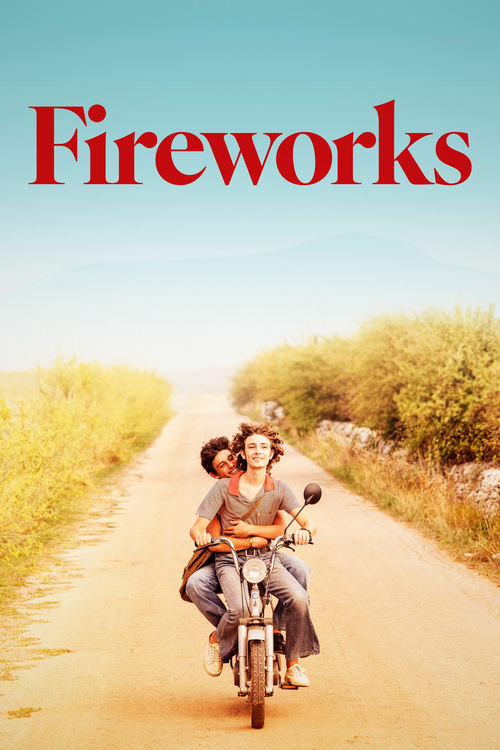
Fireworks
2023 · Giuseppe Fiorello
For when you want a first-love story with real stakes and are ready to have your heart bruised; not the pick for a light night, but exactly right when you want to feel something and sit with it after.
What it's about
In a small Sicilian town in the summer of 1982 — with the whole country glued to Italy's World Cup run — two teenage boys, Gianni and Nino, fall into a friendship that deepens into first love. Around them is a community whose prejudice runs deep and whose judgment arrives fast, and the film watches what that pressure does to two kids who have done nothing wrong. It draws on a real Sicilian case from that era.
The experience
Sun-drenched and tender for long stretches — scooter rides, sea light, pop songs — with a tightening dread underneath, because you can feel the town watching. It's the kind of film that makes the sweetness hurt.
The craft
Actor-turned-director Giuseppe Fiorello builds the film from Sicilian dialect, period pop music — the title comes from a Franco Battiato song — and the texture of a specific summer, letting the 1982 World Cup euphoria play against the story's private tragedy. The location shooting gives it a lived-in warmth that makes the intolerance around the boys feel all the more suffocating.
Why it matters
A rare mainstream Italian film to confront the country's history of homophobic violence head-on, bringing a half-forgotten real case back into national conversation and marking a serious directing debut for a well-known actor.
Snapshot
Fireworks is the international English release title of Stranizza d'amuri, the feature directorial debut of the Italian actor Giuseppe "Beppe" Fiorello. Its Sicilian-dialect original title is drawn from Franco Battiato's 1979 song "Stranizza d'amuri" — literally "a strangeness of love" — and the borrowing signals the film's register from the outset: a story of adolescent desire filtered through Sicilian vernacular, popular music, and memory. The film dramatizes the tender, doomed relationship between two teenage boys, Gianni and Nino, in a small Sicilian town in the summer of 1982, against a social backdrop of entrenched homophobia and the euphoric national distraction of Italy's World Cup victory that year.
The project's deepest ground is historical. It is widely understood to be inspired by the delitto di Giarre (the Giarre murder) of 1980, in which two young men, Giorgio Giammona and Antonio Galatola, were found dead in circumstances that became a landmark in Italian public consciousness of anti-gay violence — an event frequently cited as a catalyst for the country's organized LGBT movement and the founding of Arcigay. Fiorello has spoken of the case as the seed of the film, though the finished work fictionalizes names, ages, and circumstances and moves the action to 1982. It should be said plainly that Fireworks is a recent film with, as yet, a thin scholarly record; much of what follows synthesizes its evident craft and its clear historical lineage rather than an established critical literature.
Industry & production
Fireworks belongs to a familiar and durable stratum of Italian production: the mid-budget, socially themed auteur-adjacent drama, often assembled with public and broadcaster support and pitched simultaneously at domestic theatrical audiences and the festival circuit. It was an Italian production released theatrically in Italy in the first half of 2023. Precise financing particulars, budget, and box-office figures are not something I can state reliably, and I will not invent them; readers seeking those numbers should consult the film's distributor records and the Italian trade press.
What is significant industrially is the film as a career pivot. Giuseppe Fiorello is one of the most recognizable faces of Italian television, long associated with prestige TV-movies and miniseries in which he frequently portrayed real historical figures. Fireworks marks his crossing from performer to feature director, and the film carries the marks of that background — a confidence with actors, an instinct for the emotional set-piece, and a production sensibility tuned to broad legibility rather than avant-garde difficulty. The casting strategy is also notable: the two leads are young, relatively unknown performers, a choice that lends the central relationship freshness and avoids the distancing effect of established stars in roles of first love.
Technology
Fireworks is a contemporary digital production and shows no sign of period-simulating photochemical process; it reconstructs 1982 through design and light rather than through the grain or format of the era. This is the ordinary condition of a 2023 European drama: digital acquisition, digital intermediate, and a controlled color pipeline used to warm and age the image. I do not have verified information on the specific camera and lens packages used, and will not fabricate them. The more meaningful "technology" in the film is diegetic and period-bound — the transistor radios and television broadcasts of the 1982 World Cup, the fireworks and pyrotechnic craft around which part of the plot turns, and the popular-music soundscape of early-1980s Italy. These are the machines and media that locate the story in its moment.
Technique
Cinematography
The film's visual strategy is built on the tension between the openness of the Sicilian landscape and the confinement of its social world. Sun-struck exteriors — coast, scrubland, the roads and yards of a provincial town — give the boys' relationship a sense of stolen air and space, while interiors and the watchful geometry of the town press that freedom back down. The palette leans warm and nostalgic, consistent with a memory-film reconstructing a lost summer. I cannot confirm the director of photography by name from a reliable source and decline to guess; the cinematographic authorship of the film is one of the details a user should verify against the credits. What can be said with confidence is that the camera privileges the two young faces, favoring proximity and duration over spectacle, so that the drama accumulates in glances and physical hesitation.
Editing
Structurally, the film follows a broadly chronological arc across a single fateful season, building intimacy in its middle stretches so that the gathering menace of the surrounding community registers as an intrusion upon an established idyll. The editing serves emotional continuity rather than formal disruption; it is a film that wants the audience to inhabit the relationship long enough to feel its loss, and its cutting rhythm is accordingly patient in the love scenes and tighter as social pressure mounts. Specific editorial credits I cannot confirm and will not invent.
Mise-en-scène / staging
Production and costume design carry much of the film's period argument. The 1982 setting is rendered through vernacular detail — clothing, vehicles, domestic interiors, the omnipresence of the World Cup as televised event and communal ritual. The staging repeatedly contrasts the two boys' private world with public space: the town square, the family table, the workplace, and the church-and-gossip circuitry of a small community are staged as arenas of surveillance. Fireworks themselves function as the film's central visual and thematic object — beautiful, brief, explosive, and dangerous — and their staging (in the workshop, in the night sky) is the film's most overt symbolic register.
Sound
Sound is one of the film's defining instruments, and here the record is clearer in spirit than in credited detail. The title itself is a song, and the soundtrack draws on the popular Italian music of the era to fix the period and to lend the romance its emotional grammar; Franco Battiato's "Stranizza d'amuri" is the touchstone. The 1982 World Cup enters largely through sound — radio and television commentary, the roar of collective celebration — so that the nation's joy becomes an aural counterpoint to the couple's isolation. I am not able to confirm the original score's composer by name and will not invent an attribution.
Performance
The film rests on its two young leads, Samuele Segreto and Gabriele Pizzurro, as Nino and Gianni. (Segreto came to notice through the Italian television talent context before this role.) Their performances are the film's core achievement: unguarded, physically specific, and calibrated to the awkward truthfulness of first love. The surrounding adult cast supplies the social weather — families torn between affection and shame, a community whose ordinary prejudice curdles into something lethal. Fiorello's own strength as an actor's director is legible in the restraint asked of the ensemble; the cruelty of the story lands because it is played without melodramatic excess.
Narrative & dramatic mode
Fireworks operates in the mode of the lyrical social-realist tragedy — a coming-of-age love story whose ending is foreknown by anyone acquainted with its historical source, which lends the whole film the ache of dramatic irony. It is not a thriller and does not organize itself around suspense; the audience's dread is structural, arising from what the surrounding society is understood to be capable of. The dramatic architecture is that of the idyll under threat: establish tenderness, deepen it, and let the social world close in. This alignment of intimate romance with an inexorable communal violence is the film's fundamental design, and it places the work in a lineage of queer cinema in which private love is staged against a hostile collective.
Genre & cycle
The film sits at the intersection of several cycles. It is a queer coming-of-age drama, participating in an international wave of such films that gathered particular visibility in the 2010s and after; comparisons to Italian-set queer romance — most obviously the very different, more affluent world of Call Me by Your Name (2017) — are almost unavoidable, though Fireworks is a work of provincial hardship rather than bourgeois summer leisure. It is equally a based-on-true-events social-issue film, a well-established Italian mode, and a Sicilian regional drama in a tradition that has long used the island as a stage for questions of honor, silence, and violence. Its specific contribution to these cycles is the fusion of the queer romance with the true-crime memorial: it is a love story written as an act of historical commemoration.
Authorship & method
The controlling authorship is Giuseppe Fiorello's. As a first-time feature director drawing on decades of on-screen experience, he brings a method oriented toward performance, emotional clarity, and the reconstruction of a specific Italian past — the latter continuous with the historical-portrait work of his television career. Fiorello is credited among the film's screenwriters; the screenplay is a collaborative work, and while I can attribute the film's conception and co-writing to him, I am not able to confirm the full writing credits (the additional screenwriters) with certainty and decline to invent names. The same caution applies to the key below-the-line collaborators — cinematographer, editor, and composer — whom I cannot reliably name here. This is a genuine gap in the readily available record as I hold it, and it should be filled from the film's official credits rather than from conjecture. What is not in doubt is the authorial intention: Fiorello has framed the film as an act of witness toward the real young men whose deaths inspired it.
Movement / national cinema
Fireworks is firmly a work of contemporary Italian cinema, and more specifically of its Sicilian strand. It belongs to no formal movement but participates in an enduring national tendency — reaching back through neorealism and its descendants — to locate social and moral inquiry in regional specificity, dialect, and the textures of ordinary life. The use of Sicilian, the provincial setting, and the theme of communal complicity in violence connect it to a long line of films that treat the island as a place where affection and cruelty, intimacy and code, are inseparable. At the same time its queer subject and its festival-and-theatrical release pattern place it within a transnational contemporary current of LGBT storytelling.
Era / period
Two eras matter. The film's setting is the summer of 1982 — an intensely specific Italian moment, defined by the national delirium of the World Cup win and by a social conservatism, particularly in the provinces, in which homosexuality was met with silence, shame, and danger. The film mines the contrast between public jubilation and private persecution. The film's making, four decades later in 2023, situates it in a period of far greater visibility for LGBT stories and rights in Italy and internationally, which is precisely what makes the backward look possible: Fireworks is a present-day reckoning with a past the country has only partly metabolized. The distance between 1982 and 2023 is itself part of the film's meaning.
Themes
The film's governing themes are first love and its criminalization — the collision between the innocence of adolescent desire and a social order that treats that desire as intolerable. Around this center cluster several others: shame and the family, as parents are caught between love for their children and fear of the community's judgment; the complicity of the ordinary, the idea that lethal prejudice is enacted not by monsters but by neighbors; and memory and commemoration, the film's stance as a monument to real victims. The fireworks motif gathers these together — love as something luminous, brief, and combustible, beautiful and destructive at once. The 1982 World Cup functions thematically as the mask of national unity behind which a small community's violence goes unseen.
Reception, canon & influence
Fireworks was received as a notable Italian debut and drew particular attention for its two young leads and for Fiorello's crossing into direction. It circulated in the awards conversation of its year — I recall it featuring in Italy's David di Donatello recognition around Fiorello's debut and the film's performances — but I am not able to confirm the specific nominations or any wins with certainty, and will not manufacture an awards record; these should be checked against the David di Donatello and other official listings. Reviews broadly credited the film's sincerity, its performances, and its emotional force, while the more skeptical strain of criticism that tends to greet earnest social-issue cinema would note the risk of sentimentality inherent in the form.
On the question of influences upon the film (backward): the deepest is documentary and historical — the Giarre case and the broader history of Italian homophobia — rather than cinematic. Where cinematic lineage is concerned, the film stands in a tradition of Italian regional realism and within an international body of queer coming-of-age cinema; the contrast with a work like Call Me by Your Name is instructive precisely because Fireworks answers that film's sunlit privilege with provincial danger. Franco Battiato's music is a direct, acknowledged source, giving the film its title and part of its sensibility.
On its legacy (forward): as a 2023 film, its influence is not yet legible, and it would be premature to claim one. Its likeliest lasting significance is twofold — as the film that launched Giuseppe Fiorello's directorial career, and as a work of popular commemoration that reintroduced the Giarre history to a broad contemporary Italian audience, converting a decades-old crime into an act of cultural memory. Whether it becomes a reference point for subsequent Italian queer cinema is a judgment the coming years, not this dossier, will settle.
Reception
A word-of-mouth sleeper in Italy in spring 2023 — rare box-office traction for a homegrown queer drama — it then trickled out internationally via festivals and streaming, where it's still being 'discovered' by anglophone film Twitter and Letterboxd.
How Fireworks was received, from release to now →
Influences: the films it descends from and the films it influenced
- La terra trema (1948) — Establishes the Sicilian-realist template Fiorello inherits — casting real locals speaking regional dialect and shooting on actual southern locations rather than in studios.
- Bicycle Thieves (1948) — The neorealist method of building a film around non-professional, unknown faces to secure emotional authenticity, which Fireworks reuses in its two untrained young leads.
- Salvatore Giuliano (1962) — Model for reconstructing a real Sicilian killing as civic inquiry, converting a documented crime into cinema of investigation and public reckoning — Fireworks' approach to the Giarre case.
- Cinema Paradiso (1988) — Supplies the warm, golden memory-palette and the small-Sicilian-town period reconstruction filtered through nostalgic longing that Fireworks adopts for its 1982 setting.
- One Hundred Steps (2000) — Directly precedes Fireworks in dramatizing a real young Sicilian destroyed by his own community, scored to period pop as an act of commemoration against local silence.
- Maurice (1987) — Codifies the first-love-criminalized structure in which the tenderness of the romance is inseparable from the legal and social threat surrounding it.
- Brokeback Mountain (2005) — The idyll-under-threat architecture — a stolen pastoral of male intimacy shadowed by dramatic irony of impending violence — that Fireworks transplants to provincial Sicily.
- Call Me by Your Name (2017) — The sun-drenched, tactile Italian-summer first-love idyll Fireworks deliberately answers, replacing Guadagnino's bourgeois safety with provincial danger while keeping the sensory bloom.
- Beautiful Thing (1996) — Pioneers the working-class queer coming-of-age scored by a wall-to-wall period-pop soundscape as emotional and generational anchor, a device central to Fireworks' Battiato-driven sound.
- Fox and His Friends (1975) — Fuses gay desire with class vulnerability and social predation, the 'complicity of the ordinary' by which a community, not a single villain, engineers the tragedy.
- Lord of the Ants (2022) — The closest contemporary-Italian sibling: dramatizes a real Italian homophobia case (the Braibanti trial) as popular commemoration, the exact 'true-events-as-cultural-memory' project Fireworks pursues.
- Firebird (2021) — Based-on-true-events retelling of a criminalized gay romance crushed by an intolerant state apparatus, extending the idyll-under-threat form into archival period reconstruction.
- God's Own Country (2017) — Shares the rural-provincial realist register and the reliance on unknown leads whose physical, near-wordless performances carry a romance rooted in a hostile agrarian community.
- And Then We Danced (2019) — Extends the same craft of queer coming-of-age staged inside a tradition-bound, homophobic society where public space itself becomes a site of surveillance and risk.
- Close (2022) — Mirrors the casting of unknown young leads whose boyhood intimacy is policed by peers into catastrophe, sustaining tension through dramatic irony toward an off-screen loss.
- Great Freedom (2021) — Dramatizes the literal criminalization of same-sex love under a punitive statute, foregrounding how the state and the ordinary citizen enforce persecution — the same historical-witness impulse.
Similar films
- Call Me by Your Name (2017) — influence & lineage · same viewing thread
- Cinema Paradiso (1988) — influence & lineage · same viewing thread
- Close (2022) — influence & lineage
- Great Freedom (2021) — influence & lineage
- The Hand of God (2021) — same viewing thread
- The Best of Youth (2003) — same viewing thread
- Amarcord (1973) — same viewing thread
- Au Revoir les Enfants (1987) — same viewing thread
All the films related to Fireworks →
Watch it with: curated runs of related films
- The Past Is a Foreign Country — A run of films that reach back through memory — lost summers, vanished friends, the golden light of a place you can never return to — best watched in a row when you're in the mood to ache a little.