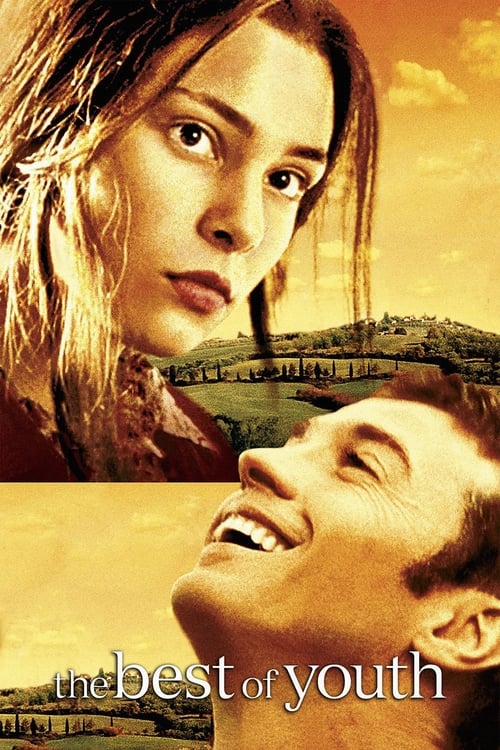
The Best of Youth
2003 · Marco Tullio Giordana
For when you want to disappear into something vast — a long weekend immersion, a life-spanning epic to live inside rather than merely watch. Comfort viewing of the deepest kind, best taken in two or three sittings.
What it's about
Two brothers from a middle-class Roman family come to a fork in the road in the summer of 1966, and the film follows their diverging lives across four decades of Italian history — the Florence flood, the movement that emptied the asylums, the terrorism of the Years of Lead, the anti-mafia fight in Sicily. It's a family story where the nation's convulsions are the weather the characters live inside.
The experience
Six hours that move like a great novel — unhurried, warm, and cumulative, so that by the final stretch small gestures land with the weight of whole lifetimes. It earns real tears honestly, without ever forcing them.
Performances
Luigi Lo Cascio and Alessio Boni age twenty-five years on screen with barely a seam showing — two performances that carry decades of history in posture and silence.
The craft
Marco Tullio Giordana treats postwar Italy with frankly novelistic ambition, weaving private lives through public catastrophe so naturally you never feel the history lesson. Made for Italian television, it was good enough to win the Un Certain Regard prize at Cannes in 2003.
Why it matters
It proved long-form television could achieve genuine cinematic stature years before prestige TV made that argument fashionable, and it remains a defining screen account of postwar Italy.
Six hours long, made for Italian television, and turned away by no less than Cannes — where it instead won the Un Certain Regard prize in 2003 — Marco Tullio Giordana's saga follows two Roman brothers from a luminous summer in 1966 across four decades of Italian history: the Florence flood, the radical psychiatry movement that emptied the asylums, the terrorism of the Years of Lead, the anti-mafia crusades in Sicily. The title comes from a poetry collection by Pasolini, and the ambition is frankly novelistic — Giordana, who had already reckoned with Italy's traumas in One Hundred Steps, treats the nation's postwar convulsions not as backdrop but as the weather his characters live inside. Luigi Lo Cascio and Alessio Boni age twenty-five years on screen with barely a seam showing. The film proved that long-form television could carry the moral seriousness of the great Italian cinema — a lesson the prestige-TV era would spend the next twenty years relearning — and it played theatrically around the world, usually in two sittings, to audiences who emerged feeling they had lived an extra life.
Reception
Made for Italian TV and initially shelved by RAI, it detoured to Cannes 2003, won Un Certain Regard, and came home a phenomenon — two decades on it's settled in as one of the great 21st-century epics, the film people cite when arguing that six hours can fly by.
How The Best of Youth was received, from release to now →
Influences: the films it descends from and the films it influenced
- Rocco and His Brothers (1960) — Establishes the novelistic Italian saga built as discrete chapters, each named for and centered on a diverging brother, that Giordana adopts wholesale for Nicola and Matteo.
- The Leopard (1963) — Models the long-breathed historical-epic sweep in which private family fortunes are staged against precise turning points of Italian national history and physical aging.
- 1900 (Novecento) (1976) — Supplies the template of a two-part, decade-spanning epic that reads twentieth-century Italian political history through the paralleled lives of two contrasting men.
- Accattone (1961) — The Pasolinian debt (Giordana filmed 'Pasolini, un delitto italiano') — location-shot working-class Rome and a political-poetic realism whose very title 'La meglio gioventù' quotes Pasolini's verse.
- Fists in the Pocket (1965) — Pioneers the Italian art film's clinical gaze on familial mental illness and institutional confinement that shapes Giordana's Matteo/Giorgia asylum thread.
- Family Life (1971) — Dramatizes the R.D. Laing / anti-psychiatry critique of the mental institution that underwrites the film's Basaglia-era radical-psychiatry storyline.
- Illustrious Corpses (1976) — Founds the cinema of political inquiry that braids fictional protagonists into documented Italian state crimes and terrorism, a method Giordana inherits for the Years of Lead.
- The Godfather Part II (1974) — Demonstrates the cross-generational family chronicle whose emotional force comes from watching the same actors carry a bloodline across sweeping historical time.
- Heimat (1984) — The long-form television precedent: national history told across many hours through one family's decades, exactly the broadcast-scale ambition Giordana made for RAI.
- Fanny and Alexander (1982) — The TV-originated family epic released theatrically in an extended cut screened in two sittings — the very exhibition model The Best of Youth used at Cannes and in cinemas.
- Berlin Alexanderplatz (1980) — Proves television serial length can sustain a novelistic character study without narrative compression, licensing Giordana's unhurried six-hour interior arcs.
- Padre Padrone (1977) — The RAI-funded Italian feature that vaulted from television commission to Palme d'Or, the crossover path from TV production to prestige cinema Giordana would repeat.
- The Best Years of a Life / La prima cosa bella (2010) — Extends the Italian multi-decade family melodrama that shuttles between generations and requires performers to age credibly across the postwar-to-present span.
- Romanzo Criminale (2005) — Carries forward the decade-spanning Italian chronicle that maps friends' diverging lives onto the concrete chronology of terrorism and the Years of Lead.
- Boyhood (2014) — Radicalizes the film's signature effect — performance registering the passage of years — by shooting the same cast across real elapsed decades.
- My Brilliant Friend (2018) — The RAI/HBO fulfillment of the prestige-TV lineage Giordana seeded: a novelistic, multi-decade Neapolitan saga tracing paired lives against postwar Italian history.
- 1992 (2015) — Inherits the model of Italian long-form serial drama that threads invented characters through a precisely dated national political rupture (Tangentopoli).
- Good Morning, Night (2003) — Released the same year and reckoning with the identical trauma — the Red Brigades' kidnapping of Aldo Moro — as intimate domestic tragedy rather than thriller.
Similar films
- Rocco and His Brothers (1960) — influence & lineage
- The Leopard (1963) — influence & lineage
- The Godfather Part II (1974) — influence & lineage
- We All Loved Each Other So Much (1974) — same viewing thread
- Amarcord (1973) — same viewing thread
- Cinema Paradiso (1988) — same viewing thread
- Fireworks (2023) — same viewing thread
- The Hand of God (2021) — same viewing thread
All the films related to The Best of Youth →
Watch it with: curated runs of related films
- The Past Is a Foreign Country — A run of films that reach back through memory — lost summers, vanished friends, the golden light of a place you can never return to — best watched in a row when you're in the mood to ache a little.