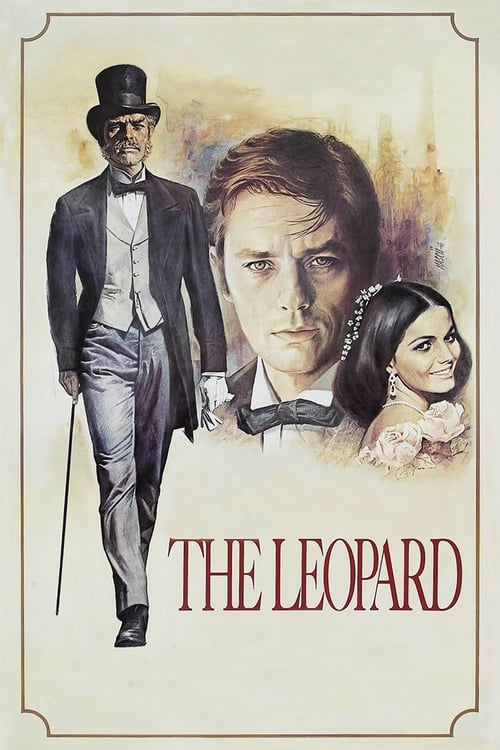
The Leopard
1963 · Luchino Visconti
For a long, unhurried evening when you want to be swallowed by something grand — a film to sink into, not snack on. It's a challenge in patience but pure comfort in beauty; save it for when you have the time to give it.
What it's about
Sicily, the 1860s: Garibaldi's redshirts are landing and Italy is being stitched into a single nation, and an aging prince watches the world that made him quietly come apart. Don Fabrizio, head of an ancient aristocratic family, is clear-eyed enough to see his class is finished — so he maneuvers, marries off, and adapts, brokering a match between his dashing opportunist nephew and the beautiful daughter of a rich new-money mayor. It's a story about power changing hands at a ball, at a dinner table, in an arranged marriage — revolution felt from inside a palazzo rather than on a battlefield.
The experience
Slow, sumptuous, and quietly devastating — three hours that move at the pace of a long summer afternoon and end up feeling like a whole life. You sink into it rather than race through it, and the melancholy creeps up on you until a glance across a ballroom carries more weight than a battle.
Performances
Burt Lancaster, cast against all expectation as a Sicilian prince, gives one of the great late-career performances — all weary authority and buried grief. Alain Delon and Claudia Cardinale are impossibly magnetic as the young couple whose glamour is the future arriving.
The craft
Visconti, himself an aristocrat, dresses every frame with obsessive authenticity — real palazzos, candlelight, dust, brocade — and the widescreen color photography is among the most beautiful ever shot. It builds to an extended ball sequence that's a landmark of staging: dozens of rooms, hundreds of dancers, an entire social order captured in one night. Absolutely a big-screen film if you ever get the chance.
Why it matters
A Palme d'Or winner whose central idea — change everything so everything stays the same — entered Italy's political vocabulary, and whose scale and melancholy became the template for the elegiac historical epic. It's the film later directors reach for when they want to show a world ending in style.
Snapshot
Il Gattopardo is the supreme achievement of Luchino Visconti's middle period and one of the great works of world cinema: a three-hour meditation on aristocratic extinction set against the Risorgimento unification of Italy in the 1860s. Adapted from Giuseppe Tomasi di Lampedusa's posthumously published 1958 novel — one of the defining Italian literary events of the postwar era — the film follows Don Fabrizio Corbera, Prince of Salina, as he watches his class dissolve and, with characteristic lucidity, does nothing to stop it. The film's governing paradox, distilled in Tancredi's celebrated line ("If we want things to stay as they are, things will have to change"), entered Italian political vocabulary as gattopardismo and has never left. Winner of the Palme d'Or at Cannes in 1963, the film was simultaneously a triumph of European prestige cinema and, in its American release, a misunderstood casualty of transatlantic distribution politics. Its rehabilitation — slow, then complete — placed it among the handful of films that permanently enlarged what cinema could do with time, class, and elegiac historical consciousness.
Industry & production
Lampedusa's novel was rejected by major Italian publishers during the author's lifetime; he died in 1957 without seeing it in print. When it appeared posthumously the following year, it immediately won the Premio Strega and sold in enormous quantities. The producer Goffredo Lombardo at Titanus, Italy's largest production company, secured the rights and approached Visconti, who had been orbiting similar historical and aristocratic material for years. Visconti was himself born into Milanese nobility — he was the Duke of Modrone — which gave him an insider's instinct for the psychology of a ruling class watching its own obsolescence.
The co-production arrangement with 20th Century Fox introduced the central industrial complication: the American distributor required an internationally bankable star in the lead role. Visconti reportedly preferred a European actor, with Laurence Olivier mentioned in various accounts, but accepted Burt Lancaster, whose imposing physical authority ultimately proved an asset. Lancaster threw himself into the preparation, working to inhabit a register of dignified melancholy that ran against his Hollywood typecasting. The production was one of the most expensive undertaken in Italy to that point, involving the renovation and dressing of actual Sicilian palaces — including the Palazzo Gangi in Palermo for the climactic ball — and the costuming of hundreds of extras in period-accurate dress. Filming took place in Sicily across several months in 1962.
The film was released in Italy at approximately 185 minutes and was a major critical and commercial success. For its American release, Fox cut the film by roughly 35 minutes, dubbed it into English (including Lancaster's own performance), and struck prints from a degraded Technicolor dupe that flattened and dulled Rotunno's original photography. This version performed poorly and met with mixed reviews, producing a critical record that would take decades to fully correct.
Technology
The Leopard was photographed in Technicolor and Technirama, the widescreen anamorphic process developed as an alternative to CinemaScope. Technirama's optical system produced a wide-format image with a sharpness and tonal richness suited to Visconti's painterly ambitions. The large format placed additional demands on set dressing and costuming, since the wide frame would expose any historical inaccuracy at the edges of the image — a concern Visconti took with extreme seriousness.
The ball sequence, which runs approximately forty-five minutes and constitutes the film's final movement, presented particular technical challenges. The sequence was shot in the actual rooms of the Palazzo Gangi, requiring the lighting to be managed within an authentic period interior. Giuseppe Rotunno used artificial light to simulate the warm, directionless diffusion of candlelight and oil lamp, achieving a glow that feels both historically plausible and voluptuously cinematic. The original Italian prints preserved this quality; the Fox dupe that reached American audiences did not.
Technique
Cinematography
Giuseppe Rotunno had already worked with Visconti on Rocco and His Brothers (1960) and would become one of the defining cinematographers of Italian and international prestige cinema. On The Leopard, his approach was explicitly organized around 19th-century Italian academic and Romantic painting. The early sequences in and around the Salina villa draw on the warm, slightly theatrical light of painters such as Francesco Hayez; the Sicilian landscape exteriors have a bleached, geological harshness that resists romanticization. Rotunno's palette shifts register across the film's three movements — the intimate household opening, the chaos and heat of wartime Sicily, and the gilded excess of the ball — tracking the emotional temperature of each episode without imposing a schematic visual grammar.
The ball sequence is his most sustained achievement in the film. The large, mirrored rooms at the Palazzo Gangi created multiple reflected light sources and complicated the spatial logic for the camera. Rotunno's solution was to keep the frame dense with figures and surfaces while allowing the protagonist to move through the crowd in a series of long, fluid takes that feel simultaneously immersive and distanced — we observe Don Fabrizio observing the party that has superseded him.
Editing
Mario Serandrei, Visconti's long-term editing collaborator (the two had worked together since Ossessione in 1943), cuts The Leopard with a deliberateness that was unusual even by the standards of European art cinema in 1963. The film trusts duration. Individual sequences are allowed to breathe at length, accumulating texture through sustained presence rather than through rhythmic compression. The ball occupies the final third of the film without apology, operating at something closer to real time than the conventions of narrative editing would normally permit. This choice — which American distributors treated as a flaw — is in fact the film's defining structural argument: Visconti makes the audience endure the ball alongside Don Fabrizio, feeling its exhaustion and beauty simultaneously.
Mise-en-scène / staging
Visconti's background as an opera and theater director shapes every composition. His mise-en-scène operates at a monumental scale while remaining attentive to individual gesture. The staging of group scenes — processions, meals, the ball itself — draws on theatrical conventions of the tableau while remaining cinematically fluid. His obsession with material authenticity was legendary and sometimes excessive: furniture, tableware, fabrics, and personal objects were sourced or fabricated to period specification, and Visconti is said to have insisted on period-accurate undergarments for the actors, on the theory that posture and movement follow what is worn beneath the costume.
The blocking of Don Fabrizio through the ball — his movement from room to room, his encounters with the old guard and the new, his solitary exit into the night at the sequence's end — is choreographed with the structural care of an operatic finale. Each room the Prince enters has a distinct social and emotional register; crossing thresholds is always narratively freighted.
Sound
Nino Rota composed the score, continuing an association with Visconti that stretched back to the late 1940s and running parallel to his more famous work with Fellini and, later, Coppola. For The Leopard, Rota worked with the contradictions built into the dramatic situation: the score needed to evoke both the grandeur of the aristocratic world and its underlying fragility. The ball sequence incorporates period waltzes and polkas, some authentically 19th-century, others composed by Rota in period style, which creates an ambiguity between historical document and aesthetic construction that suits the film's thematic concerns. The score outside the ball sequence is sparing; Visconti frequently allows ambient sound — heat, insects, wind off the Sicilian hills — to carry scenes that a more conventional director would underscored.
Performance
Burt Lancaster's performance is one of the great transformations in screen acting. Lancaster, then in his early forties and known primarily for athletic, American action roles, found in Don Fabrizio a gravity and interiority that surprised audiences and critics who had underestimated his range. His physicality — tall, broad, imposing — suited the aristocratic bearing Visconti required, but the performance's distinction lies in its stillness. Lancaster communicates a man who has thought everything through and found the conclusions unendurable, yet carries on. The dubbing imposed by Fox for the American release — Lancaster's own voice replaced by an approximation of Italian-accented English — damaged the performance's reception in that market and contributed to the film's commercial failure there.
Alain Delon, as the Prince's nephew Tancredi, brings an insolent, mobile energy that makes the character's opportunism seductive. He is the future the film cannot bring itself to endorse but cannot stop watching. Claudia Cardinale as Angelica — the bourgeois mayor's daughter who captivates both Tancredi and, in a more complex register, the Prince — is radiant and self-possessed, an embodiment of the new Italy that does not know it is supposed to be ashamed of its origins.
Narrative & dramatic mode
The Leopard is organized episodically rather than dramatically in the conventional sense. There is no plot in the forward-thrusting, crisis-resolving meaning; instead, the film moves through a series of extended tableaux that accumulate into a historical portrait. The first movement establishes the Salina household in medias res, preparing to decamp to their summer palace. The second traces the family's engagement with the Risorgimento — Garibaldi's forces passing through, Tancredi joining them — and the calculations of self-interest and survival that adaptation requires. The third movement, the ball, pulls everything into focus: Don Fabrizio watches the Palermo aristocracy mix with the new bourgeois elite, watches Tancredi dance with Angelica, and arrives at a private reckoning with mortality that the film extends over nearly an hour.
The dominant mode is contemplative and elegiac. Visconti is less interested in what happens than in what the happening means to a consciousness formed in one world and forced to inhabit its successor. The film's interiority is achieved not through voiceover or flashback but through performance and mise-en-scène — the weight of objects, the light in specific rooms, the posture of a man at rest.
Genre & cycle
The Leopard belongs to the Italian film in costume or historical epic tradition, but exceeds it. It shares period and some thematic concerns with Visconti's earlier Senso (1954), which also stages political betrayal against a Risorgimento backdrop and a failing aristocracy. Both films draw on the operatic conventions of 19th-century Italian melodrama while subjecting those conventions to a materialist, critical analysis. More broadly, the film sits at a moment when Italian cinema was negotiating a transition away from neorealism toward something more stylized, literary, and formally ambitious — a transition embodied by Fellini's 8½, released the same year.
Within European cinema, the film belongs alongside the prestige literary adaptations of the 1960s — Losey's The Go-Between, Visconti's own later Death in Venice — in which the adaptation of high literary sources is treated not as illustration but as an opportunity for cinema to develop its own resources of duration, image, and material density.
Authorship & method
Visconti's authorial position was paradoxical and generative: a committed Marxist and a hereditary aristocrat, he brought to the material both a class insider's eye for authentic detail and an intellectual's understanding of what that world represented historically. His fidelity to Lampedusa's novel was not slavish — the screenplay, credited to Suso Cecchi d'Amico (Visconti's most trusted collaborator on adaptation), Pasquale Festa Campanile, Massimo Franciosa, and Enrico Medioli, as well as Visconti himself, makes structural changes and condenses subplots — but it preserves the novel's melancholic intelligence and its refusal of nostalgia even while indulging in beauty.
Suso Cecchi d'Amico's contribution to Visconti's screenplays throughout his mature period is difficult to overstate; she was a dramaturgical intelligence who understood how to translate novelistic interiority into scenic structure, and her work on The Leopard is among the most sophisticated adaptations in Italian cinema. Rotunno, Serandrei, and Rota formed a collaborative core whose aesthetic sensibilities Visconti trusted and pushed simultaneously.
Movement / national cinema
The Leopard arrived at a moment of intense creative productivity in Italian cinema — 1963 was also the year of Fellini's 8½ and Pasolini's Mamma Roma — but it stands somewhat apart from the prevailing currents. Neorealism, which had defined Italian cinema internationally through the late 1940s and 1950s, was giving way to a more diverse landscape: the baroque personal mythology of Fellini, the political modernism of Antonioni, the literary engagements of Visconti, the raw provocations of Pasolini. Visconti's engagement with the Southern Question — the economic and cultural divide between northern and southern Italy that Unification had papered over rather than resolved — connects him to a broader tradition of Italian intellectual engagement with the Mezzogiorno, from Gramsci to Pasolini, but he approaches it from within the history of the class that created the problem.
Era / period
The film was made at the height of the boom economico, Italy's postwar economic miracle, when Italian society was undergoing rapid modernization and the question of what Italians were becoming was pressing and unresolved. Lampedusa's novel, published in 1958, had already registered the paradox that Italian modernization encoded: the sense that transformation was simultaneous with stasis, that the new Italy was structured around the same accommodations as the old. Visconti's film, released in 1963, brought this analysis into the vocabulary of cinema precisely as the European art film was reaching the height of its international prestige and audience.
Themes
The central theme is historical transformation without genuine change — gattopardismo as a structural condition rather than a personal strategy. The Salina family's accommodation of the new order is not presented as cowardice or venality but as the only available form of wisdom, which makes it more, not less, damning. Don Fabrizio's lucidity about his own class's demise is the film's moral center, and Visconti refuses to offer consolation: the aristocrats who survive do so by becoming something else, while those who remain pure disappear.
Mortality runs through the film as both personal and historical. Don Fabrizio's late-night meditation during the ball — one of cinema's great extended sequences of private reckoning — fuses the biological fact of aging with the historical fact of class extinction. The film is equally a film about time: time experienced in the body, in the built environment, in the ceremony of social life. The ball's length is not indulgence but argument; Visconti insists that we feel time passing in a way that narrative compression would prevent.
The beauty of the world the film depicts is held in careful tension with the film's awareness that this beauty was produced by exploitation and is ending because it must end. Visconti does not let the viewer off the hook of finding it beautiful.
Reception, canon & influence
The Leopard won the Palme d'Or at Cannes in 1963, the most prestigious award in European festival cinema. In Italy, it was received as a major achievement — a confirmation that Italian cinema could address the nation's history with the formal ambition the subject deserved. The American release, as noted, was a significant reversal: the cut, dubbed, and visually degraded print that Fox distributed was met with qualified reviews, some critics correctly intuiting that something had been lost, others concluding that the film was simply too slow.
The film's canonical rehabilitation in the English-speaking world owes substantially to a restoration undertaken in the 1980s — the reconstruction of the original Italian cut from surviving elements — and to champions including Martin Scorsese, who has consistently ranked it among the greatest films ever made and supported its preservation. Successive polls and retrospectives have placed it in the company of the acknowledged masterworks of world cinema.
Its influence backward includes the operatic historical sensibility of Jean Renoir (whose The Rules of the Game shares its meditation on a class at its own funeral), the Visconti of Senso and Ossessione, and the Italian verismo tradition in both literature and opera. The long-take choreography of the ball sequence has antecedents in Max Ophüls's Lola Montès (1955) and the waltz sequences of La Ronde (1950).
Its influence forward is extensive and not always acknowledged. Stanley Kubrick's Barry Lyndon (1975) — another study of class aspiration and historical extinction, lit entirely from period-authentic sources — is the most obvious descendant: the approach to 18th-century candlelight interiors, the elegiac pacing, the narrative's refusal to permit the protagonist's self-understanding to constitute genuine insight. Bernardo Bertolucci's 1900 (1976) operates in a similar register of Italian historical epic. Francis Ford Coppola has cited Visconti's influence on The Godfather films, and the Sicilian historical sequences of The Godfather Part II — their texture of landscape, family ceremony, and historical determinism — are recognizably in Visconti's debt.
More broadly, The Leopard established that the historical film could operate at the tempo of lived historical consciousness rather than the tempo of narrative event — that cinema could find a form adequate to the experience of watching your world end. This is its permanent contribution to the medium.
A Deleuzian reading
Late in the ball, Don Fabrizio steps away from the dancing and finds an empty room with a mirror.
The full Deleuzian reading of The Leopard →
Reception
It won the Palme d'Or in 1963, but Americans saw a butchered version — 20th Century Fox cut it down, dubbed it into English, and printed it in inferior DeLuxe color, and Visconti disowned it. The 1980s restoration flipped the script entirely, and it's now routinely called one of the greatest films ever made, with Scorsese as its loudest evangelist.
How The Leopard was received, from release to now →
Influences: the films it descends from and the films it influenced
- The Rules of the Game (1939) — Renoir's country-house party sequences established the theatrical-tableau model — deep-focus staging that keeps aristocrats, servants, and hunting guests simultaneously legible within a single frame — which Visconti inherited as the structural template for the Palazzo Gangi ball.
- Ossessione (1943) — Visconti's debut established his twenty-year editorial collaboration with Mario Serandrei, whose method of cutting against conventional rhythm by trusting extended duration — holding on a face or a room well past dramatic necessity — became the pacing logic of The Leopard.
- Madame de... (1953) — Ophüls' method of tracking through waltzing ballroom crowds with a continuously mobile camera that simultaneously penetrates and choreographs social ritual — keeping one central figure anchored while the world rotates around them — is the direct technical source for Rotunno's Palazzo Gangi choreography.
- Senso (1954) — Visconti's first Technicolor costume epic established the specific mode — Risorgimento-era Italy as vehicle for aristocratic dissolution, theatrical staging of historical crowds in authenticated period interiors — that The Leopard would deepen nine years later at greater scale and with Rotunno's more fully developed painterly palette.
- Lola Montès (1955) — Shot in CinemaScope, Ophüls developed the wide horizontal frame as a vehicle for historical-elegiac staging — figures placed within theatrical interiors to emphasize retrospective distance — providing the compositional model for Rotunno's Technirama framing of Don Fabrizio moving through his own obsolescence.
- Rocco and His Brothers (1960) — The Visconti-Rotunno collaboration immediately preceding The Leopard, in which Rotunno developed his technique of simulating warm, directionless period-interior light using artificial sources to mimic available-light diffusion — the specific method he then applied to the Palazzo Gangi candlelight sequences.
- The Magnificent Ambersons (1942) — Visconti's staging of an aristocratic family watching its own historical extinction — the ball sequence sustaining celebration and funeral rite simultaneously within a single extended take — directly inherits Welles's method of using duration and spatial choreography to render a dying class's elegiac self-awareness from the inside.
- La Terra Trema (1949) — Develops Terra Trema's operatic tableau staging and pictorial composition of Sicilian landscape and social ritual into full-scale historical spectacle.
- White Nights (1957) — Expands the compact dance-hall setpiece into the celebrated extended ballroom sequence that becomes the film's structural and emotional climax — the same setpiece logic scaled to epic.
- Teorema (1968) — Pasolini extends Visconti's method of staging bourgeois psychology through performance restraint and material-authentic interiors: theatrical-tableau compositions in a patrician Milan household, stillness-as-interiority in Terence Stamp's performance, and the material excess of the décor deployed as an index of class extinction.
- The Conformist (1970) — Vittorio Storaro, working in direct conversation with the Visconti-Rotunno method, uses long fluid takes through period interiors lit to reference Italian academic and Fascist-era painting — the warm, chiaroscuro directional sources Rotunno had established as the vocabulary of Italian prestige historical cinema.
- Death in Venice (1971) — Visconti's own extension of The Leopard's method: Rotunno now simulates diffuse northern light rather than Sicilian candlelight, Bogarde's stillness-as-interiority is the sole expressive register for a man watching his era dissolve, and Mahler is elevated to near-diegetic period music — all three innovations carried forward from the earlier film.
- Amarcord (1973) — Rotunno as cinematographer applies his period-interior light method — warm, simulated available-light diffusion in large architectural spaces — to Fascist-era Rimini, while Fellini's episodic-tableau narrative structure and period-accurate diegetic music as the ambient sonic register directly extend The Leopard's formal and sound approach.
- Barry Lyndon (1975) — Kubrick's explicit extension of The Leopard's simulated-candlelight innovation: where Rotunno used diffusion techniques to approximate candle diffusion, Kubrick deployed specially adapted Zeiss f/0.7 lenses to shoot by actual candlelight, making Barry Lyndon the most technically radical development of the period-accurate interior-light principle.
- 1900 (1976) — Rotunno carries The Leopard's visual method forward directly — warm, directionless interior light simulating period sources in massive Italian architectural spaces — while Bertolucci's episodic-tableau structure spanning a century of Italian agrarian class history explicitly positions the film as a sequel to The Leopard's historical and formal project.
- Once Upon a Time in America (1984) — Leone deploys the near-realtime extended sequence and period-accurate diegetic music bleeding into Morricone's score as structural devices, extending The Leopard's innovation of duration and diegetic sound as the primary vehicles of elegiac historical consciousness, with the film's temporal leaps organized around the same grammar of mourning.
- The Age of Innocence (1993) — Scorsese, who explicitly cited The Leopard as his primary source, had Michael Ballhaus use 19th-century American Impressionist painting as a visual reference in the systematic way Rotunno used Italian academic painters, while the near-realtime dinner and party sequences replicate The Leopard's method of immersive duration as social and class anthropology.
- The Remains of the Day (1993) — Ivory extends The Leopard's literary-adaptation method for aristocratic decline: theatrical-tableau staging in authenticated period interiors, ambient sound privileged over underscore in emotionally critical sequences, and Hopkins' deliberately constrained stillness-as-interiority — a conscious extension of the Lancaster method of registering historical extinction through bodily stillness.
- The Godfather (1972) — Coppola has named this as a direct formal model; Visconti's long-take staging of aristocratic ceremony — the ballroom sequence's management of social hierarchy across a vast space — shaped the wedding-sequence grammar, and the dynastic-family-in-decline narrative rendered as operatic period spectacle is the tonal template.
- The Godfather Part II (1974) — Visconti's anamorphic staging of powerful men dwarfed by palatial architecture — the Prince framed small against grand interiors as his class becomes obsolete — is directly absorbed into Willis's compositional habit of placing Michael at frame edges and behind reflective glass to register his isolation.
- The Last Emperor (1987) — Visconti's Technicolor anamorphic prestige epic stages the aristocrat-as-epoch figure against ceremony that overwhelms individual agency; the ball sequence's spatial choreography of crowd and collapse directly anticipates TLE's investiture staging and its argument that ceremony enacts ideology.
- La Notte (1961) — Near-contemporaneous Italian art film deploying the same formal vocabulary — extended duration without conventional dramatic cuts, ambient sound privileged over musical score, stillness-as-interiority in performance, the bourgeois party sequence as vehicle for class alienation — in active aesthetic conversation with The Leopard about what Italian prestige cinema could do with duration and social critique.
- The Irishman (2019) — Canonical 'twilight film' — a man lucidly watching his world and himself pass into oblivion — supplying the elegiac mortality register Irishman applies to the gangster picture.
- The Music Room (1958) — An aristocrat presiding over his own class's extinction, with the great ballroom set-piece functioning as extended elegy and the score saturating the film — the definitive expansion of Jalsaghar's feudal-decline mode.
- War and Peace, Part II: Natasha Rostova (1966) — Visconti's forty-five-minute ball builds a whole third act out of period-accurate interiors, real chandeliers and continuously reblocked extras, letting a protagonist's interior recognition emerge from the crowd's movement rather than from dialogue — the same wager Bondarchuk makes on Natasha's ball.
Similar films
- 1900 (1976) — influence & lineage · same viewing thread · often watched together
- Rocco and His Brothers (1960) — influence & lineage · same viewing thread
- Senso (1954) — influence & lineage
- Death in Venice (1971) — influence & lineage
- Obsession (1943) — influence & lineage · same viewing thread
- The Conformist (1971) — same viewing thread
- La Dolce Vita (1960) — often watched together
- Once Upon a Time in the West (1968) — often watched together
All the films related to The Leopard →
Watch it with: curated runs of related films
- Neorealism and Its Shadows — Watch these together to see Italy from the ground up — the unemployed, the sharecropped, the compromised — from neorealism's birth to its stylish, sinister heirs.