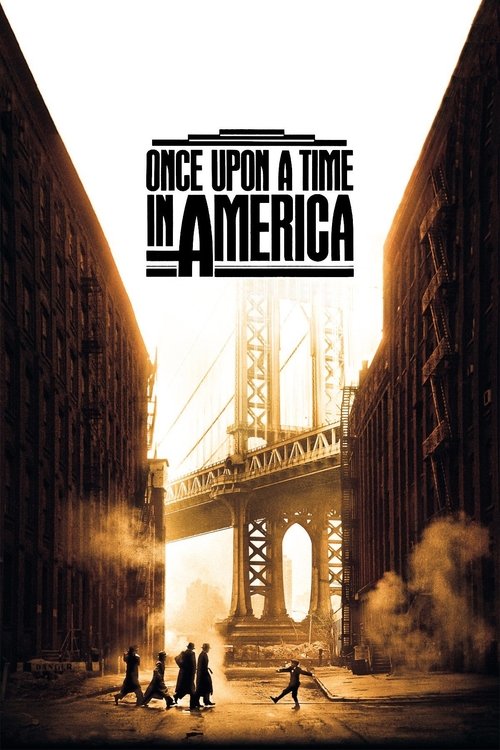
Once Upon a Time in America
1984 · Sergio Leone
For when you want to surrender an entire evening to one enormous, melancholy epic — a commitment watch for a patient mood, best taken in one sitting with the phone off. Emotionally heavy rather than fun.
What it's about
A Jewish gangster who came up on Manhattan's Lower East Side returns to the old neighborhood after thirty-five years in hiding, and the film moves fluidly between three eras of his life: the boyhood street gang, the Prohibition rackets that made and broke them, and the desolate reckoning of old age. At its center is a lifelong, ultimately ruinous friendship — and the weight of everything that can't be undone. Fair warning: it contains scenes of brutal violence, including sexual violence.
The experience
Slow, vast, and mournful — nearly four hours that move like remembering rather than storytelling, drifting between decades on a cut or a phone's ring. It's less exciting than haunting; the sadness accumulates until the final stretch lands like a held breath.
Performances
Robert De Niro gives one of his most interior performances, doing his deepest work in silence and stillness as the aged Noodles, while James Woods is all live-wire ambition as the friend he can neither trust nor quit.
The craft
Leone's images are staggering — period New York recreated at overwhelming scale — and the time-jumping structure turns a gangster saga into something closer to a dream of the past. Ennio Morricone's score, one of his most beautiful, does half the film's emotional work. See the full-length cut; the film was infamously butchered for its American release.
Why it matters
Leone's final film, mutilated by its US distributor and vindicated by its restoration, it's now regarded as one of the great gangster epics and the summit of his lifelong project of mythologizing America from the outside.
Snapshot
Once Upon a Time in America is Sergio Leone's final film, a sprawling, elegiac gangster epic that closed both his career and, in a sense, the project he had been refining across two decades — the mythologization of America through European eyes. Adapted from Harry Grey's autobiographical novel The Hoods, it follows a cohort of Jewish boys on the Lower East Side from childhood through Prohibition-era racketeering to the desolate aftermath of the 1960s, anchored by David "Noodles" Aaronson (Robert De Niro) and his complex, ultimately ruinous bond with Maximilian "Max" Bercovicz (James Woods). The film is less a crime narrative than a meditation on memory, betrayal, and time — its three temporal strata (roughly 1920s childhood, 1930s Prohibition, 1968 return) interleaved so that the past continually bleeds into the present. Famously, the film exists in radically different versions: Leone's preferred cut runs well over four hours, while the U.S. theatrical release was recut into chronological order and slashed to around two hours, an act of studio butchery widely regarded as one of the great vandalisms in modern film history. It is now canonized in its long form as a masterpiece.
Industry & production
The production history is long and tortured, which is part of the film's legend. Leone optioned Gray's novel in the late 1960s and reportedly turned down the chance to direct The Godfather because his ambition lay with this material; the project then languished for over a decade through financing collapses and rights complications. It was finally produced under the aegis of Italian producer Arnon Milchan, with The Ladd Company involved on the American side, and shot largely in 1982–83 on locations in New York, in Montreal (which doubled for period New York streets), and at Cinecittà in Rome, where much of the period New York was reconstructed on stages and backlots. The budget was substantial for a European-led production of its era, reflecting the scale of period reconstruction.
The film's release became a notorious case study in distributor interference. Leone's cut — running in the region of 229 minutes — premiered at Cannes in 1984 to acclaim. The Ladd Company / Warner Bros. handling of the American release re-edited the film into strict chronological sequence and cut it to roughly 139 minutes for U.S. theaters. The shortened, reordered version was a critical and commercial disaster in the States, and the discrepancy between the two versions became the dominant story of the film's reception: American critics who saw only the butchered cut were baffled, while those who had seen the European version recognized a major work. The long version has since been restored and re-released, including a partial "extended" reconstruction in 2012 that reintegrated additional footage, though some material Leone shot remains lost or in compromised form.
Technology
Once Upon a Time in America was made on 35mm photochemical film using anamorphic widescreen, the format Leone had long favored for its capacity to hold vast, deep compositions and to isolate faces against expanses of architecture and landscape. The technology of the film is essentially that of the classical-to-late-studio era applied at the highest level of craft rather than any innovation in capture: the spectacle is one of art direction, optical control, and period reconstruction rather than novel apparatus. Where the film is genuinely ambitious technologically is in its production design and in the seamless integration of constructed Cinecittà environments with location work, and in the makeup and aging effects required to carry De Niro, Woods, and the ensemble across roughly half a century of screen time. The editing and sound work depended on then-standard analog post-production, but the structural complexity — the constant temporal cross-cutting triggered by visual and aural rhymes — placed unusual demands on the cutting room and the music-to-image relationship, which was planned in unusually close concert (see below).
Technique
Cinematography
Tonino Delli Colli, Leone's cinematographer on his late films, shot Once Upon a Time in America, and the photography is among the most beautiful of the director's career. The visual scheme distinguishes the time periods through light and color temperature: the childhood and Prohibition sequences carry a warm, amber, almost honeyed nostalgia — sunlight through dust, golden interiors, period streets bathed in romantic glow — while the 1968 frame is colder, grayer, emptier, the palette draining as Noodles confronts what his life has become. Delli Colli and Leone construct images of extraordinary depth and symmetry, using the widescreen frame to stage faces in extreme foreground against receding architectural perspectives. The film's most famous compositional motif is the framing of the Manhattan Bridge seen down a Brooklyn street, a postcard-perfect period vista that recurs as an emblem of the lost world. Leone's signature contrast of the monumental and the intimate — the enormous close-up against the wide tableau — is everywhere.
Editing
Nino Baragli edited the film, and editing is arguably its central artistic instrument. The long version's power derives from its associative, memory-driven structure: transitions are motivated by graphic matches, sounds, and objects rather than chronology, so that the 1968 Noodles and the 1920s Noodles are continually superimposed in the viewer's mind. The opening movement — a barrage of violence, a ringing telephone whose insistent sound carries across scenes and decades, an opium den — establishes a temporally unstable consciousness through which the whole film is filtered. The notorious U.S. recut, which "fixed" the film by reordering everything chronologically, demonstrated by negation how essential Baragli's and Leone's structure was: linearized, the film lost its meaning and became merely a long crime story. The editing's deliberate ambiguity also sustains the film's most debated interpretive crux (the possibility that the later events are an opium dream).
Mise-en-scène / staging
Leone's staging is operatic and patient. The film is built from long, dilated set pieces in which time is stretched and gesture becomes monumental — a child waiting outside a door, a slow ascent of stairs, the prolonged ritual of violence or seduction. The period mise-en-scène is meticulous: the Lower East Side tenements, the speakeasies, the deco interiors of the gang's later prosperity are reconstructed with obsessive detail. Leone repeatedly uses thresholds, doorways, and windows to frame characters as watchers and watched, reinforcing the film's preoccupation with looking, voyeurism, and the inaccessibility of the past. The choreography of the ensemble across the childhood scenes — the boys' petty rackets, their first deaths, the seeds of loyalty and betrayal — is staged with the same gravity as the adult tragedy.
Sound
Sound design is integral to the film's temporal architecture, most famously the ringing telephone that bridges scenes in the opening, a sound that seems to issue from inside Noodles's guilt-stricken memory. Ennio Morricone's score — composed in close collaboration with Leone, much of it written before or during production so that scenes could be staged to the music — is among the most celebrated of the composer's career. Its principal themes, including the plaintive "Deborah's Theme" and the use of a pan flute (associated with the performer Gheorghe Zamfir) for a keening, nostalgic lament, function less as accompaniment than as the film's emotional memory made audible. The score is suffused with longing and loss, and Leone's habit of building images around Morricone's pre-composed cues gives the film its quality of remembered reverie.
Performance
Robert De Niro's Noodles is a study in passivity, guilt, and arrested emotional life — a man defined by what he has destroyed and cannot recover, his great act in the film an unforgivable one. James Woods as Max is his volatile counterweight: ambitious, manipulative, and ultimately the engine of the film's long con. The two performances are built as a study in contrast and codependency. The supporting ensemble is deep — Tuesday Weld, Joe Pesci in a smaller role, Treat Williams, and others populate the criminal and political world — while Elizabeth McGovern plays the adult Deborah, the unattainable object of Noodles's lifelong obsession. Crucially, the childhood cast (notably the young performers playing Noodles, Max, and Deborah, including a young Jennifer Connelly as the girl Deborah) carries an enormous share of the film's emotional weight; the early scenes are not prologue but the affective heart against which all later loss is measured.
Narrative & dramatic mode
The film operates in a memorial, subjective mode rather than a linear dramatic one. Its events are organized as the recollections — and possibly the hallucinations — of an aging man, and the narration's unreliability is structural, not incidental. The famous interpretive question is whether the 1968 strand is "real" or an opium-induced dream dreamt by Noodles in 1933, after the betrayal that destroys his friends; the film's bookending images of Noodles in the opium den, and his enigmatic closing smile, are deliberately left to sustain both readings. Whatever one's conclusion, the dramatic mode is elegiac and confessional: the through-line is guilt, the betrayal of Max and the rape of Deborah being the twin sins Noodles cannot expiate. The narrative withholds and reveals across decades, so that meaning accretes retrospectively — a structure of belated understanding that mirrors its themes of regret.
Genre & cycle
The film belongs to the gangster genre and specifically to the wave of revisionist, novelistic crime epics that The Godfather (1972) inaugurated — films that treated organized crime as a vehicle for tragedy, history, and the American myth. But Leone's relationship to the genre is, as ever, mythic and distanced. The title's "Once Upon a Time" signals fairy tale and legend, the same fabular framing he used for Once Upon a Time in the West (1968) and the film sometimes called Once Upon a Time in the Revolution / Duck, You Sucker (1971); together these form Leone's loose "Once Upon a Time" cycle, his sustained project of treating American (and revolutionary) history as folklore. Where his Westerns mythologized the frontier, America mythologizes the immigrant gangster and the city, completing a movement from the genre of national origin (the Western) to the genre of the modern metropolis (the gangster film).
Authorship & method
This is an auteur's summa, the product of Leone's decade-long obsession and his mature method. His authorship is legible in every register: the stretched temporality, the monumental close-ups, the fusion of the operatic and the brutal, the fairy-tale framing, and the conviction that American genres are best understood as myths. His method was deeply collaborative with a stable of long-term partners. Tonino Delli Colli (cinematography) gave the film its dual-temperature beauty. Ennio Morricone (music), Leone's lifelong collaborator since their childhood acquaintance and through the Westerns, composed much of the score in advance so the staging could be built to it — a reversal of the usual scoring process that is central to Leone's authorship. Nino Baragli (editing) realized the associative, memory-driven cut. The screenplay was the work of many hands over many years — a large team of credited writers, including Leonardo Benvenuti, Piero De Bernardi, Enrico Medioli, Franco Arcalli, Franco Ferrini, and Leone himself, with Stuart Kaminsky credited for English-language dialogue — reflecting the long gestation and the adaptation's complexity. The film bears the marks of that collective labor but is unmistakably governed by a single sensibility.
Movement / national cinema
Leone is the central figure of a peculiar transatlantic phenomenon: an Italian filmmaker, formed in the postwar Cinecittà industry and the Italian genre system, who built his art entirely out of American mythology. Once Upon a Time in America is an Italian-American co-production with European financing and craft (Cinecittà construction, Italian cinematographer, composer, and editor) applied to quintessentially American material. It thus belongs less to any national movement than to Leone's singular position as the great outsider-interpreter of the American imaginary — heir, in spirit, to the Italian taste for spectacle and operatic emotion, and to the European art cinema's freedom with time and subjectivity, here turned upon the Hollywood gangster picture.
Era / period
The film was made in the early 1980s, at the tail end of the New Hollywood era's appetite for the ambitious director-driven epic and at the cusp of the blockbuster-dominated industry that would have little patience for a four-hour European art-gangster film — a context that helps explain the studio's destructive recut. Its diegetic periods span the 1900s–1920s immigrant childhood, the Prohibition years of the late 1920s–1933 (the gang's rise and fall pegged to the end of Prohibition), and a 1968 return. The film is thus doubly a period piece: a 1980s reconstruction of early-20th-century New York and a backward glance from the 1960s, layering nostalgia upon nostalgia.
Themes
The governing theme is memory and the irrecoverability of the past — the film is, in form and content, an act of looking back. Tightly bound to it are guilt and betrayal: Noodles's two unpardonable acts (his betrayal that he believes kills his friends, and his sexual violence against Deborah) define a man who has forfeited the possibility of love and redemption. Friendship and its corruption — the Noodles/Max bond and Max's long deception — anchor the plot. Time itself is a theme made formal through the editing. Other threads include the immigrant pursuit and perversion of the American dream; the corruptions linking organized crime, labor unions, and political power in the later strand; and the persistent motif of voyeurism and unattainable desire, crystallized in Noodles watching Deborah. The film's treatment of women, and especially the Deborah assault, has been the subject of sustained and serious critical discomfort, and any honest account must register that the film's romanticism coexists with a deeply troubling sexual brutality.
Reception, canon & influence
Influences on the film run backward to Harry Grey's source novel The Hoods, to the classical Hollywood gangster cycle (Hawks, the Warner Bros. crime pictures), and, inescapably, to the post-Godfather mode of the operatic crime epic. Leone's own earlier "Once Upon a Time" films are the most direct lineage, this being the urban completion of his mythic project.
The reception is a tale of two films. The full European/Cannes version was widely hailed as a masterpiece; the truncated, chronologically reordered American cut was a critical and box-office failure that for a time damaged the film's reputation in the United States. Subsequent restorations vindicated Leone's version, which is now routinely ranked among the great films of the 1980s and among the finest gangster films ever made, and appears on major critics' canons. Sergio Leone died in 1989, a few years after its release, making it a valedictory work whose stature has only grown.
Forward influence is substantial. The film deepened the template of the long-form, memory-structured crime epic and is frequently cited as a touchstone by later filmmakers working in elegiac registers; Morricone's score, particularly "Deborah's Theme" and the pan-flute lament, became among the most recognizable and imitated in film music, widely sampled and referenced. Perhaps its most lasting industry legacy is cautionary: the gulf between Leone's cut and the studio's mutilation became the canonical example invoked in debates over directors' final-cut rights and the restoration of damaged films, helping to legitimize the "director's cut" as a serious category of film scholarship and home-video culture. Where the record of specific later homages is more diffuse than often claimed, it is fair to say the film's reputation now rests securely on the long version as one of the supreme achievements of its genre and its director.
A Deleuzian reading
Start with the last image, because the film does.
The full Deleuzian reading of Once Upon a Time in America →
Reception
Infamously butchered for its 1984 US release — cut from Leone's ~4-hour vision to 139 minutes and re-edited into chronological order — it flopped and was savaged, while the full European cut drew raves at Cannes. The restored version has since been fully canonized, and it's now widely held up as Leone's masterpiece and one of the great gangster epics.
How Once Upon a Time in America was received, from release to now →
Influences: the films it descends from and the films it influenced
- Once Upon a Time in the West (1968) — The direct predecessor of Leone's prescore method — Morricone wrote character leitmotifs in advance and the staging of the dilated setpieces was built around the music, the exact reversal OUATIA perfects.
- The Good, the Bad and the Ugly (1966) — Establishes the operatic standoff grammar Leone carries forward: extreme-telephoto monumental close-ups rhythmically intercut against a prescored Morricone cue that dictates the editing tempo.
- The Godfather Part II (1974) — Pioneers the braided dual-timeline crime epic in which past and present are cross-cut so each era ironically comments on the other — the structural model OUATIA radicalizes into three strata.
- Citizen Kane (1941) — The template of reconstructing a whole life through fragmented, unreliable retrospective testimony, with deep-focus compositions that frame figures across thresholds and time.
- Scarface (1932) — Supplies the classical Warner-era gangster-rise iconography and the immigrant-criminal myth that Leone treats as American folklore rather than reportage.
- 2001: A Space Odyssey (1968) — The graphic match-cut that leaps across enormous spans of time (bone to satellite) is the formal ancestor of OUATIA's time-bridging associative cuts, like the ringing-phone sound match.
- Lawrence of Arabia (1962) — Anamorphic widescreen scale wedded to temporal dilation, and the celebrated match-cut transition (blown match to desert sunrise) that collapses time within a single edit.
- 8½ (1963) — Fluid intercutting of memory, fantasy, and present tense all issuing from one subjective consciousness — the Italian art-cinema interiority underlying OUATIA's opium-haze unreliable recall.
- The Godfather (1972) — Leone extends Coppola's dynastic immigrant-gangster epic into non-linear structure, using Morricone's spare recurring motif in explicit dialogue with Nino Rota's approach, and constructs a meditation on fraternal betrayal and dynastic succession that the baptism sequence's ironic counterpoint directly anticipates.
- The Leopard (1963) — Leone deploys the near-realtime extended sequence and period-accurate diegetic music bleeding into Morricone's score as structural devices, extending The Leopard's innovation of duration and diegetic sound as the primary vehicles of elegiac historical consciousness, with the film's temporal leaps organized around the same grammar of mourning.
- The Conformist (1971) — Leone and editor Nino Baragli construct the most ambitious nested-analepsis structure in Italian cinema since The Conformist — the entire film is the opium-haze memory of a man whose defining act of betrayal is repeatedly deferred and finally revealed — while Morricone's elegiac score creates the same ironic counterpoint between nostalgic musical beauty and the acts of political and personal violence it accompanies.
- Rocco and His Brothers (1960) — Leone's elegiac immigrant epic mirrors Rocco's operatic blend of street naturalism and tragic grandeur — brothers sundered, a city corrupting innocence, scored as lament — across a deliberately fractured time structure.
- The Untouchables (1987) — Morricone-scored operatic period-gangster filmmaking in which whole setpieces (the Union Station staircase) are choreographed to a pre-composed cue, applying Leone's music-first staging to Prohibition Chicago.
- Goodfellas (1990) — A retrospective, memory-narrated gangster bildungsroman spanning decades, structured by elegiac hindsight and guilt rather than chronological plot.
- Cinema Paradiso (1988) — A Morricone leitmotif scoring a childhood-and-regret structure framed by adult retrospection, with a child ensemble whose lost world is recovered through associative memory.
- Once Upon a Time in Hollywood (2019) — Explicit title homage; deploys dilated hangout setpieces and an elegiac, fairy-tale mythologizing of a vanished American milieu in Leone's register of nostalgia-as-myth.
- The Assassination of Jesse James by the Coward Robert Ford (2007) — Anamorphic elegiac Americana built on a foregrounded prescored ambient leitmotif (Cave/Ellis) and Leone-style temporal dilation that mythologizes its outlaw through stillness and threshold framing.
- The Irishman (2019) — An aged gangster's guilt-and-regret recollection across decades — a valedictory crime epic whose entire architecture is memory and the long reckoning OUATIA pioneered.
- Casino (1995) — A music-saturated, operatic rise-and-fall epic carried by braided retrospective narration, treating organized crime as a mythic American empire in elegiac decline.
- Miller's Crossing (1990) — Leone's technique of sustaining a violent set piece over a single unbroken musical cue — letting the sequence breathe far past conventional cutting rhythm — is the direct formal antecedent for the 'Danny Boy' assassination sequence, in which the accordion piece plays uninterrupted while the scene shifts registers from domestic comedy to explosion to methodical violence.
- Blow (2001) — Blow inherits Leone's circular retrospective framing device: the criminal narrator reconstructing his life from ruin, with the ending returning to the opening image of the imprisoned, aging protagonist — a formal echo of Leone's opium-haze bookends spanning decades.
- American Gangster (2007) — Leone's multi-decade crime epic constructs its criminal world through deliberate withholding — ellipsis over exposition, the gap between scenes carrying more weight than the scenes themselves — and distributes the moral reckoning across time rather than a single climactic confrontation; Scalia's long-form rhythm in AG is a direct compression of this structural inheritance.
- Fireworks (1997) — Leone's non-linear parallel editing withholds temporal markers—no dissolves, no title cards—trusting the viewer to navigate across decades; Morricone's score runs continuously through brutal violence, delivering both the low-signal structural editing and the score-over-violence technique Hana-bi deploys.
- Infernal Affairs II (2003) — Leone's amber-gold period palette for criminal nostalgia — warm, suffused with loss — combined with Morricone's elegiac orchestral scoring of criminal memory across historical time, provides IA2's tonal and chromatic blueprint for reconstructing late-1990s Hong Kong as a mourned, irretrievable space.
- There Will Be Blood (2007) — Operatic, dilated setpieces of American origin-myth driven by a foregrounded, near-prescored score (Greenwood) that governs the staging — Leone's music-led monumentality transposed to capitalist allegory.
- Heaven's Gate (1980) — Another auteur's recut-history casualty — a vast personal epic where duration is structure, butchered by distributors and later restored, sharing Heaven's Gate's twin fate of release-cut catastrophe and full-length rehabilitation.
- The Funeral (1996) — Elegiac memory-flashback architecture and the tragedy-of-inevitability mode — gangster lives narrated as already-foreclosed, recalled from a vantage of loss.
- Life Is Beautiful (1997) — Cinematographer Tonino Delli Colli's warm, memory-soft, high-key lensing of the past — the same lighting signature he carries into Life Is Beautiful's golden first half.
- Vada Chennai (2018) — A decades-spanning gangster epic told as fractured memory, hinging on prison and a friend's betrayal — the exact non-linear loyalty-and-treachery scaffolding of Vada Chennai's carrom-board brotherhood.
- 1900 (1976) — Morricone's elegiac folk score plus a framed-flashback architecture spanning a life across the century — the same score-as-co-author and parallel-biography structure.
Similar films
- Casino (1995) — influence & lineage · same viewing thread · often watched together
- Once Upon a Time in the West (1968) — influence & lineage · often watched together
- GoodFellas (1990) — influence & lineage · often watched together
- The Irishman (2019) — influence & lineage
- The Godfather Part II (1974) — influence & lineage
- The Good, the Bad and the Ugly (1966) — influence & lineage
- Cinema Paradiso (1988) — influence & lineage
- Raging Bull (1980) — same viewing thread · often watched together
All the films related to Once Upon a Time in America →
Watch it with: curated runs of related films
- American Crime, Long Memory — A run of mob epics, noir, and neighborhood tragedies that all circle the same wound — loyalty, masculine violence, and the past that never lets go — so watch them close together and let the decades and cities blur into one long American story.
Film essays and courses that include it
- Blood, Dust & Opera: How Leone Reinvented the Western
- Blood, Myth, and Grammar: The Gangster Film's Century
- Scope and Shadow: The Anamorphic Vision
- The Wound of Time: Cinema's Elegiac Masters
- What We Owe Each Other: Friendship Under Pressure
- The Family Business: Ten Films That Built the Mob Movie
- The Architecture of Forgetting
- The Corrupting Vein: Cinema's Century with Greed
- The Ones Who Stay to Watch: A Course in the Cinema of the Seer
- The American Dream's Dark Twin
- The Voice in the Score