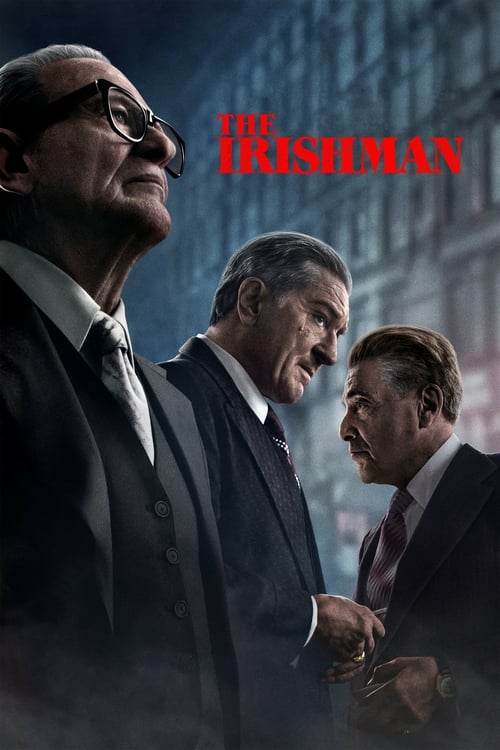
The Irishman
2019 · Martin Scorsese
For a long winter evening when you want to settle into an epic — and when you're ready for a crime saga that's more about regret than glamour. This one's for chewing on, not for a casual half-watch.
What it's about
A Pennsylvania truck driver and war veteran, Frank Sheeran, falls in with mob fixer Russell Bufalino in the 1950s and becomes his trusted hitman — work that eventually places him at the side of Jimmy Hoffa, the most powerful union boss in America. Across decades of loyalty, favors, and friendship, Frank rises through a world where debts always come due. It's a gangster epic told from the far end of a life, by a man taking stock of what his loyalty cost.
The experience
Patient, absorbing, and finally haunting — it has the pleasures of a classic mob picture, the wit and the menace, but the pace is deliberately unhurried, and the last hour lands with a stillness that stays with you long after. At three and a half hours it's a commitment that pays off.
Performances
Robert De Niro carries the film's slow-dawning sorrow, Al Pacino is gloriously alive as the vain, magnetic Hoffa, and Joe Pesci, coaxed out of retirement, gives the quietest and maybe finest performance of his career — all menace held in a whisper.
The craft
Scorsese uses then-unprecedented digital de-aging to let his leads play forty years of one life, and Thelma Schoonmaker's editing gives the sprawl a mournful, unhurried rhythm entirely unlike the razzle of his earlier crime films. The scale and the era-hopping production design reward a proper sit-down viewing with no distractions.
Why it matters
A landmark of the streaming era — financed by Netflix when studios balked — and a late-career summation in which Scorsese turns the gangster genre he helped define back on itself to ask what all that violence amounts to.
Snapshot
The Irishman is Martin Scorsese's elegiac, three-and-a-half-hour reckoning with the gangster genre he helped define — a film that uses the iconography of organized crime to stage a meditation on aging, guilt, and oblivion. Adapted from Charles Brandt's 2004 nonfiction book I Heard You Paint Houses, it follows Frank Sheeran (Robert De Niro), a Teamster hitman whose decades of loyalty to mob fixer Russell Bufalino (Joe Pesci) and labor titan Jimmy Hoffa (Al Pacino) culminate in the act that defines his life and damns his soul. Running 209 minutes and deploying then-unprecedented digital de-aging to let its septuagenarian leads play across four decades, the picture became a landmark of the streaming era: financed by Netflix after traditional studios balked at its cost, given a brief awards-qualifying theatrical run, and released to the platform in November 2019. It is at once a summation of Scorsese's career-long fascination with American criminal life and a deliberate inversion of its energies — a gangster film built around stillness, regret, and the long silence after the violence stops.
Industry & production
The project had a notably protracted gestation. De Niro brought Brandt's book to Scorsese in the mid-2000s, and Steven Zaillian was engaged to write the screenplay; the production then spent roughly a decade in development, stalled in significant part by the expense and technical uncertainty of de-aging its cast across long stretches of screen time. Paramount Pictures, Scorsese's frequent partner, was originally attached but ultimately could not absorb a budget that ballooned with visual-effects costs widely reported in the $150–200 million range (precise figures have not been authoritatively disclosed). Netflix stepped in to finance and distribute, a decision emblematic of the period's shifting economics: a prestige, director-driven film of immense length and cost that conventional theatrical studios deemed unviable found a home with a streaming company willing to treat it as a flagship.
The arrangement reignited the era's central exhibition dispute. Major theater chains, objecting to Netflix's compressed or nonexistent exclusive theatrical windows, largely declined to book the film; Netflix gave it a limited release in independent venues beginning in November 2019 before streaming it on November 27. Because Netflix does not release viewership or box-office data in conventional terms, no reliable theatrical gross exists, and audience figures remain a matter of the company's own selective disclosures rather than verifiable record. The film premiered as the opening selection of the 2019 New York Film Festival, a prestige berth that framed it as a cultural event. It went on to receive ten Academy Award nominations — including Best Picture, Best Director, and supporting nods for both Pacino and Pesci — and won none, a shutout that became part of the film's reception narrative.
Technology
The Irishman is inseparable from the de-aging technology that made it possible. Industrial Light & Magic, under visual-effects supervisor Pablo Helman, developed a markerless system that allowed De Niro, Pesci, and Pacino to be rejuvenated digitally without the dots, tracking markers, or head-mounted helmet cameras typical of performance-capture work — apparatus that Scorsese felt would inhibit naturalistic acting. The solution was a custom three-camera rig, nicknamed the "three-headed monster," that captured each performance with the production camera flanked by two infrared witness cameras, supplying ILM the geometric data to reconstruct and age-alter the faces in post. The software pipeline, developed over years, was branded "Flux."
The ambition was significant: rather than de-aging for a single flashback, the film required actors in their mid-to-late seventies to credibly read as men in their thirties, forties, and fifties across the bulk of the runtime. Results were widely debated. Many observers praised the facial work while noting the limits the technology could not reach — the physical bearing, gait, and movement of elderly men, which no facial alteration could disguise, producing an occasional dissonance between youthful faces and aged bodies. The film thus stands as a genuine technological milestone and a candid demonstration of that milestone's frontier.
Technique
Cinematography
Rodrigo Prieto, shooting his third feature for Scorsese, photographed the film digitally — a practical necessity given the witness-camera de-aging rig — while working to evoke the textures of the film stocks associated with each era the story passes through. Prieto has described tailoring the image's color and grain to different historical periods, lending the decades-spanning narrative a subtly shifting visual register. The camera style is markedly more restrained than the kinetic, prowling work of Goodfellas or Casino. Compositions are often static and frontal; the celebrated long Steadicam takes of Scorsese's earlier crime films give way to a contemplative, observational grammar suited to a story told largely in retrospect by a dying man.
Editing
Thelma Schoonmaker, Scorsese's editor since Raging Bull and one of cinema's most enduring director-editor partnerships, cut the film. Her work here negotiates an unusually intricate temporal architecture: the narrative nests at least three time frames — Sheeran's old age in a nursing home, a 1975 road trip toward the film's pivotal event, and the decades of memory that trip unspools — moving among them with a control that keeps a sprawling chronology legible. The editing's defining quality is its patience. Where her earlier collaborations with Scorsese are famous for percussive, propulsive cutting, The Irishman slows the rhythm to match its subject, lingering on faces and silences and allowing the final act to decelerate into something approaching stasis.
Mise-en-scène / staging
The film's production design and staging meticulously reconstruct mid-century American interiors — union halls, diners, hotel rooms, courtrooms, suburban kitchens — across the postwar decades. Scorsese stages much of the drama in conversation: men at tables, in cars, in doorways, negotiating power through coded talk. The recurring motif of the 1975 car journey, with Sheeran, Bufalino, and their wives driving toward a wedding that masks a darker purpose, functions as the film's structural spine, a slow procession toward an act of betrayal. The closing images — Sheeran alone, the door of his room left ajar at his request — are staged with deliberate spareness, an unmistakable inversion of the closing door of The Godfather.
Sound
Robbie Robertson, the former Band guitarist and a longtime Scorsese music collaborator, served as composer and music supervisor, threading period songs and a spare original presence through the film; it stands among his last major works before his death in 2023. The soundscape favors restraint, with stretches of quiet that amplify the film's autumnal mood rather than the wall-to-wall pop-music propulsion of Goodfellas. Sound design lends weight to the procedural details of violence — Scorsese's characteristically unsentimental treatment of gunfire — while the dominant aural impression of the final hour is one of encroaching silence.
Performance
The performances are the film's living center. De Niro plays Sheeran with a guarded, watchful flatness — a man whose capacity for violence is inseparable from his emotional opacity, and whose final loneliness registers as the slow surfacing of a buried conscience. Pacino, in his first collaboration with Scorsese, plays Hoffa with expansive, voluble bravado, a performance of appetite and ego that supplies the film much of its vitality. Pesci, coaxed out of retirement reportedly after numerous refusals, inverts his explosive Goodfellas/Casino persona entirely: his Bufalino is soft-spoken, courtly, and quietly lethal, with menace conveyed through stillness. The supporting ensemble — including Ray Romano, Bobby Cannavale, Stephen Graham, and Anna Paquin, whose near-wordless role as Sheeran's estranged daughter Peggy became a point of critical discussion — extends the film's interest in what goes unspoken.
Narrative & dramatic mode
The film is structured as retrospective confession: an aged, ailing Sheeran narrates his life from a nursing home, the story unfolding as memory framed within memory. This first-person voiceover, a Scorsese signature, here carries a different charge — not the seductive, complicit narration of Goodfellas but the testimony of a man accounting for himself near death. Scorsese punctuates the chronicle with onscreen titles that flash the eventual violent fates of minor mobsters as they are introduced, a mordant device that renders the whole criminal world a procession toward death foretold. The dramatic mode is fundamentally elegiac and moral: the film withholds catharsis, ending not in spectacle but in the prolonged anticlimax of survival, as Sheeran outlives everyone who gave his life meaning and is left to face a God he half-believes in and a daughter who will not speak to him.
Genre & cycle
The Irishman belongs unmistakably to the American gangster film and to Scorsese's own cycle of crime epics — Mean Streets, Goodfellas, Casino — but it functions as a valedictory commentary on that cycle. Where the earlier films dramatize the intoxication of criminal life before its collapse, this one strips away the intoxication almost entirely, foregrounding consequence over thrill. It engages directly with the genre's foundational texts, especially The Godfather, both echoing and rebuking their mythologies of family and honor. Its kinship with the broader tradition of the late-career "twilight" film — the aging master's reckoning with mortality through familiar material — is as strong as its generic lineage.
Authorship & method
The film is a summa of Scorsese's authorship and a reunion of his enduring collaborators. It marks his ninth feature with De Niro, the actor who anchored his early career, and his first with Pacino, completing a long-deferred pairing of the two defining actors of New Hollywood crime cinema. Behind the camera it convenes Scorsese's core craft team: editor Thelma Schoonmaker, cinematographer Rodrigo Prieto, and composer Robbie Robertson, alongside screenwriter Steven Zaillian, who shaped Brandt's book into its nested confessional structure. Scorsese's method here — long incubation, fidelity to a source rooted in claimed firsthand testimony, and a willingness to bet a vast budget on unproven technology in service of casting — reflects both his authorial control and the unusual latitude Netflix's financing afforded. It should be noted that the historical reliability of Brandt's source has been seriously contested by historians and journalists, who dispute Sheeran's confessions; the film adapts a contested account, and Scorsese's interest lies less in forensic truth than in the moral weight of a man's self-narration.
Movement / national cinema
The film is a quintessential product of American cinema and specifically of the New Hollywood generation in its late maturity — Scorsese, De Niro, Pacino, and Pesci all formed by or emblematic of the 1970s renaissance, here convened decades on. As an artifact of national-industrial history it is equally significant as a marker of the streaming transition, one of the first prestige works of its scale and ambition to bypass the traditional studio-theatrical system in favor of a technology company's distribution. It thus sits at the intersection of an aesthetic lineage and an industrial rupture.
Era / period
Set across roughly the 1950s through the early 2000s, the film moves through the postwar heyday of American organized labor and its entanglement with the Mafia, the Kennedy era, and the disappearance of Jimmy Hoffa in 1975 — the historical event toward which the entire narrative gravitates. It treats the mid-century union movement, the Teamsters, and the period's criminal-political nexus as a vanished American world, observed from the vantage of its survivors' old age. Produced and released in 2019, it is also firmly a film of its own moment in its industrial form and technology.
Themes
At its core the film concerns mortality, guilt, and the moral cost of a life given over to violence and loyalty. Catholic conscience runs beneath the surface — the late scenes turn on confession, penance, and the question of whether redemption is possible or even sought. Loyalty is examined as both virtue and trap: Sheeran's fidelity to Bufalino requires the destruction of the man he loves most, and the film's central tragedy is the impossibility of serving two masters. The estrangement of Sheeran's daughter Peggy dramatizes the human wreckage left by a life of complicity, her silence functioning as the film's moral verdict. Above all the film is about time and oblivion: the erosion of a world, the loneliness of outliving one's own significance, and the indifferent approach of death, which the gangster's code is powerless to forestall.
Reception, canon & influence
Critical reception was strongly favorable, with wide praise for the performances — particularly Pacino's and Pesci's — for Schoonmaker's editing, and for the film's ambition and somber maturity, alongside ongoing debate about the persuasiveness of the de-aging and the demands of the runtime. It featured prominently on critics' year-end and decade-end lists and accrued ten Academy Award nominations, though it won none, a result that drew commentary given its stature. The de-aging technology generated extensive coverage in its own right, positioning the film as a reference point in discussions of digital performance alteration.
Backward, the film draws on the entire tradition of the American gangster picture and on Scorsese's own earlier crime films, in conscious dialogue with The Godfather and with the labor and mob histories of postwar America. Forward, its most immediate influence is industrial and technological: it advanced and popularized markerless de-aging, fueling debate over the ethics and aesthetics of digitally altering actors that has only intensified, and it stood as a high-profile demonstration that a film of uncompromising length, cost, and artistic seriousness could be made outside the theatrical studio system — a precedent for the streaming era's relationship to auteur cinema. As a late-career statement it has come to be read as a capstone to Scorsese's crime cycle, the work in which the genre's master turned its tools toward an unflinching contemplation of his own mortality and ours.
A Deleuzian reading
The first thing the film does is sit an old man in a chair and let the camera find him.
The full Deleuzian reading of The Irishman →
Reception
Landed in 2019 as an instant event — rapturous reviews, 10 Oscar nominations — then went 0-for-10 on the night, and the 'too long, watched it in parts' chatter briefly threatened to define it. A few years on it's settled into consensus as late-Scorsese's elegiac masterpiece, the mournful capstone to the Goodfellas/Casino lineage.
How The Irishman was received, from release to now →
Influences: the films it descends from and the films it influenced
- Once Upon a Time in America (1984) — Frames a De Niro gangster's whole life as an old man's guilt-soaked memory, the aged-survivor-remembering device and lifetime-spanning casting that Irishman echoes via de-aging instead of makeup.
- The Curious Case of Benjamin Button (2008) — Landmark in photoreal digital alteration of a lead actor's face across an entire lifespan, the VFX-driven age-shifting performance precedent Irishman's markerless de-aging builds on.
- American Gangster (2007) — Scorsese's crime-biopic procedural epic extends the supporting-anchor ensemble principle — distributing moral weight across Joe Pesci, Al Pacino, and Harvey Keitel rather than concentrating it in De Niro — and sustains a three-and-a-half-hour withholding register that treats criminal enterprise as institutional housekeeping rather than tragedy, the diagnosis AG established in 2007.
- J. Edgar (2011) — Scorsese's non-linear memoir structure — an aged institutional man recollecting decades of violence in retrospect, with de-aging technology as J. Edgar's prosthetics inverted — directly extends the unreliable-retrospective-narrator biographical form, substituting digital age-manipulation for Eastwood's analog makeup work.
- 25th Hour (2002) — Prieto's elegiac, desaturated photography of aging men reckoning with irreversible consequence extends the mournful, color-controlled visual grammar he first brought to Lee's countdown drama.
- Forrest Gump (1994) — Digitally de-ages its actors to let single performers span decades of American history, the logical endpoint of Gump's manipulation of the actor's body across time.
- Captain America: The First Avenger (2011) — Advances the same digital de-augmentation lineage (ILM/Lola-style facial and body manipulation) that reshaped Evans, here inverted to de-age actors seamlessly across performance rather than shrink them.
- Silence (2016) — Schoonmaker cutting long and unhurried against her own kinetic signature, invisible digital work in service of realism rather than display, and a coda of solitary penance rhyming with the coffin-crucifix shot.
- Goodfellas (1990) — Establishes the Scorsese/Schoonmaker first-person-criminal grammar — wall-to-wall retrospective voiceover narrating a mob career — whose propulsive energy The Irishman deliberately drains into stillness and silence.
- Casino (1995) — Originates the deadpan onscreen accounting of how mobsters die and the matter-of-fact narration of violence that The Irishman literalizes into its freeze-frame death titles.
- Raging Bull (1980) — Template for Schoonmaker editing married to De Niro's bodily transformation across decades and a protagonist crushed by Catholic guilt — Irishman swaps prosthetics and weight for digital de-aging.
- The Godfather (1972) — The operatic, dynastic gangster grammar — sacramental family rituals, hushed conversational blocking — that The Irishman consciously inverts (its 'godfather-inversion' facet) into bureaucratic, unglamorous labor-mob drudgery.
- The Godfather Part II (1974) — Pioneers the decades-spanning nonlinear crime epic carried by age makeup and elegiac cross-cutting, the multi-era structural model Zaillian's nested confession reworks.
- The Leopard (1963) — Canonical 'twilight film' — a man lucidly watching his world and himself pass into oblivion — supplying the elegiac mortality register Irishman applies to the gangster picture.
- TRON: Legacy (2010) — Early sustained CG de-aging of a lead (Bridges as CLU) that exposed the uncanny-valley problem in digital youth which Irishman's markerless rig was designed to overcome.
- Rogue One: A Star Wars Story (2016) — Demonstrated markerless digital recreation/de-aging of a performer's face as a narrative tool, the facial-replacement pipeline lineage Irishman extends to three principal actors.
- Gemini Man (2019) — Contemporaneous sibling experiment building a fully synthetic de-aged younger Will Smith, splitting from Irishman's approach by generating a wholly digital young face rather than altering live capture.
- Captain Marvel (2019) — Sibling proof that an actor (Samuel L. Jackson) could be convincingly de-aged across a full feature, part of the same 2019 inflection point that normalized digital youth on screen.
- Killers of the Flower Moon (2023) — Direct descendant in Scorsese's twilight-crime cycle — De Niro, Prieto's period color grading, and a mortality-soaked reckoning with complicity told through restrained, conversational staging.
- Here (2024) — Pushes Irishman's premise further with neural-network de-aging of Hanks and Wright across a lifetime, locked to a single static composition — the fixed-frame, full-life de-aging film Irishman made thinkable.
Similar films
- GoodFellas (1990) — influence & lineage · same viewing thread
- Casino (1995) — influence & lineage
- Once Upon a Time in America (1984) — influence & lineage
- The Godfather (1972) — influence & lineage
- Raging Bull (1980) — influence & lineage
- The Godfather Part II (1974) — influence & lineage
- Killers of the Flower Moon (2023) — influence & lineage
- Miller's Crossing (1990) — same viewing thread
All the films related to The Irishman →
Watch it with: curated runs of related films
- The Great American Crime Film — A run through the seductions and wreckage of American crime — mob epics that span a whole life beside capers that unravel over a weekend, all told with the same eye for how ordinary greed curdles into violence.