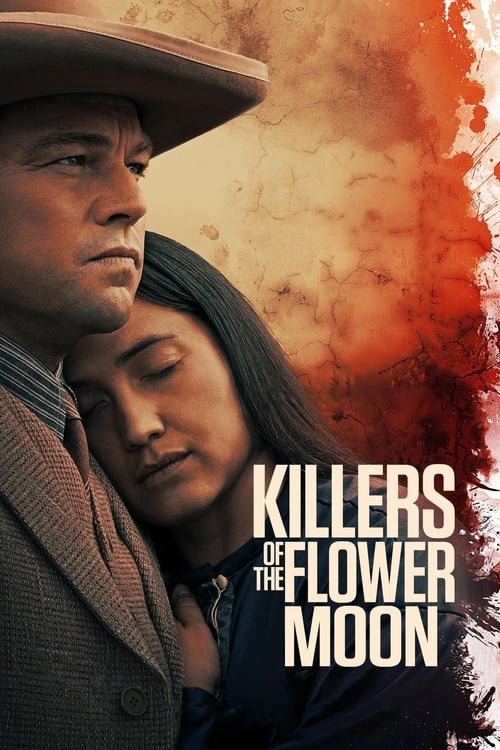
Killers of the Flower Moon
2023 · Martin Scorsese
The runtime-discourse flagship (206 minutes, "they'll pause it at home" arguments), plus serious debate about centering the white perspective in Osage history and the Lily Gladstone awards arc.
For when you want to give a whole evening to something serious — a big, devastating American story to sit with and argue about afterward, not a comfort watch.
What it's about
In 1920s Oklahoma, oil under Osage Nation land has made the Osage the wealthiest people per capita on earth — and made them targets. A drifting war veteran comes home to work for his powerful cattleman uncle, marries an Osage woman named Mollie, and gets drawn into a conspiracy as her family members begin to die, one after another, while the town looks away. It's a true-crime epic told from inside the marriage at the center of the killings.
The experience
Slow-burning, immense, and quietly horrifying — less a whodunit than a portrait of evil operating in plain daylight. At three and a half hours it demands patience and repays it with a weight very few films carry; you leave sobered, angry, and haunted.
Performances
Lily Gladstone anchors the film with a performance of extraordinary stillness and watchfulness as Mollie, while Leonardo DiCaprio plays weak-willed complicity and Robert De Niro folksy menace as well as either has ever done.
The craft
Scorsese stages the Osage murders with sweeping period detail — oil fields, prairie funerals, boomtown streets — shot in burnished widescreen by Rodrigo Prieto and driven by Robbie Robertson's bluesy, heartbeat-like final score. It's built for the biggest screen and best sound you can find.
Why it matters
A landmark late-career Scorsese picture that pushed a suppressed chapter of American history — the Osage Reign of Terror — into mainstream consciousness, and one of the defining swings of the streaming-era prestige epic.
Snapshot
A three-and-a-half-hour crime epic about the systematic murder of Osage Nation members in 1920s Oklahoma — the Reign of Terror, as it came to be known — Killers of the Flower Moon is among the most morally ambitious American films of the 2020s. Adapted from David Grann's 2017 nonfiction bestseller, the film refuses the procedural comfort of its source material, repositioning its narrative center from the FBI investigation to the intimate betrayal at the heart of the murders: a white man complicit in the killing of his Osage wife's family. It is Scorsese's longest film, his most explicitly political, and arguably his most searching inquiry into American guilt.
Industry & production
The film is a co-production between Apple Original Films and Paramount Pictures, with Appian Way (Leonardo DiCaprio's company) and Imperative Entertainment also producing. The arrangement — Apple financing the production in exchange for streaming rights after a theatrical window, with Paramount handling theatrical distribution — was a landmark deal in the ongoing negotiation between streaming platforms and cinema exhibition. Scorsese, who had written publicly and at length about the threat streaming posed to cinema culture, accepted Apple's terms while insisting on a full theatrical release; the resulting theatrical run was wide and extended, though the film underperformed at the box office relative to its reported budget of approximately $200 million. Its streaming life on Apple TV+ extended its cultural reach considerably.
Production took place substantially in Oklahoma, including on Osage Nation land, with the Osage Nation deeply involved from early development. Principal Chief Geoffrey Standing Bear and the Nation's cultural offices participated in consultation throughout; Osage language coaches and cultural advisors shaped the depiction of ceremony, dress, and domestic life. Osage community members appear extensively in the film as cast and extras. This collaboration represented an unusual degree of Indigenous institutional involvement for a major Hollywood production, and drew on lessons the industry had absorbed — unevenly — from prior controversies over representation.
Technology
Cinematographer Rodrigo Prieto shot the film on 35mm, favoring anamorphic lenses that lend the Oklahoma prairie an expansive, elegiac quality. The choice to shoot photochemically rather than digitally aligns the film with a sustained materialist tendency in Scorsese's late career — Silence (2016) and The Irishman (2019) similarly insisted on celluloid. Prieto, working with colorist Stefan Sonnenfeld, developed a warm amber palette for the Oklahoma sequences that evokes both the heat of the southern plains and something golden and tainted — prosperity built on blood. Post-production incorporated digital intermediate work for color and compositing, but the base image retains the grain and tonal range of photochemical capture.
The film's 206-minute runtime required careful theatrical presentation infrastructure. IMAX engagements were offered in select markets, though the film was not natively composed for the format.
Technique
Cinematography
Prieto's work here is among the most considered of his career. He deploys the widescreen frame to emphasize the Osage landscape as both paradise and trap — the oil derricks that crowd the horizon read as both wealth and encroachment. His most sustained achievement is the handling of interiority: long close-ups on Lily Gladstone's face carry enormous dramatic weight, the camera patient in a way that trusts the actor completely. Where Scorsese's crime films have historically used kinetic camera movement as a grammar of energy and danger, Killers of the Flower Moon is largely still. The camera watches. The dominant mode is observation rather than propulsion — fitting for a film whose subject is complicity unfolding in plain sight.
Editing
Thelma Schoonmaker, editing her thirteenth Scorsese feature, structures the film in a way that resists conventional genre momentum. The procedural excitement of Grann's book — the detective story, the revelation — is deliberately withheld. Instead, Schoonmaker and Scorsese organize the film around accumulation and dread: we know, broadly, what is happening long before the characters acknowledge it. Transitions are often abrupt in ways that compress time and foreground pattern over incident. The epilogue — a meta-cinematic radio play sequence that breaks sharply from the film's otherwise naturalistic register — required a tonal jump cut of unusual audacity.
Mise-en-scène / staging
Production designer Jack Fisk, whose long association with Terrence Malick (Days of Heaven, The New World, The Tree of Life) schooled him in the construction of American historical landscapes, builds the Osage Hills world with accumulative authenticity. The domestic spaces of the Osage families — initially prosperous, filled with the material signs of genuine wealth — are staged in contrast to the more modest or grasping spaces of white settlers. As the murders proceed, the Osage interiors feel increasingly besieged. William Hale's ranch, by contrast, radiates a provincial baronialism: the staging of his authority over the landscape and its people is architectural before it is dramatic.
The staging of Ernest and Mollie's marriage is handled with unusual delicacy. Scenes of domestic intimacy — meals, conversations, physical tenderness — are played straight, without ironic undercutting, which is what gives them their horror. The banality of Ernest's complicity requires that the love appear genuine.
Sound
Sound designer Eugene Gearty and re-recording mixer Tom Fleischman build an aural landscape defined by the industrial intrusion of the oil economy: derricks, pump jacks, the mechanical heartbeat of extraction underlying the natural soundscape. The film uses silence strategically, particularly in scenes of violence or its aftermath, where the expected sonic emphasis is withheld. Robbie Robertson's score — discussed further below — is woven into the film in ways that blur the boundary between diegetic Osage music and scored underscore.
Performance
Lily Gladstone's performance as Mollie Burkhart is the film's moral and emotional center. Playing a woman who understands, on some level, the treachery surrounding her while remaining within a relationship that is also genuinely her own, Gladstone achieves an economy of expression that reads as both cultural specificity and human universality. She had appeared in Kelly Reichardt's Certain Women (2016) and other independent productions, but Killers of the Flower Moon brought her to international prominence; her Golden Globe win — the first for an Indigenous woman — was widely regarded as historically significant.
Robert De Niro's William Hale is perhaps his most unsettling late-career work: a performance of bottomless affability that never entirely drops the mask, even in moments of exposure. DiCaprio's Ernest is more internally divided, a portrayal of moral vacancy that is less comfortable but more interesting than heroism would have been. The risk of centering DiCaprio's character — making the audience track a compromised man rather than an investigator — is one the film earns, though not without tension.
Narrative & dramatic mode
The film's central structural decision — departing from Grann's book, which takes Tom White (the FBI investigator) as its protagonist — was made relatively late in development. Eric Roth's early drafts were closer to the source material's procedural architecture. Scorsese and DiCaprio reoriented the film toward Ernest's perspective, a choice that radically changes the ethical position of the viewer. We are not given an outsider discovering corruption; we are placed inside it, adjacent to its logic. The FBI investigation, when it arrives (embodied by Jesse Plemons's Tom White), appears as a kind of genre intrusion — the expected movie reasserting itself — rather than a resolution.
The epilogue is the film's most formally daring gesture: a radio play dramatization of the trial and its aftermath, narrated by Scorsese himself (appearing on screen as a radio announcer), which briefly becomes a meditation on how such stories are told and by whom. The film then ends with an Osage ceremonial dance — a return of presence and continuity to the people whose story has been filtered through, necessarily incompletely, a Hollywood production.
Genre & cycle
Killers of the Flower Moon enters the American crime film at an angle of critique rather than contribution. Its genre affiliations — the gangster film, the Western, the historical procedural — are present as structural pressures the film works against. Scorsese's crime films have always been aware of their genre conventions; here that awareness becomes the film's explicit moral argument. The Western, in particular, haunts the film as a genre built on the erasure of exactly this kind of violence. The film belongs to a recognizable post-2010 cycle of American historical reckonings — 12 Years a Slave (2013), Moonlight (2016), Selma (2014), First Cow (2019) — that use the formal resources of prestige cinema to address the violence foundational to American identity.
Authorship & method
Scorsese's collaboration with Rodrigo Prieto (who had shot Silence and The Wolf of Wall Street for him) continues a practice of pairing with major cinematographers across multiple projects — Néstor Almendros was never Scorsese's DP, but the tradition of sustained DP relationships (Michael Chapman for Raging Bull, Michael Ballhaus for The Color of Money and Goodfellas, Robert Richardson for Casino, and Prieto now) is foundational to his visual consistency. Thelma Schoonmaker has edited every Scorsese feature since Raging Bull; her presence is constitutive of his work's rhythm and structure, not merely technical.
Robbie Robertson, who scored the film and died in August 2023 before its theatrical release, had collaborated with Scorsese since The Last Waltz (1978) and Raging Bull (1980); Killers of the Flower Moon was their deepest engagement with Native American musical materials, drawing on Osage ceremonial music and Robertson's own Mohawk heritage. The score is notably sparse and percussive, structured around drums and vocal music that give the film's most intimate scenes an undertow of ritual. The film is dedicated to Robertson.
Eric Roth's screenplay, substantially revised in collaboration with Scorsese, demonstrates the accumulated craft of a writer whose credits include The Insider (1999) and Munich (2005) — large-scale historical dramas organized around moral complicity. The structural reorientation away from the investigator-hero and toward the perpetrator-adjacent protagonist is the script's most significant departure from genre expectation.
Movement / national cinema
The film sits squarely within the tradition of American auteur cinema, specifically the strain of the prestige historical epic that has accommodated serious political intent within commercial framework — Chinatown, All the President's Men, There Will Be Blood. It is notable as a product of the streaming era's engagement with theatrical cinema: Apple's financing model, which has also supported Sofia Coppola, Alfonso Cuarón, and others, represents a new institutional structure for auteur filmmaking that displaces the traditional studio system without fully abandoning theatrical exhibition. Scorsese's public ambivalence about this arrangement — his advocacy for theatrical cinema alongside his acceptance of Apple's terms — mirrors the film's own ambivalence about the stories mainstream cinema can and cannot tell.
Era / period
The film reconstructs the early 1920s Osage Nation with considerable material specificity — the period of Oklahoma's oil boom, the Osage Reign of Terror (c. 1921–1926), and the early formation of the FBI under J. Edgar Hoover. Its release in 2023 places it in a moment of heightened national reckoning with Indigenous history in the United States and Canada: the period following revelations about residential school mass graves, the ongoing work of federal land-back movements, and increased visibility of Indigenous artists and intellectuals across cultural fields.
Themes
The film's central inquiry is into complicity and its psychological preconditions: how an ordinary man can participate in atrocity through cowardice, cupidity, and the structures of racial entitlement that make the deaths of certain people feel less real. Ernest Burkhart is not presented as a monster; he is presented as a vacuum — a man who does not resist because resistance would cost him something. This makes him, the film argues, an American type rather than an anomaly.
Alongside complicity: the intimacy of betrayal. Ernest and Mollie's marriage is, the film insists, real — and that reality is what makes the betrayal totalizing. The Osage headright system, which concentrated oil wealth in Osage hands, made Osage women targets of exactly this form of intimate theft. Mollie's progressive poisoning by her husband — arsenic administered as insulin — is the film's governing image of structural violence passing as care.
Money, land, extraction, and the conversion of Indigenous territory into American capital: Killers of the Flower Moon joins There Will Be Blood (2007) and First Cow (2019) in the company of films that place accumulation and dispossession at the origin of American prosperity. The oil derricks are not incidental; they are the film's material argument.
Reception, canon & influence
Influences on the film (backward): Paul Thomas Anderson's There Will Be Blood shadows the film's treatment of oil capitalism and American moral rot. Malick's Days of Heaven (1978) and The New World (2005) inform its handling of American landscape as both beautiful and colonized. Scorsese's own Goodfellas (1990) and Casino (1995) — organized crime as American institution — provide a template that Killers extends and critiques by foregrounding race rather than ethnicity. The Western genre, particularly John Ford's cavalry pictures, haunts the film as a counter-tradition to argue against.
Critical reception: The film received overwhelming critical praise on its world premiere at the Cannes Film Festival in May 2023 and at subsequent festival screenings. Lily Gladstone's performance was singled out in nearly every review; the structural decision to center Ernest was widely debated but generally respected as a serious formal choice. The epilogue provoked sustained critical discussion about the limits of Hollywood storytelling and Scorsese's self-awareness of them. The film was named on the majority of year-end best-of lists for 2023.
It received ten Academy Award nominations including Best Picture, Best Director, Best Actress (Gladstone), Best Supporting Actor (De Niro), Best Adapted Screenplay, Best Cinematography, Best Film Editing, Best Original Score, Best Costume Design, and Best Production Design. It won none — an outcome widely perceived as a failure of the Academy to honor work of significant moral and artistic seriousness. At the Golden Globes, Gladstone won Best Actress in a Motion Picture Drama, becoming the first Indigenous woman to receive that award.
Legacy (forward): Too recent for extended documented influence on subsequent films, though several currents are already visible. Gladstone's prominence has accelerated conversations about Indigenous representation and casting in Hollywood that had been building for years. The Apple TV+ co-production model it exemplifies has been cited as a template for financing auteur work at scale outside traditional studio arrangements. The film's formal argument — that American crime cinema must eventually confront the racial structures on which it is built — remains a provocation whose full influence on the genre is yet to be measured.
A Deleuzian reading
The camera does not move.
The full Deleuzian reading of Killers of the Flower Moon →
Reception
Premiered at Cannes 2023 to a nine-minute ovation and rode into awards season as a presumed juggernaut — then went a stunning 0-for-10 at the Oscars, with Lily Gladstone's Best Actress loss to Emma Stone still one of the most relitigated results of the decade. The film's stature hasn't dipped, but its awards shutout has become part of its story.
How Killers of the Flower Moon was received, from release to now →
Influences: the films it descends from and the films it influenced
- There Will Be Blood (2007) — Establishes the structural model of extraction capitalism as protagonist biography — a single man's moral rot filmed in wide static frames that implicate landscape in the crime — which Killers inherits and racializes by making the extraction victim an Indigenous nation.
- Days of Heaven (1978) — Néstor Almendros's magic-hour amber palette — agricultural exploitation rendered in golden light so that the crime looks transcendent — is the direct visual precedent for Rodrigo Prieto's warm Oklahoma cinematography making Osage dispossession beautiful and damning simultaneously.
- Raging Bull (1980) — The founding Scorsese-Schoonmaker collaboration establishing violence as ritualized accumulation, protagonist self-destruction mirrored in editing rhythm — a grammar Killers inherits while exchanging visceral impact for prolonged, quieter dread across three-plus hours.
- Goodfellas (1990) — Schoonmaker's accumulation editing — criminal duration chronicled through rhythmic montage rather than plot revelation — is the structural grammar Killers stretches into patient, unironic long-form chronicle, removing Goodfellas' propulsive irony.
- Casino (1995) — The embedded-perpetrator voice-over that simultaneously confesses and disavows — narrator as both architect and witness of the crime — is the direct formal model Killers complicates by distributing narration across Ernest and then finally abandoning it for the radio-drama epilogue.
- Chinatown (1974) — The noir template in which systemic land-and-power crime defeats individual moral witness — a genre architecture Killers dismantles by beginning inside the perpetrator system rather than approaching it through an external investigator.
- Little Big Man (1970) — The first major Hollywood Western to structurally invert the genre's racial logic — making Cheyenne genocide the moral measure of white civilization rather than its backdrop — a genre precedent Killers radicalizes by removing the white mediating consciousness entirely.
- McCabe & Mrs. Miller (1971) — Vilmos Zsigmond's soft anamorphic amber photography of the frontier as capitalist extraction zone — the first major American Western to name commerce rather than Indians as the structural villain — is a formal and tonal ancestor Killers revisits with explicit racial specificity.
- Heaven's Gate (1980) — The anamorphic epic Western organized around ethnic dispossession by economic interests — Zsigmond's dust-diffused amber palette, accumulative duration over action — is the commercial and formal precedent Killers revisits at comparable scale but with greater historical rigor and Indigenous agency.
- The New World (2005) — Malick's staging of colonial encounter through contrasting interior spaces — Indigenous domestic warmth versus armored settler architecture — provides a visual grammar for power imbalance that Scorsese applies directly to Osage-settler household scenes.
- Munich (2005) — Eric Roth's screenplay structure for large-scale historical crime — moral compromise accumulating incrementally across a complicit protagonist without cathartic confession — is carried directly into Killers' script architecture, the same writer applying the same moral-accumulation method.
- The Assassination of Jesse James by the Coward Robert Ford (2007) — Roger Deakins's static, wide-frame slow cinematography of the American West as elegy rather than adventure — accumulative duration replacing momentum — establishes the visual grammar of observational patience Prieto and Scorsese extend to Osage Country.
- The Power of the Dog (2021) — Ari Wegner's static observational widescreen suppresses action in favor of psychic accumulation across domestic interiors, applying the same revisionist Western logic — coercion and complicity rather than frontier heroism — that Killers scales to historical epic.
- The Irishman (2019) — Direct descendant in Scorsese's twilight-crime cycle — De Niro, Prieto's period color grading, and a mortality-soaked reckoning with complicity told through restrained, conversational staging.
Similar films
- Casino (1995) — influence & lineage · often watched together
- GoodFellas (1990) — influence & lineage
- Raging Bull (1980) — influence & lineage
- The Power of the Dog (2021) — influence & lineage
- Dances with Wolves (1990) — influence & lineage
- The Revenant (2015) — influence & lineage
- The Brutalist (2024) — same viewing thread
- The Promised Land (2023) — same viewing thread
All the films related to Killers of the Flower Moon →
Watch it with: curated runs of related films
- Great Men, Grand Reckonings — A run of prestige true stories about singular, obsessive men chasing an epochal achievement — the bomb, the moon, the checkered flag, a nation — and reckoning with what it cost them and everyone around them.