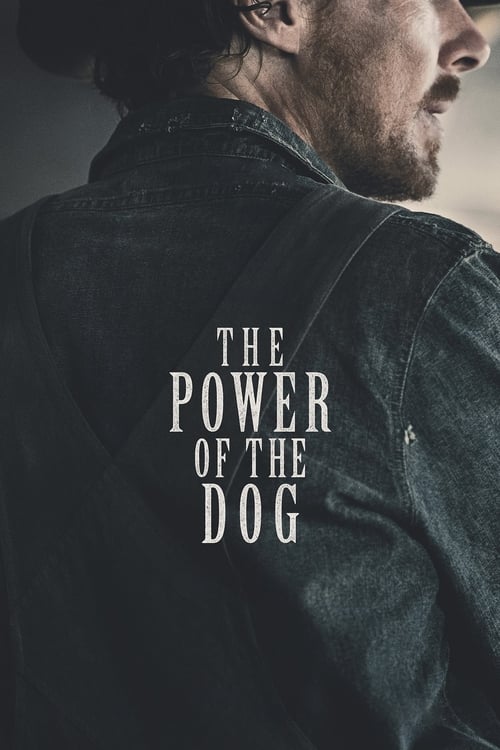
The Power of the Dog
2021 · Jane Campion
The streaming-wars Oscar proxy battle: Apple's feel-good crowd-pleaser beating Netflix's auteur favorite, plus Sam Elliott's rant and Campion's Williams-sisters gaffe — a whole season of discourse in one race.
For when you want a film to chew on for days, not comfort food — a patient, unnerving evening that pays off your full attention. Perfect for viewers who like their thrillers psychological and their westerns revisionist.
What it's about
On a Montana cattle ranch in 1925, a brilliant, cruel rancher watches his quiet brother marry a widowed innkeeper — and begins a campaign of intimidation against her and her delicate, bookish teenage son. The house fills with dread: a piano no one dares play, whistling from the top of the stairs, a boy who watches everything. What looks like a story about a bully slowly reveals other currents running underneath, and you realize you may not know who's hunting whom.
The experience
A slow, coiled watch — quiet on the surface, with menace humming under every meal and every look. It withholds and withholds, then rewards your patience with an ending that reorganizes everything you saw; expect to sit in silence when it's over.
Performances
Benedict Cumberbatch is frightening and pitiable at once as Phil, all performed roughness over something buried; Kirsten Dunst makes Rose's unraveling almost unbearable to watch, and Kodi Smit-McPhee is unforgettable as the son — still, precise, impossible to read.
The craft
Campion directs with total control: vast golden hills that dwarf the characters, interiors shot like traps, and a nerve-scraping string score that turns even a banjo-and-piano duet into warfare. The film hides its real story in plain sight, planting details that only snap into place at the end. The landscapes and sound design genuinely reward the biggest screen and best speakers you have.
Why it matters
Campion's triumphant return after more than a decade and one of the defining films of the 2020s — a revisionist western that proved the genre could hold gothic psychology, and a major awards success that cemented her legacy.
Snapshot
Set on a Montana cattle ranch in 1925, The Power of the Dog follows Phil Burbank — a violently brilliant rancher who performs roughness as a second skin — as he wages a campaign of psychological cruelty against his brother George's new wife Rose and her slight, bookish son Peter. What appears to be a study in masculine domination slowly reveals itself as something stranger and more dangerous: a gothic chess match in which the apparent victim is the most calculating player on the board. Adapted from Thomas Savage's long-undervalued 1967 novel, the film marked Jane Campion's first feature after more than a decade and stands as one of the defining works of the 2020s: a revisionist Western in the guise of a slow-burn psychological thriller.
Industry & production
The project originated with producer Tanya Seghatchian, who optioned Savage's novel. Campion wrote the screenplay herself, and the film was produced by See-Saw Films (Emile Sherman and Iain Canning), Max Films, and Bad Girl Creek in co-production with Netflix, which acquired global rights. Netflix's involvement guaranteed a large production budget and wide distribution but also shaped the film's release strategy: a limited theatrical run followed by streaming availability, a model that would generate considerable debate during awards season about whether Netflix films belonged in the traditional festival-and-theatrical ecosystem.
Campion returned to New Zealand, her home country, to shoot a film set entirely in the American West. The South Island — specifically the Otago and Canterbury regions — doubled for Montana's high plains and mountains, a substitution that required extensive production design work by Grant Major to plant the right grasses, road textures, and period-accurate ranch architecture across landscapes that otherwise read unmistakably as Aotearoa. The shoot took place in early 2020, threading through the onset of global pandemic disruptions.
Technology
Cinematographer Ari Wegner shot the film digitally on Arri cameras, taking advantage of large-format sensor capabilities to render the New Zealand high country with both grandeur and a quality of watchful menace. The choice of digital acquisition was consistent with contemporary prestige production norms while allowing Wegner to manage the extreme contrast between blazing exterior light and shuttered, lamp-lit interiors. Visual effects work was used judiciously to composite New Zealand skies and terrain elements into a coherent and consistent "Montana," and the production design and location teams worked in close collaboration to ensure that nothing in the landscape broke period credibility. The score by Jonny Greenwood was composed and recorded separately from principal photography, but its integration into the final mix — particularly its relationship to the banjo motifs Phil plays on screen — required close alignment between Greenwood, Campion, and re-recording mixer Christopher Frith.
Technique
Cinematography
Ari Wegner's work on The Power of the Dog is among the most discussed cinematographic achievements of the decade's first half. She treats the landscape as a psychological surface: the mountains that Phil gazes at obsessively conceal, to his eyes alone, the silhouetted profile of Bronco Henry, the older cowhand who mentored and — the film strongly implies — loved him. Wegner moves between two registers with unsettling ease. In the expansive exterior shots, the frame is filled with light-bleached plains and hard-edged ridgelines that communicate both freedom and exposure. In the interiors, she compresses the space: low ceilings, amber lamplight, walls that seem to press in. Close-ups are reserved strategically; when Wegner does push in on Cumberbatch or Smit-McPhee, the effect is almost suffocating. Her framing of Rose's decline — shot glasses, shaking hands, the gradual contraction of her world within the domestic space — is achieved almost entirely through mise-en-scène and camera distance rather than editorial intervention.
Editing
Peter Sciberras edited the film with a deliberate restraint that prioritizes the accumulation of atmosphere over event. Cuts are motivated by character attention rather than narrative efficiency: the film withholds and lingers. Sciberras's management of the film's dual temporal structure — the story as lived versus the story as retroactively understood — is central to its success as a thriller. Information is consistently present in the frame before the viewer knows what it means, a technique that rewards and demands re-viewing. The film's pacing has been compared to that of European art cinema, and the editorial rhythm enforces the idea that violence, in this world, is something that accrues rather than erupts.
Mise-en-scène / staging
Campion stages the film's power relations through space and sound before dialogue. Phil occupies rooms; others arrange themselves around him. His entry into any interior changes its geometry. Grant Major's production design establishes the Burbank ranch as a place of accumulated masculine mythology — hides, ropes, the soaking pit where Phil takes his private bath — set against the incongruous refinements that suggest his secret cultivation: hidden books, a beloved banjo. The ranch-house's physical layout externalizes the film's social architecture. When Rose begins to drink, her spiral is tracked through where she places herself in the house — progressively smaller rooms, progressively more marginal positions. Peter, by contrast, grows more spatially confident as the film proceeds, a shift almost entirely communicated through staging rather than exposition.
Sound
The sound design by Robert Mackenzie and the score by Jonny Greenwood are inseparable collaborators in the film's texture. Greenwood — who had previously composed for Paul Thomas Anderson on There Will Be Blood, The Master, and Phantom Thread, films all concerned in different ways with the psychology of domination — here writes music that disassembles the Western's traditional heroic register. The banjo, played diegetically by Cumberbatch (who learned the instrument for the role), appears first as a weapon of social humiliation — Phil plays it loudly when Rose attempts to perform piano — before the score gradually absorbs the instrument's timbre into something elegiac and then ominous. Greenwood's strings and prepared piano create an atmosphere of sustained unease rather than declared menace. The film is, for long stretches, very quiet, and that quiet is never neutral.
Performance
Benedict Cumberbatch's performance as Phil Burbank is a career-defining piece of physical and psychological work: a performance of performance, a man wearing roughness as armor. Cumberbatch trained extensively in cowhand skills — rope work, cattle handling, banjo — so that Phil's command of the physical world is never a shorthand or impression but a sustained embodied reality. Against this, Kodi Smit-McPhee's Peter is the film's most complex achievement. Smit-McPhee presents as androgynous, slight, and apparently naive, allowing every other character (and the audience) to misread him as the passive object of others' intentions. His stillness is not passivity but concealment. Kirsten Dunst conveys Rose's dissolution with a rigorous absence of self-pity, her performance stripped of the defenses that might invite sympathy at the cost of clarity. Jesse Plemons, as the quiet, decent George, anchors the film's moral world without ever making George its hero.
Narrative & dramatic mode
The Power of the Dog operates as a retrograde thriller: a film that can only be fully understood backward. Its narrative mode is that of the unreliable surface — what appears to be a character study of cruelty, then a story of unlikely tenderness between a bully and a boy, turns out to be a story of patient, premeditated murder. Savage's novel, and Campion's adaptation, deploy this structure to interrogate the genre conventions that condition the viewer's assumptions: that Phil, as the dominant Western male, is the agent; that Peter, as the gentle outsider, is the object. The film uses those assumptions against itself. Its dramatic mode is elliptical; it respects the viewer enough to leave critical information permanently offscreen, trusting implication over explication.
Genre & cycle
The film belongs to the tradition of the revisionist Western but extends that tradition into territory that is as much gothic and psychological thriller as it is genre Western. The revisionist Western — from the post-studio 1960s and '70s works of Peckinpah and Leone through to Altman's McCabe & Mrs. Miller (1971) — had always interrogated the mythologies of masculine frontier violence. Campion extends this lineage by centering the West's homophobia and its costs, and by treating the psychological interior as the true site of action. The film sits alongside Ang Lee's Brokeback Mountain (2005) as one of the definitive treatments of queer interiority in the Western landscape, though The Power of the Dog is more clinical and more willing to be ruthless about what that repression produces. Within the 2020s specifically, it represents a strand of prestige streaming cinema — formally demanding, festival-oriented — that has partially replaced the mid-budget adult drama once distributed by theatrical studios.
Authorship & method
Jane Campion has consistently worked with material centered on interiority, desire, and the violence that social forms do to private selves. From An Angel at My Table (1990) through The Piano (1993) and Bright Star (2009), her filmography returns repeatedly to the costs paid by people — often but not exclusively women — who cannot contain their inner lives within the spaces available to them. The Power of the Dog shifts her perspective toward the male agent of that containment, asking what it costs him too. Campion adapted Savage's novel closely in structural terms while sharpening its ambiguities; the screenplay leaves several of the novel's more explicit passages as implication, trusting the performances and Wegner's framing.
Wegner and Campion's collaboration was notable for the degree of visual preparation: extensive storyboarding and location scouting established a shared visual language before the shoot. Jonny Greenwood was engaged early, contributing thematic sketches that informed the edit as well as the final score. Editor Peter Sciberras worked in close proximity to Campion throughout post-production.
Movement / national cinema
The Power of the Dog occupies a peculiar position in national cinema terms. It is, on paper, a New Zealand–Australian co-production, shot in New Zealand, directed by a New Zealander, financed in part by Australian producers, and distributed by an American streaming platform. Its subject matter — Montana, 1925, with an American cast — sits entirely outside Antipodean cultural specificity. Yet the film carries traces of what is sometimes called the "landscape gothic" tradition in New Zealand and Australian cinema: the land as something that witnesses and resists human settlement, that carries secrets. The Otago region's light — harsh, angled, prehistoric — does something to the film that Montana itself might not have. Campion's career has always moved between New Zealand and international co-production, and The Power of the Dog is her most cosmopolitan work: genuinely transnational in its assembly, inassimilable to any single national cinema.
Era / period
The film's period setting — Montana, 1925 — places it in the twilight of the open-range West, when the frontier mythology was already becoming available for nostalgic performance. Phil Burbank is explicitly a man who performs an earlier era's cowhand identity while his brother deploys the newer manners of Eastern respectability. The 1920s setting allows Savage and Campion to explore how the codes of Western masculinity were already, by that point, a kind of theater — a set of gestures inherited and maintained rather than organically inhabited. The film has no nostalgia for this world; the landscape is beautiful and the culture it harbors is shown to be lethal.
Themes
The film's central preoccupation is the cost of concealment: what is destroyed, in oneself and in others, by the lifelong performance of a self one does not inhabit. Phil's cruelty toward Rose and toward what Peter represents is the cruelty of a man who cannot afford to recognize his kinship with them. The film is also, precisely, about masculine knowledge and its weaponization: Phil uses classical learning as a private superiority and cowhand skill as a public one; Peter uses medical knowledge to kill. The question of who is civilized and who is dangerous is kept systematically open. Secondary themes include the mythology of masculine mentorship (Bronco Henry as absent ideal), the Gothic West as space of buried desire, and the violence of class performance in a supposedly classless frontier society.
Reception, canon & influence
The Power of the Dog premiered at the Venice Film Festival in September 2021, where Campion won the Silver Lion for Best Direction. It screened at Telluride and Toronto before its Netflix release in November 2021, accompanied by an overwhelmingly positive critical response. At the 94th Academy Awards (2022), the film received twelve nominations — the most of any film that year — and won one: Best Director for Campion, making her only the third woman to win in that category and the first to have received the nomination twice, following her earlier nod for The Piano. The film did not win Best Picture (that award went to CODA), and its presumed frontrunner status collapsing in the ceremony's final hours generated considerable critical commentary. It won BAFTA Best Film and Best Direction. Cumberbatch, Smit-McPhee, Dunst, and Plemons all received acting nominations across major ceremonies.
Looking backward, the film's most direct precursor is Savage's source novel, which had never been adapted and which the film restored to wide readership. Formally and thematically, Brokeback Mountain had made the queer Western critically legible, and Campion builds on that cultural permission while working in a mode darker and less sentimentalized than Lee's film. The gothic interiority of the performances and the slow-cinema structural patience recall both Bresson and Haneke, while the landscape's relationship to psychological life connects the film to Campion's own earlier work. Peckinpah's deconstructed Western masculinity and Altman's drifting observational mode are visible influences on its genre sensibility.
Looking forward, the film's legacy is still settling. It accelerated Ari Wegner's emergence as one of the most sought-after cinematographers of her generation. Jonny Greenwood continued a run of psychologically complex period film scores. For Campion, it confirmed that her standing as one of cinema's essential voices had survived two decades of sporadic feature output. The film's Netflix release model contributed to ongoing industry debate about the relationship between prestige streaming cinema and theatrical exhibition. As a work, it seems likely to remain a reference point for any future attempt to reconcile the Western's inherited generic power with the psychological complexity that genre has long, and often violently, suppressed.
A Deleuzian reading
Phil Burbank looks at a mountain and sees a dog.
The full Deleuzian reading of The Power of the Dog →
Reception
Landed at Venice 2021 as an instant critics' darling (Campion took the directing prize) while half the audience called it slow and plotless; then it led the Oscars with 12 nominations and won just one — and losing Best Picture to CODA has only grown into a 'the Academy got it wrong' talking point since.
How The Power of the Dog was received, from release to now →
Influences: the films it descends from and the films it influenced
- Au Hasard Balthazar (1966) — Bresson's performance grammar of non-expression — suppressing demonstrative affect so viewers must infer interior states from posture and gaze alone — is the direct formal ancestor of Cumberbatch's concealed-interiority technique as coached by Campion; Phil Burbank's blank social surface over volcanic inner life is Bressonian modeling applied to the Western.
- McCabe & Mrs. Miller (1971) — Vilmos Zsigmond's long-lens observation and layered diegetic sound design — ambient noise foregrounded over score — deflate Western heroism from a distance, establishing the anti-mythologizing observational mode and the use of diegetic sound as psychological register that Campion's revisionist Western directly inherits.
- Picnic at Hanging Rock (1975) — Russell Boyd's soft-focus, backlit photography of the Australian landscape as a site of uncanny psychological threat — geography exceeding realism — establishes the antipodean landscape-gothic mode that Campion enters and transforms; the diegetic pan-flute ambience as environmental unease is the direct precursor of Campion and Greenwood's diegetic-score-integration strategy.
- The Piano (1993) — Campion's own structural template: Stuart Dryburgh's photography of the New Zealand coastal landscape as externalization of repressed desire, backstory revealed through accumulation rather than exposition, and a protagonist whose interior life exceeds the social container available to them — all three devices are carried directly and consciously into The Power of the Dog.
- Brokeback Mountain (2005) — Rodrigo Prieto's wide-angle landscape photography spatializes repressed desire across Wyoming terrain, and Lee's formal treatment of homosexual longing performed as Western masculinity creates the critical and commercial permission — for a queer Western to be a major awards drama — that Campion builds on while working in a darker, less sentimentalized register.
- There Will Be Blood (2007) — Jonny Greenwood's score integrates a gramophone playing Brahms into the diegesis before expanding into composed dissonance — establishing the diegetic-score-integration technique he reprises directly for Campion — while Daniel Day-Lewis's embodied performance of Plainview's concealed interior life through physical behavior is the immediate precursor to Cumberbatch's method for Phil Burbank.
- The White Ribbon (2009) — Haneke's retrograde thriller structure — presenting a community's unreliable social surface while withholding the violent truth beneath until the final frames — and his use of strategic silence within long static takes as a tension mechanism directly inform Campion's elliptical narrative architecture and her refusal of generic resolution.
- The Assassination of Jesse James by the Coward Robert Ford (2007) — Roger Deakins's selective-focus anamorphic cinematography renders the Western landscape as psychological portrait — vignetted edges, shallow depth, compressed space — while the retrograde thriller structure (the audience knows the outcome from the title) and Bob Ford's concealed interiority as narrative mystery run formally and philosophically parallel to Campion's approach to Phil and Peter.
- Far from the Madding Crowd (2015) — Ari Wegner's anamorphic landscape framing in which terrain externalizes male desire and psychological coercion — mountains and valley as index of emotional pressure on other characters — develops the facet of anamorphic-landscape-as-psychological-surface that Bruus Christensen established in FFTMC's Dorset compositions.
- The Hateful Eight (2015) — Campion deploys the revisionist Western as psychological chamber thriller, with Ari Wegner's 2.39:1 anamorphic framing that traps characters in confrontational horizontal tableaux — a proscenium blocking model formally descended from The Hateful Eight's staging grammar — and the widescreen Western space functions as a containing frame rather than an expansive one.
- Hell or High Water (2016) — Campion occupies the prestige neo-Western space Hell or High Water helped legitimate, pushing landscape-as-psychological-argument further with Ari Wegner's anamorphic New Zealand exteriors doubling Montana, and extending the Cave-Ellis sonic template through Jonny Greenwood's score of ambient tension and folk melancholy.
- Wind River (2017) — Ari Wegner's patient anamorphic wide frames, Jonny Greenwood's ambient-texture score, and contained-affect masculine repression rendered through procedural tension extend the neo-western emotional register Wind River helped consolidate — the formal vocabulary refined to a literary pitch.
- Spencer (2021) — Ari Wegner, who shot The Power of the Dog, brings the identical interior-compression grammar to the royal estate: corridors and rooms as instruments of surveillance, architectural confinement mapping psychological entrapment, and a palette that desaturates toward emotional extremity — a direct transfer of visual language and method between the two back-to-back collaborations.
- TÁR (2022) — Field and Florian Hoffmeister deploy concealed interiority as the central narrative engine — Blanchett's Lydia Tár performs mastery while deterioration is revealed through behavioral ellipsis and strategic withholding — extending Campion's technique of an unreliable surface over a slowly revealed psychological truth, held within an art-cinema pace that refuses generic escalation or catharsis.
- Women Talking (2022) — Polley and Luc Montpellier use spatial confinement — the barn as the entire world — and heavy desaturation to concentrate psychological and political power in compression, extending the gothic interior-compression strategy Campion and Wegner develop; strategic silence and art-cinema pacing replace conventional dramatic acceleration in a film equally committed to the costs of concealment.
- Meek's Cutoff (2010) — Reichardt shoots in the 1.33:1 Academy ratio to diminish human figures within landscape rather than heroicize them, deploys elliptical withholding by ending before any resolution, and inverts spatial power relations through gendered observation — revisionist Western formal strategies that run in precise parallel to Campion's demolition of genre convention.
- First Reformed (2017) — Schrader explicitly deploys Bressonian performance — Hawke suppressing all demonstrative affect so spiritual dissolution is inferred rather than displayed — within a retrograde thriller structure where the inner crisis is the mystery being solved; the cold visual grammar and strategic silences share the Bresson-through-Haneke lineage that Campion also inhabits.
- The Rider (2017) — Zhao casts actual Lakota rodeo riders as themselves, building performance from real embodied skill mastery — Brady Jandreau's genuine horsemanship and rodeo expertise are the dramatic material — directly paralleling Campion's insistence that Cumberbatch master banjo-playing and lasso-work as the performance foundation for Phil Burbank's concealed identity.
- Portrait of a Lady on Fire (2019) — Sciamma's eyeline choreography — systematically alternating who holds the gaze across shot-reverse-shot compositions — constructs power dynamics and their reversals without dialogue, paralleling Campion's staging method in which spatial arrangement and camera position encode Phil's dominance and Peter's slow, deliberate reclamation of the room.
- Hamnet (2025) — Marries painterly natural-light landscape photography to a suppressed-emotion domestic drama scored as sustained interiority, the same prestige-naturalist register Hamnet occupies.
- Train Dreams (2025) — Anti-mythic western of restrained interiority in which the landscape itself operates as a psychological presence rather than backdrop.
- The Revenant (2015) — Revisionist western using wide-angle landscape photography (Ari Wegner) as psychological and spiritual medium, demythologizing frontier masculinity through the same arid-landscape-as-antagonist grammar that The Revenant applies to winter wilderness and colonial trauma.
- Phantom Thread (2017) — Campion's gothic psychological inversion uses slow 35mm accumulation of behavioral detail building to a retroactive restructuring of all prior power readings — the same formal patience against contemporary editing norms, and the same structural move of concealing the woman's (here the man's) strategic agency until the final act.
- Killers of the Flower Moon (2023) — Ari Wegner's static observational widescreen suppresses action in favor of psychic accumulation across domestic interiors, applying the same revisionist Western logic — coercion and complicity rather than frontier heroism — that Killers scales to historical epic.
- First Cow (2020) — Sibling reconceiving the Western around repressed intimacy, ranch labor and material process instead of violence — the same demythologizing move First Cow makes.
- The Promised Land (2023) — Shares the anti-Western grammar of restrained menace and refined-versus-brute class opposition, landscape-dominated compositions, and a sparse dissonant score doing the psychological work in place of dialogue.
Similar films
- TÁR (2022) — influence & lineage
- The Piano (1993) — influence & lineage
- The White Ribbon (2009) — influence & lineage
- Brokeback Mountain (2005) — influence & lineage
- No Country for Old Men (2007) — shared sensibility
- Dances with Wolves (1990) — shared sensibility
- White Dog (1982) — shared sensibility
- Blue Heron (2026) — shared sensibility
All the films related to The Power of the Dog →