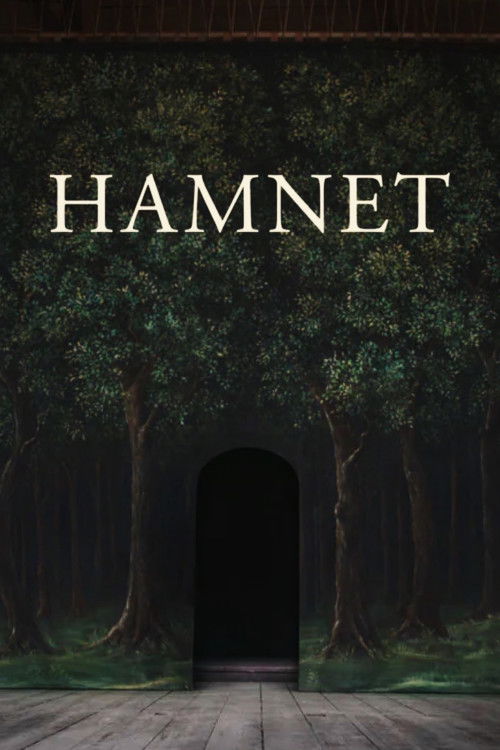
Hamnet
2025 · Chloé Zhao
Lived the decade's whiplash arc — Nomadland's Best Picture sweep to Eternals' "first rotten Marvel movie" pile-on, plus erasure in China over old interview quotes — before the Hamnet redemption narrative. A case study people cite about auteurs and franchise machinery.
When you need a good cry — the real, cathartic kind — and want it earned by craft rather than manipulation. One for a quiet evening when you're willing to feel everything.
What it's about
Stratford in the late 1500s: Agnes, a woman with a healer's knowledge of woods and herbs, builds a marriage with a young Latin tutor who will become the most famous writer in the English language — though the film pointedly keeps its eyes on her, not him. At the center is their son Hamnet, and the grief that engulfs the family when he is lost — and, years later, the strange alchemy by which private devastation becomes a play the world still performs. It's a story about a marriage, a mother, and where art actually comes from.
The experience
Tender, earthy, and ultimately shattering — it moves at the pace of seasons and handwork, then lands blows of grief that leave audiences audibly weeping. For all the sorrow, it ends somewhere closer to grace than despair.
Performances
Jessie Buckley's Agnes is the film: wild, intuitive, and devastating in grief, a performance of rare physical and emotional force. Paul Mescal matches her as a husband who can only say what he feels through other people's mouths.
The craft
Chloé Zhao brings her feel for natural light and landscape to the sixteenth century, making the period tactile — mud, herbs, wool, candle-smoke — rather than a costume pageant. Adapted from Maggie O'Farrell's beloved novel, it trusts faces and silence over speeches, and its final movement is a genuine coup of staging.
Why it matters
A centerpiece of its awards season and proof of Zhao's range, it turned a quiet literary bestseller into one of the most emotionally talked-about films of the year.
Snapshot
Hamnet is Chloé Zhao's adaptation of Maggie O'Farrell's 2020 novel, a work of historical imagination that reroutes the most over-narrated life in English literature away from its famous subject and toward the woman and child at its margins. The film takes as its premise a documented but barely glossed fact: that William Shakespeare and Agnes (the name O'Farrell prefers for Anne Hathaway) had a son, Hamnet, who died in 1596 at the age of eleven, and that some four years later his father wrote a tragedy whose title is the same name in another spelling. From that proximity O'Farrell and Zhao build a study of marriage, rural craft-knowledge, maternal grief, and the alchemical, half-indecent transformation of private loss into public art. Jessie Buckley plays Agnes and Paul Mescal plays William; the film deliberately keeps Shakespeare unnamed for much of its runtime, refusing him the gravitational pull his name usually exerts. It premiered at Telluride in August 2025, won the People's Choice Award at the Toronto International Film Festival, and became a central title of the 2025–26 awards season — Zhao's most conventionally "literary" project and, paradoxically, a return to the elemental naturalism she had set aside for studio work.
Industry & production
The film was financed in the roughly $30–35 million range (per trade reporting) and assembled from a notably prestigious producing coalition: Amblin Entertainment, with Steven Spielberg and Sam Mendes among the producers, alongside Mendes and Pippa Harris's Neal Street Productions, Liza Marshall's Hera Pictures, and Book of Shadows. Focus Features acquired worldwide rights in 2024, with Universal Pictures handling international distribution — a configuration that positioned a comparatively intimate, non-genre period drama as a flagship specialty release. Principal photography ran from late July to the end of September 2024, shooting in Wales and in Herefordshire, England, with the village of Weobley standing in for sixteenth-century Stratford and the London Charterhouse used for metropolitan scenes. A decision emblematic of the production's sensibility: rather than film at Shakespeare's Globe, production designer Fiona Crombie built a replica playhouse on the Elstree backlot, on the reasoning that the surviving reconstruction was too ornate for the film's restrained palette. Casting was by Nina Gold, a near-guarantor of British prestige-drama pedigree.
Technology
Hamnet is technologically conservative by design, and that conservatism is itself the statement. Zhao and cinematographer Łukasz Żal pursue a digital image that reads as available-light naturalism — the windows, hearths, and overcast Herefordshire skies doing much of the lighting work — in keeping with Zhao's documented preference for shooting around magic hour and within real environments. The most consequential technical choice is the avoidance of large-scale digital spectacle: after the world-building VFX of Eternals, Zhao returns here to a near-tactile register where weather, candlelight, and landscape supply the effects. The constructed Globe is a practical set rather than a digital extension, and the period reconstruction is handled through production design and costume (Malgosia Turzanska) rather than through CGI augmentation. Where the record is thin on specific camera and capture details, the consistent critical observation is of a "painterly," soft-contoured image that borders on the supernatural without ever announcing a manufactured effect.
Technique
Cinematography
Łukasz Żal — the Polish cinematographer of Ida, Cold War, and The Zone of Interest — is arguably the single most important creative decision after the casting. His work for Zhao fuses two instincts that might seem opposed: the rigorous, stately framing he is known for and the loose, weather-driven naturalism that is Zhao's signature. Reviewers consistently describe imagery that is sweeping yet intimate, with the English countryside rendered as something "uncharted" and faintly otherworldly, while the human scenes retain an earthbound, tactile quality that keeps Agnes rooted in soil, plants, and bodies. The stated effect is to "disabuse the drama of any staginess" — a real risk for a Shakespeare film — by treating the natural world as the primary text and the playhouse as a late, almost alien intrusion. The collaboration marks a meaningful evolution: Zhao's earlier features were shot by her longtime partner Joshua James Richards, and pairing instead with Żal grafts a more composed, classical eye onto her observational base.
Editing
Affonso Gonçalves cut the film with Zhao. Gonçalves brings an art-cinema lineage (a frequent collaborator of Todd Haynes and Benny & Josh Safdie, among others), and the editorial architecture of Hamnet is structured around a long withholding and a final release: the narrative patiently accumulates domestic detail and the texture of the marriage before pivoting, in its last movement, to the London premiere of Hamlet. The decisive editorial gesture is the convergence of the family's buried grief with the play's performance — a crosscutting of memory and stage that the film has spent two hours preparing. The reframing of the ending (see Sound) suggests the cut was responsive and evolving late into post-production rather than locked to the screenplay.
Mise-en-scène / staging
Crombie's design and Zhao's staging organize the film around a sustained opposition: the horizontal, organic world of Agnes — herb-gardens, woodland, the threshold of the family home — against the vertical, enclosed, performative world of the playhouse and the city. Agnes is repeatedly framed amid growing things and weather; she is a healer and a reader of the natural order, and the staging treats her knowledge as a form of authority equal to her husband's literacy. The Globe, built rather than borrowed and deliberately under-decorated, arrives as a space of artifice that both betrays and redeems private feeling. Domestic interiors are kept low, dark, and candle-scaled, so that the eventual opening-out into the theater lands as a shift in the film's entire spatial logic.
Sound
The score is by Max Richter, and its making is unusually well documented for a recent film. Richter composed roughly thirty minutes of music before and during the shoot, played on set to establish tone for cast and crew — an inversion of the usual workflow in which scoring follows the edit. The most cited detail is biographical and collaborative: Buckley introduced Zhao to Richter's 2004 composition "On the Nature of Daylight," which was then incorporated into the film, and which reportedly prompted Zhao to reframe the original ending. The piece — already among the most-licensed pieces of contemporary "post-classical" music, used in Shutter Island and Arrival — carries its own accreted associations with loss, and its presence here knits the film into a recognizable lineage of cinematic grief-scoring. Beyond the score, the sound design leans on the elemental: wind, fire, birds, the breathing room of rural silence against the roar of a theater crowd.
Performance
Performance is the film's center of gravity, and the early critical consensus singled out Buckley above all. Her Agnes is built from physical intelligence rather than rhetoric — a woman whose authority is bodily and intuitive and whose grief, when it comes, is total. Mescal's Shakespeare is conceived against type: recessive, withholding, his genius kept almost entirely offscreen so that his eventual act of writing reads as both betrayal and tribute. The supporting ensemble — Emily Watson as Mary Shakespeare, Joe Alwyn as Agnes's brother Bartholomew, and the young actors Jacobi Jupe (Hamnet) and Olivia Lynes (Judith, his twin) — anchors the household in a credible web of obligation and class. The film's wager is that two interior, anti-declamatory lead performances can carry a Shakespeare subject without a single great-man speech, and the reception suggests the wager paid off.
Narrative & dramatic mode
The dramatic mode is domestic tragedy refracted through artistic creation — a "how the art got made" story told from the perspective of the person the art exploits. Structurally the film is a slow-burn melodrama in the dignified sense: it builds emotional pressure through accumulation rather than incident, then discharges it in a cathartic final movement. Its boldest formal choice is to keep Shakespeare's name and Shakespeare's words almost entirely suppressed until the end, so that the eventual eruption of Hamlet's language onstage arrives as a genuine shock — the private suddenly made monstrous, public, and immortal in a single gesture. O'Farrell's novel famously withholds Shakespeare's name throughout, and the film translates that conceit into staging and structure. The result is a tragedy about the moral cost of turning grief into beauty, narrated by the woman asked to pay it.
Genre & cycle
Hamnet sits at the intersection of three cycles. First, the literary-biographical period drama — the prestige adaptation of an award-winning contemporary novel (O'Farrell's book won the Women's Prize for Fiction and the National Book Critics Circle Award), a reliable awards-season form. Second, the "Shakespeare's life" film, a small but persistent genre running from Shakespeare in Love (1998) through Anonymous (2011) and All Is True (2018); Hamnet pointedly inverts the genre by decentering the playwright. Third, and most distinctively, the contemporary cinema of grief and feminine interiority — a cycle to which O'Farrell's source belongs and which the film extends. Its closest kin are not other Shakespeare films but recent works of maternal loss and elemental landscape.
Authorship & method
The film is a study in productive tension between Zhao's authorship and a markedly more "designed" production apparatus than she had previously worked within. Zhao's method — observational, landscape-driven, attentive to non-professional textures and the rhythms of labor — is legible throughout, especially in Agnes's world of herbs and weather. But here it is harnessed to a tightly scripted adaptation co-written with the novelist herself, a rare and telling collaboration: O'Farrell's co-authorship suggests the film aimed to preserve the book's specific moral architecture rather than reinvent it. The key collaborators reposition Zhao deliberately. Łukasz Żal supplies a classical compositional rigor her earlier DP did not; Affonso Gonçalves brings an art-house editorial sensibility; Max Richter's pre-composed, on-set score is integral rather than applied; Fiona Crombie's design literalizes the film's thematic geography. The Amblin/Neal Street/Hera producing alliance — Spielberg and Mendes among the names — frames Hamnet as Zhao's reconciliation of indie naturalism with mainstream prestige, after the divergent experiment of Eternals.
Movement / national cinema
Hamnet is a transnational production with a British creative core and an American distribution-and-financing spine. It belongs recognizably to the tradition of British literary heritage cinema — the period adaptation, the rural-English landscape, the theatrical-pedigree ensemble — while its authorship is that of a Chinese-born, internationally trained director working in the American independent-to-studio system, photographed by a leading figure of Polish art cinema and scored by a German-British composer. This hybridity is characteristic of contemporary prestige filmmaking, in which "national cinema" categories dissolve into globally assembled coalitions. If it has a home movement, it is less a national school than the present moment's transnational auteur-prestige cinema, where festival-launched dramas are built from internationally sourced craft talent.
Era / period
The film depicts the 1580s–1590s in and around Stratford-upon-Avon and London, with the 1596 death of Hamnet and the circa-1600 composition of Hamlet as its temporal poles. Its evocation of the period emphasizes the material and the somatic over the heritage-pageant: plague, childbirth, herbal medicine, agricultural labor, and the precarious economics of a family whose absent father works in the distant, disreputable London theater. The recreated Globe and the period London scenes are handled with deliberate restraint, the film privileging the lived rural everyday over courtly spectacle — a choice that aligns the picture with revisionist period filmmaking that foregrounds women's and laborers' experience rather than great events.
Themes
The governing theme is the transmutation of grief into art, and the ethical ambivalence of that act — the suggestion that Hamlet is at once a father's deepest tribute to a lost son and an appropriation of a shared, private sorrow for public consumption. Around it cluster: maternal loss and the non-linear, bodily duration of mourning; marriage as a negotiation between two forms of knowledge (Agnes's intuitive, natural literacy against William's verbal genius); the unequal visibility of women in the historical record, recovered here by an act of narrative restitution; and naming itself — the spectral closeness of "Hamnet" and "Hamlet" — as the film's central metaphor for how the dead are kept and lost in language. The final movement reframes all of these: when Agnes watches the play, isolation gives way to a shared communal grief, and the appropriation she resents becomes, ambiguously, a gift.
Reception, canon & influence
Critical reception was strongly positive from its Telluride premiere onward, with reported aggregate scores indicating broad acclaim and near-universal singling-out of Buckley's performance as the film's defining achievement; multiple critics framed it as among the most emotionally overwhelming films of its year. The signal institutional event was its Toronto People's Choice Award — Zhao's second, after Nomadland in 2020 — a result that immediately positioned Hamnet as a leading title of the 2025–26 awards season, given that prize's strong recent correlation with Best Picture recognition. (Specific final awards tallies should be treated cautiously here; the film entered the season as a front-runner and a major Buckley showcase, and the precise outcomes are best confirmed against the awards record rather than asserted.)
The influences on the film are clear and layered: O'Farrell's novel is the proximate source, behind which stand the documented biographical record of the Shakespeare family and four centuries of Hamlet itself; Zhao's own landscape-naturalist filmography supplies the visual grammar; Żal's art-cinema compositional tradition and Richter's already-canonical "On the Nature of Daylight" supply, respectively, the look and the emotional key. Its forward influence is still emerging and therefore genuinely thin to assess this close to release, but its likely contribution is twofold: as a high-profile model for the "decentered biography" — telling a famous life through the person history overlooked — and as further evidence that intimate, naturalistic grief-dramas can occupy the center of awards-season prestige. Within Zhao's own authorship, it reads as a synthesis: the reconciliation of her independent naturalism with a fully resourced prestige production, and a return to the human scale after a studio detour.
A Deleuzian reading
Watch her hands.
The full Deleuzian reading of Hamnet →
Reception
Landed as the sob-heard-round-the-festival-circuit — it won the TIFF People's Choice Award in September 2025 and instantly became the Best Picture frontrunner, before awards season recast it as the noble runner-up: Jessie Buckley took Best Actress while One Battle After Another swept Picture and Director. It's also read as Chloé Zhao's triumphant return to form after Eternals.
How Hamnet was received, from release to now →
How to watch Hamnet: what to notice on a first viewing
- Watch Agnes's hands working with herbs and plants. Buckley builds the character from the body: crouching, gathering, pressing a leaf to a fever, reading weather off the sky. She is a healer, and her authority arrives as physical knowledge rather than speech. The film ranks her knowledge level with her husband's literacy, and it makes that case through posture.
- Look at how low and wide the country scenes sit. Lukasz Zal keeps Agnes horizontal, framed among growing things, weather and woodland, with soft-contoured light that borders on the uncanny without announcing an effect. The camera stays on the ground with her. The natural world is being treated as the main text. Keep the shape of these frames in mind for later.
- Watch how dark the house interiors are kept. Windows, hearths and overcast Herefordshire skies do most of the lighting. The rooms are low, brown and scaled to candles. Fiona Crombie and Zhao refuse any large digital effect. Weather and candlelight are the only effects in this film. That restraint is what keeps the drama off the stage.
- Notice how rarely the husband says anything memorable. Mescal plays him recessive and withholding, and the film keeps his name out of the dialogue for most of its length. His writing happens offscreen. No character in this picture makes a great speech. Taking the famous man's name away removes his gravity, and the film belongs to the household instead.
- Listen for wind, fire and birds carrying whole scenes. Max Richter wrote about thirty minutes of music before and during the shoot and it was played on set. Around it the track is rural silence: weather, animals, work. Nothing is padded. The music was in the room while the acting happened, which is why score and performance sit at the same temperature.
The whole guide to watching Hamnet, with the keys for a rewatch →
Influences: the films it descends from and the films it influenced
- The Rider (2017) — Establishes Zhao's available-light, non-professional-texture method of filming labor and weather as interior states — the grammar she imports to Agnes's herb-and-field world.
- Nomadland (2020) — Her own template for harnessing observational landscape naturalism to a single grieving consciousness, the synthesis Hamnet scales up to a resourced prestige production.
- Ida (2013) — Łukasz Żal's static, painterly compositions built on rigorous horizontal-vertical balance — the classical compositional discipline he brings to Hamnet's candle-scaled interiors.
- Cold War (2018) — Żal's available-light photography fused to an elliptical, withholding narrative structure that elides time across emotional ruptures, prefiguring Hamnet's suppression of key events.
- Days of Heaven (1978) — The founding model of magic-hour available light and elemental landscape (wind, fire, harvest) treated as the drama's emotional register rather than backdrop.
- The Tree of Life (2011) — Crosscutting between domestic grief over a lost child and elemental/cosmic imagery, with sound design woven into a near-liturgical score — the structural ancestor of Hamnet's grief montage.
- Don't Look Now (1973) — Associative, fragmentary crosscut editing organized around the death of a child, where the cut itself carries the grief — the editorial logic behind crosscutting-grief-and-stage.
- Shutter Island (2010) — First prominent placement of Max Richter's 'On the Nature of Daylight' in cinema, fixing the cue as a signifier of irrecoverable loss that Hamnet inherits as its emotional key.
- Arrival (2016) — Deploys Richter's 'On the Nature of Daylight' as a grief leitmotif bracketing a nonlinear narrative about a dead child — the exact musical-structural move Hamnet reprises.
- Shakespeare in Love (1998) — Founded the popular Shakespeare-life fiction as a genre; Hamnet defines itself against it by decentering the playwright and suppressing his name.
- Carol (2015) — Affonso Gonçalves's glance-based, withholding editorial restraint — cutting on suppressed feeling and deferred revelation — the art-house cutting sensibility he carries into Hamnet.
- The Lost Daughter (2021) — Pairs Gonçalves's past/present crosscut structure with Jessie Buckley's physical-intelligence performance of maternal anguish — the same editor-and-actor craft combination Hamnet centers.
- The Tragedy of Macbeth (2021) — Renders Shakespeare through stark geometric staging and candle-scaled, light-sculpted interiors built on horizontal-vertical opposition — the design vocabulary shared with Hamnet's theater and home.
- Aftersun (2022) — Builds grief from a withholding, elliptical structure and a recessive lead performance that buries feeling beneath surface calm — the Mescal-register restraint Hamnet extends.
- All of Us Strangers (2023) — Channels Paul Mescal's quiet, recessive presence into a domestic mourning drama that lets absence rather than incident carry the tragedy.
- The Power of the Dog (2021) — Marries painterly natural-light landscape photography to a suppressed-emotion domestic drama scored as sustained interiority, the same prestige-naturalist register Hamnet occupies.
Similar films
- All of Us Strangers (2023) — influence & lineage
- Carol (2015) — influence & lineage
- Manchester by the Sea (2016) — same viewing thread
- Room (2015) — same viewing thread
- Little Women (2019) — often watched together
- Ghostlight (2024) — shared sensibility
- Hamlet (1996) — shared sensibility
- The Notebook (2004) — shared sensibility
All the films related to Hamnet →
Watch it with: curated runs of related films
- When the Family Comes Undone — Watch these when you want intimate, one-household dramas where love and grief are the same thing — a parent fading, a marriage on trial, a child at the center of the wreckage.