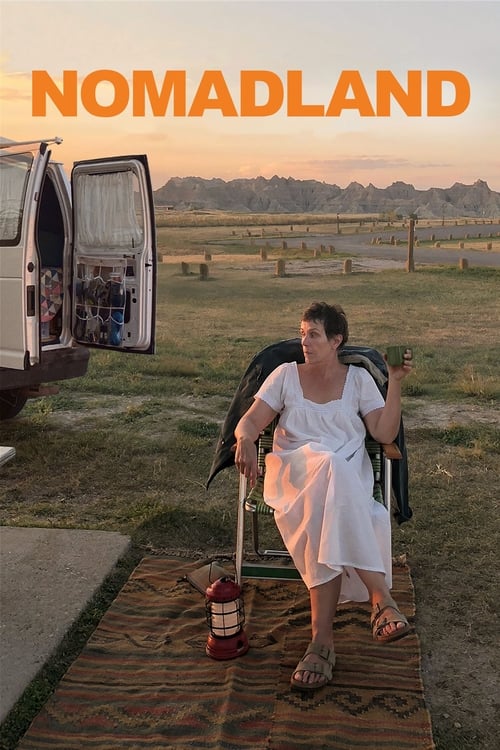
Nomadland
2021 · Chloé Zhao
Lived the decade's whiplash arc — Nomadland's Best Picture sweep to Eternals' "first rotten Marvel movie" pile-on, plus erasure in China over old interview quotes — before the Hamnet redemption narrative. A case study people cite about auteurs and franchise machinery.
For a contemplative evening when you want something gentle but true — a film about loss and freedom to sit with, not a plot to chase. Comfort and ache in equal measure.
What it's about
After the gypsum plant closes and her Nevada company town literally disappears from the map, Fern — a widow in her sixties — converts a van into a home and joins the seasonal migrant workforce drifting across the American West. She picks up shifts at an Amazon warehouse, a beet harvest, a roadside diner, moving with the weather and the work. Along the way she falls in with a loose community of older van-dwellers, most of them real nomads playing themselves, who trade repairs, campfire stories, and hard-won philosophy.
The experience
Quiet, unhurried, and unexpectedly warm — it moves at the speed of a long drive, all magic-hour light and wind on rock. Grief runs under everything, but the film keeps offering small human kindnesses, and it leaves you tender rather than wrecked.
Performances
Frances McDormand disappears into Fern, doing real labor alongside real nomads and letting her face carry what the script leaves unsaid; the non-actors — Linda May, Charlene Swankie, Bob Wells — are so unguarded you forget the line between documentary and fiction. David Strathairn brings a shy, hopeful sweetness as the one man who might tempt Fern off the road.
The craft
Chloé Zhao shoots real places and real people with a documentary patience, then edits it into something closer to an elegy — vast Western landscapes at dusk, a piano score that swells without pushing. The seams between fiction and ethnography are nearly invisible. The horizons and light are worth the biggest screen you have.
Why it matters
It swept the top prizes of its awards season — including Best Picture and a historic directing win for Zhao — and became the defining film about the human cost of the Great Recession, pushing its blend of actors and real subjects into the mainstream.
Snapshot
Nomadland is a fiction feature built on a documentary armature: Frances McDormand plays Fern, a widow in her sixties who, after the gypsum plant and the company town of Empire, Nevada, collapse in the wake of the 2008 financial crisis, converts a van into a home and joins the seasonal migrant workforce of older Americans who move across the West chasing wages and warmth. Adapted by Chloé Zhao from Jessica Bruder's 2017 nonfiction book Nomadland: Surviving America in the Twenty-First Century, the film casts real van-dwellers — Linda May, Charlene Swankie, and the movement's de facto evangelist Bob Wells — as versions of themselves alongside two professional actors, McDormand and David Strathairn. The result sits at the seam between neorealist ethnography and lyric elegy, and it became one of the most decorated American films of its decade, winning Academy Awards for Best Picture, Best Director, and Best Actress. It is a work about American precarity that refuses the register of protest, choosing instead grief, endurance, and the consolations of landscape.
Industry & production
The project originated not with the director but with the star. McDormand and producer Peter Spears optioned Bruder's book and brought Zhao aboard on the strength of her second feature, The Rider (2017). That producorial lineage matters: Nomadland is a McDormand vehicle in the deepest sense — she produced it, embedded herself in the nomad community, and by her own account worked seasonal jobs during preparation. The film was produced through a coalition including Zhao, McDormand, Spears, Mollye Asher, and Dan Janvey, and financed and released by Searchlight Pictures (the former Fox Searchlight, absorbed into Disney), which positioned it squarely as prestige awards cinema despite its modest scale and improvisational method.
It premiered at the Venice Film Festival in September 2020, where it took the Golden Lion, then won the People's Choice Award at the Toronto International Film Festival days later — a rare double that effectively announced it as a front-runner months ahead of release. Because of the pandemic, its U.S. rollout in February 2021 was a hybrid theatrical-and-Hulu release, a distribution pattern that shaped its reception as much as any aesthetic choice. Reliable, granular box-office figures for such a pandemic-window release are not the point of this film's commercial story and I will not invent them; its cultural footprint was driven by the awards circuit and streaming access rather than ticket sales.
One production-adjacent episode belongs in the record: after Zhao's Best Director win, older comments she had made about China resurfaced and the film's planned Chinese release was effectively shelved amid state censorship, an irony given that Zhao is a Beijing-born filmmaker celebrated globally that year.
Technology
Technologically the film is notable for its restraint rather than innovation. It was shot largely with available and natural light, favoring the "magic hour" windows at dawn and dusk, using compact digital cameras that permitted the small crew to work quickly inside vans, around campfires, and across vast exteriors without the apparatus of a conventional production. The film moves fluidly between staged scenes and near-documentary capture of real gatherings — most importantly Bob Wells's Rubber Tramp Rendezvous in the Arizona desert — which required a lightweight, mobile rig capable of following non-actors who were not hitting marks. The technological signature, in other words, is a deliberate lightness: equipment chosen to disappear so that the boundary between performance and life could blur.
Technique
Cinematography
Joshua James Richards, Zhao's regular cinematographer and creative partner, shot the film, and his work is central to its identity. Richards frames Fern against enormous Western skies and terrain — the Badlands of South Dakota, the Nevada high desert, the Nebraska plains, the Pacific coast at Cannon Beach — using wide compositions in which the human figure is small but never diminished. He leans heavily on the low, raking light of dawn and dusk, so that faces and rock formations alike are modeled in warm, transient gold. The camera is frequently handheld and observational, trailing Fern through fulfillment-center aisles or desert camps, yet it can also hold still for landscape tableaux that verge on the sublime. The overall effect fuses the intimacy of documentary with the pictorial grandeur of the Western.
Editing
Zhao edited the film herself, as is her practice, and the cutting is patient and associative rather than propulsive. Scenes are allowed to breathe; the film accumulates through vignette and encounter — a stranger's story, a shared meal, a departure — rather than through a tightly geared plot. Transitions often move by landscape and light, letting the highway and the horizon carry the passage of time and season. The editing's restraint is what gives the film its elegiac tempo: it withholds climax, trusting rhythm and repetition to register the cyclical, itinerant life it depicts.
Mise-en-scène / staging
The staging strategy is the film's boldest formal gamble: real nomads occupy the frame as themselves, telling their own histories, while McDormand's scripted Fern moves among them. The interiors — chiefly Fern's van, packed with the salvaged objects of a former life — are dense with lived-in detail, and much of the drama is staged in genuine locations (Amazon's CamperForce operation, a real beet harvest, Wall Drug, the desert rendezvous) rather than sets. Zhao stages encounters loosely, favoring what feels caught over what feels blocked, so that the mise-en-scène reads as found reality lightly shaped toward story.
Sound
The soundscape privileges wind, engine, gravel, and the ambient noise of camps and warehouses — the acoustic texture of a life lived largely outdoors and in transit. Against this naturalism sits the score, which is unusual and worth stating precisely: rather than an original composition, the film draws predominantly on pre-existing solo piano works by the Italian composer Ludovico Einaudi. His spare, repetitive, tonal pieces function as a recurring emotional undertow. This choice — using a body of already-published music rather than a bespoke score — is characteristic of the film's found-object sensibility, though it also drew some critical debate about how insistently the piano guides the viewer's feeling.
Performance
The performance ecology is the film's great achievement. McDormand submerges a major star into a naturalistic register, playing Fern with a weathered economy — small gestures, watchfulness, a refusal of self-pity — that allows her to share the frame with non-actors without overpowering them. Strathairn, as the fellow nomad Dave who offers Fern a possible settled life, provides the film's only other trained-actor counterweight. But much of the emotional force comes from the real nomads: Swankie's monologue about facing mortality and Bob Wells's closing reflection on grief and reunion carry documentary authenticity that no script could fabricate. The tension between McDormand's crafted stillness and their unaffected testimony is the film's living center.
Narrative & dramatic mode
Dramatically, Nomadland operates in an episodic, elliptical mode closer to the picaresque and the elegy than to conventional three-act storytelling. Its through-line is grief — Fern is mourning both her husband and the erased town of Empire — but the film advances by way of encounter and season rather than escalating conflict. There is a soft romantic possibility with Dave, and a recurring question of whether Fern will or should "settle," yet the film consistently declines the resolutions those threads promise. Its dramatic proposition is that a life of continual motion is not a problem to be solved but a chosen condition, and that endings in this world are rephrased as "see you down the road." The mode is contemplative realism: interiority conveyed through landscape, labor, and small human exchange rather than through plot machinery or explanatory dialogue.
Genre & cycle
The film participates in several genres at once. It is a road movie, tracing a circuit of the American West; it is a revisionist Western, treating the frontier not as a site of conquest but of contemporary economic exile; and it is a work of docufiction or hybrid cinema, in the lineage of films that blend real subjects with scripted narrative. Within the specific cycle of post-2008 American independent film concerned with recession, downward mobility, and the fraying of the working and middle classes, Nomadland is a landmark — the entry that carried that cycle's concerns to the summit of mainstream recognition. It belongs, too, to a strain of contemplative, landscape-driven American indie cinema that prizes atmosphere and observation over incident.
Authorship & method
Zhao's authorship is defined by a consistent, portable method rather than a fixed genre. Across her first three features — Songs My Brothers Taught Me (2015), The Rider (2017), and Nomadland — she casts non-professionals playing near-versions of themselves, immerses herself in a real community, and shapes a fiction from its members' actual lives and words, shot in natural light on real ground. Nomadland is the fullest realization of that approach, distinguished by the introduction of a major star into the ethnographic frame.
Her key collaborators are integral to the authorship. Joshua James Richards, her cinematographer and partner, gives the films their light and their vision of American space; he had already shot The Rider, so Nomadland extends an established visual language. As editor, Zhao controlled the film's rhythm directly, reinforcing that the elliptical shape is an authorial signature, not a post-hoc rescue. As screenwriter, she adapted Bruder's reportage — itself built from years of embedded journalism — into a fictional protagonist while preserving the book's real figures and its sociological substance. On music, the reliance on Einaudi's existing catalog rather than a commissioned composer is another authorial decision consistent with her found-reality method. And McDormand functions as a quasi-authorial force herself, having initiated the adaptation and produced it. Zhao's subsequent immediate move — directing Marvel's Eternals the same year — underscores by contrast how singular and hand-built the Nomadland method was.
Movement / national cinema
Nomadland is most usefully read within American independent cinema, but its DNA is transnational. Zhao, born and raised in China and educated in the United Kingdom and United States, imports the observational patience associated with international art cinema into an intensely American subject. The film's clearest ancestral movement is Italian neorealism, whose foundational tactic — casting non-professionals in stories drawn from their own social conditions — Zhao adopts wholesale. It also sits comfortably in the international festival tradition of slow, landscape-attentive realism. That a film so thoroughly American in setting won its top honors while being authored by a Chinese-born, foreign-trained director is itself a statement about the porousness of "national cinema" in the contemporary festival-and-streaming ecosystem.
Era / period
The film is precisely dated to its historical moment and self-conscious about it. Its inciting condition is the aftermath of the 2008 Great Recession, dramatized through the real 2011 shuttering of the U.S. Gypsum plant in Empire, Nevada — a company town so erased that, as the film's opening title notes, its zip code was discontinued. Fern's subsequent labor at an Amazon fulfillment center (Amazon's real CamperForce program) roots the story in the gig-and-warehouse economy of the 2010s. The film thus documents a specific era of American economic life: post-industrial collapse, precarious seasonal work, and the aging of a generation whose retirement security evaporated. Its release in the pandemic winter of 2020–21, into a country freshly reacquainted with economic fear and isolation, gave its themes an unplanned contemporary charge.
Themes
Its governing themes are grief and impermanence — Fern's mourning is the emotional engine, and the nomad life is presented as a way of living alongside loss rather than escaping it. Closely bound to this is the dignity of the precariat: the film insists on the competence, self-respect, and mutual aid of people the wider economy has discarded. It draws a careful distinction, voiced in the film, between being "homeless" and "houseless," reframing van life as a chosen identity rather than mere destitution. Freedom and its costs form another axis — the open road offers liberation from a system that has failed these characters, but also loneliness, physical hardship, and the ache of severed ties. Underpinning all of this is the American landscape itself as a moral and spiritual space, and a persistent meditation on memory, on what we carry of the dead and the places that no longer exist.
Reception, canon & influence
Critically, Nomadland was among the most acclaimed films of its year, praised for its humanism, McDormand's performance, and Richards's cinematography, though a minority of critics questioned whether its lyricism softened the harsher political realities of Bruder's reporting — particularly its relatively gentle depiction of Amazon. Its awards record is the clearest index of its standing: the Golden Lion at Venice and the People's Choice Award at Toronto, followed by a near-complete sweep of the season, including top honors from the Golden Globes and BAFTA, and Academy Awards for Best Picture, Best Director, and Best Actress from six nominations (the additional nods came in adapted screenplay, cinematography, and editing). The wins carried historical weight: Zhao became the second woman, and the first woman of color, to win the Best Director Oscar, and McDormand won her third acting Oscar while also collecting Best Picture as a producer.
Looking backward, the film's influences are legible and deep. Italian neorealism supplies its casting philosophy. The films of Kelly Reichardt — with their Western settings, economic marginality, and unhurried observation — are a natural American antecedent, as is the landscape mysticism and golden-hour lyricism associated with Terrence Malick. Documentary traditions of the road and of American labor inform its texture, and Agnès Varda's attention to society's gleaners and overlooked people offers another touchstone. Most directly, Zhao's own The Rider is its immediate predecessor, establishing the method the film perfects.
Looking forward, Nomadland's legacy is still consolidating, so claims about its influence should be made with appropriate humility. What can be said firmly is that its triumph validated the hybrid docufiction model at the highest level of industry recognition, expanded the visibility of that mode within prestige cinema, and marked a watershed for female and Asian authorship at the Oscars. It also elevated Zhao and Richards as a defining visual partnership and confirmed McDormand's late-career authority as both actor and producer. Whether it spawns a durable school of imitators or stands as a singular high-water mark is a judgment the coming years, not this dossier, will settle.
A Deleuzian reading
Late in the day the light comes in low across the Badlands and falls on Fern's face the way it falls on the rock behind her.
The full Deleuzian reading of Nomadland →
Reception
Swept the pandemic-era 2021 season — Golden Lion at Venice, TIFF People's Choice, then Best Picture — but its stock has since dipped: it's now a favorite example in 'weakest recent Best Picture winner' conversations, remembered as much for the strange empty-room Oscars year as for itself.
How Nomadland was received, from release to now →
How to watch Nomadland: what to notice on a first viewing
- Notice how often the light is low and gold, dawn or dusk. Joshua James Richards shoots in that narrow window at both ends of the day. Fern's face and the rock behind her take the same warm light, and it goes fast in both cases. A face and a cliff get equal standing in the frame. Neither one is scenery for the other.
- Watch how small Zhao lets Fern stand in the frame. Richards frames her against huge skies and open ground, then follows her handheld through warehouse aisles and desert camps. The wide shots never shrink her. She occupies the space without filling it. You learn to read her state from where she stands, because the film almost never explains her in dialogue.
- Listen for wind, gravel, and engines under most of the film. The track is mostly weather and work: camps, warehouses, tires on highway. Then Ludovico Einaudi's solo piano arrives, taken from records he had already released, and tells you plainly how to feel. Two sound worlds run side by side. One reports the life. The other leans on you, and you can hear it leaning.
- Watch Fern's hands at work: sorting, hauling, cleaning, fixing. McDormand did the real jobs alongside real workers, and plays Fern with small gestures and no self-pity. Nobody says the word recession. The hands and the shifts carry the economics. The film puts its argument in bodies instead of speeches, so you watch labor rather than listen to a case.
- Look at what Fern keeps inside the van. The van is packed with salvaged objects from a life that stopped. Zhao shot in genuine locations throughout, and this interior is the one place where the old life is allowed to sit. You are never shown Empire or the marriage. You are shown what she carried out of both and still hauls around.
The whole guide to watching Nomadland, with the keys for a rewatch →
Influences: the films it descends from and the films it influenced
- Bicycle Thieves (1948) — Established the neorealist casting philosophy Zhao inherits—building a fiction around non-professionals playing socially near-versions of themselves on real locations rather than studio sets.
- La Terra Trema (1948) — Model of the director embedding in an actual community (Sicilian fishermen) and shaping narrative from its members' real speech and labor—the ethnographic-fiction method Zhao ports to the nomad camps.
- Days of Heaven (1978) — Almendros/Malick's magic-hour, available-light shooting of vast American landscape as lyric subject is the direct visual grammar Richards extends in Nomadland's wide dusk exteriors.
- The Gleaners and I (2000) — First-person docufiction that dignifies society's discarded people and scavengers—the humanist attention to the economically overlooked that shapes Nomadland's regard for its subjects.
- Two-Lane Blacktop (1971) — Existential American road movie cast partly with non-actors and structured around drift rather than destination, prefiguring the picaresque, plotless mobility of Fern's route.
- Chop Shop (2007) — American neorealism shot vérité-style with non-professionals playing near-versions of themselves inside a real working economy—the U.S. transplant of the casting method Zhao perfects.
- Wendy and Lucy (2008) — Unhurried, observational minimalism about economic precarity on the American margin, with elliptical scene construction and refusal of melodrama that anticipates Nomadland's rhythm.
- Meek's Cutoff (2010) — Revisionist Western that treats Western landscape as an indifferent, endured expanse rather than heroic backdrop—the demythologized frontier space Nomadland reoccupies with vans instead of wagons.
- Songs My Brothers Taught Me (2015) — Zhao's debut originates her portable method—immersion in a real community (Pine Ridge) and a fiction drawn from residents' lives shot in natural light—that Nomadland completes.
- The Rider (2017) — Immediate predecessor: Richards's already-established natural-light visual language and the non-professional-playing-himself approach that Nomadland adopts wholesale, adding only a star.
- American Honey (2016) — Immersive road movie cast largely from non-professionals discovered on location, shot handheld inside a precarious itinerant economy—parallel docufiction of American drift.
- The Florida Project (2017) — Docufiction of post-recession poverty blending non-professionals with a single known star, using magic-hour lyricism to hold beauty and hardship in the same frame.
- Aftersun (2022) — Extends the elliptical, memory-shaped editing and restrained naturalistic performance that Nomadland validated at prestige level, building emotion from omission rather than exposition.
- Hamnet (2025) — Her own template for harnessing observational landscape naturalism to a single grieving consciousness, the synthesis Hamnet scales up to a resourced prestige production.
- Certain Women (2016) — Contemporaneous Montana-set study of quiet, marginal women's lives using wide static landscape framing and withheld drama—the same low-key Western realism register.
- First Cow (2019) — Revisionist Western built on naturalistic performance, patient observation, and the frontier as site of fragile economic survival rather than conquest.
- Showing Up (2022) — Continues the shared observational-realist school—undramatic daily labor, naturalistic ambience, and elliptical dailiness as narrative substance rather than plot.
- Sirāt (2025) — Embeds a non-professional itinerant cast inside real desert communities and terrain, the docu-fiction casting-in-landscape method Laxe shares.
- Train Dreams (2025) — Elegiac American-West landscape cinematography married to near-documentary, restrained performance tracing solitude and loss across a life.
- Never Rarely Sometimes Always (2020) — American neorealism blending a professional lead with nonprofessionals playing themselves along a road of transient labor — the docu-fiction naturalism Hittman shares in the same season.
- Bones and All (2022) — A naturalistic landscape road film of American outsiders living at the economic margins, dignity found in movement and dusk-lit exteriors of the plains.
- The Intouchables (2011) — The most direct heir to the film's scoring signature: Ludovico Einaudi's minimalist solo-piano pieces deployed as emotional needle-drops rather than bespoke underscore.
- Captain Fantastic (2016) — Vehicle-as-house pushed to its endpoint — stop-by-stop episodic structure, magic-hour available light, and non-professionals playing versions of themselves so that opting out registers as a documented condition rather than a staged position.
Similar films
- American Honey (2016) — influence & lineage
- Certain Women (2016) — influence & lineage
- The Rider (2018) — same viewing thread
- Minari (2021) — often watched together
- Dogville (2003) — often watched together
- My Own Private Idaho (1991) — often watched together
- No Other Land (2024) — shared sensibility
- Honeyland (2019) — shared sensibility
All the films related to Nomadland →
Watch it with: curated runs of related films
- Grief with Nowhere to Land — Watch these together when you can sit with loss — widows, addicts, and lost children drifting through worlds that refuse to hold still.