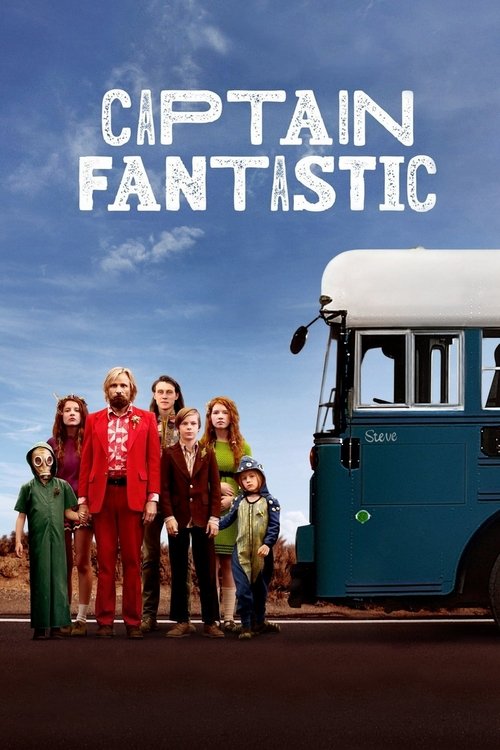
Captain Fantastic
2016 · Matt Ross
For when you want a film to argue with — about parenting, principles, and what we owe our kids — that still delivers warmth, laughs and a good cry. Thoughtful comfort with real friction in it.
What it's about
Deep in the Pacific Northwest woods, Ben Cash is raising six kids on rock climbing, knife skills, radical politics and serious books — a homemade utopia sealed off from consumer America. When a family tragedy forces them onto a converted bus and down into the world of supermarkets, suburbs and grieving in-laws, every collision with ordinary life puts Ben's whole project on trial. The question the film keeps turning over: is he the best father imaginable, or a well-read tyrant?
The experience
Funny, prickly and genuinely moving, often in the same scene — it lets you fall for this strange brilliant family and then keeps complicating your sympathies. It's a road movie with an argument at its center, and it respects you enough not to settle it cleanly.
Performances
Viggo Mortensen earned an Oscar nomination for making Ben magnetic and maddening at once — you believe both the children's devotion and the damage. George MacKay stands out among the kids as the eldest son, worldly in books and helpless in the world.
The craft
Matt Ross writes each roadside encounter as a genuine test rather than a straw man, so the comedy keeps drawing blood. The lush forest photography against fluorescent suburbia does quiet thematic work, and the family's shared music-making pays off in one of the film's loveliest passages.
Why it matters
A Sundance-launched sleeper that became a word-of-mouth favorite and a staple of arguments about off-grid living and modern parenting, and it announced actor Matt Ross as a director of real substance.
Snapshot
Captain Fantastic is a road movie built around an argument that never quite resolves. Ben Cash (Viggo Mortensen) has raised six children in the forests of the Pacific Northwest on a regimen of rock climbing, knife work, Marxist theory and close reading, insulated from consumer capitalism and, not incidentally, from anyone who might contradict him. When his wife Leslie dies by suicide in a hospital far from their homestead, the family boards a converted bus and drives south to crash her funeral and enforce the Buddhist instructions of her will. The journey is structured as a sequence of collisions — with a suburban sister's household, with a wealthy and grieving father-in-law, with a teenage girl at a campground, with an emergency room — and each collision tests the project Ben has built. The film's real subject is not wilderness but pedagogy: what it costs children to be raised as the proof of a parent's thesis.
Written and directed by Matt Ross, better known at the time as a character actor, it premiered at Sundance in January 2016, won the directing prize in Un Certain Regard at Cannes that May, and earned Mortensen his second Academy Award nomination for Best Actor. It has had a long, unusually persistent afterlife on streaming, and a contested critical one.
Industry & production
The film is a textbook artifact of the mid-2010s American specialty market: low-budget independent financing, a Sundance premiere as the primary market event, an acquisition by a boutique distributor, and a platform release aimed at the arthouse-plus-crossover audience. It was produced through ShivHans Pictures and Electric City Entertainment, with Lynette Howell Taylor, Jamie Patricof, Shivani Rawat and Monica Levinson among the producers — a producing cohort associated with exactly this scale of character-driven American independent. Bleecker Street, then a very young distributor, took US rights out of Sundance.
Ross wrote the script over a period of years and developed it well outside the studio system; nothing about the material — a two-hour dramedy about grief, homeschooling and Noam Chomsky, with six child leads — was commercially obvious. Principal photography took place in Washington State for the homestead and forest material and in New Mexico for much of the road, in 2015. The casting of the six children was the production's central logistical problem and its central creative bet: the film depends on the audience accepting them as a functioning unit with shared training, shared vocabulary and shared physical vocabulary, which meant the ensemble had to be assembled for compatibility rather than individually.
On commercial performance I want to be careful rather than precise: the film's American specialty release was modest, and it was proportionally more successful in Europe — France especially — where it read as a critique of American consumer culture from the inside. I am not going to attach figures to that impression; the widely circulated numbers vary by source and I would rather leave the shape of the result than a false decimal.
Technology
The film's most interesting technological fact is negative. It is a contemporary story, set in the mid-2010s, in which the protagonists have no screens, no phones, no internet — and the film shoots them as if that absence were a physical condition rather than a lifestyle choice. The children's ignorance of pop culture is played for comedy (a nephew's video game, a cousin's phone), but the deeper effect is that the Cash family occupies a media environment roughly a century old: books, instruments, and each other. The film arrives at the precise moment of smartphone saturation and treats that saturation as the ambient antagonist, never named directly.
On the production side, the film is a lightweight, mobile shoot: forest exteriors carried largely by available light, a practical bus interior used as a rolling stage, and a naturalistic lighting approach that keeps the woodland material soft and unlit-looking. I am not confident enough in the acquisition format to state it; sources differ, and Stéphane Fontaine has worked in both photochemical and digital registers across this period, so I will describe the look rather than assert the negative.
The distribution technology matters more than the capture technology here. Captain Fantastic is one of the mid-2010s independents whose cultural footprint was made almost entirely after theatrical release, through streaming and word of mouth — a film that became a reference point in arguments about education, parenting and off-grid living years after its specialty run had closed.
Technique
Cinematography
Stéphane Fontaine shot the film, and his presence is the single most consequential craft decision. Fontaine came to it from Jacques Audiard (The Beat That My Heart Skipped, A Prophet, Rust and Bone) and Paul Greengrass (Captain Phillips), and in 2016 he also delivered Verhoeven's Elle and Larraín's Jackie — an extraordinary cluster of tonally opposed work in a single year. What he brings is a documentary-adjacent handheld that never becomes agitated: the camera stays close to bodies in motion, follows rather than anticipates, and reserves stillness for confrontation.
The compositional strategy is consistent. In the forest, the family is repeatedly framed as a single organism in wide shots — six children and a father moving through green depth, the group legible as a unit. In the world outside, the framing fractures them: doorways, car windows, institutional corridors, the flat symmetries of suburban interiors and the manicured geometry of the grandparents' estate. The palette runs warm greens and earth tones in the woods against cooler, flatter, more evenly lit exteriors on the road. The opening deer hunt establishes the whole grammar in a few minutes: mud-camouflaged stillness, a sudden violent close-up, and then a wide that restores the boy to the landscape as a changed thing.
Editing
Joseph Krings, who had cut Ross's first feature, edits in an episodic road-movie rhythm — a chaptered structure of arrivals and departures across roughly two hours. The opening movement is a training montage in disguise: hunting, calisthenics, climbing, the reading circle, the physical drill, all establishing a regime so thoroughly that the audience is complicit in admiring it before the plot begins to dismantle it. That front-loading is the film's key structural gamble; it buys the sympathy that the second half spends.
The harder editorial problem is tonal. The film moves between broad comedy (the supermarket shoplifting operation, the "Noam Chomsky Day" gift-giving) and unmediated grief within single sequences. Krings tends to solve this by letting confrontation scenes run — the dinner table at the sister's house, the argument with Jack — playing them in longer takes and wider coverage, so that the comedy is allowed to curdle in real time rather than being cut away from.
Mise-en-scène / staging
The homestead is a designed argument: hand-built structures, salvaged materials, tarps and rope and books, a space that reads as competent rather than squalid. The bus, named Steve, functions as the family's portable institution — bunk, library, dining room, seminar. Against these, the film sets two contrasting environments, both slightly stacked: the beige, screen-lit suburban interior of Ben's sister and brother-in-law, and the wealth-signalling order of Jack's house.
Costume, by Courtney Hoffman, does much of the ideological work. The family's homemade and thrifted clothing is deliberately anachronistic and slightly ceremonial; when they enter the outside world they are always, unavoidably, in costume. The funeral sequence — the family arriving in color, in defiantly wrong formalwear, at a church observing a Christian rite the deceased explicitly rejected — is the film's clearest instance of blocking as argument: one group seated and still, another standing and moving, the aisle between them as the film's actual battle line.
Sound
Jónsi and Alex Somers — the Sigur Rós vocalist and his longtime collaborator — provide a score of processed guitar, drone and wordless vocal texture. It is used sparingly, and interestingly it is more often deployed for elation and motion than for sorrow; the film mostly declines to underline its grief.
The emotional engine is diegetic. This is a family that plays instruments, and the performances carry the weight the score refuses: campfire playing, the children's harmonies, and above all the funeral-pyre rendition of "Sweet Child o' Mine," which converts a stadium-rock cliché into an act of ritual by having it played, badly and sincerely, by children burning their mother's body. The sound design draws the same line the images do: forest ambience — wind, water, birdsong, the granular noise of a working camp — against the hum of refrigeration, air conditioning, traffic and television in the world below.
Performance
Mortensen builds Ben out of competence and stillness. It is a performance of authority that only reveals its brittleness when authority stops working; the beard operates as a mask, and the late scene of its removal is the most efficient piece of character information in the film. His best work is in the refusals — his flat insistence on telling his children the literal truth about their mother's death, delivered without euphemism or comfort, which the film presents simultaneously as integrity and as cruelty.
George MacKay's Bodevan is the film's second protagonist and its most legible tragedy: a young man with six Ivy League acceptances and no idea how to speak to a girl, whose central outburst — that everything he knows came from books and therefore he knows nothing — states the film's thesis out loud. Nicholas Hamilton's Rellian supplies the internal dissent, the child who has simply stopped agreeing. Shree Crooks, as the youngest daughter delivering a startlingly sophisticated reading of Lolita, gets the film's best single comic-serious beat. Frank Langella plays Jack as a grieving man rather than an antagonist, which is essential — the film's argument only works if the opposition is intelligent — while Kathryn Hahn and Steve Zahn are calibrated toward comedy and consequently absorb most of the criticism that the film stacks its deck.
Narrative & dramatic mode
Formally this is a road movie carrying a domestic melodrama, in a tragicomic register. Its inciting event is off-screen: Leslie is dead before the first frame, and exists in the film only as speech, memory, and a legal document. That absence is structurally clever — the will functions as a set of instructions driving the third act, and the mother becomes a text to be interpreted, which is exactly the family's mode of relating to everything.
The underlying pattern is the tested-utopia narrative: establish the ideal state, expose it to the world, watch it fail, negotiate terms. Each episode is staged as a debate with a stake — the Bill of Rights quiz at the sister's house, the dinner-table exchange about capitalism, the hospital, the custody threat. What complicates it is that Ben wins most of the debates and still loses the argument; the film's method is to let his positions be correct while their consequences accumulate on his children's bodies. The turn comes not from a counter-argument but from an injury.
The ending has been the most contested element: the family in a farmhouse, children boarding a school bus, Bodevan gone traveling. Read one way it is a mature compromise; read another it is a soft landing that lets Ben keep the aesthetics of his life after surrendering its logic. The film is genuinely ambiguous about which it intends, and that ambiguity is either its subtlety or its evasion depending on the critic.
Genre & cycle
The film sits at the intersection of the American independent family dramedy — the Sundance line running through The Squid and the Whale and Little Miss Sunshine, complete with the eccentric-family-in-a-vehicle structure — and a much older strain of American fiction about the patriarch who takes his family into the wilderness to escape a corrupted civilization. Its most direct ancestor is Peter Weir's The Mosquito Coast (1986), from Paul Theroux: Allie Fox is Ben Cash without the self-awareness or the survival.
It also belongs to a distinct mid-2010s cluster of works about children raised in ideological or physical isolation: Crystal Moselle's documentary The Wolfpack (2015), Taika Waititi's Hunt for the Wilderpeople (2016), and shortly afterward Debra Granik's Leave No Trace (2018), which critics have persistently used as the austere corrective to this film's romanticism.
Authorship & method
Matt Ross came to directing sideways, through a substantial acting career (American Psycho, Good Night, and Good Luck., Big Love, and Gavin Belson on Silicon Valley), with one prior feature, 28 Hotel Rooms (2012). He has spoken in interviews about having been raised partly in communes and alternative communities, and about the film originating in his own anxieties as a parent — which explains the film's most distinctive quality: it is written from inside the belief system rather than from outside it. The satire of the Cash family is affectionate and specific in a way that satire from a non-participant rarely is.
His key collaborators pull the film in productive directions. Fontaine's European naturalism keeps the material from tipping into whimsy, which given the costumes and the deadpan children was a live risk — several critics reached for Wes Anderson comparisons anyway. Krings's episodic cutting preserves the debate structure. Jónsi and Alex's score provides warmth without sentiment. Hoffman's costumes carry the ideology. It is a film whose craft team is doing tonal governance more than anything else.
Movement / national cinema
This is American independent cinema of the post-2010 institutional model — festival-launched, boutique-distributed, streaming-sustained — but its crew composition is transnational in the way that has become standard at this budget level: a French cinematographer, Icelandic composers, a British lead among the children.
Thematically it is unmistakably American. Ben's project descends from Emerson and Thoreau, from nineteenth-century utopian communalism, from the back-to-the-land movements of the 1960s and 70s, and from the contemporary homeschooling and unschooling milieu. Its critique of processed food, medication, obesity and consumer passivity is an American self-critique, which is very likely why the film traveled better abroad than at home.
Era / period
Set in the mid-2010s and shot in 2015, the film registers a specific post-2008, post-Occupy American mood: institutional distrust, ambient anti-capitalism, and a rising cultural fascination with opting out. Ben's politics — Trotsky, Chomsky, the celebration of Noam Chomsky Day in place of Christmas, complete with knives as gifts — place him on a recognizable left, but the film is shrewd about how closely his practice resembles right-libertarian survivalism. Released in the American election year of 2016, it landed in a moment newly attentive to that convergence.
The period detail that dates it most precisely is the absence of phones from the family's hands at exactly the moment the rest of the frame filled with them.
Themes
The governing opposition is education against socialization — whether raising children to be exceptional is compatible with raising them to be able to live. Adjacent to it: knowledge versus wisdom, articulated most directly by Bodevan; honesty as a form of violence, in Ben's refusal of euphemism about suicide; and the recurring failure mode of every utopian community, which is that it depends on a founder whose charisma cannot be questioned from inside.
The film is quieter but not silent about class. Ben and Leslie chose this life; they had the education and the resources to opt out, and their children did not choose anything. The grandparents' wealth is presented as corrupting, but it is also the safety net that makes the confrontation survivable. Beneath all of it is a study of masculine authority under grief — a father whose entire competence is physical and intellectual, confronting the one problem that neither can address.
Reception, canon & influence
Reception was broadly favourable and genuinely divided in an interesting way. The praise centered on Mortensen, on the children's ensemble, and on the film's willingness to take ideas seriously as dramatic material. The recurring criticism was that the deck is stacked: the suburban household is caricatured, the "normal" alternatives are made unattractive, and the film's late chastening of Ben is followed by an ending that lets him keep most of what he wanted. A related complaint concerned the tonal swings between farce and bereavement. Rather than attach quotations I cannot verify, I will note that the argument itself — critique or romance? — is the film's durable critical signature, and it has not settled.
The awards record is clear: Ross won the directing prize in Un Certain Regard at Cannes in 2016, and Mortensen was nominated for the Academy Award for Best Actor, along with Golden Globe, BAFTA and Screen Actors Guild nominations, losing the Oscar to Casey Affleck for Manchester by the Sea.
Looking backward, the film's lines of descent run to The Mosquito Coast for the doomed patriarch, to Sidney Lumet's Running on Empty (1988) for the near-identical third-act mechanism of a radical family's eldest child being offered a conventional future he must betray them to accept, to Little Miss Sunshine for the vehicle-bound family comedy, and to the transcendentalist literary tradition the characters themselves quote.
Looking forward, its clearest legacy is as a fixed point of comparison. Leave No Trace is routinely discussed against it, and the pairing has become a small critical genre in itself — one film that dramatizes off-grid life as a debate, one that dramatizes it as a condition. It has become a standing reference in popular arguments about homeschooling, unschooling and screen-free parenting, cited by people on both sides who watched the same footage and drew opposite conclusions. For Mortensen it consolidated a late-career run as a leading man in mid-budget American drama, leading to Green Book two years later and, in 2020, to Falling, his own directorial debut about a difficult father. For Ross, the film remains his signature work as a director; his subsequent output has been largely in television. Its most lasting achievement may simply be that it made an argument film that audiences kept re-watching, without ever telling them who won.
A Deleuzian reading
A boy lies face-down in the mud with his skin streaked to match it, holding still.
The full Deleuzian reading of Captain Fantastic →
Reception
A Sundance crowd-pleaser that won Matt Ross the Un Certain Regard directing prize at Cannes and carried Viggo Mortensen to a Best Actor Oscar nomination, it split critics between 'moving' and 'smug' — a split that never really resolved, it just calcified into two camps.
How Captain Fantastic was received, from release to now →
How to watch Captain Fantastic: what to notice on a first viewing
- Watch the family framed as one shape in wide forest shots. Fontaine holds the father and six children together in green depth; once they leave the woods, doorways and car windows break them apart. The camera itself tracks how the family stays whole in the woods and gets pulled apart outside it.
- Notice the family's homemade, thrifted clothes whenever they enter towns or houses. Courtney Hoffman's costumes look ordinary in the forest but read as ceremonial and strange the moment the Cashes step into the outside world. The clothes carry the family's ideology on their bodies, visible to everyone but themselves.
- Listen for when music is diegetic, played by the family, versus scored. Jónsi and Alex Somers' score stays sparse and mostly lifts moments of motion; grief is instead carried by the family's own campfire playing and harmonies. The film refuses to underline sorrow with music, trusting the family's own voices to carry it.
- Watch Mortensen's stillness and how rarely his face moves under the beard. Ben's authority is built from competence and a fixed, bearded calm that barely shifts even under pressure. That stillness is a mask; watching for when it cracks tells you when his certainty is failing.
The whole guide to watching Captain Fantastic, with the keys for a rewatch →
Influences: the films it descends from and the films it influenced
- The Sound of Music (1965) — The whistle-drilled child ensemble in matching handmade clothes, marshalled by an ex-officer father and finally deployed as a public musical performance that doubles as the family's escape — Ross reruns the roll-call blocking (Ben's morning drills, the graveside 'Sweet Child o' Mine') with the ideology inverted.
- The Mosquito Coast (1986) — Weir's template of the inventor-patriarch who conscripts his family as the test population for his own utopia, with the eldest son's point of view migrating from worship to indictment while the father's certainty is still played dead straight — the exact authority-mask economy Mortensen runs.
- Running on Empty (1988) — Near-identical third-act mechanism — the radical household's eldest child is offered a conventional institutional future he can only accept by betraying the parents' project — plus the long-take family birthday scene where diegetic singing carries the emotional argument the dialogue refuses to state.
- The Royal Tenenbaums (2001) — Trained-prodigy child ensemble whose uniform is the family doctrine worn on the body, staged in frontal symmetrical group tableaux; Ross takes the costume-as-ideology grammar and then has Fontaine's handheld deliberately break the symmetry so it never sets into diorama.
- The Squid and the Whale (2005) — Father as syllabus: the technique of letting a child parrot a parent's cultural verdicts verbatim so the recitation indicts the adult — precisely how Ross stages the kids' Bill of Rights and book-report catechisms.
- Little Miss Sunshine (2006) — The VW bus as portable institution — vehicle as principal set, mechanical failure supplying act breaks, roadside stops supplying episodes, and a climax in which the family performs together in front of a normative audience; Steve is the same dramaturgical machine repainted.
- Into the Wild (2007) — Transcendentalism converted into screen technique: on-screen Thoreau and Emerson as motivation, a bus repurposed as dwelling, and self-reliance dramatized through procedural competence — foraging, butchering, shelter — shot in available light instead of explained in dialogue.
- A Prophet (2009) — Stéphane Fontaine's method imported wholesale — handheld at working distance inside a closed institution, faces lit by whatever the room actually has, and takes that hold on a confrontation past the point of comfort; the discipline that keeps the Cash compound documentary rather than twee.
- Dogtooth (2009) — The sealed parental curriculum as formal system — invented vocabulary, drilled examinations, costume as doctrine — rendered in framings that crop adult heads out of shot; Ross reuses those amputated compositions once the children are measured inside conventional houses.
- We Bought a Zoo (2011) — Jónsi's first film score set the exact register he and Alex Somers reuse here: falsetto and bowed-guitar swells cut to montage rather than to close-ups, supplying warmth to a bereaved family without cueing tears.
- Rust and Bone (2012) — Fontaine's warm/cool palette contrast — sodium-and-skin interiors against blue-gray exteriors — plus his habit of shooting children handheld at their own eye height as autonomous agents rather than as objects of adult concern.
- The Glass Castle (2017) — Charismatic anti-institutional father as pedagogue, delivered through the same episodic road-and-campsite structure and front-loaded childhood montage, with the eldest child's assimilation into conventional life staged as the film's indictment.
- Leave No Trace (2018) — The standing counter-text: identical off-grid parent-and-child material with Ross's debate scenes surgically removed — Granik withholds the ideological speech, substitutes unhurried procedural detail (tarp rigging, erasing tracks), and lets long observational takes carry what Captain Fantastic argues aloud.
- Falling (2020) — Mortensen's directorial debut turns the authority-mask performance inside out — the same fixed patriarchal certainty, now filmed by the actor who wore it, with fractured time-cutting replacing the episodic road and the son's long-take confrontations as the film's spine.
- The Wolfpack (2015) — Children raised entirely inside one father's sealed ideological system, with homemade costume and shared performance ritual as their only vocabulary for the outside world, filmed as flat observational handheld that treats the apartment as an institution.
- Hunt for the Wilderpeople (2016) — Chapter-headed episodic bush structure in which survival competence is performed completely deadpan and the comedy sits in the framing, with child services as the pursuing institution the improvised household keeps outrunning.
- American Honey (2016) — Van as portable commune — a youth ensemble whose collective identity is expressed almost entirely through diegetic group singing in the vehicle, shot handheld in available light with the camera inside the huddle rather than observing it from outside.
- Nomadland (2020) — Vehicle-as-house pushed to its endpoint — stop-by-stop episodic structure, magic-hour available light, and non-professionals playing versions of themselves so that opting out registers as a documented condition rather than a staged position.
Similar films
- Hunt for the Wilderpeople (2016) — influence & lineage
- Little Miss Sunshine (2006) — influence & lineage
- Into the Wild (2007) — influence & lineage · same viewing thread
- Train Dreams (2025) — same viewing thread
- Mars One (2022) — shared sensibility
- Guardians of the Galaxy Vol. 2 (2017) — shared sensibility
- The Fantastic 4: First Steps (2025) — shared sensibility
- Green Book (2018) — shared sensibility
All the films related to Captain Fantastic →
Watch it with: curated runs of related films
- Quiet Lives at the World's Edge — Watch these when you want a life pared down to essentials — someone walking out of society to start from zero, or simply living out their days at the margins.