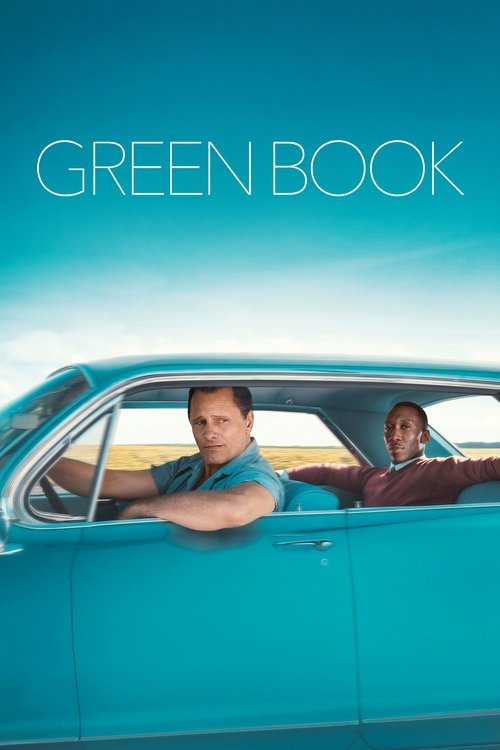
Green Book
2018 · Peter Farrelly
For a comfortable night when you want an odd-couple story with laughs, a road trip and a soft landing — comfort viewing about hard subject matter, not a challenge.
What it's about
In 1962, Tony Lip, a fast-talking Italian-American bouncer from the Bronx, is hired to drive Don Shirley, a refined Black concert pianist, on an eight-week tour through the Jim Crow South. Navigating segregated hotels and restaurants with the Green Book travel guide in the glovebox, the two men — opposites in class, temperament and experience — are stuck in a car together with a Christmas deadline to make it home.
The experience
Warm, funny and easygoing, built almost entirely on the chemistry of two big performances trading barbs across a front seat. It touches painful history but keeps the ride smooth — a crowd-pleaser first, with flashes of real sting.
Performances
Viggo Mortensen transforms into Tony with an appetite-driven, physical comic performance, and Mahershala Ali plays Shirley with immaculate, wounded reserve — work that won him his second Supporting Actor Oscar. The film is essentially the space between the two of them.
The craft
Classically built studio filmmaking: clean staging, a warm period palette, early-sixties cars and clothes rendered with affection, and the structure of a road picture ticking along beat by beat. The piano performances give it its showcase moments.
Why it matters
It won Best Picture and immediately became the most argued-over winner of its decade — a lightning rod for debates about who gets to tell stories of racism and why Hollywood keeps rewarding tales of interracial reconciliation.
Snapshot
A two-hander road picture about an Italian-American nightclub bouncer who drives a Black concert pianist through the Jim Crow South in 1962, Green Book is the most contested Best Picture winner of its decade. It is also, formally, one of the least adventurous: a mid-budget studio drama built on classical continuity, a warm period palette, and two large star performances, structured as an eight-week tour with a Christmas Eve deadline. Its interest to film history lies less in what it does with the camera than in what it reveals about the industry that rewarded it — the persistence of the reconciliation narrative in American commercial cinema, the mechanics of a preferential-ballot Academy race, and the arrival of social-media archaeology as a decisive force in awards campaigning. The film sits at the exact hinge where the mainstream's default mode of talking about race stopped being taken for granted.
Industry & production
Green Book was assembled from an unusually tangled set of financiers: Participant Media, whose entire mandate was social-issue filmmaking (An Inconvenient Truth, Spotlight, Roma), alongside DreamWorks Pictures, Innisfree Pictures, Cinetic Media, and Alibaba Pictures, with Universal handling domestic distribution. The reported production budget was roughly $23 million — modest for a period piece, and achieved partly by basing the shoot in and around New Orleans in late 2017, where Louisiana's tax incentives and architectural range allowed a single production base to stand in for the Bronx, Pennsylvania, the Midwest, and half a dozen Southern states.
The project originated with Nick Vallelonga, son of Tony "Lip" Vallelonga, who had interviewed his father and — by his account — Don Shirley decades earlier, and who possessed the letters Tony wrote home to his wife Dolores during the tour. Those letters are the film's most direct documentary inheritance. Vallelonga has said Shirley asked that the story wait until after his death; both men died in 2013, and the screenplay was written with Brian Currie and Farrelly thereafter.
The release strategy was textbook prestige: a premiere at the Toronto International Film Festival in September 2018, where it won the People's Choice Award — historically one of the most reliable Best Picture bellwethers — followed by a limited-to-wide domestic rollout in November. It won three Academy Awards from five nominations: Best Picture, Best Original Screenplay, and Best Supporting Actor for Mahershala Ali, with nominations for Viggo Mortensen and for Patrick J. Don Vito's editing. It also took the Golden Globe for Best Motion Picture – Musical or Comedy and the Producers Guild's top prize, the latter a significant predictor because the PGA, like the Academy, uses a preferential ballot.
That balloting mechanism is central to any honest account of the win. In a year whose front-runner was Alfonso Cuarón's Roma — a Netflix release, and therefore a proxy war over theatrical exhibition — Green Book was the film fewest voters actively disliked. Preferential counting rewards broad second- and third-place placement rather than passionate first-place support, and Green Book is a near-perfect specimen of the consensus winner. Commercially it outperformed expectations, grossing well over $300 million worldwide against its small budget, with an unusually large share coming from China, where it opened in March 2019 on the strength of the Best Picture win and its Alibaba backing.
Technology
Technically, the film is conservative by design. It was shot digitally and finished through a standard digital intermediate; detailed public documentation of the camera and lens package is thinner than one would expect for a Best Picture winner, and I won't guess at specifics. What is visible on screen is a deliberate softening — halation around practical sources, gentle highlight roll-off, a slightly diffused rendering of skin — that reads as an attempt to make digital capture behave like period photochemical stock rather than to exploit digital's clarity.
The genuinely interesting technical problem was the piano. Ali does not play at Shirley's level and never claimed to; composer Kris Bowers performed the music and coached Ali through months of keyboard work so that the actor's posture, attack, and hand shape would be plausible. The film solves the rest through staging and cutting: performances are covered in wide masters that include Ali's full body, medium shots framed above the keys, and inserts of hands that are not Ali's. It is an old technique — the musical-biopic doubling grammar running back through The Glenn Miller Story and Ray — executed cleanly enough that the seams rarely show.
The third technological story is extra-diegetic and arguably more consequential: the awards campaign was repeatedly disrupted by archived digital material. A years-old Nick Vallelonga tweet endorsing a false claim about Muslims celebrating the September 11 attacks resurfaced mid-campaign and forced a public apology; Farrelly's previously reported on-set behavior was recirculated; Mortensen's use of a racial slur while discussing the film at a public Q&A generated its own cycle. Green Book is one of the first Best Picture winners whose campaign was shaped, week by week, by the searchability of the internet's memory.
Technique
Cinematography
Sean Porter — whose earlier work on Green Room and 20th Century Women showed considerable range — lights Green Book for warmth and legibility. The Bronx sequences are amber and close; the road is dominated by daylight exteriors of the turquoise Cadillac against flat Southern landscape; the concert halls are pooled and theatrical, with Shirley isolated in a hard key that separates him from the white audiences he plays for. The most quietly effective visual idea is the recurring composition through the car's windshield and rear-view mirror, which keeps Tony and Shirley in the same frame while insisting on the seat-back barrier between them — a spatial rendering of the employer/employee relation the film spends two hours complicating. Porter also uses windows and doorways to fix Shirley as an observer: the shot of him watching Black field workers from the roadside, framed at a remove from both the white world that pays him and the Black world that the film says he has been separated from, is the film's single most-discussed image.
Editing
Patrick J. Don Vito, a longtime Farrelly collaborator, cuts the film for comic timing first and dramatic weight second — an inheritance from Farrelly's comedy career that is more visible in the edit than anywhere else. Scenes are held for the beat after the punchline; reaction shots land on Mortensen with the rhythm of a two-camera comedy setup. The road montages compress geography efficiently, and the escalation is managed through duration: early stops are brief and comic, later ones (the Macon YMCA arrest, the rainstorm police stop, the Birmingham dining-room refusal) run longer and cut slower. The Oscar nomination is defensible on craft grounds; the film is never confusing and never drags, which is harder than it looks in a picaresque.
Mise-en-scène / staging
Production designer Tim Galvin and costume designer Betsy Heimann build a 1962 that is specific in texture and unthreatening in tone: Formica and neon in the roadside diners, brocade and crystal in the plantation ballrooms, the Cadillac itself as a rolling set. Heimann dresses Shirley in immaculate tailoring and jewel tones — armor and performance — against Tony's rumpled off-the-rack, and the class inversion does a great deal of the film's characterization without dialogue. Shirley's apartment above Carnegie Hall, staged as a throne room crowded with African and Asian objets, is the most pointed piece of design in the film: a curated fortress that reads simultaneously as achievement and as isolation.
Sound
The sound design is unobtrusive; the mix's real work is musical. Kris Bowers reconstructed the Don Shirley Trio's idiom — a hybrid of classical technique, jazz voicings, and popular song arrangement — for the concert sequences, while the road is scored with the period R&B and soul that Tony plays on the radio. The film builds an explicit sonic argument out of this: Shirley's ignorance of Little Richard, Aretha Franklin, and Chubby Checker is used as evidence of his estrangement, and his eventual sit-in at a Black roadhouse piano, where he plays Chopin and then jumps into blues with the house band, is the resolution. It is the film's most elegant scene and also the one most criticized, since it locates Shirley's liberation in his return to a Black vernacular that his actual biography never required him to leave.
Performance
Mortensen's Tony is a total-transformation performance in the old-fashioned sense — widely reported weight gain, a Bronx-Italian cadence built from recordings of the real Tony Lip (himself a working character actor, seen in Goodfellas and as Carmine Lupertazzi on The Sopranos), and a physical vocabulary of appetite and occupancy. Ali's Shirley is its precise opposite: stillness, elongated vowels, an accent constructed to belong nowhere, and a performance built almost entirely on withholding. Ali finds the film's ceiling in the rain-soaked monologue about being neither Black enough, nor white enough, nor man enough — a speech that would collapse under any less controlled reading. It won him his second Supporting Actor Oscar in three years, after Moonlight. Linda Cardellini, given very little, makes Dolores the film's moral witness, and the closing beat belongs to her.
Narrative & dramatic mode
The structure is the road movie's oldest: a journey outward that is really a journey inward, with a deadline (Christmas Eve) supplying the clock. Farrelly and his co-writers run it as an odd-couple comedy for the first act, let the comedy and the danger interleave through the second, and resolve on sentiment. The engine is the letter-writing conceit — Shirley coaching Tony's crude notes home into something lyrical — which is both the truest element (the real letters exist) and the most efficient dramatization of mutual dependence the script has.
The dramatic mode is reconciliation: two men whose prejudices are presented as symmetrical obstacles, dissolved through proximity. This is where the film's critics locate its central problem. Tony's racism is a bad habit he outgrows; Shirley's suffering is systemic and does not change, but the film's emotional accounting treats the two arcs as equivalent, and gives the transformation — and therefore the moral center — to the white character. The Negro Motorist Green Book itself, Victor Hugo Green's Harlem-published travel guide that ran from 1936 to the mid-1960s and is a genuine artifact of Black self-preservation under segregation, functions in the film as a title and a prop rather than a structuring device.
Genre & cycle
Green Book belongs to the interracial-buddy cycle that runs from The Defiant Ones (1958) and In the Heat of the Night (1967) through 48 Hrs., Lethal Weapon, and Driving Miss Daisy (1989). The comparison to Bruce Beresford's film was immediate and inescapable — a chauffeur picture, a Best Picture winner, a story of racial understanding brokered inside a car — with the races of driver and passenger reversed. Spike Lee, whose BlacKkKlansman lost to it, made the connection publicly and acidly on Oscar night. The film also sits in the late-2010s cycle of based-on-true-events, uplift-oriented civil-rights-adjacent dramas alongside Hidden Figures and, further back, The Help and The Blind Side.
Authorship & method
Peter Farrelly's authorship is the film's oddest feature. Directing solo for the first time after two decades of gross-out comedies made with his brother Bobby — Dumb and Dumber, Kingpin, There's Something About Mary — he brought a comedian's instinct for the two-hander and almost no experience with the tonal management a Jim Crow road picture requires. What he is genuinely good at is visible: the fried-chicken sequence is a superbly built comic setpiece, and the rapport between the leads is directed with real attention to timing. What is missing is any formal skepticism about the story being told.
The screenplay's method — a son reconstructing his father's account, decades after the fact, from interviews and letters — is the source of both its intimacy and its evidentiary weakness. Shirley's surviving relatives, including his brother Maurice and nephew Edwin Shirley III, publicly disputed the film after release: they said the two men were employer and employee rather than lifelong friends, that the family was never consulted, and that the portrait of Shirley as estranged from his family and from Black life was false. They also noted that Shirley was engaged with the civil rights movement in ways the film omits. Ali apologized to the family. Shirley's own biography is genuinely difficult terrain — parts of it were self-narrated and are not independently well documented — but the family's central objection, that the film's premise required a lonelier Shirley than the record supports, is not answered by the film.
Among collaborators, Kris Bowers is the one whose career the film most visibly launched; he went on to Bridgerton, King Richard, and an Academy Award for the documentary short The Last Repair Shop.
Movement / national cinema
The film is a pure product of American mid-budget studio filmmaking in its late phase, and specifically of Participant Media's model: socially themed, broadly accessible pictures designed to travel through awards season and into classrooms. Participant ceased operations in 2024, which retrospectively frames Green Book as a late artifact of an approach — the message picture as commercial category — that no longer has a dedicated institutional home.
Era / period
Two periods matter. The depicted one, 1962, sits between the Freedom Rides and the Civil Rights Act, with sundown towns and segregated accommodation still legally enforced across the South — the conditions Green's guide existed to navigate.
The period of production matters more. Green Book arrived three years after #OscarsSoWhite, two years after Moonlight, into an Academy actively expanding and diversifying its membership, and into a 2018 field that included BlacKkKlansman, If Beale Street Could Talk, Sorry to Bother You, Blindspotting, and Black Panther — Black-authored films offering formally and politically incompatible accounts of the same subject. Rewarding Green Book over that slate is what made it a referendum rather than a movie.
Themes
Dignity as performance and as cost; the difference between being admired and being accepted; class as a solvent and a barrier (Shirley has money and education, Tony has whiteness, and the film is honest about which is worth more below the Mason-Dixon line); the loneliness of exceptionalism; and food, music, and letters as the three currencies through which two men who cannot discuss anything directly manage to communicate. Beneath these runs the film's governing thesis — that proximity cures prejudice — which is simultaneously its emotional appeal and its intellectual limit.
Reception, canon & influence
Backward. The film's lineage is explicit: Driving Miss Daisy, the Poitier vehicles of the 1960s, and the road-movie tradition of It Happened One Night and Rain Man. Farrelly's comic sensibility is the other inheritance, and the letter-writing conceit borrows from the epistolary romance.
Reception. Reviews were, on aggregate, favorable but unusually polarized: many critics praised the performances and the craftsmanship while objecting to the film's politics, and the objections intensified as the awards campaign progressed. The "white savior" and "reverse Driving Miss Daisy" critiques dominated coverage; the Shirley family's dissent gave them documentary weight; the successive campaign controversies made the eventual win read to many as the Academy voting against its critics. The National Board of Review named it the year's best film, and Toronto audiences had chosen it — the gap between popular and critical response is itself part of the film's record.
Forward. Green Book's influence is mostly negative and mostly institutional. The title became shorthand — a genre label for the well-meaning reconciliation drama — in a way that has made such projects harder to greenlight and much harder to campaign. It is now routinely grouped with Crash and Driving Miss Daisy as the canonical examples of Best Picture winners that curdled, and it is invoked whenever the Academy's taste is being litigated. The winners that followed — Parasite, Nomadland, CODA, Everything Everywhere All at Once — are frequently read, fairly or not, against it. Its other durable legacy is commercial: its enormous success in China demonstrated that an American prestige drama with a legible emotional arc could travel where superhero and franchise films dominated, and it remains a reference point for that kind of crossover. As a film it is skillful, warm, and well acted. As an event in film history it is the moment the American mainstream's default story about race stopped commanding assent.
Reception
It premiered as a crowd-pleaser — winning TIFF's People's Choice Award — then rode a backlash-ridden awards season to a shock Best Picture win in 2019; today that win is routinely cited as one of the Academy's most regrettable, the modern shorthand for an out-of-touch Oscar choice.
How Green Book was received, from release to now →
How to watch Green Book: what to notice on a first viewing
- Watch the car shots through the windshield and rear-view mirror. Porter keeps Mortensen and Ali in one frame, with the front seat back cutting across the image between them. The two men share the shot and stay divided by it. The employer-employee arrangement is built into the framing, so you see the distance before anyone talks about it.
- Look at the hard pool of light on Ali during concerts. In the halls Shirley plays inside a tight key light while the white audiences sit in warm, softer darkness. The amber Bronx interiors and daylight road scenes never treat him this way. Light does the sorting: he is displayed to the room, not seated in it.
- Compare the two men's clothes in every scene they share. Heimann puts Shirley in immaculate tailoring and jewel tones and leaves Tony in rumpled off-the-rack. The money and education sit on one body, the freedom of movement on the other. Costume tells you the class inversion without a line of dialogue, and what it fails to buy below the Mason-Dixon line.
- Listen for the car radio, and for Shirley's silence when it plays. Tony fills the road with Little Richard, Aretha Franklin, Chubby Checker. Shirley has nothing to say back. The film keeps returning to this gap between the two soundtracks in the car. The music is the film's evidence for how separated it wants Shirley to be, an argument made in songs rather than speeches.
- Watch Mortensen eat and Ali sit still. Mortensen built Tony out of appetite and occupancy: he takes up seats, food, air. Ali withholds everything, stillness, elongated vowels, an accent that belongs nowhere. Two opposite acting methods share every scene, so the gap between the men is legible in posture alone.
The whole guide to watching Green Book, with the keys for a rewatch →
Influences: the films it descends from and the films it influenced
- Driving Miss Daisy (1989) — The template Green Book inverts seat-for-seat: a decades-long employer/driver bond built almost entirely from repeated car-interior two-shots — rearview-mirror eyelines, over-the-shoulder from the back seat — with affection registered not in dialogue but in the gradual softening of who initiates the ritual exchanges.
- The Defiant Ones (1958) — Establishes the enforced-proximity structure Green Book runs on wheels instead of a chain: a Black man and a white bigot locked in a shared frame they cannot exit, with each episode escalating physical dependency until the bigot's conversion becomes a plot mechanism rather than an argument.
- In the Heat of the Night (1967) — Poitier's withholding stillness against Southern authority — the humiliation absorbed in close-up, the retort delayed — is Ali's whole register; Haskell Wexler's practice of giving the Black lead a separate hard key so he reads distinctly against night interiors is directly echoed in Sean Porter's isolating key on Shirley.
- Guess Who's Coming to Dinner (1967) — Supplies the impeccably credentialed Black professional whose accumulated respectability — doctorates, diction, tailoring — is itself the film's rhetorical argument, staged in parlor-room dialogue turns where white characters are talked out of prejudice within a single scene.
- It Happened One Night (1934) — The class-inversion road comedy in which antagonism is metered out through episodic roadside setpieces and, crucially, through lessons in how to eat: the doughnut-dunking tutorial is the direct formal ancestor of the fried-chicken sequence, where table manners carry the entire power reversal.
- Rain Man (1988) — The cross-country two-hander whose arc is engineered as a caretaker/charge reversal — mercenary driver softened, rigid companion's rituals treated first as comic obstacle then as dignity — and the prestige-vehicle template of pairing a transformation performance against a reactive everyman.
- There's Something About Mary (1998) — Farrelly's own comic method carried intact into a Jim Crow picture: hold a single mortifying situation past the point of comfort so escalation comes from duration rather than cutting, and let the joke land on the deadpan reaction shot in a sustained two-shot.
- Cyrano de Bergerac (1990) — The ghostwritten-letter device Green Book lifts whole — eloquence loaned from the cultured man to the inarticulate one, the letters delivered in voiceover cut against the recipient reading them, so the collaboration on the page dramatizes an intimacy the men never state aloud.
- Ray (2004) — The musical-biopic doubling protocol: an actor drilled to a master player's recorded take, then covered so hands, torso and face can be intercut into a seamless body — the exact method by which Kris Bowers' playing and hand-doubling were grafted onto Mahershala Ali.
- The Help (2011) — Period Jim Crow rendered in the same warm, honeyed grade, with a broad comic revenge setpiece (the pie) load-bearing inside a civil rights frame, and domestic service used as the pretext for cross-racial intimacy the film then reads as friendship.
- The Upside (2019) — Released weeks after and cut to the same measure: a comedy-trained director staging a wealthy disabled employer and his Black employee as a gag-driven two-hander, with the caregiving contract doing the structural work Green Book assigns to the driving job.
- The Best of Enemies (2019) — The template applied verbatim — a Klansman and a Black organizer confined to a shared room over a fixed period, reconciliation paced by scheduled sessions so that duration of forced dialogue, not evidence, produces the conversion.
- King Richard (2021) — Carries forward Kris Bowers' scoring method launched here: period-inflected jazz and soul textures used as warm connective tissue under a Black subject's uplift narrative, cueing reconciliation beats rather than commenting on them.
- American Fiction (2023) — A negative descendant that reverse-engineers the grammar — the legible suffering, the tidy arc, the prestige-season packaging — and stages the industry's appetite for it as farce, then closes on a producer's pitch that is a direct parody of this film's mode.
- The Intouchables (2011) — Comedy directors applying gag-timing discipline to a caregiver relationship across a race and class gulf, structuring the bond as a series of comic incongruity setpieces — and proving the crossover commercial ceiling for this exact shape of feel-good reconciliation.
- Hidden Figures (2016) — Segregation dismantled by a single demonstrative gesture from a white authority figure — the sledgehammered restroom sign — the same compression of structural racism into one convertible individual that Green Book performs with Tony's letters and fists.
- Crash (2004) — Resolves racial animus through discrete two-person encounters in vehicles and at traffic stops, each engineered so a bigot and his target are forced into mutual obligation; the shared craft is the belief that prejudice is a scene-level problem solvable by proximity.
- Bohemian Rhapsody (2018) — Same-season demonstration of the total-transformation performance built from prosthetics plus lip-and-hand sync to an archival master track, with the concert/recital sequence cut as the emotional climax that certifies the impersonation.
- Philomena (2013) — The same machine applied to American racial violence — a mismatched pair, a car, tonal modulation between comedy and atrocity — and it draws the identical critique leveled at Philomena, that the road-movie shape converts structural violence into a story about two people learning to get along.
Similar films
- The Intouchables (2011) — influence & lineage · same viewing thread · often watched together
- American Fiction (2023) — influence & lineage
- The Help (2011) — influence & lineage
- King Richard (2021) — influence & lineage
- Hidden Figures (2016) — influence & lineage
- The Big Lebowski (1998) — often watched together
- GoodFellas (1990) — often watched together
- Moonlight (2016) — shared sensibility
All the films related to Green Book →
Watch it with: curated runs of related films
- Strangers Who Change Each Other — Watch these back-to-back when you want the warmth of two people who shouldn't have met becoming each other's whole world — a ladder from the multiplex hit down to its arthouse ancestors.