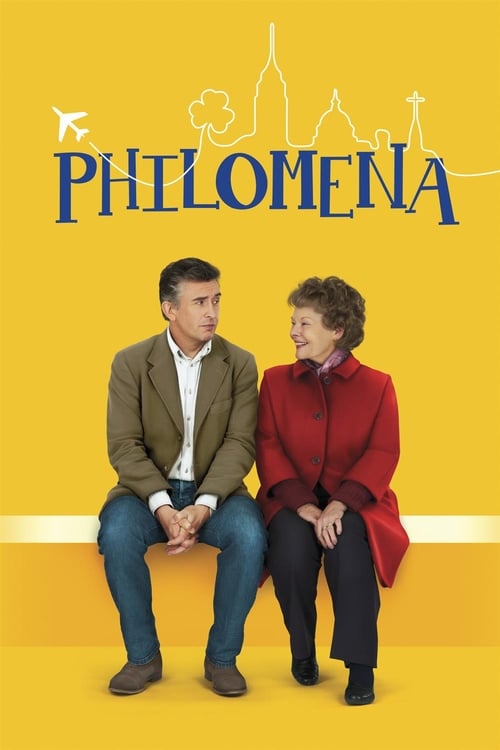
Philomena
2013 · Stephen Frears
For when you want a good cry that's earned honestly, wrapped in genuinely good company — a film about grief and forgiveness that still works as a cozy Sunday-evening watch.
What it's about
On the fiftieth birthday of the son she has never stopped thinking about, an elderly Irishwoman reveals a secret: as an unmarried teenager in 1952 she gave birth in a convent, and the nuns sold her boy to American adopters. She teams up with a sacked government spin doctor turned reluctant journalist, and the odd couple — devout working-class woman, prickly Oxbridge cynic — follow the trail from an abbey in Tipperary to Washington, D.C.
The experience
Far funnier than its premise suggests and far more devastating than its gentleness lets on — the bickering warmth between the two leads keeps you smiling right up until the film quietly breaks your heart. It's angry underneath, but it never raises its voice.
Performances
Judi Dench is extraordinary, playing Philomena's ordinariness without a drop of condescension — her faith, her airport-novel chatter, her bottomless composure all feel like one real person. Steve Coogan, who also co-wrote the script, is the perfect foil: all superior irony slowly dismantled.
The craft
The Coogan–Jeff Pope screenplay is a marvel of balance, running a two-hander comedy and an institutional exposé through the same scenes without either cheapening the other. Stephen Frears directs with invisible tact, and Alexandre Desplat's score keeps the sentiment on a short leash.
Why it matters
A word-of-mouth hit that carried four Oscar nominations, it pushed the real scandal of Ireland's mother-and-baby homes into international view and gave the actual Philomena Lee a public platform for her campaign.
Snapshot
Philomena is a small, disciplined film about an enormous institutional crime. Adapted from journalist Martin Sixsmith's 2009 book The Lost Child of Philomena Lee, it follows Philomena Lee (Judi Dench), an elderly working-class Irishwoman who reveals to her daughter, on the fiftieth birthday of the son she has never stopped thinking about, that she gave birth in 1952 at Sean Ross Abbey in Roscrea, County Tipperary, and that the nuns sold the boy to American adopters. She joins forces with Sixsmith (Steve Coogan), a disgraced former Labor government spin doctor casting about for freelance work, and the two travel from Ireland to Washington, D.C. in search of a man who, it emerges, had a substantial career in Republican politics and died of AIDS-related illness before she could find him.
The film's method is to stage a moral argument inside a comic double act. Coogan — who co-wrote the screenplay with Jeff Pope and produced through his company Baby Cow, the setup that got the project made — plays Sixsmith as an Oxbridge skeptic, allergic to sentiment and to religion, whose contempt for the Church supplies the film's prosecutorial energy. Dench plays Philomena as a woman of genuine, unironic faith who has absorbed decades of shame and who will not be recruited into anyone's polemic. The structure lets the film say the harsh thing and then refuse the easy landing: the last movement turns on Philomena's forgiveness of the nuns, which the film presents not as capitulation but as an act she alone is entitled to perform, and which Sixsmith visibly cannot match.
It is also, in Frears's career, a characteristic object: a modestly budgeted British production, made quickly, in which unfashionable subject matter — an old woman, a religious institution, adoption records — is handled with the tact of a director who has spent forty years alternating between television and cinema and who distrusts stylistic display. The film was widely honored, including Academy Award nominations for Best Picture, Best Actress, Best Adapted Screenplay, and Best Original Score, and it became one of the more visible cultural interventions in the ongoing Irish reckoning with the Magdalene laundries and mother-and-baby homes.
Industry & production
Philomena belongs to a specific British production ecology: independent finance assembled around a star, a name director, and a pre-sold nonfiction property, with public money and international distribution completing the package. Baby Cow Productions — founded by Coogan and Henry Normal, better known for television comedy — developed the project, with Coogan producing alongside Gabrielle Tana and Tracey Seaward. BBC Films and the British Film Institute were among the backers; Pathé and, in the United States, The Weinstein Company handled distribution. The budget was small by any international standard, and the film's economics depended on exactly what it delivered: a critically acclaimed vehicle for a beloved star, capable of long theatrical legs in the specialty market and a strong awards campaign.
The Weinstein Company's involvement shaped the film's public life more than its aesthetics. The company had built its reputation on precisely this kind of release — a mid-budget British drama with prestige performances, pushed hard through the autumn festival circuit into the spring awards. Philomena premiered in competition at the 70th Venice International Film Festival in 2013, where the screenplay was recognized, then traveled to Telluride and Toronto, the conventional route for a film seeking American critical consensus before its commercial release. It opened in the UK in the autumn of 2013 and in the US in stages thereafter. It performed strongly relative to its cost; I won't cite specific grosses, since precise figures are the sort of thing that ought to be checked against a reliable source rather than recalled.
Two production circumstances deserve note. First, the film's central figures were living people, and Philomena Lee herself participated in the film's publicity, appearing alongside Dench and Coogan; the campaign explicitly folded into advocacy, with the Lee family later founding the Philomena Project to press for access to adoption records in Ireland. This blurring of promotion and activism is unusual and was clearly deliberate. Second, the film's American distribution ran into a ratings dispute: the Motion Picture Association initially assigned an R for language, a decision Weinstein appealed publicly and successfully, arguing that a film about an elderly woman's search for her son should be available to the general audience most likely to want it. The episode is a small case study in how ratings function as distribution economics rather than moral evaluation.
The film also drew organized objection. Some Catholic commentators in the US, most audibly in conservative media, characterized it as anti-Catholic propaganda; the filmmakers responded by pointing to the historical record and to Philomena Lee's own continued faith. The controversy was, in commercial terms, useful, and in critical terms a reminder that the film's real subject is institutional power rather than belief.
Technology
Philomena was shot digitally by Robbie Ryan — a choice worth pausing on, because Ryan was at that moment one of the more committed celluloid advocates among British and Irish cinematographers, having shot Andrea Arnold's Fish Tank and Wuthering Heights on film. By 2013 the industrial default had flipped: the major exhibition chains had completed digital conversion, laboratory capacity was contracting, and a production of this scale with locations in Ireland, England, and the United States had straightforward practical reasons to work digitally. The film's images show the period's better digital character rather than any nostalgia for grain — clean, low-contrast, comfortable in mixed and available light, with the tolerance for dim interiors that the convent and archive scenes require.
The technological substrate matters thematically as well, because the film is partly about information systems. Sixsmith is introduced as a man whose professional world is email, Google, and the telephone; the investigation proceeds through record searches, an internet video, a database of names. The film stages the digital archive as both the instrument of discovery and a mocking counterpoint to the paper records the abbey claims were destroyed by fire. That the truth is finally sitting in plain sight — in publicly available images and documents — is the film's sharpest structural irony, and it is an irony only available in the search-engine era.
Technique
Cinematography
Ryan's work here is deliberately unshowy, and its restraint is a considered position rather than an absence of ideas. The dominant grammar is medium and medium-close two-shots that keep Dench and Coogan in the same frame, letting the comedy of mismatch play spatially: Philomena small and settled, Sixsmith long-limbed and impatient, the composition doing the work a lesser film would give to dialogue. Ryan favours a shallow-ish depth that isolates faces against soft backgrounds, and he lights Dench with unusual generosity — not flatteringly, but legibly, so that the film's most important information, the micro-movements of an old woman's face as she decides how much to reveal, is always readable.
The palette divides along the film's geography. The Irish material — convent exteriors, the graveyard, the ruined outbuildings — runs cool and desaturated, gray-green, weather-bound. The American sequences are warmer and blander, the anonymous beige of hotel corridors, airport lounges, and suburban Washington, a visual register of the placelessness into which the child disappeared. The 1950s flashbacks, glimpsed in short fragments rather than developed as a parallel narrative, are handled with a slightly different texture — brighter, more particulate, closer to memory or home movie than to dramatic reconstruction. This is an economical solution to a real problem: full-scale period sequences would have unbalanced the film and inflated the budget, and the fragmentary approach makes the past feel like intrusive recollection rather than exposition.
Ryan's camera is mostly still or moving very slightly, often on a slow push. There are almost no crane shots, no visible virtuosity. The film's one recurring formal gesture is the profile shot of Philomena in transit — in a car, on a plane, at a window — which accumulates into a portrait of a woman carried along by other people's momentum.
Editing
Valerio Bonelli's cutting is the film's most underrated element, because it manages a genuinely awkward tonal problem: the script alternates between broad comic set pieces and material about forced adoption and death. Bonelli's solution is rhythmic rather than tonal — he cuts the comedy tight, with quick exchanges and hard outs on Coogan's exasperation, and lets the serious scenes run long on single shots, particularly on Dench. The audience learns the film's grammar quickly: when the cutting slows, something is being felt rather than said.
The flashback insertions are placed with care, frequently arriving mid-scene rather than at scene boundaries, so that the past interrupts the present the way intrusive memory does. Crucially, the film withholds. Information that a conventional mystery structure would parcel out as clues is instead delivered in blunt, deflating lumps — the son is dead; he was a Republican operative; he was gay; he had, in fact, come looking for her. Each revelation lands as an anticlimax rather than a twist, which is the honest shape of this kind of search and a real act of discipline given the material's melodramatic potential.
Mise-en-scène / staging
The film's spaces are organized around institutional versus domestic scale. The convent interiors — long corridors, high windows, polished floors, chairs arranged for interviews rather than conversation — are staged to place Philomena as a supplicant in a room designed to make supplicants. Sisters are frequently positioned above or behind desks; the blocking of the late confrontation, with Sister Hildegarde in a wheelchair, reverses the power geometry without softening it.
Against this, the film's domestic and transitional spaces are cluttered and small: Philomena's home, a hotel breakfast room, a rental car. Some of the film's best staging is in vehicles and airports, dead zones where the two leads have nothing to do but talk. Frears also uses food and small consumer pleasures as characterization — the hotel's complimentary buffet, an in-flight meal, a paperback romance — which sounds like whimsy but functions as class notation. Philomena's delight in ordinary comforts is set against Sixsmith's practiced disdain, and the film knows which of them is the snob.
Sound
Alexandre Desplat's score, Oscar-nominated, is built on repeated small figures — piano, strings, a recurring theme that turns slightly and returns — and is used sparingly enough that its entrances register. Desplat resists the two obvious temptations: no Celtic-inflected lament, and no sacred-choral setting for the convent material. The music is secular, chamber-scaled, and faintly restless, appropriate to a road film.
Sound design elsewhere favours ambient realism: rain, corridors, the specific acoustic deadness of institutional rooms, the hum of transit. The film also uses recorded and mediated sound pointedly — a video image with its own thin audio, a telephone voice — as part of its argument about evidence. Dialogue is mixed forward and clearly; this is a script-driven film and the sound respects that.
Performance
Dench's performance works largely through withholding and misdirection. She plays Philomena as a woman who has spent sixty years managing shame, and the technical accomplishment is a doubled register: the surface is chatty, deferential, self-deprecating, full of digressions about novels and food, while underneath a much harder intelligence is continually assessing what can be said and to whom. The famous effect is that her plainest lines land hardest, because the performance has trained us to hear evasion. Dench also resists any suggestion of the saintly; her Philomena is capable of stubbornness, snobbery of her own, and flashes of anger.
Coogan's performance is the riskier one, and it succeeds because he lets Sixsmith be genuinely unlikeable — vain, condescending, using Philomena's grief as career rehabilitation and only gradually admitting it. Coogan's comic instrument, honed across decades of playing self-regarding men, is repurposed rather than suppressed; the Alan Partridge inheritance is audible in Sixsmith's wounded pomposity, and the film uses it knowingly. The supporting work is precise and small: Michelle Fairley as an editor, Barbara Jefford as Sister Hildegarde, Anna Maxwell Martin as Philomena's daughter, Mare Winningham as the sister of the adopted son.
Narrative & dramatic mode
The film's mode is the odd-couple road movie fused to the investigative procedural, with the investigation's structure inverted. Where a procedural normally accumulates toward revelation, Philomena systematically converts revelations into dead ends: each discovery closes a possibility rather than opening one. The son cannot be met; he is dead. His partner can be found, but only after the film has established that Philomena's real antagonist is not a person but a record-keeping practice.
The dual protagonist structure is doing argumentative work. Sixsmith is the film's engine of anger and its surrogate for the skeptical viewer; Philomena is its conscience and its resistance to that viewer's satisfaction. The screenplay by Coogan and Pope repeatedly sets up a scene in which Sixsmith will say the righteous thing and Philomena will decline to endorse it. The climax is not the discovery of the son but the confrontation at the abbey, and its dramatic content is a disagreement between the two leads about what to do with the truth. Sixsmith's fury and Philomena's forgiveness are staged as equally intelligible and not reconciled; the film ends with him writing the story because she permits it, which is a modest and honest resolution.
Tonally the film runs on what one might call the British comic-humanist register: jokes as the medium through which serious material becomes bearable, with the understanding that the jokes are also a class and character index. It is a mode with obvious risks — the charge of tastefulness, of making a crime companionable — and the film's defense is that its central character is precisely the sort of person the tasteful version would patronize.
Genre & cycle
Philomena sits at the intersection of three cycles. The first is the British "true story" prestige drama, a durable form running from Shadowlands through The Queen and into a 2010s vogue that included The King's Speech, The Iron Lady, and Frears's own later Florence Foster Jenkins. The second is the small-scale British film about aging as an active rather than valedictory condition — the Marigold Hotel films, Quartet, Mr. Holmes — a cycle underwritten by the reliability of a generation of stage-trained stars and by an older audience the multiplex had discovered was worth serving.
The third and most substantive is the cycle of Irish films and documentaries confronting Church-run institutions: Peter Mullan's The Magdalene Sisters (2002), Aisling Walsh's television film Song for a Raggy Boy (2003), and the documentary Sex in a Cold Climate (1998) that informed Mullan. Against these, Philomena is notably the gentlest in method and arguably the widest in reach — it made the argument to an international mainstream audience that the harder films made to art-house viewers, and this trade-off is the honest subject of any critical account of it.
Authorship & method
Frears's authorship is often described as invisible, which understates a real and consistent practice. Across a career that includes My Beautiful Laundrette, Prick Up Your Ears, Dangerous Liaisons, The Grifters, High Fidelity, Dirty Pretty Things, and The Queen, his signature is a preference for the script and the actor over the image, a career-long fluency between television and film, and a durable interest in outsiders negotiating with English institutions. He works fast and does not over-rehearse; the sense that his films are simply happening in front of you is the product of choices, not their absence.
The collaboration structure here is distinctive in that the writer-star was also the producer, and the film's authorship is genuinely shared. Coogan and Pope's screenplay — Pope a highly experienced British television dramatist — reshaped Sixsmith's book substantially, foregrounding the journalist as a character (in the book he is far less present) and compressing the search into a compact two-hander journey. This is the film's key adaptive decision and the source of both its power and the objections to it.
Robbie Ryan brought a naturalist's eye from his work with Arnold and, later, Ken Loach and Yorgos Lanthimos, and applied it in a restrained register. Valerio Bonelli's editing manages the tonal architecture. Alexandre Desplat, at the height of a period in which he seemed to be scoring everything, supplied a score whose reticence is its virtue. Sixsmith himself was involved in the project as the source author, and the participation of Philomena Lee gave the production an unusual proximity to its subject.
Movement / national cinema
The film is British in production and Irish in subject, and that division is the interesting fact about it. It belongs to the strand of publicly-supported British cinema — BBC Films, BFI — that has functioned since the 1980s as the country's de facto art-cinema infrastructure, and it carries that strand's characteristic virtues (literacy, performance, social attentiveness) and limits (a tendency toward the well-made and the reasonable).
Its Irish material, however, connects it to a national reckoning it observes from outside. The Magdalene laundries and mother-and-baby homes had moved through Irish public life across two decades: the 1993 discovery of unmarked graves at High Park, the 1999 state apology for industrial school abuse, the Ryan Report (2009), the Murphy Report (2009), and the state apology for the laundries in 2013 — the year of the film's release. The film arrived into that live argument as an English-financed account of Irish institutional harm, which some Irish commentators noted; its counterweight is that its subject was a living Irishwoman who endorsed it.
Era / period
Two periods operate. The depicted past is 1950s Ireland: a state in which the Church administered welfare, education, and morality, and in which unmarried pregnancy meant institutional confinement, unpaid labor, and adoptions arranged for money, often to American Catholic families. The film's flashbacks are careful not to over-explain this; it assumes an audience who will grasp the arrangement from the fact of it.
The present is 2000s Britain, and the film's date-stamping is precise. Sixsmith is a New Labour casualty, sacked from a government communications role — the film opens with him at the end of the spin era, which locates it in the aftermath of the Blair government's credibility collapse. His condescension toward human-interest journalism, and his eventual capitulation to writing one, is a joke about the state of the British press in the years when broadsheet feature writing was giving way to something softer. The film is thus a period piece about two moments of institutional bad faith, ecclesiastical and political, and it declines to flatter either.
Themes
The film's central theme is the conflict between forgiveness and justice, staged without resolving it. Philomena's forgiveness of Sister Hildegarde is presented as a real spiritual achievement and as something the film's other protagonist finds unbearable; the film neither corrects Sixsmith's anger nor undermines Philomena's grace.
Second, shame as an inherited and institutionally manufactured condition. Philomena's decades of silence are the crime's most durable effect — she was taught to consider herself the sinner, and the film's most quietly devastating material is her assumption of blame for what was done to her.
Third, the ethics of the record. Documents, archives, and evidence are the film's real terrain: contracts signed under duress, files destroyed, names changed, graves unmarked. The Church's power is exercised through its control of information, and the film's argument is that the withholding of records is a continuing offense rather than a historical one — the position from which the Philomena Project subsequently campaigned.
Fourth, class and the uses of other people's suffering. Sixsmith's arc requires him to recognize that his contempt for "human interest stories" is contempt for the humans in them. The film is unusually candid about journalism as extraction.
Fifth, faith surviving the institution. Philomena remains a believing Catholic; the film insists on the distinction between a Church and a faith, which is what separates it from a straightforwardly anticlerical picture and what its critics on both flanks disliked.
Reception, canon & influence
Critical reception was strongly favourable, with near-unanimous praise for Dench and considerable admiration for Coogan's performance and screenplay. The film's Venice competition premiere, screenplay recognition there, and subsequent festival run produced the consensus that carried it to four Academy Award nominations — Picture, Actress, Adapted Screenplay, Original Score — and a substantial BAFTA presence, where the adapted screenplay was honored. The dissenting line, where it existed, held that the film's tonal management was too accommodating: that the comic double act domesticated an atrocity and that the road-movie shape converted institutional violence into a story about two people getting along. That criticism is worth taking seriously and is, in a sense, anticipated by the film's own refusal to let Sixsmith's anger be resolved.
Its influences run backward along two lines. Institutionally and thematically, it stands downstream from The Magdalene Sisters and the documentary work on the laundries, and from the long British tradition of social-realist filmmaking about people whom the state and Church have processed. Formally, it draws on the mismatched-pair road film and on the British comic-dramatic tradition Frears has worked in since My Beautiful Laundrette — as well as on Frears's own The Queen, which established the template of a Frears film built around an actress's precise impersonation of restraint and a screenwriter's argument about British institutions.
Its forward influence is clearest outside cinema. The film measurably intensified international attention on Irish forced adoption; the Philomena Project pressed for adoption-records legislation, and Philomena Lee's public advocacy — including her reception at the Vatican and the eventual Irish Commission of Investigation into Mother and Baby Homes, whose final report appeared in 2021 — unfolded in a media environment the film had helped shape. It would be too much to claim direct causation for legislative change, and I won't; what can be said is that the film gave a diffuse historical scandal a single legible face at a moment when the Irish state was already being forced to respond.
Within film culture, its legacy is more modest and generic. It confirmed the commercial viability of the small British true-story drama built around a senior star, a formula the 2010s exploited heavily, including by Frears himself in Florence Foster Jenkins and by the wider cycle running through Mr. Holmes, Victoria & Abdul, and their successors. It also marked a decisive turn in Coogan's career, establishing him as a serious screenwriter and dramatic actor — a repositioning he extended in Stan & Ollie and The Lost King, the latter reuniting him with Pope on another true story about an underestimated person and an institutional archive. In that sense Philomena's most traceable descendants are Coogan's own films: the same structure, the same argument about who gets believed, applied to smaller injuries.
A Deleuzian reading
There's a shot Frears keeps coming back to and never underlines.
The full Deleuzian reading of Philomena →
Reception
A Venice-and-Oscars crowd-pleaser in 2013 (four nominations, including Best Picture), it's since settled into a curious afterlife: dismissed by some as peak tasteful-awards-season fare, but increasingly credited as part of the cultural reckoning with Ireland's Magdalene laundries and mother-and-baby homes.
How Philomena was received, from release to now →
How to watch Philomena: what to notice on a first viewing
- Watch Dench and Coogan share nearly every two-shot. Ryan keeps them together in medium frames rather than cutting between close-ups, letting their mismatch play out in the same shot instead of through editing. The comedy of their differences is staged in space, not manufactured by the cut.
- Notice the color shift once they land in America. Ireland runs cool and gray-green, weather-bound and specific, while the American scenes turn warm, bland, and anonymously beige, hotel corridors and airport lounges. The palette itself tells you where the search feels like a place and where it feels like nowhere.
- Notice when the cutting slows down on Dench's face. Bonelli cuts comic scenes tight with quick exchanges, then lets the serious moments run long on a single held shot, usually hers. The pace of the edit tells you when something is being felt rather than said.
- Watch how chatty Philomena stays even in hard moments. Dench plays a surface of digressions about novels and food over a much harder intelligence quietly deciding what to reveal and to whom. Her plainest lines land hardest because the performance has trained you to expect evasion.
- Track the recurring shot of Philomena's profile in transit. Ryan returns again and again to her profile in a car, on a plane, at a window, always carried along by someone else's momentum. The repeated shot quietly states who is driving this journey and who is along for it.
The whole guide to watching Philomena, with the keys for a rewatch →
Influences: the films it descends from and the films it influenced
- Cathy Come Home (1966) — Establishes the British TV-play grammar Frears trained in — the state's removal of a child staged as flat, unemphatic procedure with the authority figures shot at working distance rather than as villains — which is exactly the register of Philomena's convent flashbacks, where Anthony is driven away without a single reaction close-up cued for weeping.
- It Happened One Night (1934) — Originates the load-bearing structure Coogan and Pope reuse wholesale: a cynical newspaperman traveling with a woman he initially regards as copy, with the film's moral turn located precisely in the moment he stops filing the story and starts protecting the subject.
- Prick Up Your Ears (1987) — Frears's earlier solution to the same formal problem — a biographer in the present interrogating survivors and papers, with the reconstructed past entering as short, unsignposted fragments rather than a continuous parallel narrative — is the template for Sixsmith's archive work intercut with the Roscrea inserts.
- Rain Man (1988) — The mismatched-pair road film in which the driving is mostly ellipsis and the real scenes are motel-room and diner two-shots; Philomena inherits its rhythm of comic irritation punctuated by one withheld institutional fact that reframes everything already played for laughs.
- The Snapper (1993) — Frears's own prior Irish film about an unmarried pregnancy and the community shame around it, playing the material as warm comedy without softening the coercion — the tonal-modulation license he draws on to let Philomena crack jokes about a romance novel minutes after describing the sale of her son.
- The Magdalene Sisters (2002) — Supplies the institutional power geometry Philomena quotes directly: the nun framed frontally behind a desk with the girl standing, the laundry's regimented rows, and the confiscated infant as the film's withheld object — Frears reproduces the blocking but keeps the camera further back and the score chamber-quiet.
- The Queen (2006) — The direct model — a Frears film built on a great actress's minutely calibrated withholding opposite a screenwriter's argument about a British institution, scored by Desplat in small-ensemble strings and piano that comment on decorum rather than emotion; Dench's flattened affect is Mirren's method transposed downward in class.
- Zodiac (2007) — The modern inverted procedural, where the investigation's payoff is a document, a doorway and a look rather than a confession — Philomena borrows its deflation curve, delivering the crucial fact (Anthony's grave is inside the convent) as an administrative sentence that lands flat and refuses catharsis.
- Oranges and Sunshine (2010) — The nearest formal sibling in the prior decade: an outside investigator reuniting forcibly displaced children with parents, structured around records-office refusals and transcribed testimony, and staging Church complicity through polite institutional stonewalling rather than melodramatic confrontation.
- The Trip (2010) — Builds the Coogan screen persona Philomena weaponizes — the metropolitan snob whose condescension is punctured by an unflappable traveling companion — so that Sixsmith's contempt for 'human interest stories' reads as self-parody the audience already knows how to hear.
- Florence Foster Jenkins (2016) — Frears immediately reapplying the Philomena formula — a senior star, a true story, and a comic premise that would humiliate its subject if the direction let it, defused by keeping the performance restrained and cutting away from the laughter before it curdles.
- Lion (2016) — Extends the forced-separation search into a records-and-database procedural whose reunion is deliberately underplayed — no swelling reveal, just two people in a doorway — an anticlimactic-revelation strategy Philomena had just proved commercially survivable.
- Stan & Ollie (2018) — Coogan converting the Philomena two-hander into a whole film: a touring odd couple whose comic bits carry the dramatic freight, with the emotional reveal placed in a dressing-room conversation rather than a performance, and mortality never spoken outright.
- The Lost King (2022) — The literal continuation: same director, same Coogan–Pope screenplay partnership, same structure of an underestimated person versus an institutional archive, with Coogan again writing himself the skeptical foil and again ending on institutional non-apology rather than vindication.
- Small Things Like These (2024) — Returns to the laundries with Philomena's staging vocabulary intact — the convent parlor negotiation in which a nun's threat is delivered as hospitality across a tea tray — but strips out the comic counterweight, making explicit the complicity that Philomena's road-movie structure had allowed the audience to leave behind.
- The Boy Who Harnessed the Wind (2019) — Editor Valerio Bonelli's patient, classical prestige-drama cutting — letting scenes breathe to build dignity — is the structural rhythm he imports into the film.
- The Angels' Share (2012) — Robbie Ryan's immediately preceding job, shooting social-realist material in a comic register with available-light interiors and a cool green-gray northern palette that warms only when the characters leave home — the same palette split Ryan runs between Ireland's overcast institutional exteriors and the flatter, brighter Washington sequences.
- Spotlight (2015) — Independently arrives at the same anti-thriller treatment of Catholic institutional abuse: the drama is document retrieval, refused meetings and clerical politeness, with the camera kept at neutral eye-level and the score withheld from every scene that could have been scored for outrage.
- Green Book (2018) — The same machine applied to American racial violence — a mismatched pair, a car, tonal modulation between comedy and atrocity — and it draws the identical critique leveled at Philomena, that the road-movie shape converts structural violence into a story about two people learning to get along.
Similar films
- Spotlight (2015) — influence & lineage
- Small Things Like These (2024) — influence & lineage
- The Queen (2006) — influence & lineage
- Secrets & Lies (1996) — shared sensibility
- All About My Mother (1999) — shared sensibility
- Doubt (2008) — shared sensibility
- In the Name of the Father (1993) — shared sensibility
- Hamnet (2025) — shared sensibility