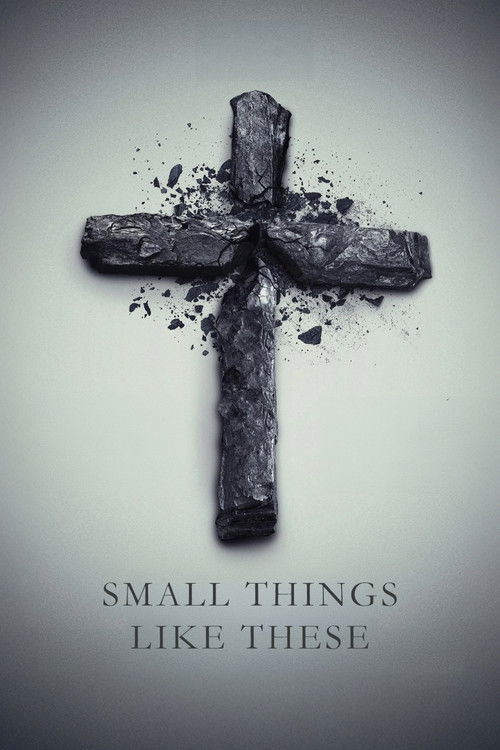
Small Things Like These
2024 · Tim Mielants
For a contemplative evening when you want something short, serious, and morally clarifying — a film to chew on for days. This is challenge, not comfort, though it leaves you with something like hope.
What it's about
New Ross, Ireland, in the cold weeks before Christmas 1985. Bill Furlong, a coal merchant with a wife and five daughters, makes his rounds through a town where everyone knows everything and says nothing. A delivery to the local convent shows him something he can't unsee, and the film watches him decide — slowly, at real cost — whether to look away like everyone else.
The experience
Hushed, wintry, and deliberate — more held breath than raised voice. The tension is all moral: you feel the weight of a whole town's silence pressing on one ordinary man, and the quiet becomes almost unbearable.
Performances
Cillian Murphy gives one of his most interior performances — a man whose whole struggle plays out in his eyes and hands, barely a raised word in the film. Emily Watson, as the convent's Mother Superior, is chilling precisely because she's so pleasant.
The craft
Adapted from Claire Keegan's slim novella with the same compression: nothing wasted, everything implied. The filmmaking is all cold light, coal dust, and small rooms — a Christmas-card town shot so you feel what it hides. It trusts silence more than dialogue and rewards close attention.
Why it matters
Part of Ireland's ongoing reckoning with the Magdalene laundries and the Church's grip on its towns, it turned a beloved novella into cinema without losing its stillness — and gave Murphy a defining quiet role right after his biggest one.
Snapshot
Small Things Like These is a chamber-scaled adaptation of Claire Keegan's slender 2021 novella, transposing her compressed prose into an equally compressed film: a study of conscience set in the cold weeks before Christmas 1985 in New Ross, County Wexford. Cillian Murphy plays Bill Furlong, a coal and timber merchant and family man whose deliveries to the local convent bring him face to face with the suffering of girls confined there — an institution belonging to the network of Magdalene laundries operated by Catholic religious orders. The film's drama is almost entirely interior: it watches a quiet man recognize a town-wide architecture of silence and decide, against his own interest, not to look away. Directed by the Belgian filmmaker Tim Mielants and adapted by the Irish playwright Enda Walsh, it premiered as the opening film of the 2024 Berlin International Film Festival, where it competed for the Golden Bear. At roughly 96 minutes it is deliberately small in scale and runtime, a deliberate formal echo of its title and of Keegan's minimalism.
Industry & production
The project originated as a vehicle for Cillian Murphy through his production company, Big Things Films, formed with the veteran Irish producer Alan Moloney; Murphy serves as both star and producer. The film's most conspicuous industrial fact is its backing by Artists Equity, the production company founded by Ben Affleck and Matt Damon, who took on the project as one of the new company's early features — an instance of American star-driven capital underwriting a modestly budgeted, regionally specific Irish drama. This pairing of a homegrown Irish production base with American financing is characteristic of how contemporary Irish prestige cinema reaches international screens.
Mielants and Murphy already had a working relationship from television: Mielants had directed Murphy in episodes of Peaky Blinders, and that prior trust plainly shaped the casting and the production's confidence in a restrained leading performance. The film was shot on location in Ireland, with New Ross and surrounding Wexford and southeastern locations standing in for the 1985 setting. Lionsgate handled the U.S. release in late 2024 following the Berlinale launch. Precise budget and box-office figures are not something I can state reliably here; the film was positioned as a specialty/awards-season release rather than a wide commercial title, and that distribution posture is consistent with its festival-first rollout.
Technology
The film was photographed digitally in a manner that privileges low light, muted color, and the textures of a winter town. There is no evidence the production sought a showy technical signature; rather, the technology serves a naturalist, period-faithful palette dominated by coal dust, gray daylight, and the warm pools of domestic and shop interiors. Where the record is thin on specific camera and lens packages, I will not invent them. What can be said is that the digital cinematography is calibrated for restraint and for faces in close, low-key light — a tonal choice closer to painterly realism than to any contemporary high-gloss aesthetic.
Technique
Cinematography
The cinematographer is Frank van den Eeden, the Belgian DP best known for Lukas Dhont's Girl (2018). His work here is built on proximity and stillness: the camera stays near Furlong, often in close or medium framing, letting his face carry information the script withholds. The palette is wintry and desaturated — blacks of coal, the bruised blue-gray of December skies, the sodium and incandescent warmth of homes and the merchant's yard. Light is frequently sourced and low, so that interiors of the convent read as institutional and chilling while the Furlong household reads as fragile warmth. The visual strategy is one of constraint, mirroring Keegan's refusal of melodramatic underlining.
Editing
The cutting is patient and observational, holding on Furlong's silences and on small physical labor — scrubbing his hands, loading sacks, watching from a doorway. The film's brevity is itself an editorial argument: rather than dramatize the laundry system at large, the edit confines us to one man's narrowing field of attention. I do not have a confidently verified credit for the editor and will not guess at a name; what is clear from the finished film is an editorial sensibility that trusts duration and withholding over exposition.
Mise-en-scène / staging
Production design reconstructs a small Irish town in 1985 with understated specificity: the coal yard, the cramped family kitchen, the shop windows and the looming convent. The staging repeatedly places Furlong on thresholds — gates, doorways, the convent's parlor — visualizing his position as a man caught between inside and outside, witness and participant. The Christmas setting is used without sentimentality, its rituals and decorations a counterpoint to the cruelty being normalized just out of sight. Costuming and the grime of manual labor ground Murphy's character in class and work; this is a film acutely conscious of economic dependence as the engine of silence.
Sound
The soundtrack favors quiet — ambient winter sound, the scrape of shovels, church and domestic interiors — over score. The original music is credited to the Belgian composer Senjan Jansen, a frequent Mielants collaborator; the scoring is sparing, used to deepen interiority rather than to cue emotion. Silence is itself a dramatic instrument: the film's withholding of music in key confrontations forces attention onto breath, glance, and the unsaid.
Performance
Murphy delivers a deliberately minimal, internalized performance — a portrait built from small gestures, downcast eyes, and the strain of a decent man metabolizing horror. It is a study in restraint that depends on the camera's closeness to register at all. Emily Watson, as the convent's Mother Superior (Sister Mary), provides the film's chilling counterweight: a soft-spoken authority whose menace is procedural and polite, the institution made flesh. Watson's work was recognized at the 2024 Berlinale with the Silver Bear for Best Supporting Performance. Eileen Walsh, as Furlong's wife Eileen, embodies the pragmatic counsel of self-preservation, giving voice to the town's logic of looking away. The supporting ensemble fills out a community whose complicity is collective and ordinary.
Narrative & dramatic mode
The film's mode is the moral chamber drama, structured around a single conscience rather than a plot of incident. Its dramatic question is not what happened in the laundries — that is largely assumed and glimpsed — but what one ordinary man will do upon being made to see. Keegan's novella braids Furlong's present-tense crisis with memories of his own childhood as the son of an unmarried mother who was spared the laundries' fate only through a benefactor's mercy; the film carries this backward-reaching structure, so that his decision becomes an act of recognition across time. The narration is spare and elliptical, trusting the audience to assemble meaning from withheld information. It is a film of accumulation — the "small things" of the title — building to a final, quiet act of defiance whose consequences the film leaves deliberately open.
Genre & cycle
Formally it is a literary period drama; thematically it belongs to a distinct cycle of Irish films reckoning with the abuses of Church-run institutions and the state's collusion with them. Its closest companions are Peter Mullan's The Magdalene Sisters (2002) and Stephen Frears's Philomena (2013), both of which dramatize the Magdalene system and the trafficking of women and children through Catholic institutions. Where those films center victims and survivors, Small Things Like These shifts the vantage to the bystander, joining a strand of "complicity" dramas concerned with how ordinary citizens sustain atrocity through silence. It also sits within the broader prestige tradition of restrained, literary-adaptation cinema.
Authorship & method
Tim Mielants brings a European art-cinema sensibility — patience, restraint, an emphasis on faces and atmosphere over plot — honed in Belgian feature work (Patrick, 2019) and in television, including Peaky Blinders. His direction here is self-effacing, subordinating style to Keegan's material and to Murphy's performance.
Enda Walsh, the screenwriter, is an acclaimed Irish playwright (Disco Pigs, the book for the musical Once) and a longtime Murphy collaborator across stage works such as Misterman, Ballyturk, and Grief Is the Thing with Feathers. His adaptation honors Keegan's compression, resisting the temptation to expand or explain.
Cillian Murphy functions as an author of the project as producer and star, having championed Keegan's book and built the production around it.
Frank van den Eeden (cinematography) and Senjan Jansen (music) carry over Mielants's Belgian collaborators, giving the Irish story a distinctly Northern-European visual and sonic austerity. The source author, Claire Keegan, whose novella was shortlisted for the 2022 Booker Prize, is the originating authorial voice; the film's whole method is an exercise in fidelity to her minimalism.
Movement / national cinema
The film is a hybrid of Irish national cinema and Belgian/European art-house craft — an Irish subject and cast filtered through a Flemish director and crew. It belongs to a confident wave of contemporary Irish filmmaking (alongside work such as The Banshees of Inisherin and An Cailín Ciúin / The Quiet Girl, the latter also adapted from Claire Keegan) that has drawn international attention to Irish stories, landscapes, and the country's ongoing public reckoning with its institutional past. That reckoning is not merely thematic backdrop: it is national history. The Magdalene laundries operated into the 1990s, and the Irish state issued a formal apology in 2013 — context that gives the film's 1985 setting the charge of living memory rather than distant history.
Era / period
Released in 2024, the film arrives in an era of Irish cinema's international ascendancy and of sustained cultural processing of Church and state abuses, including the Magdalene laundries and mother-and-baby homes. Its 1985 setting is precise and pointed: a moment when these institutions were still functioning and socially protected, the Church still woven into the economic and moral fabric of small-town life. The film's period detail is therefore not nostalgia but indictment, locating complicity in a recognizable, recent past.
Themes
The film's governing theme is moral courage as an ordinary, costly act — the difference between knowing and acting. Around it cluster: complicity and the social machinery of silence; the entanglement of economic dependence with moral compromise (Furlong's livelihood, his daughters' schooling, all run through the same Church that controls the town); inheritance and grace, as Furlong's own rescued origins make him uniquely unable to look away; class and labor, rendered in coal dust and chapped hands; and the quiet heroism of small gestures, the "small things" that constitute decency. The title itself frames an ethics of the minor — the idea that conscience is exercised not in grand confrontation but in modest, concrete choices.
Reception, canon & influence
Critically, the film was received as a model of restraint, with particular praise for Murphy's internalized lead performance — sustained so soon after his Academy Award–winning turn in Oppenheimer — and for Emily Watson's quietly formidable antagonist, whose work earned the Silver Bear for Best Supporting Performance at the 2024 Berlinale. Reviews tended to frame the film's brevity and reticence as both its discipline and, for some, a limitation, given the enormity of the subject it approaches obliquely. (I am characterizing the broad critical consensus rather than quoting specific notices, and will not attribute particular phrases I cannot verify.)
Influences on the film (backward): Most directly, Claire Keegan's novella and its minimalist literary tradition; the precedent of Irish institutional-abuse cinema, above all The Magdalene Sisters (2002) and Philomena (2013); and the European art-house lineage of restrained, observational realism that Mielants and van den Eeden bring from Belgian cinema. The bystander focus also resonates with a wider tradition of moral-witness dramas in which an individual conscience confronts a complicit society.
Legacy / what it shaped (forward): As a recent release, its long influence is still unwritten, and it would be premature to claim a measurable legacy. Its immediate significance lies in consolidating two trends: the international viability of Irish literary adaptations (it pairs naturally with The Quiet Girl as evidence of Claire Keegan's screen translatability), and the model of a major star using his capital — and high-profile American financing through Artists Equity — to mount a small, uncompromising, regionally specific drama. Its most likely lasting role is as a touchstone in the cinema of complicity and conscience, and as part of the ongoing body of work through which Irish film continues to confront the Magdalene laundries and the silence that sustained them.
A Deleuzian reading
He keeps washing his hands.
The full Deleuzian reading of Small Things Like These →
Reception
Opened the 2024 Berlinale to warm reviews as Cillian Murphy's first lead after Oppenheimer, then slipped through cinemas so quietly that it's since become a 'why did nobody see this?' cause — championed as one of 2024's most underseen films and a notable awards-season snub.
How Small Things Like These was received, from release to now →
Influences: the films it descends from and the films it influenced
- Philomena (2013) — Restrained confrontation with Irish Catholic institutional abuse that withholds melodrama and lets the systemic silence indict itself — the immediate national-cinema precedent for Small Things' oblique approach to the laundries.
- The Quiet Girl (2022) — The sibling Claire Keegan adaptation — same minimalist source voice, elliptical withholding of backstory, emotional restraint expressed through gesture and silence, proving Keegan's compression's screen translatability.
- Diary of a Country Priest (1951) — Establishes the model of conviction conveyed through a withheld, near-blank face and diary-voice ellipsis rather than dramatic outburst — Murphy's internalized restraint and the film's elliptical withholding descend directly from this Bressonian suppression of affect.
- Winter Light (1963) — The moral-chamber drama built from long, quiet two-handers and stretches of pregnant silence treated as an instrument — the spiritual crisis staged through stillness and faces rather than plot is the template for Small Things' reticent conscience.
- Mouchette (1967) — Childhood/working-class suffering observed at close proximity with sparse sound and refusal of sentiment; its diegetic-ambient austerity and unblinking watching of an institution's cruelty inform the film's observational grammar.
- Rosetta (1999) — The close-proximity, body-tethered following of a protagonist through a working environment — the Belgian observational realism van den Eeden and Mielants carry over — gives Small Things its handheld intimacy of labor and threshold.
- The Son (2002) — Over-the-shoulder framing that keeps moral deliberation locked to the back of a withholding man's neck; its slow accrual of an ethical decision through watched physical work is the direct staging precedent for Furlong's reckoning.
- The Magdalene Sisters (2002) — The foundational cinematic reconstruction of the Magdalene laundry interior — its institutional geography, the nun-as-quiet-authority figure prefiguring Emily Watson's Sister Mary, and the laundry's labor as oppression.
- The White Ribbon (2009) — Desaturated, period-precise reconstruction of a community whose silence sustains its cruelty; complicity rendered as a formal problem of what the frame and the townspeople refuse to see — the complicity-drama in austere monochrome key.
- Of Gods and Men (2010) — Conscience dramatized through patient, low-key-lit faces deliberating in quiet rooms, with sparse score and ambient sound carrying the weight — the restrained religious-moral chamber Small Things inhabits.
- First Reformed (2017) — Transcendental-style austerity — static framing, sparse score, an internalized man's faith-crisis withheld until a single moral choice — sharing Small Things' ascetic visual discipline and conscience-in-extremis structure.
- A Hidden Life (2019) — The lone conscience refusing complicity with a community that has made its peace with evil; moral witness staged as quiet, costly daily refusal rather than confrontation — the same bystander-to-actor arc.
- Patrick (2019) — Mielants's own feature establishes his method imported here: patient observational long takes, faces and atmosphere over plot, and a self-effacing camera that subordinates style to a withholding central performance.
- Aftersun (2022) — Memory-braiding through fragmentary, withheld images and an internalized, near-wordless emotional register — the contemporary sibling in elliptical, affect-suppressed storytelling where meaning accrues in the gaps.
Similar films
- The Quiet Girl (2022) — influence & lineage
- The White Ribbon (2009) — influence & lineage
- A Hidden Life (2019) — influence & lineage
- Diary of a Country Priest (1951) — influence & lineage
- Conclave (2024) — shared sensibility
- Hard Truths (2024) — shared sensibility
- Ghostlight (2024) — shared sensibility
- All of Us Strangers (2023) — shared sensibility