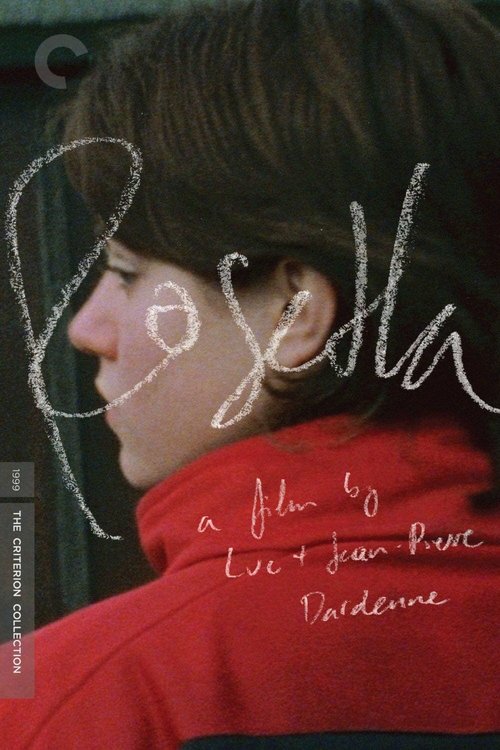
Rosetta
1999 · Jean-Pierre Dardenne
For when you want cinema that hits like real life, no cushioning — a challenge, not a comfort, but one that pays you back in pure empathy. Reach for it when you're ready to be shaken rather than soothed.
What it's about
A teenage girl lives in a caravan park on the edge of a Belgian town, propping up an alcoholic mother while fighting tooth and nail for the one thing she believes will make her a normal person: a steady job. She sells waffles, hauls water, hides her boots at the edge of the trailer park like a secret identity, and treats every shift of work as territory to be defended. It's a survival story where the battlefield is minimum-wage employment.
The experience
Relentless and physical — the camera stays inches from Rosetta's back and shoulders, so you feel every trudge, scramble, and slammed door in your own body. It's short, tense, and stripped of any music or relief; by the end you're wrung out in a way few thrillers manage.
Performances
Émilie Dequenne, seventeen and in her first screen role, carries virtually every frame and shared the Best Actress prize at Cannes for it — a ferocious, unsentimental performance built out of stubbornness and physical will rather than tears.
The craft
The Dardenne brothers shoot handheld at punishing proximity, with no score and no establishing shots — the frame is Rosetta's body and whatever she's fighting for at that moment. The sound is all breath, traffic, and mud, and the editing never lets a scene settle into prettiness. It's filmmaking as endurance test, and the rigor is the point.
Why it matters
It took the Palme d'Or at Cannes in 1999 in a famous upset, cemented the Dardennes as the defining social-realist filmmakers of their era, and its portrait of youth unemployment resonated all the way into real Belgian labor policy debates.
Snapshot
Rosetta is a seventy-odd-minute hammer-blow of social realism: a film that fixes its camera to the back and shoulders of a teenage girl and refuses to let go. Directed by the Belgian brothers Jean-Pierre and Luc Dardenne — the prompt names Jean-Pierre alone, but the film is, like all their mature work, a genuine co-direction — it follows Rosetta (Émilie Dequenne), who lives in a trailer-park caravan with her alcoholic mother and wages a ferocious, almost feral campaign to secure and keep a legitimate job. The film won the Palme d'Or at the 1999 Cannes Film Festival, an upset that startled critics who had expected the prize to go elsewhere, and Dequenne, then seventeen and in her first screen role, shared the festival's Best Actress award. Beyond its festival laurels, Rosetta produced something almost no fiction film can claim: a piece of legislation. The Belgian youth-employment measure popularly dubbed the "Plan Rosetta" (or "Convention Rosetta"), enacted in 2000, took its name and impetus from the film. Rosetta consolidated the aesthetic the Dardennes had announced three years earlier with La Promesse and became, with it, a foundational text of a renewed European cinema of the dispossessed.
Industry & production
Rosetta was produced through Les Films du Fleuve, the Liège-based production company the Dardenne brothers established to control their own work, in co-production with French and Belgian partners typical of the European art-cinema financing model — small budgets assembled from national funds, regional support, and co-production treaties rather than studio backing. The brothers had spent the 1970s and 1980s making documentaries and largely unseen fiction features before La Promesse (1996) brought them international attention; Rosetta was the film that confirmed that breakthrough was a method rather than an accident.
The production was deliberately modest and concentrated. It was shot in and around Seraing, the depressed industrial suburb of Liège in French-speaking Wallonia where the Dardennes grew up and to which they have returned obsessively throughout their careers. The setting is not incidental local color but the precondition of the whole enterprise: a landscape of shuttered steelworks, ring roads, and caravan parks that gives the film its geography of marginality. The Palme d'Or it received was a watershed for Belgian cinema, dramatically raising the international profile of a small national industry, and it cemented the Dardennes' position as festival fixtures — they would go on to win a second Palme for L'Enfant in 2005, joining the rare company of two-time winners. Precise budget and box-office figures are not something I can responsibly state from memory; the film's commercial footprint was, in any case, secondary to its critical and political reverberation.
Technology
Rosetta was shot on 16mm film (Super 16), a format consonant with both its economy and its aesthetic of immediacy — lighter cameras, faster setups, a grainier and less glossy image than 35mm. The choice of a small-gauge, handholdable camera is inseparable from the film's style: the technology enables the relentless mobile proximity that defines it. This was a film made before the digital turn that would later reshape low-budget realist production, and its texture is recognizably photochemical. The Dardennes' technical apparatus is otherwise conspicuous for its subtractions rather than its additions: no cranes, no dollies of the conventional kind, no elaborate lighting rigs, and — crucially — no non-diegetic music. The "technology" of Rosetta is, to a significant degree, the technology of restraint.
Technique
Cinematography
The cinematography, by the Dardennes' regular collaborator Alain Marcoen, is the film's signature and its argument. The camera is handheld throughout and stays punishingly close to Rosetta — often behind her head and shoulders as she walks, runs, and struggles, so that the viewer is yoked to her body and her forward momentum. There are essentially no establishing shots, no reassuring wide views that would let us survey the situation from a position of comfort or mastery; we are kept inside Rosetta's restricted, hard-pressed field of perception. The framing is tight, jostling, sometimes losing and recovering her, which produces both documentary urgency and a near-physical sense of effort. Natural and available light dominates. The effect is to collapse the distance between spectator and subject: we are not observing Rosetta's life so much as being dragged along inside it. This camera grammar — close, mobile, shoulder-mounted, refusing the omniscient view — became one of the most imitated styles in subsequent realist cinema, often loosely called the "Dardenne shot."
Editing
Editing was handled by Marie-Hélène Dozo, another long-standing member of the Dardennes' company. The cutting is unobtrusive but exacting, sustaining long, breathing takes that follow action in something close to real time, then cutting on movement or task. The film withholds the conventional rhythms of dramatic build; scenes begin in the middle of activity and end before resolution, denying the audience the satisfactions of clean dramatic punctuation. The relative brevity of the whole — well under ninety minutes — gives the editing a compressed, propulsive quality, but within scenes the duration is patient. The cumulative effect is of a narrative stripped to gesture and consequence.
Mise-en-scène / staging
Staging in Rosetta is organized entirely around labor, repetition, and the body's negotiation with hostile environments. The film attends with almost ritual precision to physical processes: how Rosetta hides her shoes and changes into boots to cross the muddy ground to her caravan, how she catches fish with a line and bottle, how she works the waffle stand. These repeated material rituals are the substance of the mise-en-scène, building character through action rather than exposition. Locations are real and unbeautified — the trailer park, the factory floor, the roadside food stand, the ring road. Crucially, the film refuses to aestheticize poverty; the staging neither prettifies nor sentimentalizes the spaces it inhabits. The drama is choreographed as physical struggle — Rosetta wrestling with a propane tank, fighting, running — so that interior states are externalized as bodily effort.
Sound
Sound, by Jean-Pierre Duret, is one of the film's most radical elements, precisely because there is no musical score. The Dardennes' refusal of non-diegetic music is a principled aesthetic stance — they regard score as a manipulation that tells the audience how to feel — and Rosetta is among the purest expressions of that creed. The soundtrack is built entirely from the diegetic world: traffic, wind, water, breath, the hum of machinery, the scrape and clatter of work. This austerity throws enormous expressive weight onto ambient noise and, above all, onto the labored breathing of its protagonist, which functions almost as a substitute for music — a rhythmic index of stress and exertion. The absence of score is not a void but a discipline that keeps the film tethered to material reality.
Performance
Émilie Dequenne's performance as Rosetta is the film's center of gravity and one of the most celebrated screen debuts in modern European cinema, recognized with a share of the Best Actress prize at Cannes. Cast as an unknown, Dequenne plays Rosetta with a clenched, watchful intensity — guarded, suspicious, capable of sudden violence and sudden tenderness — that never tips into the picturesque pathos the material might invite. Her physicality is total: the performance is built from how Rosetta moves, carries weight, and holds her body against the world. Olivier Gourmet, the Dardennes' great repertory actor, appears as the waffle-stand boss, and Fabrizio Rongione plays Riquet, the young man whose friendship Rosetta both needs and betrays; Anne Yernaux plays the mother. The Dardennes' well-documented method of extensive rehearsal and many takes, drilling physical action until it becomes second nature, underwrites the naturalism of the ensemble — performances that read as behavior rather than acting.
Narrative & dramatic mode
Rosetta operates in a mode of stripped, present-tense behavioral realism. The narrative is linear and tightly bounded, following a short, fraught span of its protagonist's life with minimal backstory and no explanatory voiceover. Causation is moral and material rather than psychological in the conventional sense: we understand Rosetta through what she does and the situations that press on her, not through confession or flashback. The film's dramatic engine is the simplest and most relentless imaginable — the desperate need for a job and the fierce refusal of charity — and from this it generates almost unbearable tension. The Dardennes withhold the cues of melodrama, declining to score emotional peaks or to telegraph turning points. The central ethical crisis — Rosetta's betrayal of Riquet to take his job — is rendered without editorializing, leaving the moral reckoning to the viewer. The ending is famously abrupt and ambiguous, a moment of collapse and possible human contact that refuses both tidy redemption and despair-as-spectacle. This is dramaturgy as moral inquiry: the film poses the question of what a person will do, and what dignity costs, under conditions of structural abandonment.
Genre & cycle
The film belongs to the tradition of social-realist drama, and more specifically to a contemporary European art-cinema cycle concerned with precarity, immigration, and the working poor in the post-industrial West. It sits within the lineage of Italian neorealism and the British social-realist tradition associated with Ken Loach, while extending and intensifying their methods. Within the Dardennes' own filmography it forms part of a tight cycle of Seraing-set moral fables — La Promesse (1996), Rosetta (1999), Le Fils (2002), L'Enfant (2005) — that share a setting, a method, a repertory of actors, and a recurring preoccupation with guilt, responsibility, and the possibility of grace among the economically marginal. Rosetta is the film that crystallized this cycle into a recognizable signature.
Authorship & method
The authorship of Rosetta is collective in the precise sense that the Dardenne brothers write and direct as a single creative unit, jointly conceiving the screenplay and sharing direction. Their method is by now well documented and visible in the film itself: original screenplays developed from a moral situation rather than a plot; lengthy rehearsal periods in which physical action is choreographed and repeated; shooting in real locations in their native region; the use of a stable company of collaborators across films. That company is essential to the authorship: cinematographer Alain Marcoen, editor Marie-Hélène Dozo, sound recordist Jean-Pierre Duret, and the recurring actor Olivier Gourmet are not interchangeable technicians but co-authors of a house style. The decisions that define the film — handheld proximity, the banishment of score, the refusal of establishing shots and of psychological exposition — are authorial choices applied with unusual consistency. The Dardennes' background in documentary informs all of this: their fiction retains documentary's attention to process, place, and the unrhetorical observation of work.
Movement / national cinema
Rosetta is a landmark of Belgian — specifically Walloon, French-language — cinema, and a touchstone of what is sometimes loosely grouped as a turn-of-the-millennium European realist movement. It belongs to no formal manifesto-driven school, but its rigor and its critical canonization made it a reference point comparable to the way movements function: a model that other filmmakers cited and emulated. The film's rootedness in Seraing makes it an intensely regional cinema, yet its Cannes triumph universalized it, and it became a key exhibit in arguments about the vitality of small-nation European filmmaking. For Belgian cinema, the Palme d'Or was a defining international validation; for the broader European art film, Rosetta helped reassert social realism as a prestige mode at the highest festival level.
Era / period
The film is a document of late-1990s post-industrial Europe, made and set in the aftermath of the collapse of the heavy industry — coal and steel — that had defined the Liège region. Its world is one of structural unemployment, informal and precarious labor, and a frayed social safety net, concerns acutely topical at the close of the twentieth century as Western European welfare states confronted deindustrialization and youth joblessness. Aesthetically it belongs to the last moment of small-gauge photochemical filmmaking before digital tools transformed low-budget production. Its near-immediate translation into the "Plan Rosetta" legislation makes it unusually legible as a period artifact — a film whose subject was urgent enough to its political moment to provoke a direct policy response.
Themes
At its core Rosetta is a study of dignity under economic siege. Its governing theme is the desperate, almost pathological insistence on legitimate work as the foundation of selfhood: Rosetta does not want charity or pity; she wants a normal job and the normal life she imagines it confers. This drive shades into its darker counterpart — the way scarcity corrodes solidarity, pushing Rosetta to betray the one person who offers her friendship in order to take his place. The film thus interrogates the ethics of survival: what is permitted to a person whom society has abandoned, and whether moral life is even possible without economic security. Surrounding themes include the burden of the alcoholic mother and the inversion of the parent-child relationship; shame and the policing of appearances; the body as the site where social violence is registered; and, in its ambiguous final movement, the faint persistence of human connection and the possibility of grace. The Dardennes frame all of this as a moral rather than merely sociological inquiry — poverty as an ethical crucible.
Reception, canon & influence
Critically, Rosetta was received as a major work, its Palme d'Or both celebrated and debated; the win surprised observers and provoked discussion about the festival's embrace of austere realism over more conventionally pleasurable cinema, while Dequenne's shared Best Actress award was widely praised. Over the following decades the film's standing only grew, and it is now routinely treated as a modern classic and a defining statement of contemporary social realism.
Its influences ON the film run backward to Italian neorealism's location shooting and use of nonprofessionals, to the moral severity and physical attentiveness of Robert Bresson, and to the committed social cinema of Ken Loach — though the Dardennes synthesized these into something distinctively their own, more bodily and more relentless than any single precursor. Their own documentary practice is the other crucial source.
Its legacy FORWARD is twofold. Politically, the "Plan Rosetta" stands as a near-unique instance of a fiction film lending its name and momentum to actual legislation, a measure aimed at compelling employers to hire young workers. Aesthetically, the film's handheld, shoulder-following, score-less proximity became one of the most widely imitated styles in twenty-first-century cinema, shaping countless realist and quasi-realist films and even bleeding into more commercial idioms; the "Dardenne style" became shorthand for a whole approach to filming the marginalized. Within the brothers' own oeuvre it confirmed the template that would yield a second Palme d'Or and a sustained body of internationally acclaimed work. Rosetta endures as both an ethical provocation and a formal model — proof that a small film, made cheaply in a forgotten corner of Belgium, could alter both the language of cinema and, briefly, the law.
A Deleuzian reading
She stops at the edge of the mud.
The full Deleuzian reading of Rosetta →
Reception
Its surprise Palme d'Or in 1999 — awarded by David Cronenberg's jury after a last-minute festival screening — drew audible grumbling at Cannes, with many convinced All About My Mother was robbed; today the win looks prophetic, the film that announced the Dardennes as a defining force in modern cinema.
How Rosetta was received, from release to now →
Influences: the films it descends from and the films it influenced
- Bicycle Thieves (1948) — Italian neorealism's location shooting and nonprofessional casting, with a narrative built entirely around the threat of losing a job — the same economic-survival armature that drives Rosetta's monomaniacal hunt for work.
- Germany Year Zero (1948) — A child protagonist tracked through a ruined economy in real exterior locations, refusing melodramatic framing — the neorealist precedent for observing a minor's economic desperation without sentiment.
- Mouchette (1967) — Bressonian 'model' performance and ascetic refusal of psychological exposition applied to an immiserated rural girl, culminating in an abrupt watery near-death that Rosetta's pond/suicidal collapse directly rhymes with.
- Pickpocket (1959) — Fragmentary close framing of hands performing a repeated manual process, privileging physical gesture and ritual over interiority — the source of the Dardennes' obsessive attention to Rosetta's labor of selling waffles and hauling water.
- Kes (1969) — Loach's committed social cinema observing a regional working-class youth through a nonprofessional lead and unrhetorical, documentary-tinged observation of class hardship.
- Faces (1968) — Handheld camera pressed into actors' faces for behavioral, body-first naturalism, prioritizing physical performance over plot mechanics — a precedent for the Dardennes' shoulder-following proximity.
- La Promesse (1996) — The Dardennes' own immediately prior film that first locked their template — Super 16 handheld proximity, banished score, real Seraing locations — which Rosetta then intensified into pure relentlessness.
- Breaking the Waves (1996) — The Dardennes adopt the close-following handheld camera that tracks a young woman's social and economic abjection without editorial mitigation—refusing reaction shots, cutaways, or scored emphasis—building directly on the observational documentary grammar von Trier and Müller established for female degradation-narrative.
- Rome, Open City (1945) — The Dardenne brothers' handheld camera follows the protagonist's body through actual industrial-zone locations with sparse ambient sound and zero non-diegetic score, applying Rossellini's post-synchronization acoustic restraint and constrained location blocking to contemporary Belgian working-class precarity; the Dardennes have explicitly cited Rossellini as a founding influence on their ethics of proximity to the suffering body.
- Pusher (1996) — The Dardennes' refinement of the handheld physiological tracking shot — camera locked to the body through desperate economic survival, no establishing shots, no spatial relief — extends the method Pusher helped establish toward even greater physical specificity and the removal of all remaining narrative comfort.
- Europa '51 (1952) — The Dardennes' shoulder-mounted observational tracking of a socially marginal figure through industrial and domestic found environments — ambient sound without score, mixed-nonprofessional performance, no psychological commentary — is the Rossellinian-Bressonian hagiographic lineage applied to contemporary precarity, the drama of witness with the camera as sole institutional presence.
- Umberto D. (1952) — The Dardennes update the pedinamento into a handheld camera that physically dogs a precarious protagonist through her daily survival, preserving Umberto D.'s observational, dignity-of-ordinary-lives ethic.
- The Son (2002) — Pushes the shoulder-mounted style further — the camera glued to the back of Olivier Gourmet's neck through workshop labor — extending Rosetta's no-establishing-shots, proximity-only grammar to its extreme.
- The Death of Mr. Lazarescu (2005) — Romanian New Wave handheld, score-less, near-real-time tracking of a body through an indifferent institutional system, inheriting the Dardenne method of following one person's deterioration in unbroken proximity.
- L'Enfant (2005) — Confirms the Rosetta template into a second Palme d'Or — same handheld pursuit, diegetic-only sound, and a young precarious protagonist filmed through behavioral action rather than dialogue.
- 4 Months, 3 Weeks and 2 Days (2007) — Long-take, no-score, handheld realism following a young woman in real time through a clandestine ordeal, adopting the Dardenne refusal of musical underlining and establishing geography.
- The Class (2008) — Multi-camera handheld shooting of nonprofessionals in a single real location, building behavioral truth from rehearsed-then-improvised process — Dardenne documentary-attention extended to the classroom.
- Wendy and Lucy (2008) — American minimalist realism of economic precarity — a lone protagonist, available light, near-absent score, and an ambiguous open ending — transposing the Dardenne ethics of watching the marginalized to the Pacific Northwest.
- Fish Tank (2009) — Super 16 handheld proximity following a volatile working-class teenage girl played by a nonprofessional, with available light and behavioral physicality — the most direct stylistic descendant of Rosetta's female-youth portrait.
- Winter's Bone (2010) — Naturalist, location-shot study of a poor young woman shouldering adult survival labor, cast partly with locals and shot in available light with documentary fidelity to a marginalized region.
- Two Days, One Night (2014) — Structures an entire film around a worker pleading to keep a job, the Rosetta premise made explicit, sustained by the same handheld walking-pursuit and refusal of nondiegetic music.
- The Rider (2017) — Nonprofessionals playing versions of themselves through real labor rituals, shot with available natural light and behavioral, process-driven naturalism — the Dardenne fusion of documentary observation and fiction.
- The Little Sister (2025) — Camera welded to a working-class protagonist's body with withheld exposition and no score — the restraint-driven, follow-the-lead realism underpinning French social cinema.
- A Prophet (2009) — The Dardennes' pressed-close handheld grammar — camera affixed to a non-professional performer's body, ambient sound entirely displacing score, character built through procedural accumulation without declared interiority — feeds directly into A Prophet's cinematographic and acoustic approach, the method arriving at Audiard via French-language social realism rather than British.
- Ratcatcher (1999) — A contemporaneous European social-realist study of a poor child shot on location with available light, sharing the era's turn toward austere, score-light observation of marginalized youth (though more lyrical in its imagery).
- Young Mothers (2025) — The originating engine of the whole method: the handheld camera pinned to the back of a young woman's neck as she scrabbles for survival, refusing establishing shots so geography is only ever discovered by pursuit.
- The Celebration (1998) — Independently arrived at the same technical grammar as Dogme — handheld available-light camera fixed to the body of a performer, diegetic sound only, no score, no location modification — as a contemporaneous parallel development in European realism that confirmed Dogme's constraints were a convergent aesthetic logic, not merely a manifesto exercise.
- Code Unknown (2000) — The Dardennes deploy the same handheld 35mm in close-body proximity to a marginalized European protagonist, no nondiegetic score, and mixed professional/nonprofessional cast within the same contemporaneous ethical commitment — both films perform the long take as a refusal of sentimental alibi.
- Small Things Like These (2024) — The close-proximity, body-tethered following of a protagonist through a working environment — the Belgian observational realism van den Eeden and Mielants carry over — gives Small Things its handheld intimacy of labor and threshold.
- Humanité (1999) — Same-Cannes regional realism built on a non-professional lead and a hollowed procedural that withholds motive and backstory — the inverse (handheld) pole of Dumont's static naturalism.
- Nobody Knows (2004) — Observational immersion in a young person's hand-to-mouth survival economy—rent, food, small hustles—filmed as procedural daily labor with no melodramatic underscoring.
- Violet Perfume: Nobody Hears You (2001) — Handheld camera glued to a working-class girl's body, accretive realist cutting, and a breakthrough nonprofessional lead — a near-contemporaneous parallel of the same observational-immersion craft.
- Oasis (2002) — Contemporary handheld long-take realism that physically tails a single marginalized protagonist through cramped, obstructed space, the observational grammar Oasis deploys in Korean register.
- Love for Sale (2006) — Present-tense, bodily-close observational pacing that stays with a working-class woman's survival and refuses melodramatic uplift — the anti-melodrama grammar Suely applies to the sertão.
- I, Daniel Blake (2016) — The Dardennes' Palme-winning precarity study shares the handheld, following-camera observation of a non-professional fighting for the right to work and welfare — the frequently cited contemporary kin to Loach's method.
- A Hero (2021) — Ancestor of the handheld-observational moral thriller — a camera pinned to a protagonist's back as economic desperation forces a dishonest choice, refusing score and legible reaction shots.
Similar films
- La Promesse (1996) — influence & lineage
- The Child (2005) — influence & lineage
- Young Mothers (2025) — influence & lineage
- Two Days, One Night (2014) — influence & lineage
- Mouchette (1967) — influence & lineage
- Germany, Year Zero (1948) — influence & lineage
- Fish Tank (2009) — influence & lineage
- Ratcatcher (1999) — influence & lineage
All the films related to Rosetta →
Watch it with: curated runs of related films
- The World Against Her — A run of women worn down or driven to extremity by a merciless community, marriage, or economy — watch them near each other and the sacrifice, the drift, and the violence start to rhyme.
Film essays and courses that include it
- The Vow of Chastity: Dogme 95 and the Handheld Revolution
- The Unblinking Camera: Social Realism from the Dardennes to the Romanian New Wave
- Camera on the Street: Italian Neorealism and the World It Made
- The Game and Those Outside It: A Century of Class on Film
- Unfinished Creatures: Cinema's Invention of Growing Up
- Nothing to Lose: A Century of Cinema at the Margins
- The Interior Eye: Cinema's Search for Lives Felt From Within
- The Face That Cannot Act
- When Cinema Went Outside
- The Camera at the Nape of the Neck