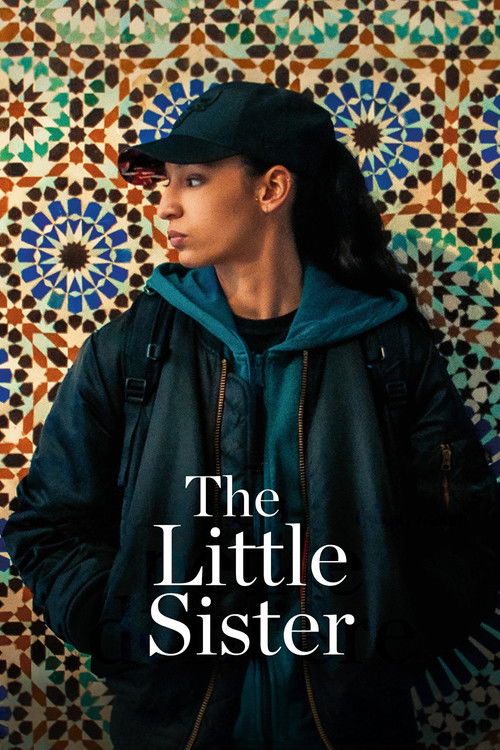
The Little Sister
2025 · Hafsia Herzi
For when you want a coming-of-age story with real stakes — something to watch when you're thinking about who you are versus who your family needs you to be. Emotionally honest rather than punishing; it leaves you with warmth, not wreckage.
What it's about
Fatima is seventeen, the youngest daughter of a French-Algerian family in a Paris suburb — a good student, a footballer, a daughter who performs the version of herself her family expects. As she moves into a prestigious Paris prep class and then university, she begins, carefully and secretly, to live out her attraction to women. It's a coming-of-age story about holding faith, family, and desire in the same body without letting any of them go.
The experience
Intimate and clear-eyed, tender without being soft — it moves through Fatima's double life with real suspense, not from plot twists but from the everyday risk of being found out. You come away moved by how unsentimental and generous it is.
Performances
Newcomer Nadia Melliti won Best Actress at Cannes for her debut — a remarkably contained performance where whole battles play out in a guarded face, and every small unguarded moment lands like a confession.
The craft
Hafsia Herzi, the acclaimed French actress turned director, adapts Fatima Daas's autofiction novel with a performer's instinct for behavior — scenes breathe, conversations sound overheard, and the Paris banlieue is rendered with lived-in specificity rather than cliché. Her direction trusts the audience to read what Fatima can't say.
Why it matters
It won both the Queer Palm and Best Actress at Cannes, took the Prix Louis Delluc, and earned seven César nominations — landing as a landmark French film about being queer, Muslim, and working-class at once.
Snapshot
The Little Sister (La Petite Dernière) is the third feature directed by the French actress-turned-filmmaker Hafsia Herzi, adapted by Herzi herself from Fatima Daas's 2020 autofiction novel of the same title (published in English as The Last One). It follows Fatima, the youngest daughter of a French-Algerian family in a Paris banlieue, as she finishes her baccalauréat, enters a Paris university to study philosophy, and—against the weight of family expectation and Muslim faith—begins to live out her attraction to women. The film premiered in Competition at the 78th Cannes Film Festival on 16 May 2025, where it won both the Best Actress prize for newcomer Nadia Melliti and the Queer Palm; it was later named Best Film by the Prix Louis Delluc and earned seven César nominations, with Melliti taking Best Female Revelation. A modestly scaled, restraint-driven coming-of-age and coming-out drama, it consolidates Herzi's standing as one of the most assured chroniclers of working-class, immigrant-descended French life now working. Its distinguishing achievement is less formal innovation than the calibration of a single performance and the patience of its observation: a film that, in the words of much of its press, prefers unfolding to declaration.
Industry & production
The film was produced by Julie Billy and Naomi Denamur for the Paris-based June Films, a company that has positioned itself around director-driven, festival-oriented French cinema. It is a France–Germany co-production, with Germany's Katuh Studio as co-producer alongside Arte France Cinéma and the public broadcaster ZDF/ARTE, and with MK Productions also attached; Ad Vitam handled French theatrical distribution and MK2 Films managed international sales. The Arte/ZDF involvement situates the project squarely within the Franco-German public-service ecosystem that has long underwritten auteur cinema unlikely to recoup through the market alone, and the modest reported gross (on the order of $2.6 million) is consistent with a film conceived for that ecosystem and for festival prestige rather than commercial scale. The picture's economic logic, in other words, is the familiar European art-cinema model: state-and-broadcaster backing, a Cannes launch as the principal marketing event, and a slow theatrical rollout (France, 22 October 2025) amplified by awards. Within that model, the casting strategy was the decisive production gamble—built around an unknown lead discovered through an open call—a choice that paid off both critically and in the awards season that followed.
Technology
Detailed technical documentation for the production is not yet part of the public record, and this dossier will not invent camera, lens, or format specifications. What can be said responsibly is that the film belongs to the contemporary tradition of digitally originated French naturalism: shot in a register that prioritizes available-feeling light, faces in close registration, and unobtrusive coverage over conspicuous technological display. The relevant "technology" here is therefore less a matter of capture hardware than of the now-standard digital workflow that permits long takes, low-light interiors (nightclubs, family apartments, dorm rooms), and the kind of responsive, performer-led shooting that an improvisatory casting process demands. Where earlier generations of social-realist cinema were constrained by film stock and lighting setups, the digital baseline frees a director like Herzi to keep the apparatus light and the actor central—an enabling condition for the film's intimate, reactive method rather than a stylistic statement in itself.
Technique
Cinematography
Cinematographer Jérémie Attard shoots the film, his third consecutive collaboration with Herzi, and the continuity matters: theirs is a worked-in visual language rather than a first encounter. The photography serves observation over composition-as-statement. Critics repeatedly described an approach that keeps Fatima at the center of the frame and lets the surrounding world—a pride march, the press of a gay nightclub, the kitchen of the family flat—carry meaning around her. The camera's project is legibility of feeling: it is positioned to catch micro-expression, the "merest" shift across the lead's face, which several reviewers singled out as the film's true subject. This is photography in the service of a performance, valuing proximity and patience over the bravura handheld immersion associated with the films of Abdellatif Kechiche, in whose work Herzi herself came up.
Editing
Géraldine Mangenot's editing—nominated for the César for Best Editing—organizes the film around accretion rather than propulsion. Reviewers noted a structure that some read as broadly seasonal, marking Fatima's passage across an academic and emotional year, and an editorial intelligence that "connects exuberant set pieces to the smallest shifts in perspective"—that is, that knows how to cut from the public, collective scene (march, club) back down to the private register of a single look. The cutting tempo is deliberate; the film's defenders called this patience, its skeptics called it over-caution. Notably, the adaptation drops or compresses material from the novel—the commute between banlieue and city, the most strained passages of the parental relationship—so the editorial shaping is also an act of selection that streamlines Daas's fragmentary, repetitive prose into a more continuous dramatic line.
Mise-en-scène / staging
Herzi's staging is environmental and situational. Rather than externalize Fatima's growing freedom through dialogue, she dramatizes it through placement—Fatima moving from the margins toward the center of public, queer-coded spaces as her self-possession grows. The domestic scenes are staged for the choreography of concealment: a household in which love and desire are unspeakable, so that meaning lives in what is withheld, deflected, or performed for family eyes. The film's two worlds—the banlieue home and the Parisian student milieu—are staged as distinct social atmospheres the protagonist must continually re-enter and re-exit, the mise-en-scène carrying the burden of a double life the script largely declines to spell out.
Sound
Specific sound-design credits and strategies are thinly documented in the available record, and this account will not overstate them. The score is by Amine Bouhafa, the Tunisian composer best known for his César-winning music for Timbuktu; his contribution earned a César nomination for Best Original Music, indicating a scoring presence substantial enough to register with voters. At least one critic singled out the film's soundtrack selections as among its more confident stylistic choices, suggesting that needle-drops and curated music function alongside Bouhafa's score to mark the textures of contemporary youth and nightlife. Beyond that, claims about ambient design or mixing would be speculation.
Performance
The film is, by near-unanimous agreement, a performance vehicle, and its central discovery is Nadia Melliti as Fatima. Melliti—cast through an open call, with a background as a high-level footballer that aligns with the character—gives a study in restraint: reserved, "coolly confident," legible through small gestures rather than emotional display, so that a flicker of a smile when she brushes against another woman carries the charge that lesser films would stage with a monologue. The work won her Best Actress at Cannes and the César for Best Female Revelation. Among the ensemble, Park Ji-min—the lead of Davy Chou's Return to Seoul—appears as Ji-Na, lending the film a second figure of practiced screen presence against Melliti's raw discovery. The supporting cast, drawn to populate the family and the student world, sustains the naturalist texture, and a Best Supporting Actress César nomination within the ensemble points to depth beyond the lead.
Narrative & dramatic mode
The dramatic mode is intimate realism in the Bildungsroman key: a single protagonist's interior passage from constraint toward self-authorship, told without melodramatic incident. Drama arises not from plot mechanics but from the friction between irreconcilable loyalties—desire and faith, freedom and family, the self one performs at home and the self one discovers in the city. Adapted from Daas's autofiction, the film inherits a first-person, confessional source built on repetition and self-naming, but translates it into a more conventionally linear screen narrative; some critics judged that the translation lost the novel's immediacy and its harder edges, smoothing the parental conflict and arriving only late, and somewhat unprepared, at the central reconciliation of belief and sexuality. The mode is observational and undramatized by design: the film "latches onto a feeling" and trusts accumulation, asking the viewer to read a life rather than follow a story.
Genre & cycle
The Little Sister sits at the intersection of the coming-of-age drama and the coming-out narrative, inflected by the French banlieue film and the broader European tradition of queer first-love cinema. Critics located it explicitly within a lineage that includes Abdellatif Kechiche's Blue Is the Warmest Colour (2013) and Danielle Arbid's Parisienne (2015)—films about young women, desire, and self-invention in France—while several worried it risked resembling "countless other coming-out stories" were it not for its specific cultural location. That specificity—Muslim faith, Algerian-immigrant family, the banlieue-to-Paris axis—is what differentiates it within the cycle: it is a queer awakening narrated through, rather than against, religious and ethnic belonging, refusing the genre's frequent demand that the protagonist choose liberation by repudiating her origins.
Authorship & method
Hafsia Herzi (b. 1987, Manosque), of Algerian and Tunisian descent, came to prominence as an actress in Abdellatif Kechiche's The Secret of the Grain (La Graine et le mulet, 2007), a breakout that brought a César nomination and early-career honors and embedded her in Kechiche's improvisatory, durational, performance-first school of filmmaking. Her direction bears that inheritance—naturalism, non-professional or newly discovered actors, working-class milieux—while tempering it toward restraint. The Little Sister is her third feature as director after You Deserve a Lover (Tu mérites un amour, 2019) and Good Mother (Bonne mère, 2021), the latter shown in Cannes' Un Certain Regard; across them she has returned to immigrant-descended French communities and to women navigating constrained circumstances. Her method here joins authorship to discovery: writing the adaptation alone, then building the film around an unknown lead found by open call—a casting practice that doubles as a directorial philosophy, locating truth in the untrained body and face. Her key collaborators reinforce a settled artisanal team: cinematographer Jérémie Attard (third film together), editor Géraldine Mangenot, and composer Amine Bouhafa, with producers Julie Billy and Naomi Denamur of June Films.
Movement / national cinema
The film is a contemporary French production working in the long shadow of French social realism and its post-2000 banlieue and immigrant-cinema currents—a lineage running from the naturalism of the Dardenne-influenced 2000s through Kechiche to a present generation of filmmakers of North African descent telling stories from inside, not about, their communities. Its Franco-German financing also marks it as a product of the pan-European public-broadcast art-cinema system. Within French national cinema specifically, it belongs to a notable wave of women directors and of issu·e de l'immigration filmmakers reshaping which French lives reach the Competition at Cannes, and its dual Cannes laurels (an acting prize plus the Queer Palm) register its place at the meeting point of mainstream prestige and queer cinema's parallel canon.
Era / period
The film is contemporary in both setting and sensibility: a 2020s portrait of a French Muslim teenager negotiating sexuality, faith, and family in a present moment unusually attentive—and politically charged—around all three. It arrives in a period when French cinema and French public life alike are contesting questions of laïcité, immigration, and the visibility of Muslim and queer identities, and it intervenes by insisting these need not be opposed within a single person. Formally it reflects the era's prevailing art-house naturalism: light digital capture, performance-centered direction, restrained scoring, and a suspicion of stylistic flourish—an idiom that values authenticity and observational patience as the markers of seriousness.
Themes
Its central theme is the attempt to hold incompatible loyalties together without sacrificing any of them: to be at once a believing Muslim, a daughter loyal to an Algerian immigrant family, and a young woman who loves women. Where many coming-out narratives resolve through rupture, The Little Sister is interested in non-rupture—in a self that wants to remain attached even as it differentiates. Surrounding this are themes of class and mobility (the banlieue-to-Paris passage, the university as a threshold of self-reinvention), of concealment and the double life, of female desire and the body's first awakenings, and of naming and self-definition inherited from Daas's anaphoric "I am Fatima" source. Critics divided over how fully the film delivered on its hardest theme—the reconciliation of faith and sexuality—some finding its arrival late and underprepared relative to the novel; the ambition, however, is unmistakably to dramatize coexistence rather than choice.
Reception, canon & influence
Critical reception was strong-to-favorable: an 85% positive rating across 41 reviews on Rotten Tomatoes and a 71/100 "generally favorable" Metacritic score. Admirers praised Herzi's patience and subtlety—one widely echoed line described her as choreographing emotion "like a dance"—and were nearly unanimous on Melliti's restrained, gesture-driven performance as the film's center of gravity. Dissenters argued the film "plays it safe," that its deliberateness could overshadow its protagonist, and that something of the novel's rawness was lost in adaptation—especially in the softened parental conflict and the late, thinly dramatized handling of faith.
The influences on the film are clear and partly acknowledged: Fatima Daas's autofiction as direct source; Kechiche's naturalist, performance-first cinema as Herzi's formative school; and a queer-awakening lineage that critics named through Blue Is the Warmest Colour and Parisienne. Its forward influence is still emerging—this is a 2025 release—but its most concrete legacy is already visible in two registers. First, it is a launch vehicle: Nadia Melliti's Cannes Best Actress prize, César and Lumière Revelation wins, and arrival via open casting make her the film's most durable export and a likely template invoked in future discoveries. Second, the film strengthens an ongoing reconfiguration of French cinema's center—women directors of North African descent winning the Competition's top honors—and offers a model for queer narratives that refuse to set sexuality against faith and family. As the broader awards record (Louis Delluc Prize, Queer Palm, seven César nominations) attests, it entered the canon of its year as a significant, if quietly made, film; whether it proves foundational or representative of its moment is a judgment the coming years will settle.
A Deleuzian reading
Watch her face when she brushes past another woman in the crush of the club.
The full Deleuzian reading of The Little Sister →
Reception
It arrived already garlanded — a Cannes 2025 competition premiere that took home Best Actress and the Queer Palm — so its story so far is less reappraisal than confirmation that Hafsia Herzi is as serious a director as she is an actress.
How The Little Sister was received, from release to now →
How to watch The Little Sister: what to notice on a first viewing
- Watch for the flicker of a smile she quickly hides. Nadia Melliti plays Fatima as guarded and composed, but small, fast expressions break through, gone almost before you register them. A film built on restraint hands its real information to the smallest movements on one face.
- Watch where Fatima stands in a crowded room. Herzi stages her moving from the edges of public, queer-coded spaces, a march, a club, toward their center as the film goes on. Her growing self-possession is shown in where she is allowed to stand, not in anything she says.
- Watch how the family kitchen is staged around her. Domestic scenes are staged for concealment: bodies angled away, conversations that skirt what cannot be said, love and desire kept unspeakable in the room. The blocking carries a secret the dialogue is never allowed to state directly.
- Listen for curated songs alongside the film's score. Amine Bouhafa's score shares space with needle-drop music that marks the textures of youth and nightlife, so the soundtrack shifts registers with her two worlds. The music itself moves between her two lives before she does.
- Notice cuts that drop from a crowd to one glance. The editing connects exuberant public set pieces to the smallest shifts in perspective, cutting from a packed march or club back to a single private look. The film keeps reminding you that a crowd and one private feeling are part of the same event.
The whole guide to watching The Little Sister, with the keys for a rewatch →
Influences: the films it descends from and the films it influenced
- The Secret of the Grain (2007) — Herzi trained as an actress here; its durational, improvised meal-and-conversation scenes built from a non-professional ensemble are the performance-first naturalist method she carries into her direction.
- Blue Is the Warmest Colour (2013) — Handheld close-ups that linger on a teenage girl's face, charting a queer awakening through micro-expression and appetite — the observational-proximity grammar Herzi inherits and tempers.
- L'Esquive (2003) — Open-cast banlieue non-professionals improvising in dense vernacular, locating dramatic truth in untrained speech and bodies rather than plot.
- Parisienne (2015) — An Arab-French young woman's sexual and intellectual self-discovery in Paris — the specific immigrant-descent queer-awakening template critics named alongside the seed.
- The 400 Blows (1959) — Bildungsroman assembled from observational, undramatized episodes around a newly discovered youth, ending on the unresolved freeze rather than catharsis.
- Rosetta (1999) — Camera welded to a working-class protagonist's body with withheld exposition and no score — the restraint-driven, follow-the-lead realism underpinning French social cinema.
- Water Lilies (2007) — Adolescent female queer desire rendered through gesture, glance and held silence instead of dialogue — restraint as the medium of awakening.
- Girlhood (2014) — Working-class French girls whose interior life surfaces in curated needle-drop set-pieces (the Rihanna 'Diamonds' sequence), the same use of pop music to mark feeling.
- Tomboy (2011) — A concealed identity sustained as a double life, staged through patient observation of the body and the dread of exposure rather than confession scenes.
- Fish Tank (2009) — Lead found by chance/open casting (Katie Jarvis), shot in boxed Academy ratio with observational proximity to a restless, guarded working-class girl.
- American Honey (2016) — A street-cast non-professional lead carried through an episodic, accretive coming-of-age scored by curated pop needle-drops.
- Timbuktu (2014) — Direct collaborator link: composer Amine Bouhafa's restrained, sparse score laid over faith-and-community tension is the sonic signature he brings to the seed.
- Cuties (2020) — A French-Maghrebi girl negotiating a double life between strict family/faith and the world outside, anchored by an open-casting discovery.
- Saint Omer (2022) — French-African woman director working in deliberate restraint and undramatized, observational composition that withholds judgment from its subject.
- Mustang (2015) — Young women's awakening against family and religious constraint, built from a non-professional ensemble and an accretive, season-marked structure.
- Divines (2016) — A banlieue female lead discovered through open casting (Oulaya Amamra), part of the same reconfiguration of French cinema around North-African-descended women.
Similar films
- Mustang (2015) — influence & lineage
- Tomboy (2011) — influence & lineage
- Sundays (2025) — same viewing thread
- The Mysterious Gaze of the Flamingo (2025) — same viewing thread
- 20,000 Species of Bees (2023) — same viewing thread
- Sound of Falling (2025) — same viewing thread
- Left-Handed Girl (2025) — same viewing thread
- The Ice Tower (2025) — same viewing thread
All the films related to The Little Sister →
Watch it with: curated runs of related films
- What the Mothers Left — A run of daughters and young women — grieving lost mothers, wary of surrogate ones, unearthing the family's secrets — where a house or a legacy keeps shaping who a girl becomes.