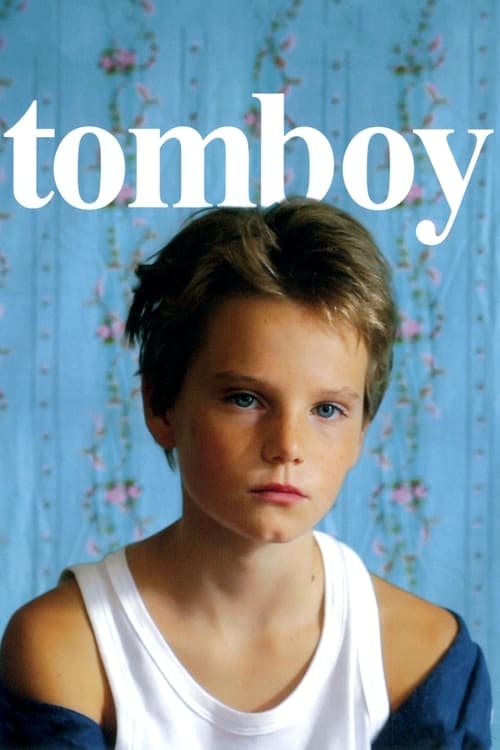
Tomboy
2011 · Céline Sciamma
For when you want something small, quiet, and true — a short film-length sit that stays with you for days. More tender ache than heavy drama, but bring your empathy; it asks you to feel rather than judge.
What it's about
Ten-year-old Laure moves to a new suburb at the start of summer, and when a neighborhood girl named Lisa takes her for a boy, Laure doesn't correct her. As Mickaël, the summer opens up — football, playground games, a first crush — while the start of the school year quietly approaches like a deadline.
The experience
Gentle, sunlit, and almost unbearably tender, but strung through with a low hum of suspense — you watch these long summer afternoons knowing they can't last. It observes rather than explains, and that restraint is what makes it hit so hard.
Performances
Ten-year-old Zoé Héran carries virtually the entire film, giving one of the great child performances — watchful, physical, utterly unselfconscious — with meanings adult actors would struggle to convey in dialogue.
The craft
Céline Sciamma wrote it in weeks and shot it in twenty days on a consumer DSLR, and the modesty is the method: long observational takes, ambient summer sound, faces over words. It trusts children's bodies and silences to carry what most films would underline twice.
Why it matters
It became a foundational film for a generation thinking about gender before the vocabulary went mainstream — in France it was distributed to schools and became a genuine political object — and cemented Sciamma as a major voice in coming-of-age cinema.
Between Water Lilies and Girlhood, Céline Sciamma made the quietest and perhaps most perfect panel of her coming-of-age triptych: written in a matter of weeks, shot in twenty days on a consumer Canon DSLR, and carried almost entirely by ten-year-old Zoé Héran. Laure, newly arrived in a Paris suburb at the start of summer, is taken for a boy by the neighborhood kids and doesn't correct them; the film simply watches, with enormous tact and zero editorializing, as a self is tried on in real time. Sciamma's method — long observational takes, ambient sound, faces over dialogue — trusts children's bodies and silences to carry meanings most cinema would underline twice. It became a foundational text for a generation thinking about gender before the vocabulary went mainstream, and in France it became a genuine political object: distributed to schools through a national film-education program, it drew organized conservative protest in 2014 — confirmation of how much power sat inside its unassuming eighty-odd minutes.
A Deleuzian reading
A kid arrives in a new neighborhood at the start of summer.
The full Deleuzian reading of Tomboy →
Reception
A quiet Berlinale premiere that grew into something bigger: in 2013–14 it became a flashpoint in France's culture wars when far-right Catholic groups protested its inclusion in a national school-screening program — and after Portrait of a Lady on Fire (2019), a wave of viewers worked backwards through Sciamma's filmography and canonized it.
How Tomboy was received, from release to now →
Influences: the films it descends from and the films it influenced
- Water Lilies (2007) — Sciamma's own debut established her method of holding on adolescent bodies and unspoken desire in long, non-editorializing takes with faces doing the narrative work — Tomboy refines that same wordless observational gaze onto a younger child.
- The 400 Blows (1959) — Set the French template of trusting a non-professional child lead to carry a film through observed behavior rather than expository dialogue, ending on a held, unresolved close-up of the child's face — a structure Tomboy inherits.
- L'Enfance nue (1968) — Pialat's unsentimental, near-documentary observation of a child directed to behave rather than perform, with the camera refusing to judge, is the naturalist grammar Tomboy adopts.
- Ponette (1996) — Demonstrated how to coax a fully interior, naturalistic performance from a very young lead by shooting at child eye-level and letting behavior improvise inside a fixed situation — Sciamma directs Zoé Héran the same way.
- The Spirit of the Beehive (1973) — Pioneered building meaning almost entirely from a child's watching face and ambient rural quiet rather than plot, a faces-over-dialogue economy Tomboy echoes in its summer stillness.
- Ratcatcher (1999) — Ramsay's tactile, sound-forward naturalism — ambient hum, held bodily detail, sparse speech around a child protagonist — is a direct antecedent to Tomboy's ambient sound design and physical observation.
- Rosetta (1999) — The Dardennes' proximate, non-judgmental camera trailing a young protagonist's body through concrete tasks, with no score and no editorial framing, is the observational ethic Tomboy applies to Laure/Mikäel.
- Kes (1969) — Loach's use of a non-professional child lead and naturalistic playground/peer dynamics captured with an unobtrusive camera models the socially observed childhood realism Tomboy stages among the neighborhood kids.
- Fat Girl (2001) — Breillat's unflinching, clinical framing of the adolescent female body and its social policing without melodrama prefigures Sciamma's frank, non-editorializing attention to a child negotiating gendered embodiment.
- Girlhood (2014) — Sciamma's next film continues the exact craft — shooting a young lead's self-fashioning of identity through clothing, posture, and group choreography in long observed takes with ambient-forward sound.
- Portrait of a Lady on Fire (2019) — Sciamma pushes her faces-over-dialogue principle to its extreme, building an entire love story from held looks and framing exchanged glances as narrative events — the mature form of Tomboy's silent watching.
- Petite Maman (2021) — Returns to child leads directed non-editorially, with an economical runtime and restrained camera trusting kids to carry emotional weight through play and quiet, distilling Tomboy's method to its essence.
- The Fits (2015) — Holmer builds an almost dialogue-free portrait of a young girl's gender and body identity through watching, physical routine, and ambient sound — an American inheritance of Tomboy's observational, non-verbal grammar.
- Girl (2018) — Dhont observes a trans adolescent's relationship to her own body through sustained, close, non-editorializing takes on physical practice, extending Tomboy's method of reading identity off the body rather than speech.
- Close (2022) — Dhont routes childhood intimacy and its rupture through faces, proximity, and gesture in long observational takes with a naturalist child lead, a clear formal descendant of Tomboy's wordless attention.
- Young Hearts (2024) — Shows childhood queerness in a warm naturalist key with a handheld camera at child's-eye level and a nonprofessional lead, modeling tenderness-over-tragedy.
- 20,000 Species of Bees (2023) — The explicit reference point for gender-nonconforming childhood: child-eye-level framing of gendered play, a non-professional child directed naturalistically across a summer, which the seed both joins and revises.
- Fish Tank (2009) — Arnold's intimate handheld naturalism and tight Academy-adjacent framing on a working-class girl's body and gaze, shot in sequence with a non-professional lead, runs parallel to Tomboy's close observational method.
- Mustang (2015) — Co-written by Sciamma, it carries her signature of observing girls' bodies and their social confinement through group physicality and faces rather than exposition — a direct authorship link, not just theme.
- Being 17 (2016) — Co-written by Sciamma, it extends her screenwriting method of routing adolescent identity and desire through physical confrontation and unspoken tension rather than confessional dialogue.
- The Little Sister (2025) — A concealed identity sustained as a double life, staged through patient observation of the body and the dread of exposure rather than confession scenes.
- My Life as a Zucchini (2016) — Sciamma's own method of a camera pitched at kid-height and dialogue stripped to what children actually say — the 'left unsaid' emotional economy she then wrote into Zucchini.
- Love Letters (2025) — French queer domestic realism built on observation and children's/adults' unspoken negotiation, where meaning lands in glances and silences.
- Great Freedom (2021) — Another Fournier collaboration whose close, unhurried observation of embodied identity and gesture over expository dialogue directly informs Great Freedom's performance-first mode.
- The World of Us (2016) — Films children's group play as the actual mechanism of inclusion and expulsion, camera at their height and locked to the body, so that a change in who passes the ball reads as a change in social standing — identical to the dodgeball bookend's function.
Similar films
- Close (2022) — influence & lineage · same viewing thread
- Petite Maman (2021) — influence & lineage
- Portrait of a Lady on Fire (2019) — influence & lineage
- The 400 Blows (1959) — influence & lineage
- Monster (2023) — same viewing thread
- Young Hearts (2024) — same viewing thread
- 20,000 Species of Bees (2023) — shared sensibility
- Laurence Anyways (2012) — shared sensibility
All the films related to Tomboy →
Watch it with: curated runs of related films
- The Unspoken Between Boys — Watch these together for the way each lets a boyhood friendship curdle into longing, grief, or something neither kid can quite name.