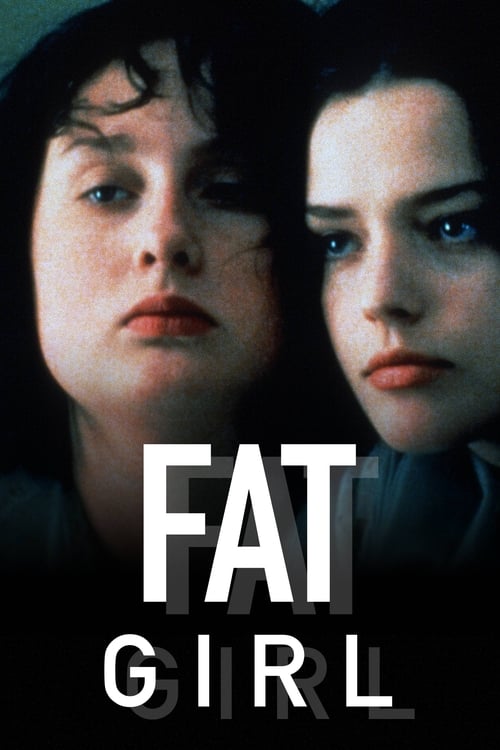
Fat Girl
2001 · Catherine Breillat
Only for when you're ready to be challenged: a demanding, unflinching film to reckon with rather than enjoy, and one you'll chew on — and possibly argue about — for days. Not remotely comfort viewing.
What it's about
On a French seaside holiday, twelve-year-old Anaïs watches her fifteen-year-old sister Elena fall for an older law student who is far more calculating than he appears. From the next bed in their shared room, Anaïs sees exactly how flattery becomes pressure — and the film stays with her clear, unsparing view of a bond between sisters and the predatory dynamics adults prefer not to name.
The experience
Stark, uncomfortable, and deliberately confrontational — this is a film about coercion that refuses to look away or soften anything, and its final stretch is genuinely shocking. It's watched with a knot in your stomach and argued about afterward.
Performances
Anaïs Reboux, a first-time actor, is remarkable as the watchful younger sister — sullen, funny, and wiser than every adult around her — and Roxane Mesquida makes Elena's naivety heartbreaking rather than foolish.
The craft
Breillat constructs the film with cold precision: long, unbroken bedroom scenes that force you to register every step of persuasion, and a structure that builds toward one of the most debated endings in modern French cinema. The plainness of the style is the point — no music cues or cutaways to let you off the hook.
Why it matters
A defining, fiercely contested work of the confrontational turn in French filmmaking around 2000, banned or cut in several countries and central to Breillat's reputation as cinema's most rigorous examiner of how girls are preyed upon.
Snapshot
À ma sœur! — released internationally under the blunter title Fat Girl — is Catherine Breillat's most tightly constructed film and the one on which her reputation now largely rests. Two sisters on a French seaside holiday: Elena, fifteen and beautiful, and Anaïs, twelve, heavy, watchful, and by the film's own accounting the only person in it who sees clearly. Elena is picked up by Fernando, an Italian law student, and over one long night in the bedroom the sisters share, he talks her out of her virginity while Anaïs lies in the next bed pretending to sleep. The affair is exposed, the mother drives the girls home overnight, and on a motorway rest area the film detonates: a man with an axe kills Elena and the mother, then rapes Anaïs in the trees. The last image is Anaïs walking out of the woods under police escort, telling the officers not to believe her if they don't want to.
The film is Breillat's clearest statement of a thesis she had been circling since the 1970s — that the loss of virginity is not a private threshold but a transaction conducted in a language of love that both parties know to be false — and its formal severity (long takes, near-absent score, refusal of reaction shots) gave that thesis a rigor her earlier work sometimes lacked. It premiered in competition at the Berlin International Film Festival in 2001, was refused classification in Ontario, and has since been absorbed into the canon as a founding text of what James Quandt would name, in a 2004 Artforum essay, the New French Extremity.
Industry & production
À ma sœur! was made inside the durable French system of producer-plus-television-plus-regional-support financing, as a French–Italian co-production, with Jean-François Lepetit — who had produced Breillat's Romance (1999) — again shepherding the project. That continuity matters: Romance had been a genuine succès de scandale, an art film with unsimulated sex and a pornographic star (Rocco Siffredi) in the cast that crossed over commercially, and it bought Breillat, at fifty-two, the freedom to make a smaller, harder, less sensational film immediately afterward. Fat Girl is in every respect the anti-Romance: no stars, no adult transgression, two unknown girls, one house, one car.
The release landed in a French classification climate that had just been convulsed. Virginie Despentes and Coralie Trinh Thi's Baise-moi (2000) had been stripped of its certificate after a Conseil d'État ruling and effectively pushed into the X category, prompting France to restore an "18" classification rather than consign such films to the pornographic circuit. Breillat's film arrived into that argument and inevitably became part of it. Abroad it fared worse: the Ontario Film Review Board refused it classification in 2001, making it a test case in the long campaign against that board's powers — a regime Ontario courts later found constitutionally untenable, leading to its replacement mid-decade. The English-language title, imposed for international release, was itself a small scandal; where À ma sœur! is a dedication, Fat Girl is a taunt, and the substitution says something about how the film was expected to be sold.
Commercially it was a specialty release — modest theatrical numbers in France, a small autumn 2001 opening in the United States through an independent distributor. Its real commercial life came on home video, and specifically through a Criterion Collection edition that arrived in the middle of the decade and fixed the film in the American cinephile canon. Precise budget and gross figures for the film are not reliably in the public record, and I won't invent them.
Technology
Nothing about Fat Girl is technologically novel, and that is a choice worth reading. 2001 sat at the crest of the first digital wave: Dogme 95 had made handheld DV a badge of authenticity, and a great deal of European transgressive cinema was reaching for the immediacy of video. Breillat went the other way, shooting 35mm with Yorgos Arvanitis, a cinematographer trained in the most classical of long-take traditions, and framing in the boxy 1.66:1 ratio that European art cinema had used for decades. The result is that the film's scandalous content is delivered in an entirely unscandalous form — composed, lit, patient. Where Gaspar Noé would soon use camera technology itself as an assault (Irréversible, 2002), Breillat's provocation is entirely in duration and in what she declines to cut away from.
The film's afterlife, however, is a story about technology. Fat Girl is a case study in how DVD — with its capacity for uncut editions, director's commentary, and critical essays — rescued films that theatrical censorship regimes had strangled. A film banned outright in a Canadian province in 2001 was, within a few years, a curated object with scholarly apparatus.
Technique
Cinematography
Arvanitis is best known for his decades of work with Theo Angelopoulos, where the long take is a landscape instrument, and part of what makes Fat Girl strange is watching that grammar turned inward on bedrooms and car interiors. The camera is mostly static or drifting; setups are held far past the point where conventional coverage would intervene. In the seduction sequence — the film's twenty-odd-minute centerpiece — the camera sits at roughly bed height and simply stays, so that Fernando's escalating rhetoric plays in real time and the viewer accumulates the same fatigue Elena does. Light is largely naturalistic: chalky Atlantic daylight, the flat green of the pool, a single lamp at night. The final motorway passage shifts register — the three of them boxed in the car, trucks strobing past, the windscreen a proscenium — so that the car becomes a lit vitrine on a black road, which is exactly what makes the shattering of the glass so unbearable.
Editing
Pascale Chavance, who had cut Romance, builds the film out of very few, very long units. The average shot length is high, and the film's power depends on it: Breillat's argument is that coercion is a process, not an event, and a process cannot be conveyed in a montage. Then, having trained the viewer in duration, the film uses ellipsis as a weapon. The rest-area killing arrives without preparation — no ominous build, no establishing of a threat, no music cue. And the rape is elided into a hard cut, so that the last movement of the film consists of an aftermath the audience is denied the "satisfaction" of having witnessed. Breillat withholds the reaction shot almost systematically; we are rarely told how to feel about what we've seen.
Mise-en-scène / staging
The film is organized around beds, and around doubling. The sisters' shared room — two beds, one occupied by a girl being persuaded, one by a girl performing sleep — is the film's central stage, and the composition that puts both in frame does the thematic work without a line of dialogue. Around it Breillat arranges a set of rhyming spaces: the beach where Elena is looked at and Anaïs is not; the swimming pool where Anaïs, alone, plays out a love triangle between a ladder and a diving-board support, kissing both, narrating both — the film's most tender and most desolate scene; the dinner table where Anaïs eats, and eating is staged as both appetite and armor. The final space is a motorway rest area, the archetypal non-place, chosen precisely because it belongs to no one.
Sound
There is essentially no conventional score. The soundtrack is the sea, cicadas, breathing, bedsprings, cutlery, gravel, the drone of trucks, the car radio, and Anaïs's own unaccompanied singing. The public record on a composer credit for this film is thin, and I'd rather say so than guess. The effect of the sparseness is that dialogue carries an almost forensic weight: Fernando's speeches about proof of love, about how she would be hurting him, about anal sex as a technicality that preserves what he claims to value, are audible as rhetoric because nothing is scoring them as romance. When violence comes, it is announced by breaking glass — the first genuinely loud sound in the film.
Performance
Anaïs Reboux, cast as Anaïs, was a non-professional child and gives a performance of extraordinary opacity — a face that absorbs rather than reacts, which is why the film's point of view works. Roxane Mesquida, as Elena, was reportedly around nineteen during production, playing fifteen; she went on to a substantial career (including several further Breillat films). Libero De Rienzo, the Italian actor who plays Fernando and who died in 2021, calibrates the seducer so that his sincerity and his predation are indistinguishable, which is the part's whole difficulty. Arsinée Khanjian — the Armenian-Canadian actor closely associated with Atom Egoyan — plays the mother as exhausted rather than monstrous, and the filmmaker Romain Goupil plays the largely absent father.
The staging of the bedroom scene with performers of these ages has been an object of legitimate scrutiny. Breillat's own most substantial answer is Sex Is Comedy (2002), a feature that fictionalizes the shooting of exactly this sequence — a director bullying, coaxing and manipulating two young actors, with prosthetics and body doubles part of the apparatus. It is one of the frankest accounts any filmmaker has given of the coercion latent in directing intimacy.
Narrative & dramatic mode
Three movements: seduction, exposure, annihilation. The first occupies most of the running time and is built almost entirely from talk. The second is comic in the cruelest way — Fernando's mother arrives to reclaim the opal ring he had given Elena as a love token and had in fact stolen, and the romance collapses into a farce of property, watched by two humiliated mothers. The third is thirty minutes of driving and ninety seconds of murder.
The mode is realist on the surface and fabular underneath. Nothing in the first two acts prepares the third by the rules of psychological realism; everything prepares it by the rules of the fairy tale, where a girl who goes into the woods meets what is in the woods. Breillat would make that undertow explicit later with Barbe bleue (2009) and La Belle endormie (2010). The most widely held reading — and the one Breillat has consistently endorsed in interviews — is that the ending is not a rupture but a literalization: the ogre at the rest stop merely does openly what Fernando did with a ring and a vocabulary. Anaïs's closing line, refusing in advance to be disbelieved, is the film's final and most contested gesture: a twelve-year-old claiming narrative authority over what has just happened to her.
Genre & cycle
Formally it belongs to the French summer-holiday film — the seaside vacation as a laboratory for erotic education, a form Éric Rohmer had perfected (Pauline à la plage, 1983) and which Breillat systematically strips of its charm. It also belongs to the adolescent-girl film and, most specifically, to the loss-of-virginity narrative, which Breillat had already worked in 36 fillette (1988).
By reception, though, it was absorbed into a different cycle: the wave of French films between roughly 1999 and 2004 that combined explicit sexuality with sudden brutality — Romance, Baise-moi, Claire Denis's Trouble Every Day (2001), Irréversible, Marina de Van's Dans ma peau (2002), Bruno Dumont's Twentynine Palms (2003), Breillat's own Anatomie de l'enfer (2004). Quandt's Artforum piece named this the New French Extremity, largely as a critique; the label stuck and has since been rehabilitated by academics as a genuine, if loose, formation.
Authorship & method
Breillat's career is unusually continuous. She published a novel at seventeen that was restricted to adult readers in France; she appeared briefly in Bertolucci's Last Tango in Paris (1972); her first feature, Une vraie jeune fille (1976), was effectively suppressed for over two decades before its belated release around 1999–2000; and she wrote for other directors, including on Maurice Pialat's Police (1985). By 2001 she had been making the same film — a girl's body understood as a contested territory — for twenty-five years, and Fat Girl is the version in which the argument finally has a shape hard enough to carry it.
Her method is polemical and anti-naturalist in intent even when the surface is naturalistic: she works from written dialogue of considerable length, directs performers toward discomfort rather than away from it, and treats the sex scene as the primary dramatic unit rather than a punctuation mark. The key collaborators here are Arvanitis, whose contemplative long-take instincts supply the patience the script requires, and Chavance, whose cutting protects that patience. The near-total absence of non-diegetic music is itself an authorial signature: Breillat consistently refuses the emotional underwriting that a score provides. Her body of work also has a habit of self-commentary — Sex Is Comedy is a sequel not to Fat Girl's story but to its production.
Movement / national cinema
Fat Girl is French art cinema in the fullest institutional sense: state-supported, festival-launched, auteur-signed, and argumentative. Its lineage runs less through the Nouvelle Vague's playfulness than through the French realist-moralist line — Bresson's flat affect and abrupt violence (Mouchette, 1967), Pialat's raw family scenes (À nos amours, 1983), and, structurally, Chabrol's Les Bonnes Femmes (1960), which likewise ends by murdering a young woman after an hour of unremarkable girls' lives. Whether those are influences or convergences is not something the record settles; the rhymes are real regardless.
It also belongs to a specifically French debate about sexual representation that runs from the 1970s liberalization through to the classification fights of 2000–01, and to a generation of women directors — Breillat, Denis, de Van, later Lucile Hadžihalilović, Céline Sciamma and Julia Ducournau — who took possession of the female body on screen as a subject rather than a spectacle.
Era / period
The film is set and shot in a recognizable present, but its period identity is about production context: a European art cinema at the last moment before digital democratization, confident enough in 35mm and duration to make a film that would have been unmakeable a few years later on those terms and unreleasable a few decades earlier on any. It is also a pre-consent-discourse film that reads, twenty-plus years on, as if it were written for that discourse. Fernando's night-long negotiation — the pressure, the bargaining, the reframing of refusal as cruelty, the technical compromise offered as respect — is now taught as a near-clinical account of coercion, which is not how it was primarily received in 2001, when the argument was largely about whether Breillat had the right to show it at all.
Reception, canon & influence
Reception was sharply split. The film was defended by critics who read the ending as the necessary consequence of everything preceding it, and attacked by those who read it as sadistic punishment of the characters and a bad-faith bid for shock — a charge that trailed Breillat throughout her career and that Quandt's essay would formalize. It appeared on year-end lists in the Anglophone press and was a fixture of the arthouse conversation of 2001–02; it was also, simultaneously, banned outright in Ontario, which tells you the range. Over time the balance has shifted decisively toward the defenders: the film now appears regularly in critical polls and retrospectives of the period, and Breillat's late-career reassessment — helped by her return to filmmaking after a 2004 stroke and, more recently, by a fresh generation encountering the work — has made Fat Girl the anchor title of her filmography.
Backward, the film draws on Breillat's own 36 fillette and Une vraie jeune fille; on the Rohmerian holiday film it inverts; on Pialat's family violence, from whom Breillat learned directly; and on the Bresson–Chabrol tradition of the abrupt, unearned-looking catastrophe. Forward, its footprint is wide and easy to trace. The unglamorous, physically specific adolescent girl — watching, eating, unwanted, and in possession of the film's intelligence — becomes a recurring figure in Lucile Hadžihalilović's Innocence (2004), Céline Sciamma's Naissance des pieuvres (2007), Andrea Arnold's Fish Tank (2009), Eliza Hittman's It Felt Like Love (2013), and Julia Ducournau's Grave (2016), where appetite and the body's hungers again carry the argument. The long, unbroken, deliberately uncomfortable seduction scene has become something close to a standard tool in contemporary art cinema's treatment of consent. And Sex Is Comedy opened a small, valuable sub-genre of films that interrogate the ethics of their own making.
What has aged best is the least sensational thing about it. Strip away the axe and the scandal and Fat Girl is a film about a girl listening to her sister be talked into something, and knowing exactly what she is hearing — which is why it remains, two decades on, harder to shake than most of the films it was grouped with.
A Deleuzian reading
A girl swims to the pool ladder and kisses it.
The full Deleuzian reading of Fat Girl →
Reception
Scandalous on arrival in 2001 — it was even banned outright in Ontario before the decision was reversed on appeal — it has since been canonized by Criterion and is now widely treated as Breillat's masterpiece.
How Fat Girl was received, from release to now →
How to watch Fat Girl: what to notice on a first viewing
- Notice how long the camera holds without cutting away. Arvanitis keeps the camera mostly still or slowly drifting, staying on scenes far past the point where most films would cut, so a conversation plays out in something close to real time. The duration itself becomes the point. You feel time pass the way the characters do, not the way editing usually compresses it.
- Spot both sisters' beds in the same shot. The sisters' shared room is staged so both beds sit inside a single composition: one girl being talked to, one girl lying still nearby, pretending to be asleep. The blocking alone tells you someone is always watching, without a single line of dialogue saying so.
- Listen for the total absence of any musical score. Aside from Anaïs singing to herself once, there is no music anywhere in the film. What you hear is the sea, cicadas, breathing, and the sound of talk itself. Without music telling you how to feel, dialogue carries the full weight of every scene on its own.
- Watch Anaïs's face for what it refuses to show. Reboux plays Anaïs with a face that absorbs rather than reacts, rarely giving you a clear cue for what she is feeling in any given moment. You are given her watching without being told what her watching means, so you have to do the reading yourself.
- Follow Anaïs kissing the pool ladder, then the diving board. Alone in the hotel pool, Anaïs invents and performs both sides of a romance, narrating and kissing two fixed objects as if they were separate boys. It is the tenderest scene in the film and the loneliest, desire rehearsed with no one there to receive it.
The whole guide to watching Fat Girl, with the keys for a rewatch →
Influences: the films it descends from and the films it influenced
- Une vraie jeune fille (1976) — Breillat's own first draft of the method: a plain, watchful adolescent girl filmed in unflattering static setups with no score and no erotic lighting, so the body is presented as physiological fact rather than spectacle — the framing grammar Fat Girl reuses on Anaïs.
- 36 fillette (1988) — The direct prototype of the real-time seduction unit — a teenage girl and an older man locked in a hotel room for scene-length written dialogue where the bargaining over consent, not the sex, is the dramatic action; Fat Girl transposes the same scene structure to Elena's bedroom and adds a witness.
- Mouchette (1967) — Non-professional child lead directed toward blankness rather than expression, diegetic-only sound, and an ending that arrives without psychological preparation or musical cueing — Breillat's refusal to let the axe be 'earned' is Bressonian abruptness applied to a family holiday.
- À nos amours (1983) — Pialat, from whom Breillat learned directly (she scripted his Police), supplies the technique of letting a domestic scene run past comfort until violence erupts inside the same unbroken take — the mother's roadside slap and the car's escalating tension are lifted from his family-table method.
- Les Bonnes Femmes (1960) — The structural precedent for a film of banal courtship that terminates in an unmotivated murder staged flatly and briefly, with the killing given no more visual emphasis than the shopgirl chatter preceding it — Fat Girl's rest-stop coda is the same withheld-emphasis catastrophe.
- Pauline at the Beach (1983) — The seaside-holiday talk film Breillat inverts point by point: the younger girl as silent observer of adult erotic maneuvering, 1.66 naturalistic-light exteriors and dialogue-driven long takes — Fat Girl keeps the form and removes Rohmer's protective irony.
- Landscape in the Mist (1988) — Yorgos Arvanitis's camera holds the exterior of a truck while a child is raped inside, refusing the reaction shot and the cut — the exact elliptical-violence patience Arvanitis brings to Fat Girl's roadside ending and to the held two-shots of the bedroom.
- Last Tango in Paris (1972) — The film Breillat appeared in as a young actress, and the one that established the sex scene as a feature-length film's primary dramatic unit rather than punctuation — extended, verbal, negotiated, and shot in flat apartment daylight without score.
- Sex Is Comedy (2002) — Breillat's own procedural sequel: it restages Fat Girl's bedroom seduction as a shoot, exposing the prosthetic, the blocking arguments and the director's coercion of her actors — inaugurating the sub-genre of films that audit the ethics of filming sex.
- Innocence (2004) — Inherits the non-professional child ensemble directed toward unreadable affect, near-total absence of score with amplified diegetic water and footsteps, and the framing of girls' bodies as objects under institutional appraisal rather than as sexual display.
- Water Lilies (2007) — Rebuilds the pool as the arena of erotic triangulation and casts the unglamorous, hungry, watching girl as the film's intelligence, with sexual initiation staged as a flatly-lit transaction stripped of score — Anaïs's structural position given a whole feature.
- Fish Tank (2009) — Street-cast nonprofessional adolescent lead, 1.33/naturalistic available light, and a seduction shot in sustained proximity where the camera stays on the girl's body rather than cutting to signal how the act should be judged.
- It Felt Like Love (2013) — The younger, plainer girl trailing an older girl's sexual experience, filmed in beach-holiday available light with diegetic-only sound and scenes of solicited sex held past the point of relief — Fat Girl's watching-sister structure transposed to Gravesend.
- Raw (2016) — Carries forward the appetite-as-argument device — a sister pair in which eating and sexual initiation are filmed with the same clinical proximity, the body's hungers staged as physical process rather than metaphor, and the older sister's tutelage turning predatory.
- Never Rarely Sometimes Always (2020) — The unbroken single-take clinic questionnaire, held on one face with the interlocutor off-screen and no music, is the direct descendant of Breillat's real-time seduction take — duration and the withheld reverse shot doing the work a cut would foreclose.
- Tomboy (2011) — Breillat's unflinching, clinical framing of the adolescent female body and its social policing without melodrama prefigures Sciamma's frank, non-editorializing attention to a child negotiating gendered embodiment.
- The Piano Teacher (2001) — Same-year twin in method: scoreless diegetic sound, fixed camera held on the negotiation of sexual terms until the viewer's discomfort becomes the subject, and violence rendered by cutting away from the face that would tell us how to feel.
- Twentynine Palms (2003) — Extends the motorway non-place as a moral vacuum — long-lens driving durations, ambient-only sound, and a terminal atrocity delivered without score, buildup, or aftermath, structurally the same last-ten-minutes rupture Fat Girl performs.
- Blue Is the Warmest Colour (2013) — Kechiche's protracted, uninterrupted sex and eating scenes treat appetite and duration as the film's argument, with no non-diegetic music to soften either — the same insistence that a body's real-time behavior carries meaning a cut would destroy.
Similar films
- Mouchette (1967) — influence & lineage
- The Piano Teacher (2001) — influence & lineage
- The Little Sister (2025) — shared sensibility
- Raw (2017) — shared sensibility
- Martyrs (2008) — shared sensibility
- Black Girl (1966) — shared sensibility
- Chocolat (1988) — shared sensibility
- Irreversible (2002) — shared sensibility