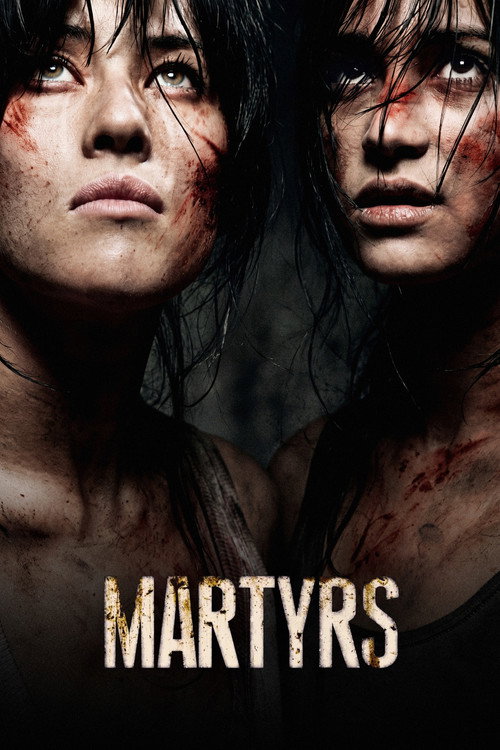
Martyrs
2008 · Pascal Laugier
Only for when you want to be pushed to your limit — a film for hardened horror viewers seeking the extreme end of the genre, not a scary-movie night with friends. Maximum challenge, zero comfort; it will stay with you for days whether you want it to or not.
What it's about
Lucie escaped captivity and horrific abuse as a child; fifteen years later, convinced she has found the ordinary suburban family responsible, she takes her revenge — and pulls her devoted friend Anna, herself a survivor, into the aftermath. What starts as a revenge story keeps shedding its skin, descending into something far stranger and darker about suffering itself.
The experience
One of the most punishing watches in modern horror — relentless, despairing, and physically hard to sit through, yet built with real intelligence and a final stretch that turns brutality into a genuinely haunting philosophical question. It does not let you off the hook, ever.
Performances
Morjana Alaoui's Anna carries the film's devastating second half with almost wordless endurance, and Mylène Jampanoï makes Lucie's trauma feel dangerously alive rather than performed.
The craft
Laugier structures the film as a series of violent rug-pulls, reorganizing what kind of movie you're watching more than once, and stages its horror with grim, unflinching precision rather than fun-house style. The sound design and makeup effects are punishingly effective — this is craft in service of dread, not spectacle.
Why it matters
The defining work of the New French Extremity, endlessly debated as either the summit or the abyss of transgressive horror, and a benchmark against which extreme cinema is still measured. Its American remake only confirmed how unrepeatable the original is.
Horror · New French Extremity & extreme · Psychological horror · Religious horror. A survivor's revenge on an ordinary family becomes a relentless, despairing ordeal about suffering itself; no comfort, no relief.
Snapshot
Martyrs is Pascal Laugier's second feature, a French-Canadian horror film that stands as one of the most severe and philosophically ambitious works to emerge from the loose wave critics labeled the New French Extremity. It follows Lucie (Mylène Jampanoï), who as an adult tracks down and slaughters the suburban family she believes imprisoned and abused her as a child, aided by her lifelong friend Anna (Morjana Alaoui). What begins as a rape-revenge revenge narrative violently reorganizes itself twice: first into a study of trauma's hallucinatory afterlife, then into the revelation of a clandestine society that tortures young women in the belief that extreme, sustained suffering can transfigure a victim into a "martyr" capable of witnessing what lies beyond death. The film is notorious for its unrelenting violence, but its lasting reputation rests on the way it yokes that violence to a genuinely metaphysical question, refusing the catharsis its genre usually promises.
Industry & production
Martyrs was produced as a French-Canadian co-production, with French backing anchored by companies including Eskwad and Wild Bunch and involvement from the Canal+ orbit, alongside Canadian partners — a financing structure that gave Laugier access to Quebec crews and locations for portions of the shoot. It arrived at a moment when French genre cinema had, over roughly 2003–2008, become internationally bankable through a cluster of hard-edged horror titles, and Wild Bunch's involvement placed the film within a distribution apparatus practiced at moving transgressive European work into festival and specialty markets abroad.
The most consequential production-adjacent event was regulatory. On submission to French classification authorities, the film ran into the certification machinery that governs extreme content, and its rating became a minor cause célèbre — the kind of case where an "18"-style restriction is debated as either commercial death sentence or badge of seriousness. The precise administrative sequence is often garbled in secondary accounts, so it is worth stating plainly that the durable, verifiable fact is the controversy itself and the film's status as a test case for how far mainstream French exhibition would tolerate this material; the finer procedural details deserve caution. Laugier has spoken in interviews of the toll the project took on him and of his ambivalence about the horror label, framing the film less as entertainment than as an argument — context that colors how one reads its refusal to modulate.
Technology
Martyrs is a photochemically-conceived film of the late-2000s transitional period, before digital capture had displaced celluloid for this tier of European production, and its look reflects a naturalistic, largely available-and-practical lighting philosophy rather than any showcase of new tools. Its technological signature is not in acquisition but in prosthetic and makeup effects: the film's central atrocities — sustained beatings, and above all the flaying of its final act — depend on practical special-effects makeup executed to withstand long, static takes and close scrutiny. This is craft in the analog tradition of appliance work and blood rigs rather than digital augmentation, and the decision to keep the horror physical and in-camera is itself an aesthetic argument, insisting on the body's literal presence. Where I cannot verify specific vendors or the exact capture format, I flag that the record in general circulation is thin; what is not in doubt is the film's commitment to tangible, practical gore over post-produced spectacle.
Technique
Cinematography
The photography is built on a deliberate tonal descent. Early sequences — the suburban family breakfast that Lucie interrupts with a shotgun — are shot in flat, unremarkable domestic daylight, a banal ordinariness that makes the eruption of violence obscene rather than stylish. As the film moves underground into the society's facility, the palette drains toward institutional grays, concrete, and clinical illumination. The camera grows increasingly still and clinical in the final movement: where the first act uses jagged, kinetic handheld coverage to convey panic and rage, the last act adopts a near-immobile, observational framing that forces the viewer into the position of a witness rather than a participant. This formal cooling is the film's cruelest stroke — it withdraws the visual excitement of horror precisely when the suffering peaks. (Credited camera work is attributed to more than one cinematographer across the production's phases; because sources vary on the exact division of labor, I note the attribution rather than overstate a single authorship.)
Editing
The editing is structurally audacious. Martyrs is essentially three films spliced into one, and the cuts between its modes are engineered as ruptures rather than transitions: the revenge thriller is abruptly abandoned, the haunting/psychological register that follows is itself overturned by the arrival of the society, and the final act settles into a punishing, near-real-time durational rhythm. The early sections cut fast and violently; the finale cuts as little as possible, letting shots run long enough to become unbearable. This deceleration is an editorial thesis — the film denies the escape valve that rapid cutting normally provides in horror, refusing to let the audience look away or feel time compress.
Mise-en-scène / staging
Laugier stages the film as a movement from surface to depth, both literally and morally. The action descends from a sunlit suburban house into a windowless subterranean complex, and the production design tracks that descent from domestic clutter to bare, cell-like functionalism. The final space is designed for immobilization: the martyr is fixed in place, stripped of agency and of the visual variety that would grant relief. Bodies are staged as objects of process — the film's horror is procedural, bureaucratic even, with suffering administered methodically rather than sadistically savored. The recurring motif of the abused, contorted female body (including the disturbing apparition that torments Lucie) is staged to keep trauma visually literal.
Sound
The sound design favors rawness over orchestral cushioning. The film leans on the concussive physical sounds of violence and on stretches of near-silence and ambient dread rather than a lush, wall-to-wall score, and this restraint intensifies the clinical quality of the later scenes — the absence of scoring where a conventional horror film would swell is part of the assault. I am not able to verify a composer credit or the full musical strategy with confidence, so I flag the record as thin here rather than attribute a score; what is clear is that the film's aural regime withholds the emotional guidance music usually supplies, leaving the spectator without acoustic comfort.
Performance
The film rests on two extraordinary lead performances. Mylène Jampanoï plays Lucie as a figure of unhealed, self-lacerating terror — her revenge is inseparable from psychosis, and Jampanoï externalizes trauma as something that literally attacks her from within. Morjana Alaoui carries the film's second half, and her performance in the final act is among the most physically demanding in modern horror: she must register transcendence through near-total passivity, conveying an interior transformation while the character is reduced to an almost inert body. Alaoui's late-film stillness — the sense of something departing behind the eyes — is what allows the film's outrageous metaphysical claim to land as anything other than exploitation. Catherine Bégin, as the society's imperious matriarch "Mademoiselle," supplies a chillingly composed rationality that frames the atrocity as doctrine.
Narrative & dramatic mode
Martyrs is defined by structural bait-and-switch. It opens as rape-revenge, mutates into a psychological ghost/trauma narrative, and finally reveals itself as a philosophical horror film about institutionalized suffering. Each shift retroactively reframes what came before — the "monster" haunting Lucie is recoded, the family's guilt is complicated, and the revenge plot is exposed as a false floor over a far larger horror. The dramatic mode is ultimately closer to a passion play or a work of religious inquiry than to a thriller: it withholds vengeance, resolution, and moral clarity, ending on an ambiguity (Mademoiselle's cryptic final response to what the martyr reportedly witnessed) that converts the audience into the same position as the society — desperate to know what suffering revealed, and denied it. This refusal of catharsis is the film's central formal and ethical gambit.
Genre & cycle
The film belongs to the mid-2000s cycle of extreme French horror that critic James Quandt influentially named the "New French Extremity" — a term he coined for a broader arthouse tendency toward transgression that critics extended to genre entries. Within horror specifically, Martyrs sits alongside Haute Tension (Alexandre Aja, 2003), À l'intérieur / Inside (Bustillo & Maury, 2007), Frontière(s) (Xavier Gens, 2007), and Ils / Them (2006) as part of a concentrated national eruption of graphic, nihilistic horror. It also intersects the international "torture" cycle of the same years, but Martyrs is best understood as using that cycle's imagery toward anti-exploitational ends, deploying the era's appetite for on-screen suffering in order to interrogate it.
Authorship & method
Martyrs is unmistakably an auteur's film: Laugier both wrote and directed it, and its uncompromising design reflects a single controlling sensibility. It followed his debut Saint Ange (House of Voices, 2004), a more atmospheric gothic piece; Martyrs represents a radical hardening of his approach. Laugier has described the film in interviews as personal and painful, rooted in depression and philosophical preoccupation rather than genre pleasure, and he has expressed discomfort at seeing it consumed as extreme entertainment. His method here is one of escalation and withdrawal — building genre expectation only to strip it away — and of insisting on practical, physical horror over stylization.
On collaborators, the durable credits are Laugier as writer-director and the two central actresses as his primary interpreters. For the below-the-line crew — cinematography, editing, and especially music — secondary sources are inconsistent, and rather than assign specific names I cannot confirm, I note that the film's technical achievement (its practical effects, its editorial deceleration, its drained palette) is verifiable even where individual attribution is not. Precision about the finale's makeup effects and the film's willingness to hold long, static takes on physical horror is safer ground than a full crew roster.
Movement / national cinema
The film is a landmark of 2000s French genre cinema and of the country's brief, intense reinvention of horror. France had not historically been a horror-producing nation on the scale of the United States, Italy, or Japan, and the mid-2000s wave represented a self-conscious national assertion of the form. Martyrs is often cited as that wave's most extreme and most intellectually serious statement — the point at which French extreme horror stopped being merely visceral and became explicitly metaphysical. As a France-Canada co-production it also reflects the transnational financing patterns common to European genre film of the period.
Era / period
Martyrs is a product of the late-2000s, the tail end of the global "torture horror" moment and just before digital capture and the subsequent turn toward "elevated" or "post-horror" arthouse horror of the 2010s. It can be read as a hinge: it belongs to the graphic extremity of its immediate cycle while anticipating the later decade's ambition to use horror for serious thematic and philosophical inquiry. It emerged in an era of heightened debate over screen violence and film classification, and it functioned as a lightning rod for exactly those anxieties.
Themes
The film's governing theme is the relationship between suffering and transcendence — the ancient, disturbing idea that extreme pain might be a route to knowledge or revelation, literalized here through the society's grotesque research program. Around this core it braids: the persistence and unhealability of childhood trauma (Lucie's revenge does not free her); the female body as a site of violence and of appropriation by systems of power; the difference between martyrdom as victimhood and as witness (the film pointedly invokes the etymological sense of "martyr" as one who bears witness); and the corruption of transcendental yearning into institutional atrocity. Crucially, the film interrogates the spectator: by making the viewer, like the society, hunger to know what the martyr saw, it implicates our own appetite for suffering-as-spectacle and then denies satisfaction.
Reception, canon & influence
Martyrs was divisive on arrival and has since hardened into a canonical, if still contested, work. Reactions split along a durable fault line: some critics and viewers dismissed it as gratuitous, punishing, or morally suspect, while others defended it as a rigorous, even devastating philosophical horror film — one of the few in its cycle to justify its extremity intellectually. That polarization has proven stable, and the film is now routinely cited in discussions of the New French Extremity and in debates over the ethics and value of extreme cinema.
Backward, the film draws on rape-revenge and home-invasion horror, on the "torture" imagery of its moment, and — more diffusely — on a tradition of religious and mystical inquiry into suffering (martyrology, the passion narrative) that gives its final act its scaffolding. Its structural willingness to overturn its own premise recalls the shock-restructuring of certain earlier genre films, though Martyrs pushes the tactic further than most.
Forward, its influence is significant within horror circles. It became a touchstone and dare-you benchmark for extreme cinema, frequently invoked in "most disturbing films" discourse in a way that both amplified and flattened its reputation. It contributed to the international standing of French horror and to the broader legitimation of horror as a vehicle for serious philosophical content, anticipating the "elevated horror" conversation of the following decade. It was remade in the United States in 2015 — an adaptation widely regarded as diluting the original's bleakness and metaphysical nerve, a comparison that, if anything, reinforced the singular reputation of Laugier's film. Its most lasting legacy is as the argument that horror's extremity can be made to mean something: that suffering on screen can be staged not as thrill but as a genuine, unanswerable question.
A Deleuzian reading
A family sits down to breakfast.
The full Deleuzian reading of Martyrs →
Reception
It premiered at the 2008 Cannes market to walkouts and 'torture porn' dismissals, splitting critics right down the middle; nearly two decades on it's routinely called the crowning achievement of the New French Extremity and one of the great horror films of its century.
How Martyrs was received, from release to now →
How to watch Martyrs: what to notice on a first viewing
- Watch how flatly the film shoots its first burst of violence. There is no slow motion, no music swell, no stylish angle. Laugier shoots the first killing exactly like an ordinary Sunday morning, so the ordinariness makes the violence obscene rather than exciting. The film refuses to make killing look like cinema, and it will keep refusing that refusal all the way through.
- Listen for how rarely music tells you how to feel. The film leans on raw, physical sound and long stretches of near silence instead of a conventional score. When violence happens, nothing swells in to cushion it for you. Without music to guide you, you are left alone with what you are watching, exactly as the film intends.
- Watch how differently Lucie and Anna carry their fear. Jampanoi plays Lucie as someone whose terror comes from inside her own body, while Alaoui plays Anna calmer, more watchful, holding herself together for her friend's sake. The contrast in how each woman holds her fear tells you who is unraveling and who is still trying to cope.
- Notice how fast and rough the early scenes cut together. The first stretch of the film moves in short, jagged, violently paced shots that mimic panic and rage rather than composed action. The cutting puts you inside the characters' urgency instead of showing their violence from a safe distance.
The whole guide to watching Martyrs, with the keys for a rewatch →
Influences: the films it descends from and the films it influenced
- The Passion of Joan of Arc (1928) — Holds sustained, near-scoreless close-ups on the martyr's transfigured face during interrogation and torment, establishing the passive-transcendence-via-visage that Martyrs' final act inherits wholesale.
- Cries and Whispers (1972) — Durational, observational stillness trained on women's bodies in agony inside a drained interior punctuated by blood-red, prefiguring Martyrs' tonal-descent palette and contemplative gaze on suffering.
- Salò, or the 120 Days of Sodom (1975) — Stages torture as a clinical, systematized institutional procedure with flatly refused catharsis, implicating the spectator in the act of watching — the template for Martyrs' final-act apparatus.
- Psycho (1960) — Pioneers the bait-and-switch structural rupture that murders its ostensible protagonist midway and re-founds the film, the exact editorial gambit Martyrs escalates with its first-to-second-act pivot.
- The Last House on the Left (1972) — Supplies the rape-revenge / home-invasion grammar of deliberately unstylized, grimy brutality that Martyrs' opening act detonates and then abandons.
- The Texas Chain Saw Massacre (1974) — Models grimy practical-effects captivity horror — the victim bound and processed within a house of atrocity — that Martyrs literalizes in its basement.
- Audition (1999) — Perfects the slow-burn genre deception that flips a romance/drama into protracted, methodical torture, the rupture-and-escalation structure Laugier openly builds on.
- Irréversible (2002) — Defines the New French Extremity's durational assault — scoreless dread, unbroken takes, and a studied refusal to relieve the viewer — that Martyrs shares.
- High Tension (2003) — French home-invasion extremity structured around a mid-film narrative reversal, a sibling exercise in the twist-plus-brutality architecture of the same cycle.
- Eyes Without a Face (1960) — Laugier's New French Extremity film brings Franju's clinical impassivity into systematic body horror: the captive woman's physical transformation through sustained violence in an enclosed architectural space, observed by the camera without moral commentary, is the logical extreme of the method Franju pioneered — the viewer forced to supply the ethical weight the film's observational posture refuses to furnish.
- Ichi the Killer (2001) — Carries Ichi's 'pain-as-language' conceit into New French Extremity, structuring sustained, unflinching bodily suffering as a philosophical interrogation rather than exploitation.
- Hellraiser (1987) — Literalises the Catholic martyrology Barker sublimated: flaying performed as a clinical, documented protocol toward ecstasy, shot with clean continuity coverage so the procedure reads as doctrine rather than as spectacle.
- Hereditary (2018) — Weaponizes a mid-film shock death to violently restructure the narrative and reset dread, extending Martyrs' rupture-structure into the elevated-horror decade.
- The Witch (2015) — Legitimizes horror as austere formal art via restrained staging and a transcendence-through-damnation ending, carrying forward Martyrs' proof that extremity can be made to mean something.
- Raw (2016) — French body-horror successor extending practical flesh transformation and intimate observational framing, the next-generation heir to the cycle's tactile craft.
- Martyrs (2015) — Direct US remake that reworks the original's escalation-and-withdrawal structure and finale, its softened metaphysics measuring precisely what Laugier's formal choices achieved.
- I Saw the Devil (2010) — The closest formal analog for I Saw the Devil's treatment of prolonged violence as an ethical rather than sensational proposition — Laugier's sustained witness shots during suffering, without score or editorial relief, establish the formal vocabulary for refusing to let the audience aestheticize what it is watching, a grammar I Saw the Devil directly inherits.
- When Evil Lurks (2023) — New French Extremity template for deploying unbearable violence against the vulnerable as an uncompromising formal/moral device rather than exploitation.
- Cobweb (2023) — The New French Extremity's violent mid-film turn, from haunting to a literal hidden captive whose existence the household concealed, sits behind Cobweb's switch to explicit carnage.
- In My Skin (2002) — Applies NFE observational stillness to self-directed bodily mutilation, holding the camera on the flesh with the same clinical patience Martyrs uses on its victim.
- Trouble Every Day (2001) — Renders flesh horror through contemplative tonal descent and scoreless restraint rather than shock cutting, the arthouse pole of the extremity cycle Martyrs occupies.
- Inside (2007) — Represents the practical-gore peak of the French cycle — a sustained domestic siege built on tactile physical effects — contemporaneous with and formally kin to Martyrs.
- The Passion of the Christ (2004) — Stages martyrology as durational, practical-effects flagellation framed as suffering-as-witness, the same religious-passion scaffolding Martyrs adopts for its finale.
- Antichrist (2009) — Uses genre horror as a vehicle for explicit metaphysical inquiry into suffering, justifying extremity intellectually — the parallel argument Martyrs makes in the same moment.
- Funny Games (2008) — Released the same year, Martyrs shares Funny Games' anti-cathartic endurance structure — sustained female suffering with no redemptive arc — and uses this structure to make a philosophical claim about spectatorship rather than deliver genre pleasure; where Haneke enforces Brechtian distance, Laugier uses maximalist immersion, but both films arrive at the same accusation directed at the viewer who remains in their seat.
Similar films
- High Tension (2003) — influence & lineage · same viewing thread
- Antichrist (2009) — influence & lineage · same viewing thread
- Trouble Every Day (2001) — influence & lineage · same viewing thread
- Irreversible (2002) — influence & lineage
- Hereditary (2018) — influence & lineage
- Titane (2021) — same viewing thread
- Raw (2017) — same viewing thread
- The House That Jack Built (2018) — same viewing thread
All the films related to Martyrs →
Watch it with: curated runs of related films
- The Fear of God — A run of horror where faith is the battleground: believers, doubters and zealots meet the devil, damnation and an afterlife that answers back, from Puritan farms and Roman convents to the catacombs under Paris.
- Extreme Cinema's Breaking Point — A run of films from the New French Extremity, Asia Extreme and the European art-house provocateurs, all rhyming on the body as the place where grief, desire, revenge and power break open, best watched near each other so you can see how differently each director uses shock.